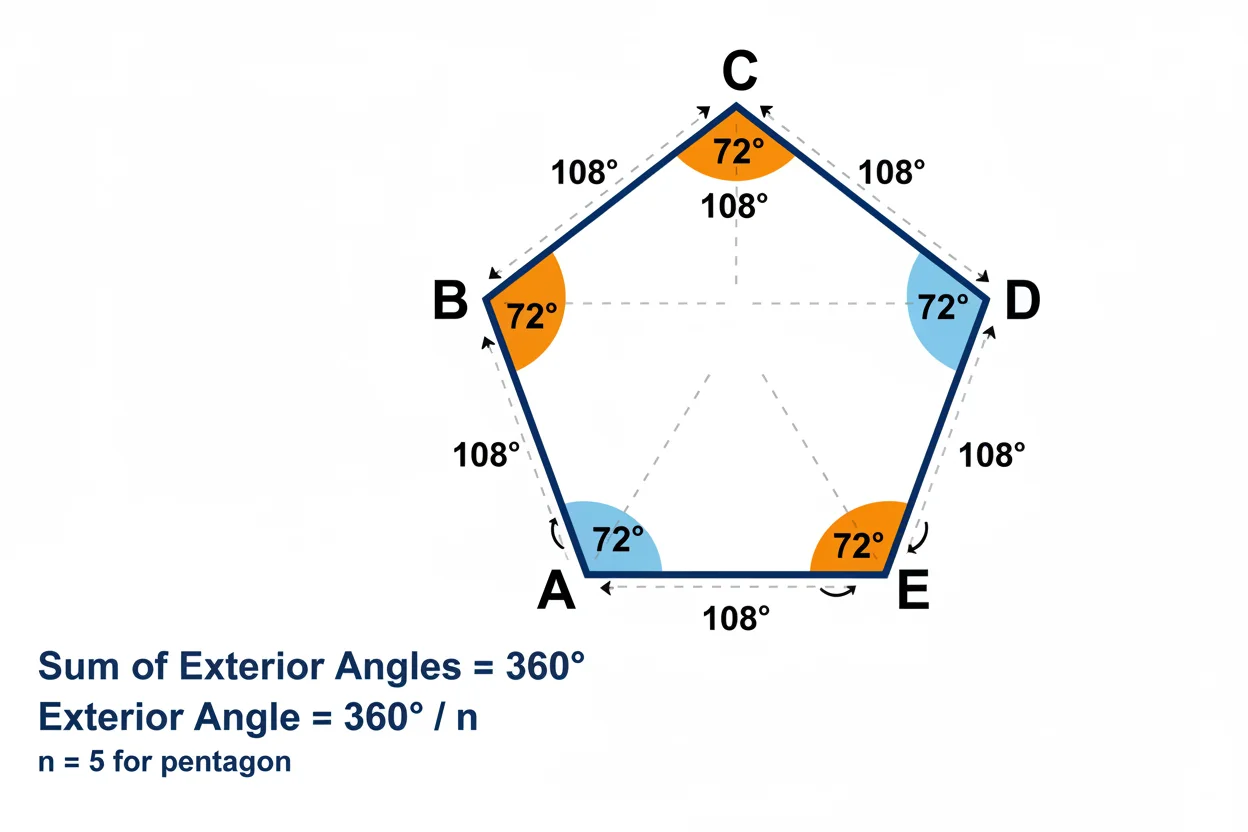
Exterior angles are angles formed outside a polygon when one side is extended beyond a vertex. For any convex polygon, taking one exterior angle at each vertex in the same direction gives a total of 360°, regardless of the number or shape of its sides. For a regular polygon with n sides, all exterior angles are equal, so each exterior angle is 360°/n. In radians, the corresponding formulas are 2π for the total and 2π/n for each exterior angle of a regular polygon. An interior angle and its adjacent exterior angle form a linear pair, so their measures add to 180°. Exterior angles can therefore be used to find interior angles, determine the number of sides of a regular polygon, analyze turning direction, and solve polygon problems without first calculating the complete interior-angle sum.
What Is an Exterior Angle?
At a polygon vertex, extend one side beyond the vertex.
The angle between that extension and the adjacent polygon side is an exterior angle.
For an ordinary convex polygon, the adjacent interior angle and exterior angle form a straight line.
Therefore:
interior angle + exterior angle = 180°
The relationship links Exterior Angles directly with Interior Angles.
Exterior Angle Formula
If an interior angle is:
I
and its adjacent exterior angle is:
E
then:
I + E = 180°
Therefore:
E = 180° − I
and:
I = 180° − E
In radians:
I + E = π
so:
E = π − I
This is a local relationship at one vertex.
Sum of Exterior Angles
For any convex polygon, one exterior angle at each vertex taken consistently around the polygon satisfies:
E₁ + E₂ + … + Eₙ = 360°
In radians:
E₁ + E₂ + … + Eₙ = 2π
This remains true whether the polygon is:
triangle
quadrilateral
pentagon
hexagon
or any other convex polygon.
Why Exterior Angles Sum to 360°
Imagine walking around a polygon.
At each vertex, you turn by the exterior angle.
After returning to the starting point and original direction, you have completed exactly one full rotation.
One full rotation is:
360°
or:
2π radians
Therefore the total turning angle is:
360°
This turning interpretation is one of the clearest ways to understand the exterior-angle sum.
Regular Polygon Exterior Angle Formula
A regular polygon has equal sides and equal angles.
If it has n vertices, all n exterior angles are equal.
Since their total is:
360°
each exterior angle is:
E = 360°/n
In radians:
E = 2π/n
This formula can also be reversed:
n = 360°/E
or:
n = 2π/E
when E is given in radians.
Equilateral Triangle Exterior Angles
An equilateral triangle has:
n = 3
Therefore each exterior angle is:
E = 360°/3
= 120°
The corresponding interior angle is:
I = 180° − 120°
= 60°
This agrees with the familiar geometry of an equilateral triangle.
Square Exterior Angles
A square has:
n = 4
Each exterior angle is:
E = 360°/4
= 90°
The corresponding interior angle is:
180° − 90°
= 90°
A square therefore turns through a right angle at every vertex.
Regular Pentagon Exterior Angles
For a regular pentagon:
n = 5
Each exterior angle is:
E = 360°/5
= 72°
The interior angle is:
I = 180° − 72°
= 108°
Check the exterior sum:
5(72°) = 360°
Regular Hexagon Exterior Angles
For:
n = 6
we have:
E = 360°/6
= 60°
Then:
I = 180° − 60°
= 120°
A regular hexagon therefore has exterior turning angles equal to the familiar:
60° = π/3
Regular Octagon Exterior Angle
For:
n = 8
each exterior angle is:
E = 360°/8
= 45°
Corresponding interior angle:
I = 180° − 45°
= 135°
Because:
8(45°) = 360°
the total exterior-angle rule is satisfied.
Find Number of Sides From Exterior Angle
For a regular polygon:
E = 360°/n
Rearrange:
n = 360°/E
Suppose each exterior angle is:
24°
Then:
n = 360/24
= 15
Therefore the polygon has:
15 sides
Another Number-of-Sides Example
Suppose:
E = 40°
Then:
n = 360/40
= 9
Therefore the shape is a regular:
nonagon
A valid regular polygon must produce a whole-number value for n.
Can a Regular Polygon Have a 50° Exterior Angle?
Use:
n = 360/50
= 7.2
A polygon cannot have:
7.2 sides
Therefore no regular polygon has an exterior angle of exactly:
50°
under the standard Euclidean definition.
Find an Exterior Angle From an Interior Angle
Suppose a polygon vertex has interior angle:
I = 135°
Then:
E = 180° − 135°
= 45°
This local formula works even when the polygon is not regular.
Regularity is only required when one exterior angle is used to infer every other exterior angle or the number of sides.
Find an Interior Angle From an Exterior Angle
Suppose:
E = 30°
Then:
I = 180° − 30°
= 150°
If every exterior angle of the polygon equals 30°, then it is regular and has:
n = 360/30
= 12
sides.
Exterior and Interior Angles of a Regular Polygon
For a regular n-gon:
E = 360°/n
and:
I = 180° − 360°/n
The interior-angle formula can also be written:
I = [(n − 2)180°]/n
The two expressions are equivalent.
To verify:
180° − 360°/n
= [180°n − 360°]/n
= 180°(n − 2)/n
Interior Angle Sum
The total Interior Angles of an n-sided polygon are:
S = (n − 2)180°
In radians:
S = (n − 2)π
For a regular polygon, divide by n to find each interior angle.
Exterior-angle calculations often provide a shorter path when regularity is known because their total is always 360°.
Deriving the Exterior-Angle Sum Algebraically
At every vertex:
interior + exterior = 180°
For n vertices:
sum of interiors + sum of exteriors = 180°n
But:
sum of interiors = (n − 2)180°
Therefore:
exterior sum = 180°n − (n − 2)180°
Factor:
= 180°[n − n + 2]
Thus:
exterior sum = 360°
This algebraic derivation agrees with the turning-angle interpretation.
Exterior Angles in Radians
Using Degrees and Radians:
360° = 2π
Therefore the exterior angles of any convex polygon sum to:
2π radians
For a regular n-gon:
E = 2π/n
For a regular hexagon:
E = 2π/6
= π/3
which corresponds to:
60°
Example in Radians
Suppose a regular polygon has exterior angle:
π/8
Then:
n = 2π/(π/8)
= 16
Therefore the polygon has:
16 sides
Its interior angle is:
π − π/8
= 7π/8
which is:
157.5°
Missing Exterior Angle
Suppose a convex pentagon has exterior angles:
60°, 75°, 80°, 65°, x
Since the total is:
360°
we have:
60 + 75 + 80 + 65 + x = 360
The known sum is:
280
Therefore:
x = 80°
No regularity assumption is required.
Missing Exterior Angles With Algebra
Suppose a quadrilateral’s exterior angles are:
x
2x
3x
4x
Their sum is:
360°
Therefore:
x + 2x + 3x + 4x = 360°
10x = 360°
so:
x = 36°
The angles are:
36°, 72°, 108°, 144°
Their total is:
360°
Another Algebraic Example
Suppose a pentagon has exterior angles:
x + 10°
x + 20°
x + 30°
x + 40°
x + 50°
Then:
5x + 150° = 360°
Therefore:
5x = 210°
x = 42°
The exterior angles are:
52°, 62°, 72°, 82°, 92°
and their sum is 360°.
Exterior Angle of a Triangle
A triangle’s exterior angles also sum to:
360°
If the three interior angles are:
A, B, C
then their adjacent exterior angles are:
180° − A
180° − B
180° − C
Adding:
540° − (A + B + C)
Since:
A + B + C = 180°
the result is:
360°
Triangle Exterior Angle Theorem
At a triangle vertex, an exterior angle equals the sum of the two nonadjacent interior angles.
Suppose exterior angle at C is E.
Then:
E = A + B
Why?
The adjacent interior angle C satisfies:
C + E = 180°
and the triangle sum gives:
A + B + C = 180°
Therefore:
A + B = 180° − C
and:
E = 180° − C
so:
E = A + B
Triangle Exterior Angle Example
Suppose a triangle has remote interior angles:
45°
and:
70°
Then the exterior angle at the third vertex is:
E = 45° + 70°
= 115°
The adjacent interior angle is:
180° − 115°
= 65°
Check the triangle:
45° + 70° + 65° = 180°
Regular Polygon Turning Angle
When tracing the boundary of a regular polygon, each directional turn is:
360°/n
That turning angle is the exterior angle.
For a square:
turn = 90°
For a regular hexagon:
turn = 60°
For a regular dodecagon:
turn = 30°
The more sides a regular polygon has, the smaller each turning angle becomes.
Exterior Angles and Polygon Side Count
The formula:
n = 360°/E
shows an inverse relationship.
As n increases:
E decreases
For example:
triangle → 120°
square → 90°
hexagon → 60°
decagon → 36°
20-gon → 18°
Many-sided regular polygons therefore change direction only slightly at each vertex.
Exterior Angles and Regular Polygon Approximation to a Circle
A regular polygon with many sides can approximate a circle.
As:
n → large
the exterior angle:
360°/n
becomes small.
The total turning remains:
360°
The direction changes are simply distributed across more vertices.
This turning interpretation helps explain why polygonal approximations approach smooth circular curvature.
Exterior Angles and Circle Geometry
A complete turn around a circle is:
360° = 2π
The Circle Circumference also represents one complete trip around a circular boundary.
Exterior-angle sums capture the same total directional rotation for a polygonal boundary.
The polygon contains discrete turns at vertices; the circle changes direction continuously.
Exterior Angles and Arc Length
If a regular polygon is associated with a circumscribed or inscribed circle, central angles may numerically equal:
360°/n
For an inscribed regular n-gon, each central angle between adjacent vertices is:
360°/n
which equals the polygon’s exterior angle.
The corresponding Arc Length is:
s = r(2π/n)
when the central angle is measured in radians.
This connects regular-polygon exterior angles with circle subdivision.
Exterior Angles and Chord Length
For a regular n-gon inscribed in a circle of radius r, adjacent vertices form a chord.
The central angle is:
θ = 2π/n
The Chord Length is:
c = 2r sin(θ/2)
Therefore:
c = 2r sin(π/n)
Because:
θ = exterior angle
for the regular polygon, exterior-angle information can indirectly determine side length when the circumradius is known.
Regular Hexagon Example With a Circle
For a regular hexagon:
exterior angle = 60° = π/3
The central angle between adjacent vertices of an inscribed regular hexagon is also:
π/3
Chord length:
c = 2r sin(π/6)
= 2r(1/2)
Therefore:
c = r
This explains the familiar result that an inscribed regular hexagon’s side length equals the circle radius.
Exterior Angles and Regular Polygon Area
Once n is known from:
n = 360°/E
the Regular Polygon Area can be calculated if sufficient length information is available.
For apothem a and perimeter P:
A = aP/2
Thus an exterior-angle problem may first reveal the number of sides, after which the relevant polygon dimensions determine area.
The angle formula itself does not determine area without a length scale.
Exterior Angles and Polygon Diagonals
If the exterior angle of a regular polygon reveals n, the number of Polygon Diagonals can then be found from:
D = n(n − 3)/2
Suppose:
E = 40°
Then:
n = 9
Therefore:
D = 9(6)/2
= 27
The exterior angle determines the polygon size by side count, while the diagonal formula counts nonadjacent vertex connections.
Exterior Angles and Distance Formula
If a polygon is specified by coordinates, the Distance Formula can determine side lengths while exterior angles describe changes in direction.
For vertices A, B, and C:
distance AB
and:
distance BC
describe lengths.
The exterior angle at B describes the turn from side AB toward BC.
Length and turning angle together provide a richer geometric description than either alone.
Exterior Angles and Vector Direction
Each polygon side can be represented as a direction vector.
Moving from one side to the next changes direction by the exterior turning angle.
After traversing a convex polygon once, the net directional rotation is:
2π
This vector-direction viewpoint generalizes the ordinary geometric turning interpretation.
Clockwise Versus Counterclockwise Turning
If exterior angles are treated as signed turns:
counterclockwise turns can be positive
clockwise turns can be negative
The signed total for a simple closed boundary depends on orientation:
+360°
or:
−360°
The ordinary school-level exterior-angle sum usually refers to the positive magnitudes of consistently chosen exterior angles around a convex polygon:
360°
Reflex Exterior Angles
At each vertex, more than one angle can be drawn outside a polygon.
The standard exterior angle used in the polygon sum theorem is the turning angle adjacent to the interior angle.
For a convex polygon:
I + E = 180°
Using the reflex angle outside instead would not satisfy the standard one-at-each-vertex 360° rule in the same way.
Correctly identifying the intended exterior angle is essential.
Exterior Angles of Concave Polygons
For concave polygons, exterior-angle treatment is clearest when angles are regarded as signed turning angles.
Traversing any simple polygon once still produces a net turning of:
±360°
depending on orientation.
If all exterior angles are instead treated only as positive magnitudes without signs, a concave polygon requires more care because one turn reverses orientation relative to the others.
The familiar:
sum = 360°
statement is simplest for convex polygons.
Exterior Angles and Frustum Geometry
A Frustum Volume problem normally concerns radii and perpendicular height rather than polygon exterior angles.
However, polygonal frustums can have regular polygon bases.
If a regular base’s exterior angle is known, then:
n = 360°/E
can determine the number of sides.
That information may help identify the base shape before its area and the frustum’s volume are calculated.
Example With a Regular Polygonal Base
Suppose a regular base has exterior angle:
45°
Then:
n = 360/45
= 8
The base is a regular octagon.
If its apothem and perimeter are later supplied, its area can be calculated and used in the appropriate three-dimensional volume relationship.
The exterior-angle calculation identifies the base geometry rather than determining volume by itself.
Exterior Angles and Heron’s Formula
Heron Formula calculates triangle area from three side lengths:
A = √[s(s − a)(s − b)(s − c)]
Exterior angles solve a different type of problem.
However, polygon problems may be decomposed into triangles after exterior-angle information determines the polygon’s structure.
Heron’s formula can then calculate component triangle areas if their three side lengths are known.
Each relationship has a distinct role.
Exterior Angle From a Regular Polygon Interior Angle
For a regular polygon:
E = 180° − I
Suppose:
I = 156°
Then:
E = 24°
Number of sides:
n = 360/24
= 15
Thus the regular polygon has:
15 sides
This two-step method is frequently useful.
Number of Sides From Interior Angle
Combine:
E = 180° − I
with:
n = 360°/E
to obtain:
n = 360°/(180° − I)
Suppose:
I = 165°
Then:
E = 15°
Therefore:
n = 24
The polygon is a regular 24-gon.
Exterior Angle From Number of Sides
For:
n = 12
we have:
E = 360°/12
= 30°
Interior angle:
I = 150°
For:
n = 20
we have:
E = 18°
Interior angle:
I = 162°
As n increases, regular-polygon interior angles approach 180° while exterior angles approach 0°.
Can an Exterior Angle Be 180° in a Regular Polygon?
Using:
n = 360°/180°
gives:
n = 2
A standard polygon requires at least:
3 sides
Therefore a regular polygon cannot have a standard exterior angle of:
180°
For n ≥ 3:
0° < E ≤ 120°
with the largest regular-polygon exterior angle occurring for an equilateral triangle.
Largest Regular Exterior Angle
For the smallest possible polygon:
n = 3
Therefore:
E = 360°/3
= 120°
As side count increases, E decreases.
So among regular polygons:
120°
is the maximum standard exterior angle.
Exterior Angle and Triangle Area
If a triangle exterior angle is given, its adjacent interior angle follows from:
I = 180° − E
The remaining triangle information may then allow its area to be found.
For example, if two sides surrounding that interior angle are known:
A = ab sinI/2
Thus exterior-angle information can become an input to the broader Area Formulas once converted to the relevant interior angle.
Example With Area
Suppose a triangle has exterior angle:
E = 120°
at a vertex.
Then the adjacent interior angle is:
I = 60°
If the two sides enclosing that angle are:
6
and:
10
then:
A = 6(10)sin60°/2
= 30(√3/2)
Therefore:
A = 15√3
The exterior angle first determines the included interior angle.
Degrees Versus Radians
Exterior angles can be expressed in either system.
A full turn is:
360°
or:
2π
A regular polygon with n sides has:
E = 360°/n
or:
E = 2π/n
Both formulas are equivalent.
The angle unit must remain consistent throughout the calculation.
Example Converting an Exterior Angle
Suppose:
E = 72°
Convert using:
radians = degrees × π/180
Then:
E = 72π/180
= 2π/5
A regular polygon with this exterior angle has:
n = 2π/(2π/5)
= 5
so it is a regular pentagon.
Exterior Angle and Rotation Commands
Imagine instructing a drawing device or robot to trace a regular polygon.
For each side:
- move forward a fixed distance;
- turn by the exterior angle.
For a regular pentagon, each turn is:
72°
Repeating this process five times returns the device to both its starting position and original direction.
The total turn is:
5(72°) = 360°
This operational interpretation makes the sum theorem especially intuitive.
Common Exterior-Angle Mistakes
A common mistake is using:
(n − 2)180°
for the exterior-angle sum.
That formula belongs to the sum of interior angles.
Exterior angles of a convex polygon sum to:
360°
Another error is assuming each exterior angle equals:
360°/n
for an irregular polygon. That equality requires a regular polygon.
An interior angle and its adjacent exterior angle sum to:
180°
not 360°.
When solving:
n = 360°/E
the resulting n must be a whole number of at least 3 for a regular polygon.
In radians, use:
2π
for a complete turn.
Finally, make sure one consistent exterior angle is selected at each vertex rather than mixing standard and reflex exterior angles.
Frequently Asked Questions
What is an exterior angle?
An exterior angle is formed by one side of a polygon and the extension of an adjacent side.
What is the sum of exterior angles of a convex polygon?
360°
What is the sum in radians?
2π
Does the exterior-angle sum depend on the number of sides?
No. One consistently chosen exterior angle at each vertex of any convex polygon sums to 360°.
What is each exterior angle of a regular polygon?
E = 360°/n
What is the formula in radians?
E = 2π/n
How do you find the number of sides from an exterior angle?
For a regular polygon:
n = 360°/E
How are interior and exterior angles related?
At the same vertex:
I + E = 180°
What is the exterior angle of a square?
90°
What is the exterior angle of a regular pentagon?
72°
What is the exterior angle of a regular hexagon?
60°
What is the exterior angle of an equilateral triangle?
120°
Does 360°/n work for irregular polygons?
Not for each individual angle. It gives equal exterior angles only when the polygon is regular.
What is the triangle exterior angle theorem?
A triangle exterior angle equals the sum of the two nonadjacent interior angles.
Why do exterior angles sum to 360°?
Walking once around a polygon changes direction by one complete turn.
How can I check an exterior-angle answer?
Verify that all exterior angles together total 360°, and for a regular polygon confirm that multiplying one exterior angle by n gives 360°.