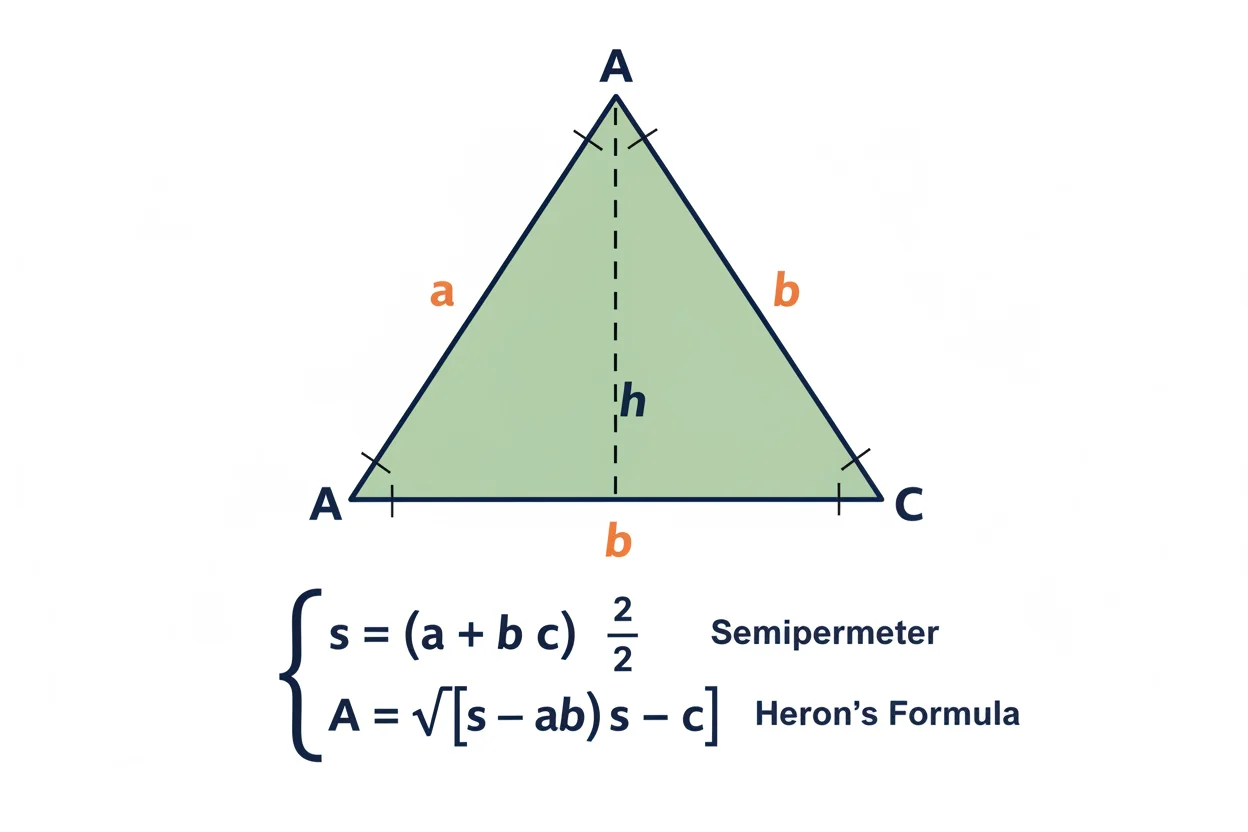

Heron formula calculates the area of a triangle when all three side lengths are known. If the sides are a, b, and c, first calculate the semiperimeter s = (a + b + c)/2. The triangle’s area is then A = √[s(s − a)(s − b)(s − c)]. Unlike A = bh/2, Heron’s formula does not require a perpendicular height. It works for scalene, isosceles, equilateral, acute, right, and obtuse triangles as long as the three side lengths form a valid nondegenerate triangle. Before using it, the triangle inequality should be checked: every pair of side lengths must add to more than the remaining side. Heron’s formula is particularly useful when side lengths come from coordinate distances, measurement problems, triangulation, or another geometric calculation.
What Is Heron Formula?
For a triangle with sides:
a
b
c
define the semiperimeter:
s = (a + b + c)/2
Then the area is:
A = √[s(s − a)(s − b)(s − c)]
This is Heron’s formula.
The result gives the same geometric Area that could be found from:
A = bh/2
if the appropriate perpendicular height were known.
Its advantage is that only the three side lengths are required.
What Is the Semiperimeter?
The perimeter is:
P = a + b + c
The semiperimeter is half the perimeter:
s = P/2
Therefore:
s = (a + b + c)/2
The semiperimeter is not the same as an average side length.
It is simply one-half of the total boundary length.
Basic Heron Formula Example
Consider a triangle with sides:
3, 4, 5
First calculate:
s = (3 + 4 + 5)/2
= 12/2
= 6
Now:
A = √[6(6 − 3)(6 − 4)(6 − 5)]
= √[6·3·2·1]
= √36
Therefore:
A = 6
square units.
Check With the Right-Triangle Formula
A 3-4-5 triangle is a right triangle because:
3² + 4² = 5²
Using the Pythagorean Theorem, the legs are 3 and 4.
Therefore:
A = 3·4/2
= 6
The result matches Heron’s formula.
This is a useful verification.
Classic 13-14-15 Example
Suppose:
a = 13
b = 14
c = 15
Semiperimeter:
s = (13 + 14 + 15)/2
= 42/2
= 21
Then:
A = √[21(21 − 13)(21 − 14)(21 − 15)]
= √(21·8·7·6)
= √7056
Therefore:
A = 84
square units.
Heron Formula Step by Step
A reliable method is:
- Identify the three side lengths.
- Check that they form a valid triangle.
- Calculate the semiperimeter.
- Calculate s − a, s − b, and s − c.
- Multiply the four factors.
- Take the nonnegative square root.
- Report square units.
For:
13, 14, 15
the critical intermediate values are:
s = 21
s − a = 8
s − b = 7
s − c = 6
Triangle Inequality
Before using Heron’s formula, verify that the side lengths form a triangle.
For positive side lengths:
a + b > c
a + c > b
b + c > a
This is the triangle inequality.
If any pair sums to less than the third side, no triangle exists.
If a pair sums exactly to the third side, the figure is degenerate and has zero area.
Valid Triangle Example
For sides:
5, 7, 9
check:
5 + 7 > 9
5 + 9 > 7
7 + 9 > 5
All are true.
Therefore a nondegenerate triangle exists and Heron’s formula can be used.
Invalid Triangle Example
Consider:
2, 3, 6
Check:
2 + 3 > 6
This is false because:
5 < 6
Therefore these lengths cannot form a triangle.
Attempting to force them through Heron’s formula would not produce a meaningful real geometric area.
Degenerate Triangle Example
Consider:
2, 3, 5
Here:
2 + 3 = 5
The points can lie on one straight line, but they do not enclose a two-dimensional region.
Semiperimeter:
s = 5
One Heron factor is:
s − c = 0
Therefore:
A = 0
This correctly reflects the degenerate geometry.
Isosceles Triangle Example
Suppose:
a = 5
b = 5
c = 6
Then:
s = (5 + 5 + 6)/2
= 8
Heron’s formula gives:
A = √[8(3)(3)(2)]
= √144
Therefore:
A = 12
square units.
Verify the Isosceles Example
In a 5-5-6 triangle, an altitude to the side of length 6 bisects that side into:
3 and 3
The height is:
h = √(5² − 3²)
= √16
= 4
Then:
A = 6(4)/2
= 12
Again, Heron’s formula agrees with the base-height method.
Equilateral Triangle From Heron’s Formula
Let all sides equal a:
a = b = c
Then:
s = 3a/2
Each difference is:
s − a = a/2
Therefore:
A = √[(3a/2)(a/2)(a/2)(a/2)]
= √(3a⁴/16)
Thus:
A = √3 a²/4
So Heron’s formula reproduces the familiar equilateral-triangle area formula.
Example With an Equilateral Triangle
Suppose:
a = 8
Then:
A = √3(8²)/4
= 16√3
Heron’s formula gives:
s = 12
and:
A = √[12·4·4·4]
= √768
= 16√3
The two methods are identical.
Heron Formula With Decimal Sides
Suppose:
a = 4.5
b = 5.5
c = 7
Then:
s = (4.5 + 5.5 + 7)/2
= 8.5
Area:
A = √[8.5(4)(3)(1.5)]
= √153
Therefore:
A ≈ 12.37
square units.
Heron’s formula works equally well with decimal side lengths.
Heron Formula With Fractions
Fractional lengths also work.
Suppose:
a = 3/2
b = 2
c = 5/2
Then:
s = (3/2 + 2 + 5/2)/2
The sum is:
6
so:
s = 3
Then:
A = √[(3)(3/2)(1)(1/2)]
= √(9/4)
Therefore:
A = 3/2
square units.
These sides form a scaled 3-4-5 right triangle.
Why Heron’s Formula Is Useful
The ordinary triangle area formula:
A = bh/2
requires a perpendicular height.
Heron’s formula replaces that missing height with the three side lengths.
This is especially useful when:
all sides are measured directly
coordinates provide all side lengths
a survey produces three boundary distances
a triangle is part of a larger polygon
the altitude is inconvenient to calculate
The formula does not require knowing any angles.
Heron’s Formula and Area Formulas
The broader collection of Area Formulas contains different methods depending on available data.
For a triangle:
base + height → A = bh/2
two sides + included angle → A = ab sinC/2
three sides → Heron’s formula
The best formula depends on which measurements are already known.
Heron Versus Base-Height Formula
Suppose:
b = 10
h = 6
Then:
A = 30
If the other two side lengths are not known, Heron’s formula cannot be used directly.
Conversely, if the three sides are known but altitude is not, Heron’s formula is often the more efficient method.
Neither formula is universally superior.
Heron Versus Sine Area Formula
If two sides and their included angle are known:
A = ab sinC/2
For example:
a = 8
b = 10
C = 30°
Then:
A = 8(10)(1/2)/2
= 20
Heron’s formula would first require finding the third side.
The sine formula is more direct in this data configuration.
Find the Third Side First
If two sides and an included angle are known but Heron’s formula is desired, the Law of Cosines can calculate the third side:
c² = a² + b² − 2ab cosC
Once c is known, Heron’s formula can use all three sides.
This provides a useful cross-check against:
A = ab sinC/2
Law of Cosines Example
Suppose:
a = 5
b = 7
C = 60°
Then:
c² = 25 + 49 − 70(1/2)
= 39
Therefore:
c = √39
Heron’s formula could then calculate the area.
But the sine formula is simpler here:
A = 5·7·sin60°/2
= 35√3/4
Both methods produce the same geometric area.
Heron Formula From Coordinate Points
If triangle vertices are given as coordinates, first calculate all three side lengths with the Distance Formula.
For:
A = (0, 0)
B = (4, 0)
C = (0, 3)
the side lengths are:
AB = 4
AC = 3
BC = 5
Heron’s formula then gives:
A = 6
square units.
Coordinate Example With a Non-Axis-Aligned Triangle
Suppose:
A = (1, 1)
B = (5, 2)
C = (3, 6)
First:
AB = √[(5 − 1)² + (2 − 1)²]
= √17
Next:
BC = √[(3 − 5)² + (6 − 2)²]
= √20
And:
AC = √[(3 − 1)² + (6 − 1)²]
= √29
These three side lengths can be substituted into Heron’s formula.
For coordinate problems, a determinant-based area formula may sometimes be faster, but Heron’s formula remains valid.
Heron Formula and Perimeter
Because:
s = P/2
Heron’s formula can also be written:
A = √[(P/2)(P/2 − a)(P/2 − b)(P/2 − c)]
If the perimeter is already known, the first step is immediate:
s = P/2
The individual side lengths are still required for the remaining factors.
Find a Missing Side From Perimeter
Suppose:
P = 30
a = 8
b = 10
Then:
c = 30 − 8 − 10
= 12
Now:
s = 15
Heron’s formula gives:
A = √[15(7)(5)(3)]
= √1575
= 15√7
Approximately:
A ≈ 39.69
Heron Formula and Interior Angles
Interior Angles of a triangle sum to:
180°
Heron’s formula does not require those angles directly.
However, once all three side lengths are known, the triangle’s angles are determined.
The area from Heron’s formula is therefore consistent with every valid angle-based area calculation for that same triangle.
Find an Angle After Using Heron
Suppose sides are:
13, 14, 15
Heron’s formula gives:
A = 84
If an angle is later required, the side lengths can be used with inverse trigonometry or the Law of Cosines.
For example, if C is opposite side 15:
cosC = (13² + 14² − 15²)/(2·13·14)
= 140/364
= 5/13
Therefore:
C = cos⁻¹(5/13)
Inverse Trigonometric Functions and Heron Problems
Inverse Trigonometric Functions are useful when a Heron problem eventually asks for an angle.
Once side lengths are known:
C = cos⁻¹[(a² + b² − c²)/(2ab)]
can determine an angle.
Heron’s formula itself remains an area formula and does not require inverse trigonometry.
The two methods answer different parts of the geometry.
Heron Formula and the Law of Sines
The Law of Sines relates sides to opposite angles:
a/sinA = b/sinB = c/sinC
Heron’s formula instead uses only side lengths.
If side-angle information is available, the Law of Sines may be useful to calculate missing sides before applying Heron’s formula.
But if all three sides are already known, the Law of Sines is unnecessary for area.
Exterior Angles and Triangle Area
A triangle’s Exterior Angles may provide information needed to recover an interior angle.
If exterior angle E is adjacent to interior angle C:
C = 180° − E
With two sides around C known:
A = ab sinC/2
This may be more direct than Heron’s formula.
If the exterior-angle information eventually allows all three side lengths to be found, Heron’s formula becomes another valid route.
Heron Formula and Congruent Triangles
Congruent Triangles have identical corresponding side lengths.
Therefore they have identical semiperimeters and identical Heron-formula areas.
If:
△ABC ≅ △DEF
then:
a, b, c
match the corresponding three sides of DEF.
So:
Area(ABC) = Area(DEF)
Congruence guarantees equal area, although equal area alone does not prove congruence.
Heron Formula and Similar Triangles
For Similar Triangles, suppose each side is multiplied by scale factor k.
Then:
a → ka
b → kb
c → kc
and:
s → ks
Substitute into Heron’s formula:
A_new = √[(ks)(k(s − a))(k(s − b))(k(s − c))]
Four factors of k appear inside the square root:
A_new = √(k⁴)A
Therefore:
A_new = k²A
This reproduces the standard area-scaling rule for similar figures.
Similarity Example
Suppose one triangle has:
area = 20
A similar triangle has side scale factor:
k = 3
Then:
A_new = 3²(20)
= 180
Heron’s formula automatically preserves this squared scaling because every side-based factor scales linearly.
Heron Formula for a Right Triangle
If a, b are perpendicular legs and c is the hypotenuse:
a² + b² = c²
Heron’s formula simplifies to the same area as:
A = ab/2
For a 5-12-13 triangle:
s = 15
Then:
A = √[15·10·3·2]
= √900
= 30
And:
5·12/2 = 30
Heron’s Formula and Triangle Type
Heron’s formula works for:
acute triangles
right triangles
obtuse triangles
scalene triangles
isosceles triangles
equilateral triangles
The triangle type does not alter the formula.
Only the three valid side lengths are needed.
Obtuse Triangle Example
Consider sides:
4, 5, 7
Semiperimeter:
s = 8
Then:
A = √[8·4·3·1]
= √96
= 4√6
Approximately:
A ≈ 9.80
Because:
7² > 4² + 5²
the triangle is obtuse, yet Heron’s formula works without modification.
Numerical Stability Near Degenerate Triangles
If one side is almost equal to the sum of the other two, the triangle is extremely thin.
One factor such as:
s − c
becomes very small.
Therefore the area approaches zero.
In computer calculations with extreme floating-point values, equivalent reformulations of Heron’s formula can sometimes be numerically more stable, but the standard form is appropriate for ordinary hand calculations.
Alternative Expanded Heron Form
An equivalent form is:
16A² = (a + b + c)(−a + b + c)(a − b + c)(a + b − c)
Therefore:
A = 1/4 √[(a + b + c)(−a + b + c)(a − b + c)(a + b − c)]
This version eliminates the separate semiperimeter variable.
For manual work, the semiperimeter form is usually easier to organize.
Why the Expanded Form Matches
Since:
s = (a + b + c)/2
we have:
s − a = (−a + b + c)/2
s − b = (a − b + c)/2
s − c = (a + b − c)/2
The product inside Heron’s square root therefore contains four factors each divided by 2.
Their combined denominator is:
16
Taking the square root produces:
1/4
which gives the expanded expression.
Heron Formula and Incircle Radius
Triangle area also satisfies:
A = rs
where:
r = inradius
s = semiperimeter
Therefore, after Heron’s formula finds A:
r = A/s
For the 13-14-15 triangle:
A = 84
s = 21
Thus:
r = 84/21
= 4
The triangle’s incircle has radius 4.
Heron Formula and Circumradius
Triangle area also satisfies:
A = abc/(4R)
where:
R = circumradius
Therefore:
R = abc/(4A)
For the 13-14-15 triangle:
R = 13·14·15/(4·84)
= 2730/336
= 65/8
Thus:
R = 8.125
Heron’s formula can therefore provide the area needed to derive other triangle measurements.
Heron Formula in Regular Polygon Area
A regular polygon can be divided into congruent triangles.
If the side lengths of those triangles are known, Heron’s formula could calculate one triangle’s area and multiply by the number of sections.
Usually the Regular Polygon Area formula:
A = aP/2
is more direct when apothem and perimeter are known.
Heron’s formula is especially useful when the triangular side lengths are the available data.
Heron Formula in Composite Figures
An irregular polygon can sometimes be divided into triangles.
If each triangle’s three side lengths are known:
total area = sum of triangle areas
Heron’s formula can calculate each component without constructing all perpendicular heights.
Care must be taken that the triangles form a nonoverlapping partition of the original region.
Heron’s Formula and Frustum Volume
In a polygonal Frustum Volume problem, a triangular base area may need to be calculated before the volume formula can be used.
If Heron’s formula gives parallel base areas:
B₁
and:
B₂
then:
V = h(B₁ + B₂ + √(B₁B₂))/3
Heron’s formula determines the two-dimensional base area; the frustum equation then converts those base areas and height into three-dimensional volume.
Units in Heron’s Formula
All side lengths must use compatible units.
If:
a, b, c
are measured in centimeters, then:
s
is also in centimeters.
Inside the square root, four length factors are multiplied:
cm⁴
Taking the square root gives:
cm²
Therefore the final result correctly has square units.
Converting Units Before Calculation
Suppose two sides are given in centimeters and one in meters.
Convert them to a common unit before calculating the semiperimeter.
For example:
1.2 m = 120 cm
Using mixed units directly would make the side sums and area meaningless.
Unit consistency should be checked before any Heron arithmetic begins.
Exact Versus Approximate Results
If the product under the square root is a perfect square, the area may be an integer or simple rational value.
Otherwise, an exact radical can be retained.
For example:
A = √96
can be simplified:
A = 4√6
Approximately:
A ≈ 9.80
The exact radical avoids unnecessary rounding.
Checking a Heron Formula Result
One useful check is that the area must be positive for a valid nondegenerate triangle.
Another is:
A ≤ bc/2
for any selected pair of sides b and c, because:
A = bc sinA/2
and:
|sinA| ≤ 1
For example, a triangle with sides 5 and 7 around some angle cannot have area greater than:
5·7/2 = 17.5
An answer above that bound signals an error.
Common Heron Formula Mistakes
A common mistake is using the full perimeter instead of the semiperimeter.
Remember:
s = (a + b + c)/2
Another error is forgetting one of the factors:
s
s − a
s − b
s − c
The square root must cover the entire product.
Check triangle validity before calculating.
Do not confuse Heron’s formula with:
A = ab sinC/2
which uses two sides and an included angle.
Use consistent measurement units.
When coordinates are given, calculate all three side lengths correctly before substituting.
Finally, area uses square units even though the input measurements are linear lengths.
Frequently Asked Questions
What is Heron formula?
Heron’s formula finds triangle area from its three side lengths:
A = √[s(s − a)(s − b)(s − c)]
What is s?
s is the semiperimeter:
s = (a + b + c)/2
Does Heron’s formula require height?
No.
Does it require an angle?
No. Only the three side lengths are required.
Does Heron’s formula work for right triangles?
Yes.
Does it work for obtuse triangles?
Yes.
Does it work for isosceles triangles?
Yes.
Does it work for equilateral triangles?
Yes.
How do you know whether three sides form a triangle?
Each pair must add to more than the third side.
What happens for a degenerate triangle?
If one pair of sides sums exactly to the third side, Heron’s formula gives:
A = 0
What is the area of a 3-4-5 triangle using Heron’s formula?
6 square units
What is the area of a 13-14-15 triangle?
84 square units
Can Heron’s formula use coordinate points?
Yes. First find the three side lengths with the distance formula.
How is Heron’s formula related to similar triangles?
If every side scales by k, Heron’s formula shows that area scales by:
k²
How can I check a Heron-formula answer?
Verify the triangle inequality, recalculate the semiperimeter, check every factor under the square root, and compare with another area formula when enough information is available.