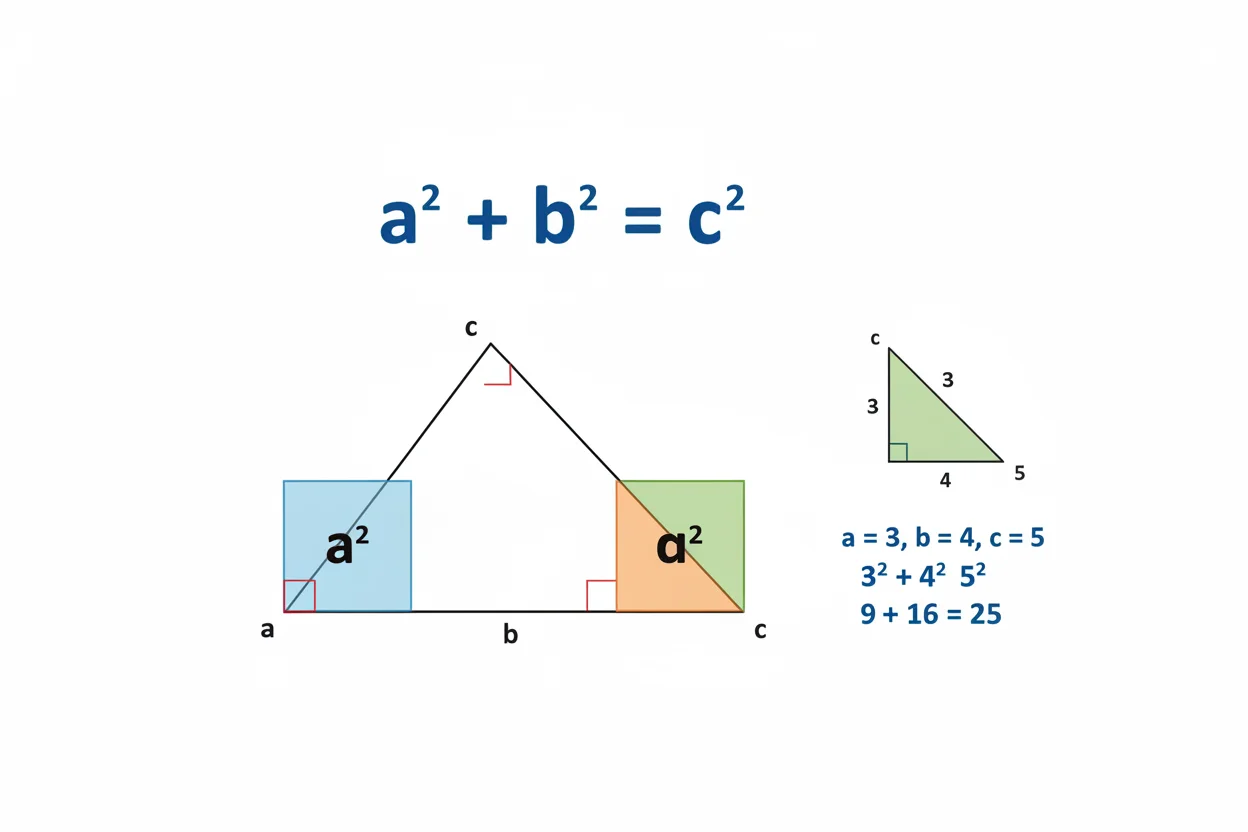

The Pythagorean theorem describes the relationship between the three side lengths of a right triangle. If a and b are the perpendicular legs and c is the hypotenuse opposite the 90° angle, then a² + b² = c². The theorem can find an unknown hypotenuse with c = √(a² + b²), or an unknown leg with a = √(c² − b²). It applies specifically to right triangles, but its converse can also test whether three side lengths form a right triangle. Comparing c² with a² + b² further distinguishes acute, right, and obtuse triangles when c is the longest side. The Pythagorean theorem underlies the distance formula, rectangle and box diagonals, circle equations, vector magnitudes, coordinate geometry, solid-geometry measurements, and many specialized formulas throughout mathematics.
What Is the Pythagorean Theorem?
For a right triangle:
a² + b² = c²
where:
a = one leg
b = other leg
c = hypotenuse
The hypotenuse is the side opposite the right angle.
It is always the longest side of a nondegenerate right triangle.
The two legs meet at:
90°
The theorem is one of the central relationships in Right Triangles.
Basic 3-4-5 Example
Suppose:
a = 3
b = 4
Then:
c² = 3² + 4²
= 9 + 16
= 25
Therefore:
c = 5
So:
3² + 4² = 5²
The 3-4-5 triangle is one of the most familiar Pythagorean triples.
Find the Hypotenuse
Starting with:
a² + b² = c²
take the nonnegative square root:
c = √(a² + b²)
The positive root is used because geometric length cannot be negative.
Hypotenuse Example
Suppose the legs are:
a = 5
b = 12
Then:
c = √(5² + 12²)
= √(25 + 144)
= √169
Therefore:
c = 13
This produces the:
5-12-13
right triangle.
Find a Missing Leg
Suppose c and one leg are known.
Starting with:
a² + b² = c²
solve for a:
a² = c² − b²
Therefore:
a = √(c² − b²)
Similarly:
b = √(c² − a²)
Missing-Leg Example
Suppose:
c = 10
b = 8
Then:
a = √(10² − 8²)
= √(100 − 64)
= √36
Therefore:
a = 6
The triangle is:
6-8-10
which is a scaled 3-4-5 triangle.
Why the Hypotenuse Must Be c
The formula:
a² + b² = c²
depends on c being the side opposite the 90° angle.
If the longest side is incorrectly placed as a or b, the relationship will be set up incorrectly.
A practical rule is:
identify the right angle first
then:
identify the side directly opposite it
That side is the hypotenuse.
The Hypotenuse Is Always Longest
Because:
c² = a² + b²
and both:
a² > 0
b² > 0
we have:
c² > a²
and:
c² > b²
For positive side lengths:
c > a
and:
c > b
This confirms that the hypotenuse must be longer than either leg.
Pythagorean Theorem Converse
The converse states that if three positive side lengths satisfy:
a² + b² = c²
with c as the longest side, then the triangle is a right triangle.
This lets the formula classify triangles rather than merely solve known right triangles.
Converse Example
Suppose sides are:
7, 24, 25
Take the longest:
c = 25
Then:
7² + 24²
= 49 + 576
= 625
and:
25² = 625
Therefore the triangle is right.
Non-Right Example
Consider sides:
5, 6, 8
Longest side:
c = 8
Then:
5² + 6² = 25 + 36 = 61
while:
8² = 64
Since:
61 ≠ 64
the triangle is not right.
Acute, Right, or Obtuse Classification
Let c be the longest side.
Compare:
c²
with:
a² + b²
If:
c² = a² + b²
the triangle is right.
If:
c² < a² + b²
the triangle is acute.
If:
c² > a² + b²
the triangle is obtuse.
This comparison follows from the Law of Cosines.
Acute Triangle Example
Sides:
5, 6, 7
Longest side:
c = 7
Then:
c² = 49
and:
a² + b² = 25 + 36
= 61
Since:
49 < 61
the triangle is acute.
Obtuse Triangle Example
Sides:
4, 5, 7
Then:
7² = 49
while:
4² + 5² = 41
Since:
49 > 41
the triangle is obtuse.
The largest angle lies opposite side 7.
Pythagorean Triples
A Pythagorean triple is a set of positive integers satisfying:
a² + b² = c²
Common examples include:
3, 4, 5
5, 12, 13
7, 24, 25
8, 15, 17
9, 40, 41
20, 21, 29
Recognizing these triples can make calculations much faster.
Multiples of Pythagorean Triples
Any common multiple of a Pythagorean triple is also a Pythagorean triple.
For example:
3,4,5
multiplied by 2 gives:
6,8,10
Check:
6² + 8² = 36 + 64 = 100
and:
10² = 100
Similarly, multiplying by 3 gives:
9,12,15
Generating Pythagorean Triples
For integers:
m > n > 0
a primitive triple can often be generated by:
a = m² − n²
b = 2mn
c = m² + n²
For:
m = 2
n = 1
we get:
a = 3
b = 4
c = 5
For:
m = 3
n = 2
we get:
a = 5
b = 12
c = 13
Why the Triple Formula Works
Using:
a = m² − n²
b = 2mn
compute:
a² + b²
= (m² − n²)² + (2mn)²
Expand:
= m⁴ − 2m²n² + n⁴ + 4m²n²
= m⁴ + 2m²n² + n⁴
Factor:
= (m² + n²)²
Therefore:
a² + b² = c²
with:
c = m² + n²
Geometric Meaning With Squares
The theorem can be interpreted as an area relationship.
Build a square on each side of a right triangle.
The square on side a has area:
a²
The square on side b has area:
b²
The square on hypotenuse c has area:
c²
The theorem says:
area of square on a + area of square on b = area of square on c
This area interpretation motivates many classical proofs.
Rearrangement Proof Intuition
One classic proof places four identical right triangles inside a large square.
The uncovered central region can be interpreted in two different ways.
Equating the two area expressions simplifies to:
a² + b² = c²
The proof shows that the theorem is fundamentally an equality of areas rather than merely an algebraic coincidence.
Similar-Triangle Proof Intuition
Drop an altitude from the right-angle vertex to the hypotenuse.
This divides the original triangle into two smaller triangles that are similar to the original.
The resulting proportional relationships imply:
a² = c·segment₁
and:
b² = c·segment₂
Adding:
a² + b² = c(segment₁ + segment₂)
Since the two segments form the entire hypotenuse:
segment₁ + segment₂ = c
Therefore:
a² + b² = c²
Pythagorean Theorem and the Distance Formula
The Distance Formula is a direct coordinate application of the theorem.
For points:
(x₁,y₁)
and:
(x₂,y₂)
horizontal change is:
Δx = x₂ − x₁
vertical change is:
Δy = y₂ − y₁
These perpendicular changes form the legs of a right triangle.
Therefore:
d² = (Δx)² + (Δy)²
so:
d = √[(x₂ − x₁)² + (y₂ − y₁)²]
Distance Example
Find the distance between:
(1,2)
and:
(5,5)
Changes:
Δx = 4
Δy = 3
Therefore:
d = √(4² + 3²)
= 5
The coordinate distance is simply the hypotenuse of a 3-4-5 right triangle.
3D Distance
The theorem can be applied twice to obtain three-dimensional distance:
d = √[(Δx)² + (Δy)² + (Δz)²]
For points:
(0,0,0)
and:
(3,4,12)
we get:
d = √(9 + 16 + 144)
= √169
Therefore:
d = 13
This extends the same perpendicular-component logic into three dimensions.
Rectangle Diagonal
For a rectangle with length l and width w, the diagonal forms a right triangle.
Therefore:
d² = l² + w²
so:
d = √(l² + w²)
This relationship often appears alongside Rectangle Area, whose formula is:
A = lw
Rectangle Example
Suppose:
l = 12
w = 5
Then:
d = √(144 + 25)
= √169
Therefore:
d = 13
The rectangle has area:
60
but diagonal:
13
These are different geometric measurements.
Find a Rectangle Side From a Diagonal
Suppose:
d = 10
w = 6
Then:
l = √(10² − 6²)
= √64
Therefore:
l = 8
The rectangle is:
6 × 8
and its area is:
48
Square Diagonal
For a square with side s:
d² = s² + s²
Therefore:
d² = 2s²
so:
d = s√2
Conversely:
s = d/√2
or:
s = d√2/2
This is a direct Pythagorean consequence.
Regular Polygon Geometry
The Regular Polygon Area formula often uses an apothem.
A regular polygon can be divided into congruent right triangles.
For circumradius R, apothem a, and half-side s/2:
R² = a² + (s/2)²
Therefore:
a = √[R² − (s/2)²]
This lets the Pythagorean theorem connect polygon side length, circumradius, and apothem.
Regular Polygon Example
Suppose:
R = 5
s = 6
Then:
s/2 = 3
Apothem:
a = √(25 − 9)
= 4
If the polygon has n sides:
P = 6n
and:
A = aP/2
The Pythagorean step supplies the missing apothem.
Circle Equation
A point:
(x,y)
lies on a circle centered at the origin with radius r when its distance from the origin equals r.
Using the theorem:
x² + y² = r²
This is the basic Circle Equation centered at:
(0,0)
For a shifted center:
(h,k)
the equation becomes:
(x − h)² + (y − k)² = r²
Again, this is a distance relationship.
Circle Example
Consider:
x² + y² = 25
This means every point has distance:
5
from the origin.
For point:
(3,4)
we have:
3² + 4² = 25
Therefore the point lies on the circle.
Chord Geometry
A perpendicular radius to a chord bisects the chord.
This creates a right triangle with:
hypotenuse = radius r
one leg = center-to-chord distance d
other leg = half-chord c/2
Therefore:
r² = d² + (c/2)²
Solving for c:
c = 2√(r² − d²)
This is a fundamental Chord Length relationship.
Chord Example
Suppose:
r = 13
d = 5
Then:
c/2 = √(13² − 5²)
= √144
= 12
Therefore:
c = 24
Pythagorean Theorem and Polar Coordinates
In Polar and Rectangular Form:
x = r cosθ
y = r sinθ
The radial distance satisfies:
r² = x² + y²
Therefore:
r = √(x² + y²)
This is exactly the Pythagorean theorem applied to the horizontal and vertical components of the point.
Polar Example
For rectangular point:
(6,8)
the polar radius is:
r = √(36 + 64)
= 10
The direction can then be found from trigonometry.
The radial component is obtained purely from the Pythagorean relationship.
Vector Magnitude
For vector:
v = (x,y)
its Vector Magnitude is:
|v| = √(x² + y²)
In 3D:
|v| = √(x² + y² + z²)
These are Pythagorean length formulas applied to perpendicular coordinate components.
Vector Example
For:
v = (2,3,6)
magnitude is:
|v| = √(4 + 9 + 36)
= √49
Therefore:
|v| = 7
Dot Product Connection
The Dot Product satisfies:
v·v = |v|²
For:
v = (x,y)
we have:
v·v = x² + y²
Therefore:
|v|² = x² + y²
This is the vector form of the Pythagorean relationship for perpendicular Cartesian components.
Pythagorean Theorem and Prism Geometry
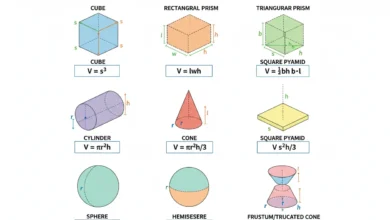
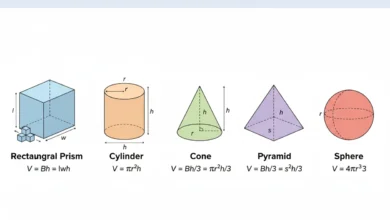
A rectangular Prism Volume problem may use face or space diagonals to recover missing dimensions.
For dimensions:
l, w, h
space diagonal d satisfies:
d² = l² + w² + h²
Once the missing side is found:
V = lwh
The theorem supplies the dimension; the prism formula supplies the volume.
Rectangular Prism Example
Suppose:
d = 13
l = 3
w = 4
Then:
h² = 13² − 3² − 4²
= 169 − 9 − 16
= 144
Therefore:
h = 12
Volume:
V = 3(4)(12)
= 144
Pyramid Geometry
A Pyramid Volume problem frequently uses the theorem when slant height or lateral-edge length is supplied instead of perpendicular height.
For a right square pyramid:
ℓ² = h² + (s/2)²
Therefore:
h = √[ℓ² − (s/2)²]
Then:
V = s²h/3
The Pythagorean theorem serves as an intermediate geometric step.
Pyramid Example
Suppose:
base side s = 10
slant height ℓ = 13
Then:
h = √[169 − 25]
= 12
Pyramid volume:
V = 100(12)/3
Therefore:
V = 400
Cone Geometry
For a right cone, radius r, vertical height h, and slant height ℓ form a right triangle:
ℓ² = r² + h²
Therefore:
ℓ = √(r² + h²)
This relationship is central to Cone Surface Area, while Cone Volume uses:
V = πr²h/3
Cone Example
Suppose:
r = 5
h = 12
Then:
ℓ = √(25 + 144)
= 13
This creates the familiar 5-12-13 relationship in a cone cross section.
Frustum Geometry
For a right conical frustum:
ℓ² = h² + (R − r)²
Therefore:
h = √[ℓ² − (R − r)²]
The resulting perpendicular h can then be used in the Frustum Volume formula.
Frustum Example
Suppose:
R = 8
r = 3
ℓ = 13
Then:
R − r = 5
Therefore:
h = √(169 − 25)
= 12
The Pythagorean theorem converts the slanted measurement into the perpendicular height required for volume.
Surface Area of Revolution
Calculus problems involving Surface Area of Revolution contain an arc-length factor such as:
√[1 + (dy/dx)²]
That structure comes from an infinitesimal Pythagorean relationship:
ds² = dx² + dy²
Dividing by dx² gives:
(ds/dx)² = 1 + (dy/dx)²
This shows how the theorem persists even in calculus.
Right-Triangle Trigonometry
For an acute angle θ in a right triangle:
sinθ = opposite/hypotenuse
cosθ = adjacent/hypotenuse
tanθ = opposite/adjacent
If two sides are known, the Pythagorean theorem can find the third before a trigonometric ratio is used.
The dedicated Right Triangle relationships build extensively on this side structure.
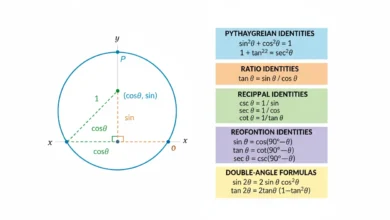
Trigonometric Identity Connection
Divide:
a² + b² = c²
by:
c²
Then:
(a/c)² + (b/c)² = 1
If:
a/c = sinθ
and:
b/c = cosθ
then:
sin²θ + cos²θ = 1
This is the fundamental identity underlying many Trigonometric Identities.
The identity can therefore be viewed as a unit-hypotenuse version of the Pythagorean theorem.
Unit Circle Connection
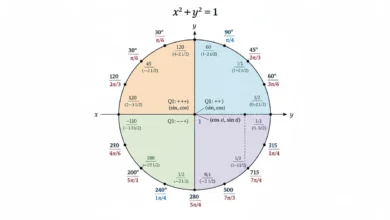
On the Unit Circle:
radius = 1
A point has coordinates:
(cosθ, sinθ)
The circle equation is:
x² + y² = 1
Therefore:
cos²θ + sin²θ = 1
Again, the Pythagorean theorem appears directly.
Law of Cosines as a Generalization
For any triangle:
c² = a² + b² − 2ab cosC
If:
C = 90°
then:
cos90° = 0
So:
c² = a² + b²
Therefore the Pythagorean theorem is the 90° special case of the Law of Cosines.
Find Whether an Angle Is Right
Suppose sides adjacent to an unknown angle are:
a = 8
b = 15
and opposite side:
c = 17
Check:
8² + 15²
= 64 + 225
= 289
and:
17² = 289
Therefore the angle opposite side 17 is:
90°
No inverse trigonometric calculation is necessary.
Triangle Area From Pythagorean Data
The Triangle Area of a right triangle is:
A = ab/2
because the legs are perpendicular.
If a leg must first be found with the Pythagorean theorem, the two methods can be combined.
Triangle Area Example
Suppose:
c = 13
a = 5
Find b:
b = √(169 − 25)
= 12
Then:
A = 5(12)/2
Therefore:
A = 30
square units.
Rectangle Area From a Diagonal
Suppose a rectangle has diagonal:
d = 17
and width:
w = 8
Find length:
l = √(17² − 8²)
= √(289 − 64)
= √225
= 15
Then:
A = lw
= 15(8)
Therefore:
A = 120
square units.
Polygon Diagonals Versus Diagonal Length
The Polygon Diagonals formula:
D = n(n − 3)/2
counts diagonals.
The Pythagorean theorem may instead calculate the length of a particular diagonal when it forms a right triangle.
These are different questions:
how many diagonals?
versus:
how long is a diagonal?
For a rectangle, there are always 2 diagonals, while their length depends on l and w.
Midpoint and Equal Distances
The Midpoint Formula identifies the halfway point between coordinates.
The Pythagorean distance formula can verify that the midpoint is equally distant from both endpoints.
For endpoints:
(0,0)
and:
(6,8)
midpoint:
(3,4)
Distance from either endpoint to the midpoint:
√(3² + 4²)
= 5
The complete endpoint distance is:
10
Perpendicular Bisectors
A point on the perpendicular bisector of segment AB is equidistant from A and B.
This can be proved algebraically by writing equal squared distances:
(x − x_A)² + (y − y_A)²
= (x − x_B)² + (y − y_B)²
The square roots need not even be taken.
The resulting equation simplifies to a straight line.
Isosceles Triangle Altitude
In an isosceles triangle, an altitude from the apex to the base bisects the base.
Suppose equal sides have length:
a
and base length:
b
Half-base:
b/2
The altitude is:
h = √[a² − (b/2)²]
The area then becomes:
A = bh/2
Isosceles Example
Suppose:
a = 5
b = 6
Then:
h = √(25 − 9)
= 4
Area:
A = 6(4)/2
Therefore:
A = 12
This agrees with Heron’s formula for a 5-5-6 triangle.
Equilateral Triangle Height
An equilateral triangle of side s can be split into two 30-60-90 right triangles.
Half-base:
s/2
Hypotenuse:
s
Height:
h = √[s² − (s/2)²]
= √(3s²/4)
Therefore:
h = s√3/2
The area is:
A = sh/2
= s²√3/4
Special Right Triangles
For a 45-45-90 triangle with leg x:
c = √(x² + x²)
= x√2
Therefore its side ratio is:
1 : 1 : √2
For a 30-60-90 triangle, Pythagorean relationships support the familiar ratio:
1 : √3 : 2
These ratios make many right-triangle calculations immediate.
Ladder Example
Suppose a ladder:
13 ft
long rests against a wall.
Its base is:
5 ft
from the wall.
The wall, ground, and ladder form a right triangle.
Height reached:
h = √(13² − 5²)
= √144
Therefore:
h = 12 ft
Diagonal Across a Rectangular Room
Suppose a room floor is:
9 m × 12 m
The straight-line floor diagonal is:
d = √(9² + 12²)
= √225
Therefore:
d = 15 m
This is shorter than traveling along two perpendicular walls:
9 + 12 = 21 m
Guy-Wire Example
Suppose a vertical pole is:
15 m
high.
A guy wire attaches to the top and is anchored:
8 m
from the base.
Wire length:
c = √(15² + 8²)
= √289
Therefore:
c = 17 m
Ramp Example
Suppose a ramp rises:
3 ft
over a horizontal run of:
4 ft
Ramp length:
c = √(3² + 4²)
= 5 ft
The Pythagorean theorem calculates the straight sloped length, while Slope would describe the rise/run ratio:
3/4
Choosing the Correct Operation
If both legs are known and the hypotenuse is missing:
add the squares
c = √(a² + b²)
If the hypotenuse and one leg are known:
subtract the squares
a = √(c² − b²)
This simple distinction prevents a large fraction of setup errors.
Radical Answers
Not every right triangle has integer sides.
Suppose:
a = 4
b = 7
Then:
c = √(16 + 49)
= √65
Since 65 has no square factor greater than 1:
√65
is already simplified.
Approximately:
c ≈ 8.06
Simplifying Radicals
Suppose:
c² = 72
Then:
c = √72
Factor:
72 = 36·2
Therefore:
c = 6√2
An exact simplified radical is often preferable to an early decimal approximation.
Decimal Measurements
Suppose:
a = 2.4
b = 3.2
Then:
c = √(2.4² + 3.2²)
= √(5.76 + 10.24)
= √16
Therefore:
c = 4
The theorem works equally well with decimals, fractions, radicals, and variables.
Algebraic Pythagorean Problems
Suppose the legs are:
x
and:
x + 1
while hypotenuse is:
5
Then:
x² + (x + 1)² = 25
Expand:
x² + x² + 2x + 1 = 25
2x² + 2x − 24 = 0
Divide by 2:
x² + x − 12 = 0
Factor:
(x + 4)(x − 3) = 0
The positive length is:
x = 3
So the sides are:
3,4,5
Common Pythagorean Theorem Mistakes
A common mistake is using the theorem on a triangle that is not known to be right.
The equation:
a² + b² = c²
requires a right triangle unless it is being used as the converse test.
Another error is treating the wrong side as c. The hypotenuse must be opposite the 90° angle and is the longest side.
When finding a leg:
subtract squares
rather than adding them.
Do not write:
a + b = c
The theorem involves squared side lengths.
Remember the final square root when solving for an actual length.
For coordinate problems, square the entire coordinate differences.
If a radical does not simplify to an integer, that is not a problem.
Finally, use linear units for side lengths, even though squared units appear during the intermediate algebra.
Frequently Asked Questions
What is the Pythagorean theorem?
For a right triangle:
a² + b² = c²
where c is the hypotenuse.
How do you find the hypotenuse?
c = √(a² + b²)
How do you find a missing leg?
a = √(c² − b²)
or:
b = √(c² − a²)
Which side is the hypotenuse?
The side opposite the 90° angle.
Is the hypotenuse always the longest side?
Yes.
Does the Pythagorean theorem work for every triangle?
The basic equality applies to right triangles. The Law of Cosines generalizes the relationship to non-right triangles.
What is the converse of the Pythagorean theorem?
If three positive side lengths satisfy:
a² + b² = c²
with c the longest side, the triangle is right.
How can you tell whether a triangle is acute or obtuse?
With longest side c:
c² < a² + b² → acute
c² = a² + b² → right
c² > a² + b² → obtuse
What are common Pythagorean triples?
Examples include:
3-4-5
5-12-13
7-24-25
8-15-17
How is the distance formula related?
The distance formula is the Pythagorean theorem applied to horizontal and vertical coordinate differences.
What is a rectangle diagonal?
d = √(l² + w²)
What is a square diagonal?
d = s√2
How is the theorem related to a circle?
A circle centered at the origin satisfies:
x² + y² = r²
because every point is distance r from the center.
How is it related to vectors?
Vector magnitude uses:
|v| = √(x² + y²)
or in three dimensions:
|v| = √(x² + y² + z²)
How can I check a Pythagorean calculation?
Identify the hypotenuse first, square all three side lengths, verify that the two leg squares sum to the hypotenuse square, and check that the calculated hypotenuse is longer than either leg.