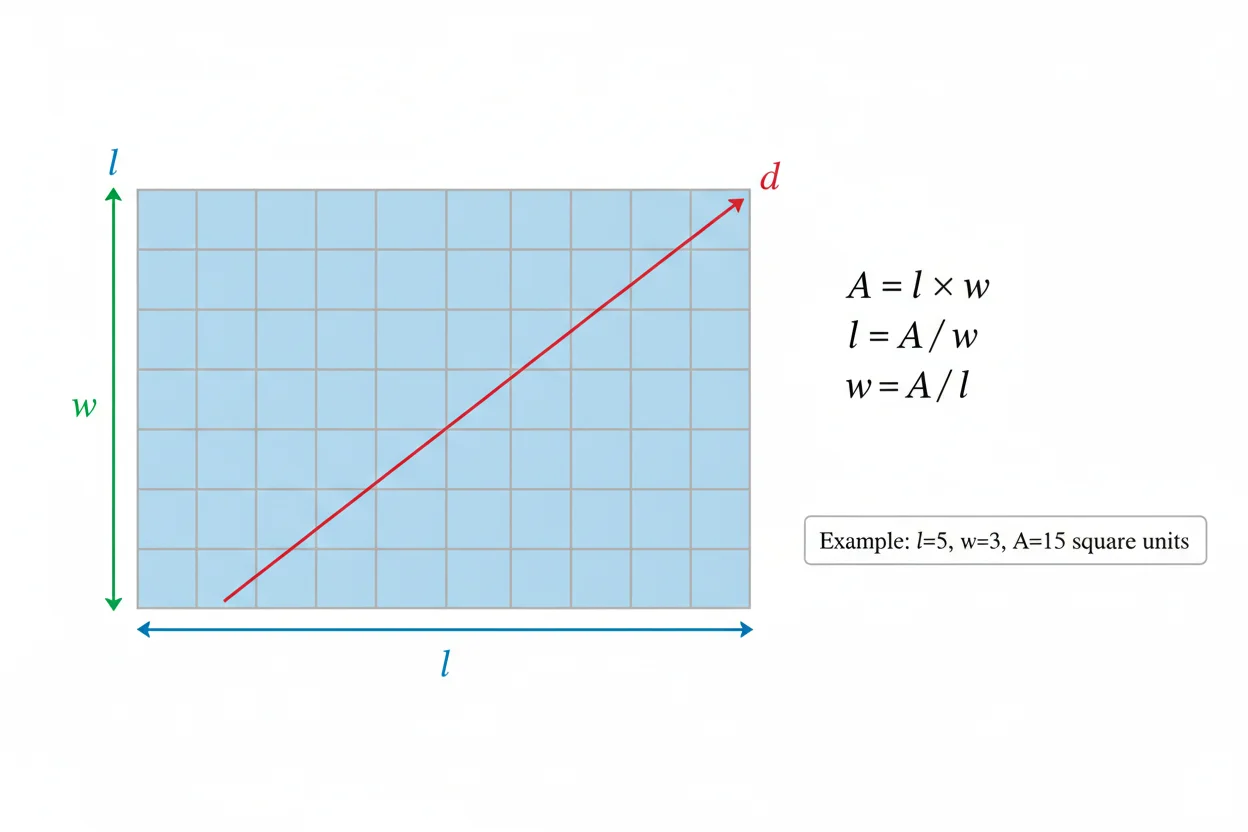

Rectangle area measures the two-dimensional region enclosed by a rectangle. The standard rectangle area formula is A = lw, where l is the length and w is the width. Because a rectangle has four right angles, either pair of perpendicular adjacent sides can serve as its two dimensions. If the area and one dimension are known, the formula can be rearranged to find the other dimension. Rectangle area is measured in square units such as cm², m², ft², or in². Problems may also provide perimeter, a diagonal, coordinates, or a composite figure instead of directly giving both side lengths. In those cases, the missing dimensions must first be determined before applying A = lw.
Rectangle Area Formula
For a rectangle:
A = lw
where:
A = area
l = length
w = width
Because multiplication is commutative:
lw = wl
it does not matter which perpendicular side is called the length and which is called the width.
Basic Rectangle Area Example
Suppose:
l = 12 cm
w = 7 cm
Then:
A = 12(7)
Therefore:
A = 84 cm²
The answer uses square centimeters because area measures a two-dimensional region.
Why the Formula Is A = lw
Imagine covering a rectangle with unit squares.
If there are:
l
unit squares along one direction and:
w
along the other, the total number of unit squares is:
l × w
Therefore:
A = lw
For a:
5 × 3
rectangle, there are:
5 rows or columns × 3
giving:
15
unit squares.
This is the fundamental idea behind the broader Area Formulas used for other shapes.
Find Length From Area
Starting with:
A = lw
divide by w:
l = A/w
Suppose:
A = 96
w = 8
Then:
l = 96/8
Therefore:
l = 12
Find Width From Area
Similarly:
w = A/l
Suppose:
A = 135
l = 15
Then:
w = 135/15
Therefore:
w = 9
Rectangle Perimeter
The Perimeter of a rectangle is:
P = 2(l + w)
Perimeter measures the boundary.
Area measures the enclosed region.
These formulas use the same dimensions but describe different quantities.
Area and Perimeter Example
Suppose:
l = 10
w = 6
Area:
A = 10(6)
= 60
Perimeter:
P = 2(10 + 6)
= 32
The area uses square units.
The perimeter uses linear units.
Find Area From Perimeter and One Side
Suppose:
P = 40
l = 12
Use:
P = 2(l + w)
Then:
40 = 2(12 + w)
Divide by 2:
20 = 12 + w
Therefore:
w = 8
Now:
A = 12(8)
Therefore:
A = 96
square units.
Rectangle Area From Perimeter Alone
Perimeter alone does not determine a unique rectangle area.
For example, rectangles:
1 × 9
and:
4 × 6
both have perimeter:
20
But their areas are:
9
and:
24
respectively.
Another condition is needed to determine a unique area.
Maximum Rectangle Area for Fixed Perimeter
For a fixed perimeter, the rectangle with maximum area is a square.
Suppose:
P = 40
Then:
l + w = 20
The square uses:
l = w = 10
Therefore:
A_max = 100
Compare a:
5 × 15
rectangle with the same perimeter:
A = 75
The equal-sided configuration encloses more area.
Rectangle Diagonal
A rectangle diagonal connects opposite vertices.
Because adjacent sides meet at 90°, the diagonal forms a right triangle.
The Pythagorean Theorem gives:
d² = l² + w²
Therefore:
d = √(l² + w²)
A diagonal can provide a missing dimension before rectangle area is calculated.
Find Width From Diagonal
Starting with:
d² = l² + w²
solve:
w = √(d² − l²)
Suppose:
d = 13
l = 12
Then:
w = √(169 − 144)
= 5
Therefore:
A = 12(5)
= 60
square units.
Find Length From Diagonal
Similarly:
l = √(d² − w²)
Suppose:
d = 10
w = 6
Then:
l = √(100 − 36)
= 8
Area:
A = 8(6)
Therefore:
A = 48
Area From Diagonal and Aspect Ratio
Suppose:
l = kw
for some positive ratio k.
Then:
d² = k²w² + w²
= (k² + 1)w²
So:
w = d/√(k² + 1)
and:
l = kd/√(k² + 1)
Therefore:
A = lw
= kd²/(k² + 1)
This is useful when the diagonal and side ratio are known.
Aspect-Ratio Example
Suppose:
l = 2w
and:
d = 5√5
Then:
A = 2d²/(2² + 1)
= 2(125)/5
Therefore:
A = 50
The actual sides are:
w = 5
l = 10
Rectangle Area From Coordinates
If rectangle vertices are given in coordinate form, calculate its side lengths first.
For axis-aligned rectangle vertices:
(x₁,y₁)
and opposite corner:
(x₂,y₂)
length and width are:
|x₂ − x₁|
and:
|y₂ − y₁|
Therefore:
A = |x₂ − x₁||y₂ − y₁|
Coordinate Example
Suppose opposite rectangle vertices are:
A = (2,3)
C = (10,9)
and the rectangle’s sides are parallel to the coordinate axes.
Then:
l = |10 − 2| = 8
w = |9 − 3| = 6
Therefore:
A = 8(6)
= 48
square units.
Slanted Rectangle From Coordinates
A rectangle does not need to have horizontal and vertical sides.
Suppose adjacent vertices are:
A = (0,0)
B = (3,4)
D = (−8,6)
Calculate:
AB = √(3² + 4²)
= 5
Using the Distance Formula:
AD = √[(−8)² + 6²]
= √100
= 10
Check perpendicularity using slopes or vectors:
AB vector = (3,4)
AD vector = (−8,6)
Their dot product is:
3(−8) + 4(6)
= 0
So the sides are perpendicular.
Therefore:
A = 5(10)
= 50
square units.
Rectangle Area From Vectors
If adjacent rectangle side vectors are:
u
and:
v
with:
u·v = 0
then their lengths are:
|u|
and:
|v|
Therefore:
A = |u||v|
For perpendicular vectors, the parallelogram determinant magnitude gives the same result.
This links rectangle area naturally with Parallelogram Area.
Rectangle as a Parallelogram
A rectangle is a parallelogram whose interior angles are all 90°.
The parallelogram formula:
A = ab sinθ
becomes:
A = ab sin90°
Since:
sin90° = 1
we get:
A = ab
which is exactly:
A = lw
The rectangle formula is therefore a special case of the general parallelogram area relationship.
Rectangle Versus Rhombus Area
A Rhombus Area may be calculated with:
A = bh
or:
A = d₁d₂/2
A rectangle also has:
A = bh
but its diagonals are not generally perpendicular.
Therefore:
d₁d₂/2
is not a general rectangle area formula.
Only a square is both a rectangle and a rhombus.
Rectangle Versus Square
A square is a rectangle with:
l = w = s
Therefore:
A = s²
The square formula is simply:
A = lw
with equal dimensions.
Likewise:
P = 4s
is the rectangle perimeter formula with:
l = w = s
Rectangle and Regular Polygon Area
A rectangle is not generally a regular polygon because regular polygons require all sides and all angles to be equal.
A square is regular.
The Regular Polygon Area formula:
A = aP/2
where a is apothem, gives the correct square area.
For a square of side s:
P = 4s
a = s/2
Therefore:
A = (s/2)(4s)/2
= s²
Composite Rectangle Area
Many composite figures can be divided into rectangles.
Then:
total area = sum of rectangle areas
or:
remaining area = large rectangle area − removed rectangle area
The pieces should not overlap unless the overlap is deliberately corrected.
L-Shaped Area Example
Suppose an outer rectangle measures:
12 × 10
and a corner rectangle:
4 × 3
is removed.
Outer area:
120
Removed area:
12
Therefore:
A = 120 − 12
= 108
square units.
Additive Composite Example
Suppose a figure consists of:
rectangle 1: 8 × 5
and:
rectangle 2: 4 × 3
with no overlap.
Then:
A₁ = 40
A₂ = 12
Therefore:
A_total = 52
square units.
Overlapping Rectangles
If two rectangles overlap:
union area = A₁ + A₂ − A_overlap
The overlap is subtracted because it was counted twice.
Suppose:
A₁ = 40
A₂ = 30
overlap = 8
Then:
union area = 40 + 30 − 8
Therefore:
union area = 62
Rectangle Area and Prism Volume
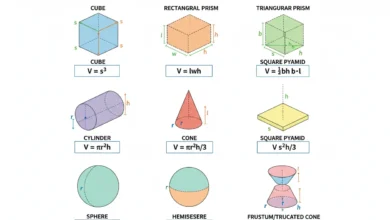
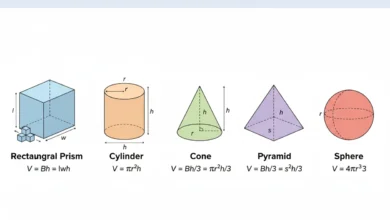
A rectangular base often appears in Prism Volume.
If the base rectangle has:
B = lw
and prism height is:
h
then:
V = Bh
becomes:
V = lwh
Thus rectangle area provides the base area for a rectangular prism.
Prism Example
Suppose a rectangular base has:
l = 8
w = 5
Then:
B = 40
If prism height is:
12
then:
V = 40(12)
Therefore:
V = 480
cubic units.
Rectangle Area and Pyramid Volume
A rectangular base can also support a Pyramid Volume calculation.
For base dimensions:
l
and:
w
we have:
B = lw
Then:
V = lwh/3
where h is the perpendicular pyramid height.
Pyramid Example
Suppose:
l = 10
w = 6
h = 9
Base area:
B = 60
Pyramid volume:
V = 60(9)/3
Therefore:
V = 180
cubic units.
Rectangle area determines the base; the pyramid formula applies the one-third factor.
Rectangle Area From Perimeter and Diagonal
If both perimeter P and diagonal d are known, the area can be found without solving l and w individually.
From:
P = 2(l + w)
we have:
l + w = P/2
Square:
(l + w)² = l² + 2lw + w²
Because:
d² = l² + w²
we obtain:
(P/2)² = d² + 2A
Therefore:
A = [(P/2)² − d²]/2
or:
A = P²/8 − d²/2
Perimeter-Diagonal Example
Suppose:
P = 28
d = 10
Then:
A = 28²/8 − 10²/2
= 784/8 − 50
= 98 − 50
Therefore:
A = 48
The corresponding dimensions are:
6 × 8
Recover Rectangle Dimensions From P and A
If:
P = 2(l + w)
then:
l + w = P/2
And:
lw = A
So l and w are roots of:
t² − (P/2)t + A = 0
This allows the dimensions to be recovered from perimeter and area.
Dimension Example
Suppose:
P = 30
A = 54
Then:
l + w = 15
lw = 54
Solve:
t² − 15t + 54 = 0
Factor:
(t − 6)(t − 9) = 0
Therefore the rectangle dimensions are:
6 and 9
Same Area With Different Dimensions
A fixed area can correspond to many rectangles.
For:
A = 36
possible dimension pairs include:
1 × 36
2 × 18
3 × 12
4 × 9
6 × 6
Their perimeters differ.
This demonstrates that area alone does not determine a unique rectangle.
Minimum Perimeter for Fixed Area
For a fixed rectangle area, the square has the smallest perimeter.
For:
A = 36
the square:
6 × 6
has:
P = 24
Compare:
4 × 9
with:
P = 26
and:
2 × 18
with:
P = 40
As the side lengths become more unequal, the perimeter grows.
Scaling Rectangle Area
If both rectangle dimensions are multiplied by scale factor k:
l → kl
w → kw
Then:
A_new = (kl)(kw)
Therefore:
A_new = k²A_old
Area scales with the square of the linear scale factor.
Scaling Example
Suppose a rectangle has:
A = 30
Every length doubles.
Then:
A_new = 2²(30)
= 120
The perimeter doubles, while the area quadruples.
Change Only One Dimension
If width remains constant and length doubles:
A_new = 2lw
Therefore area doubles.
If length increases by:
25%
while width stays fixed:
l_new = 1.25l
so:
A_new = 1.25A
Area changes linearly with either one dimension when the other remains fixed.
Similar Rectangles
Similar rectangles have the same aspect ratio.
If their corresponding lengths scale by:
k
then:
perimeter ratio = k
and:
area ratio = k²
For scale factor:
3
the larger rectangle has:
9
times the area.
Rectangle Area and Midpoints
The Midpoint Formula can identify the rectangle’s center from opposite vertices.
If:
A = (x₁,y₁)
C = (x₂,y₂)
then center:
M = ((x₁ + x₂)/2, (y₁ + y₂)/2)
The midpoint alone does not determine area, but it helps establish rectangle position and symmetry.
Rectangle Diagonal Intersection
A rectangle is a parallelogram, so its diagonals bisect one another.
Therefore the Line Intersection of the diagonals is their common midpoint.
If opposite vertices are:
(2,4)
and:
(10,12)
the center is:
(6,8)
Both diagonals pass through that point.
Rectangle Diagonal Properties
Rectangle diagonals:
are equal
bisect one another
They are not generally perpendicular.
If a parallelogram has equal diagonals, that provides an important condition associated with rectangles.
A square additionally has perpendicular diagonals because it is also a rhombus.
Find Area From Diagonal and One Angle
Suppose diagonal d makes angle θ with one rectangle side.
Then:
l = d cosθ
w = d sinθ
Therefore:
A = d² sinθ cosθ
Using:
2sinθ cosθ = sin2θ
we can write:
A = d²sin(2θ)/2
This is useful when a diagonal and its direction are known.
Diagonal-Angle Example
Suppose:
d = 10
θ = 30°
Then:
A = 100sin60°/2
= 50(√3/2)
Therefore:
A = 25√3
Approximately:
A ≈ 43.30
Maximum Area for a Fixed Diagonal
From:
A = d²sin(2θ)/2
the maximum occurs when:
sin(2θ) = 1
so:
2θ = 90°
and:
θ = 45°
That means the rectangle is a square.
Therefore the maximum area for fixed diagonal d is:
A_max = d²/2
Fixed-Diagonal Example
Suppose:
d = 10
Then:
A_max = 100/2
= 50
This occurs for a square whose side is:
10/√2 = 5√2
and:
(5√2)² = 50
Unit Conversions
Rectangle area uses square units.
If:
1 m = 100 cm
then:
1 m² = 10,000 cm²
So:
2.5 m² = 25,000 cm²
Area conversion factors are squared.
Mixed Units
Convert dimensions to compatible units before multiplying.
Suppose:
l = 2 m
w = 50 cm
Convert:
2 m = 200 cm
Then:
A = 200(50)
= 10,000 cm²
which is:
1 m²
Multiplying 2 directly by 50 without reconciling units would be incorrect.
Exact Versus Approximate Area
If a rectangle dimension contains a radical:
l = 3√2
w = 5
then:
A = 15√2
This is exact.
Approximately:
A ≈ 21.21
Keep exact expressions when possible until a decimal is specifically useful.
Common Rectangle Area Mistakes
A common mistake is adding length and width instead of multiplying them.
Area is:
A = lw
while:
2(l + w)
is perimeter.
Another error is reporting linear units rather than square units.
When using a diagonal, do not multiply the diagonal by a side as though it were the perpendicular height.
Use the Pythagorean theorem first to recover the missing side.
For coordinate rectangles, verify that the chosen segments are adjacent perpendicular sides.
In composite figures, subtract missing sections and avoid double-counting overlaps.
When units differ, convert them before multiplication.
Finally, remember that perimeter or diagonal alone does not generally determine rectangle area without additional information.
Frequently Asked Questions
What is the rectangle area formula?
A = lw
How do you find rectangle length from area?
l = A/w
How do you find width from area?
w = A/l
What units does rectangle area use?
Square units such as cm², m², ft², or in².
What is the rectangle perimeter formula?
P = 2(l + w)
Is perimeter the same as area?
No. Perimeter measures boundary length; area measures the enclosed region.
What is the rectangle diagonal formula?
d = √(l² + w²)
How do you find a missing side from the diagonal?
For example:
w = √(d² − l²)
Can rectangle area be found from coordinates?
Yes. Determine two perpendicular adjacent side lengths and multiply them.
How do you find area of an axis-aligned rectangle from opposite corners?
A = |x₂ − x₁||y₂ − y₁|
Does perimeter alone determine rectangle area?
No.
Which rectangle has the maximum area for a fixed perimeter?
A square.
Which rectangle has the minimum perimeter for a fixed area?
A square.
How does rectangle area scale?
If every length is multiplied by k:
area is multiplied by k²
How is rectangle area used in prism volume?
A rectangular base has:
B = lw
so:
V = lwh
How is rectangle area used in pyramid volume?
For a rectangular base:
V = lwh/3
How can I check a rectangle area calculation?
Verify the two dimensions are perpendicular adjacent sides, multiply rather than add them, confirm square units, and compare with perimeter or diagonal information when available.