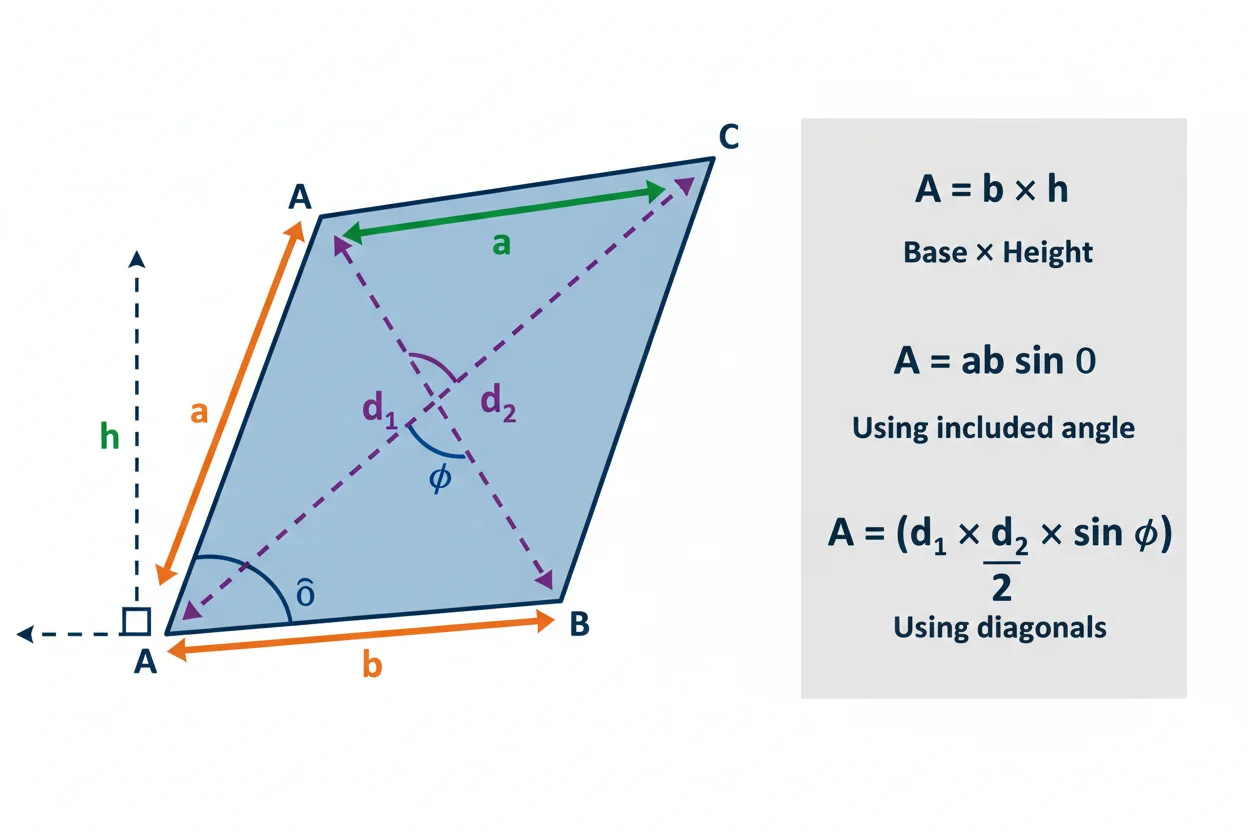

Parallelogram area measures the two-dimensional region enclosed by a parallelogram. The standard formula is A = bh, where b is a chosen base and h is the perpendicular height to the opposite parallel side. The slanted side is not automatically the height; height must meet the base at a right angle. If two adjacent sides a and b and their included angle θ are known, the area can instead be found with A = ab sinθ. When the two diagonals and the angle between them are known, A = d₁d₂ sinφ/2 can also be used. In coordinate geometry, parallelogram area can be obtained from a determinant or from its vertices, so a separate height calculation is often unnecessary. These equivalent methods make parallelogram area useful in elementary geometry, trigonometry, vectors, coordinate proofs, and composite figures.
What Is a Parallelogram?
A parallelogram is a quadrilateral with both pairs of opposite sides parallel.
If its vertices are:
A, B, C, D
then:
AB ∥ CD
and:
BC ∥ AD
Opposite sides are also equal:
AB = CD
BC = AD
Opposite angles are equal, and adjacent interior angles are supplementary.
Its diagonals bisect each other.
These structural properties distinguish a parallelogram from more general quadrilaterals.
Parallelogram Area Formula
The standard formula is:
A = bh
where:
A = area
b = base
h = perpendicular height
The base can be either pair of opposite sides.
Whichever side is chosen as the base, the height must be measured perpendicular to that base.
Basic Parallelogram Area Example
Suppose:
b = 12 cm
h = 7 cm
Then:
A = bh
= 12(7)
Therefore:
A = 84 cm²
The result uses square centimeters because area is two-dimensional.
Why the Formula Is A = bh
Imagine cutting a triangular piece from one end of a slanted parallelogram and moving it to the other end.
The rearranged figure becomes a rectangle.
Its base remains:
b
and its height remains:
h
Since rearranging the pieces does not change their total area:
parallelogram area = rectangle area
Therefore:
A = bh
This explains why the slant of the sides does not directly appear in the basic formula.
Base Versus Slanted Side
Suppose a parallelogram has:
base = 10
slanted side = 6
perpendicular height = 4
Its area is:
A = 10(4)
= 40
not:
10(6) = 60
The side of length 6 is not the height unless it happens to be perpendicular to the base.
This is one of the most common parallelogram area mistakes.
Find Height From Area
Starting with:
A = bh
divide by b:
h = A/b
Suppose:
A = 96
b = 12
Then:
h = 96/12
Therefore:
h = 8
Find Base From Area
From:
A = bh
solve:
b = A/h
Suppose:
A = 135
h = 9
Then:
b = 135/9
Therefore:
b = 15
Parallelogram Area From Two Sides and an Angle
If adjacent side lengths are:
a
and:
b
and their included angle is:
θ
then:
A = ab sinθ
This follows because the perpendicular height relative to base b is:
h = a sinθ
Substituting into:
A = bh
gives:
A = b(a sinθ)
Therefore:
A = ab sinθ
Side-Angle Example
Suppose:
a = 8
b = 13
θ = 30°
Then:
A = 8(13)sin30°
Since:
sin30° = 1/2
we get:
A = 104(1/2)
Therefore:
A = 52
square units.
Another Side-Angle Example
Suppose:
a = 7
b = 10
θ = 60°
Then:
A = 70sin60°
= 70(√3/2)
Therefore:
A = 35√3
Approximately:
A ≈ 60.62
square units.
The trigonometric form is especially useful when no perpendicular height is supplied directly.
Find the Included Angle From Area
Starting with:
A = ab sinθ
we get:
sinθ = A/(ab)
Therefore:
θ = sin⁻¹[A/(ab)]
A parallelogram normally has two supplementary adjacent angles:
θ
and:
180° − θ
Because:
sinθ = sin(180° − θ)
both give the same area.
Angle Example
Suppose:
A = 48
a = 8
b = 8
Then:
sinθ = 48/64
= 3/4
The principal angle is:
θ = sin⁻¹(3/4)
Approximately:
θ ≈ 48.59°
The supplementary angle:
131.41°
produces the same parallelogram area.
This is consistent with the principal-value behavior of Inverse Trigonometric Functions.
Why Supplementary Angles Give the Same Area
Adjacent angles of a parallelogram satisfy:
θ + φ = 180°
And:
sin(180° − θ) = sinθ
Therefore:
ab sinφ = ab sinθ
The area is unchanged whether the acute or obtuse included angle is used.
The geometry has the same perpendicular height.
Parallelogram Perimeter
If adjacent side lengths are:
a
and:
b
the Perimeter is:
P = 2a + 2b
or:
P = 2(a + b)
Perimeter measures boundary length, while parallelogram area measures the enclosed region.
Knowing perimeter alone generally does not determine area because the included angle or height can vary.
Same Perimeter, Different Area
Consider parallelograms with:
a = 6
b = 10
Their perimeter is always:
P = 2(6 + 10)
= 32
But if:
θ = 90°
then:
A = 60
If:
θ = 30°
then:
A = 30
So identical side lengths and perimeter can produce different areas when the included angle changes.
Maximum Area for Fixed Side Lengths
For fixed a and b:
A = ab sinθ
The maximum possible value of sine is:
1
Therefore the largest possible area occurs when:
θ = 90°
and:
A_max = ab
At that point the parallelogram is a rectangle.
Any slant away from 90° reduces the perpendicular height and area.
Parallelogram Area From Diagonals
If diagonal lengths are:
d₁
and:
d₂
and the angle between them is:
φ
then:
A = d₁d₂ sinφ/2
This formula works for general parallelograms.
When the diagonals are perpendicular:
sin90° = 1
so:
A = d₁d₂/2
That special case appears in rhombi.
Diagonal Example
Suppose:
d₁ = 12
d₂ = 9
φ = 60°
Then:
A = 12(9)sin60°/2
= 54(√3/2)
Therefore:
A = 27√3
Approximately:
A ≈ 46.77
Rhombus as a Special Parallelogram
A rhombus is a parallelogram with all four sides equal.
Its diagonals are perpendicular.
Therefore Rhombus Area can be calculated with:
A = d₁d₂/2
This is simply the parallelogram diagonal formula when:
φ = 90°
because:
sin90° = 1
Rectangle as a Special Parallelogram
A rectangle is a parallelogram with four right angles.
If adjacent sides are:
l
and:
w
then the perpendicular height relative to base l is simply w.
Therefore:
A = lw
This is exactly the ordinary parallelogram formula:
A = bh
for a 90° configuration.
Square as a Special Parallelogram
A square has:
a = b = s
and:
θ = 90°
Therefore:
A = s·s·sin90°
so:
A = s²
The familiar square formula is therefore another special case.
Coordinate Parallelogram Area
Suppose a parallelogram has one vertex:
A = (x₀, y₀)
and adjacent vertices:
B = (x₁, y₁)
D = (x₂, y₂)
Form the side vectors:
u = (x₁ − x₀, y₁ − y₀)
v = (x₂ − x₀, y₂ − y₀)
Then area is:
A = |uₓvᵧ − uᵧvₓ|
This determinant gives the magnitude of the two-dimensional cross-product analogue.
Coordinate Example
Let:
A = (1, 1)
B = (6, 2)
D = (3, 5)
Then:
u = (5, 1)
v = (2, 4)
Area:
A = |5(4) − 1(2)|
= |20 − 2|
Therefore:
A = 18
square units.
Find the Fourth Vertex
For parallelogram ABCD with A adjacent to B and D:
C = B + D − A
Using the previous points:
A = (1,1)
B = (6,2)
D = (3,5)
we obtain:
C = (6 + 3 − 1, 2 + 5 − 1)
Therefore:
C = (8,6)
The four vertices are:
(1,1), (6,2), (8,6), (3,5)
Verify Opposite Sides
Vector AB is:
(5,1)
Vector DC is:
(8 − 3, 6 − 5)
= (5,1)
Therefore:
AB ∥ DC
Similarly:
AD = (2,4)
and:
BC = (2,4)
So both opposite side pairs are parallel and equal.
This confirms the coordinate structure.
Parallelogram Diagonals Bisect Each Other
A fundamental property is that the diagonals have the same midpoint.
Using the previous vertices:
A = (1,1)
C = (8,6)
The Midpoint Formula gives:
midpoint AC = (9/2, 7/2)
For:
B = (6,2)
D = (3,5)
we get:
midpoint BD = (9/2, 7/2)
The matching midpoints confirm that the diagonals bisect each other.
Diagonal Intersection
Because the diagonals bisect each other, their Line Intersection is their shared midpoint.
In a known parallelogram, it is usually faster to average opposite vertices than to solve two diagonal equations.
For opposite vertices:
A = (2,3)
C = (10,9)
the diagonal intersection is:
((2 + 10)/2, (3 + 9)/2)
Therefore:
(6,6)
Coordinate Area From Four Vertices
If all four parallelogram vertices are known, area can also be calculated using a polygon determinant.
For ordered vertices:
(x₁,y₁), (x₂,y₂), (x₃,y₃), (x₄,y₄)
the shoelace relationship is:
A = 1/2 |Σxᵢyᵢ₊₁ − Σyᵢxᵢ₊₁|
For a parallelogram, the vector determinant method is usually shorter when adjacent side vectors are obvious.
Both give the same result.
Area From a Base Line and Opposite Point
Suppose a base lies on a known line.
The height is the perpendicular distance from any point on the opposite parallel side to the base line.
If the base line is:
Ax + By + C = 0
and an opposite vertex is:
(x₀,y₀)
then:
h = |Ax₀ + By₀ + C|/√(A² + B²)
Once base length b is known:
A = bh
This is useful when a parallelogram is defined by coordinate lines rather than a drawn altitude.
Finding the Base Line From Two Points
If two base endpoints are given, their supporting Line From Two Points can be calculated.
For:
P₁ = (x₁,y₁)
P₂ = (x₂,y₂)
the slope is:
m = (y₂ − y₁)/(x₂ − x₁)
when:
x₂ ≠ x₁
Then the line can be written in Point-Slope Form:
y − y₁ = m(x − x₁)
Converting it to standard form allows a perpendicular distance to the opposite side to be calculated.
Coordinate Base-Height Example
Suppose a parallelogram has base endpoints:
A = (0,0)
B = (6,0)
and an opposite vertex:
D = (2,4)
The base length is:
b = 6
The base lies on:
y = 0
The perpendicular height from D is:
h = 4
Therefore:
A = 6(4)
= 24
This matches the determinant calculation:
|6·4 − 0·2| = 24
Slanted Base Example
Suppose:
A = (0,0)
B = (4,3)
D = (−3,4)
Then:
AB = (4,3)
AD = (−3,4)
Area:
A = |4(4) − 3(−3)|
= |16 + 9|
Therefore:
A = 25
Notice that both side lengths are:
5
and their dot product is:
4(−3) + 3(4) = 0
so the sides are perpendicular and the parallelogram is actually a square.
Area From Side Length and Height Found by Trigonometry
Suppose:
a = 10
b = 14
θ = 40°
The height relative to base b is:
h = a sinθ
= 10sin40°
Therefore:
A = 14(10sin40°)
= 140sin40°
Approximately:
A ≈ 89.99
This equals the direct formula:
A = ab sinθ
Area From the Law of Cosines Data
Sometimes two sides and a diagonal are given instead of the included angle.
Suppose adjacent sides are:
a, b
and diagonal c lies opposite included angle θ.
The Law of Cosines gives:
cosθ = (a² + b² − c²)/(2ab)
After finding θ:
A = ab sinθ
This turns three-length information into an area.
Example From Two Sides and a Diagonal
Suppose:
a = 5
b = 7
c = 8
Then:
cosθ = (25 + 49 − 64)/(70)
= 1/7
Therefore:
sin²θ = 1 − 1/49
= 48/49
For a valid included angle:
sinθ = 4√3/7
Thus:
A = 5(7)(4√3/7)
Therefore:
A = 20√3
Approximately:
A ≈ 34.64
Heron Formula Alternative
A diagonal divides a parallelogram into two congruent triangles.
If the three side lengths of one triangle are known, Heron Formula can calculate its area.
Then:
A_parallelogram = 2A_triangle
For side lengths:
5, 7, 8
Heron’s formula gives one triangle area:
10√3
Therefore the parallelogram area is:
20√3
matching the previous calculation.
Why the Diagonal Creates Equal Areas
Every diagonal of a parallelogram divides it into two congruent triangles.
The triangles share the diagonal and have corresponding opposite sides equal.
Therefore they have equal area.
So:
area of each triangle = A_parallelogram/2
This is often useful in geometric proofs and subdivision problems.
Area Ratio With the Same Base
Two parallelograms with the same base b have areas:
A₁ = bh₁
A₂ = bh₂
Therefore:
A₁/A₂ = h₁/h₂
If their heights are also equal, their areas are equal regardless of horizontal slant.
This is an important property of parallelograms between the same parallel lines.
Area Ratio With the Same Height
If two parallelograms share height h:
A₁/A₂ = b₁/b₂
For example:
b₁ = 6
b₂ = 9
with equal height gives:
A₁/A₂ = 2/3
Area varies linearly with base when height is fixed.
Scaling a Parallelogram
If every length is multiplied by scale factor k:
b → kb
h → kh
Then:
A_new = (kb)(kh)
Therefore:
A_new = k²A_old
Area scales with the square of the linear scale factor.
Scaling Example
Suppose a parallelogram has:
A = 45
Every length doubles.
Then:
A_new = 2²(45)
= 180
Its Perimeter doubles, but its area quadruples.
Changing Only the Base
If height stays fixed and base is multiplied by k:
A_new = kA_old
For example, increasing base from:
8
to:
12
is a factor of:
12/8 = 1.5
Therefore area also increases by:
50%
when height remains unchanged.
Changing Only the Height
If base remains fixed:
A ∝ h
Doubling the perpendicular height doubles area.
Tripling the height triples area.
The linear relationship follows directly from:
A = bh
Composite Figures
A complicated polygon can sometimes be decomposed into a parallelogram plus other familiar regions.
Then:
total area = sum of component areas
or, when a region is removed:
remaining area = larger area − removed area
The general Area principle is to partition the figure into nonoverlapping pieces whose formulas are known.
Parallelogram With a Triangle Removed
Suppose a parallelogram has:
b = 12
h = 8
Its area is:
96
A triangular section with:
base = 4
height = 3
has:
A_triangle = 4(3)/2
= 6
The remaining region has area:
96 − 6
Therefore:
90
square units.
Units of Parallelogram Area
If base and height are measured in meters:
m × m = m²
Therefore area is measured in:
m²
Similarly:
centimeters → cm²
feet → ft²
inches → in²
The unit must be squared.
Converting Area Units
Since:
1 m = 100 cm
then:
1 m² = 10,000 cm²
So:
3.5 m² = 35,000 cm²
Area conversion uses the square of the linear conversion factor.
Exact Versus Approximate Area
Suppose:
A = 35√3
This is an exact result.
Approximately:
A ≈ 60.62
If exact values involving radicals or trigonometric constants are acceptable, retain them until the final step.
Premature rounding can reduce accuracy in later calculations.
Common Parallelogram Area Mistakes
A common mistake is multiplying two adjacent side lengths without accounting for their included angle.
The formula:
A = ab
works only when the sides are perpendicular.
In general:
A = ab sinθ
Another error is using the slanted side as height when it is not perpendicular to the base.
Do not confuse area with perimeter.
When using coordinates, select two adjacent side vectors from the same vertex.
For diagonal calculations, include:
sinφ
unless the diagonals are known to be perpendicular.
When solving for an angle with inverse sine, remember that supplementary angles produce the same area.
Finally, report square units.
Frequently Asked Questions
What is the parallelogram area formula?
A = bh
What does h mean?
h is the perpendicular distance between the chosen base and its opposite parallel side.
Is the slanted side the height?
Not unless it is perpendicular to the base.
How do you find height from area?
h = A/b
How do you find base from area?
b = A/h
What is the formula using two sides and an angle?
A = ab sinθ
How do you find area using diagonals?
A = d₁d₂ sinφ/2
where φ is the angle between the diagonals.
What happens if the diagonals are perpendicular?
Then:
A = d₁d₂/2
How is a rectangle related to a parallelogram?
A rectangle is a parallelogram with 90° angles, so:
A = bh
becomes the familiar:
A = lw
How is a rhombus related?
A rhombus is a parallelogram with four equal sides and perpendicular diagonals.
How do you find parallelogram area from coordinates?
For adjacent vectors:
u = (uₓ,uᵧ)
v = (vₓ,vᵧ)
use:
A = |uₓvᵧ − uᵧvₓ|
Where do parallelogram diagonals intersect?
At their common midpoint.
Does perimeter determine parallelogram area?
No. The included angle or perpendicular height can vary while side lengths and perimeter remain fixed.
How does area scale?
If every length is multiplied by k:
area is multiplied by k²
How can I check a parallelogram area answer?
Verify that the height is perpendicular to the base, compare with A = ab sinθ when side-angle information is available, and confirm the final units are squared.