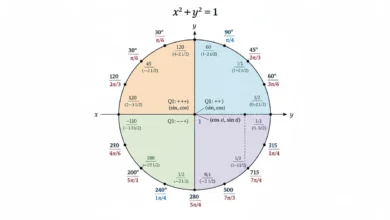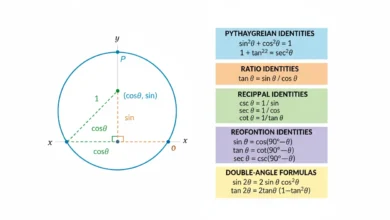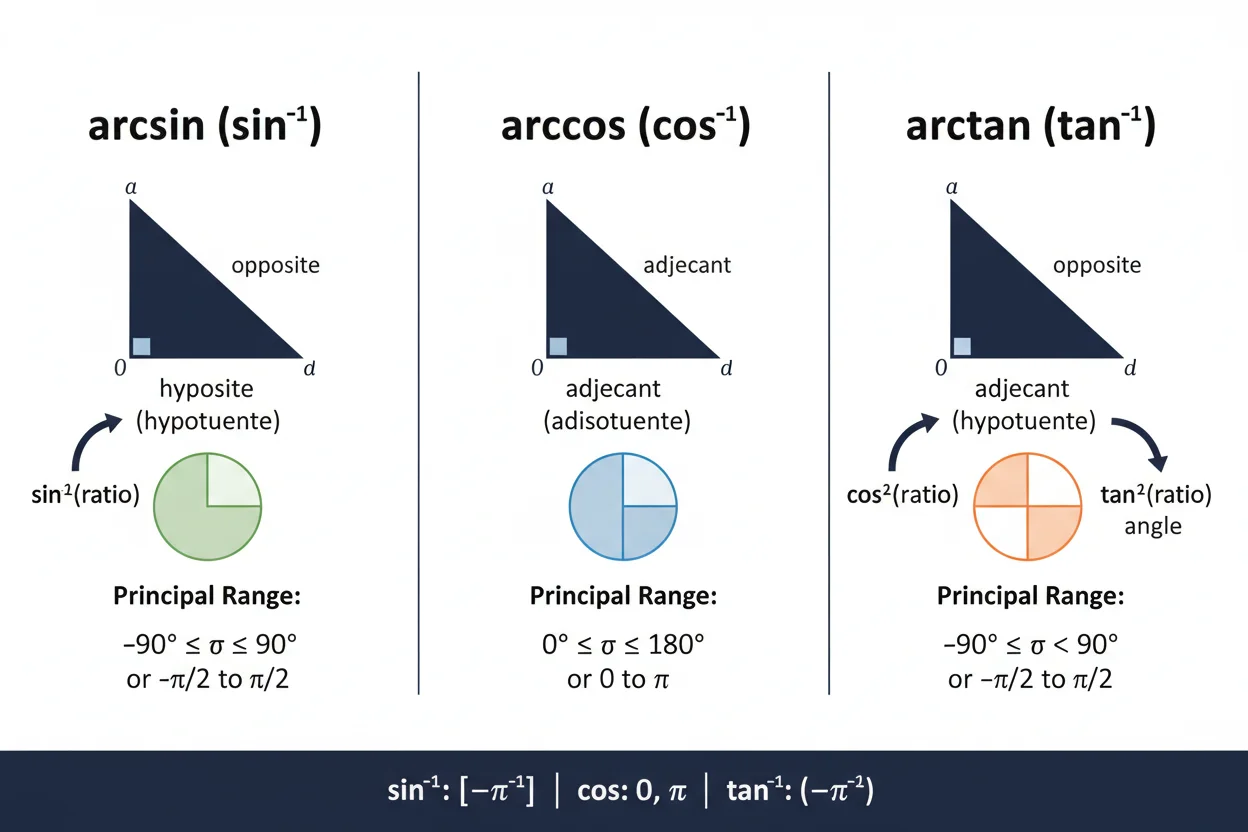

Inverse trigonometric functions recover an angle from a known trigonometric value. The three most commonly used are inverse sine, inverse cosine, and inverse tangent: θ = sin⁻¹(x), θ = cos⁻¹(x), and θ = tan⁻¹(x). They are also written arcsin(x), arccos(x), and arctan(x). Because sine, cosine, and tangent repeat, each inverse function uses a restricted principal range so that every permitted input produces one principal angle. For real numbers, arcsin and arccos accept inputs from −1 to 1, while arctan accepts every real input. In right-triangle problems, inverse trigonometric functions convert side ratios into unknown angles; in non-right triangles they appear in the Law of Cosines and Law of Sines; and in coordinate or vector problems they recover direction from numerical components. Correct interpretation requires attention to principal ranges, quadrants, radians versus degrees, and the distinction between an inverse function and a reciprocal trigonometric function.
What Are Inverse Trigonometric Functions?
Ordinary trigonometric functions take an angle and return a ratio.
For example:
sin30° = 1/2
An inverse trigonometric function reverses that operation:
sin⁻¹(1/2) = 30°
when 30° lies in the principal range of inverse sine.
Similarly:
cos60° = 1/2
so:
cos⁻¹(1/2) = 60°
And:
tan45° = 1
so:
tan⁻¹(1) = 45°
These functions are central to solving unknown-angle problems throughout Geometry & Trigonometry.
Inverse Sine
Inverse sine is written:
sin⁻¹x
or:
arcsin x
If:
sin θ = x
then:
θ = sin⁻¹x
gives the principal inverse-sine angle.
For real inputs:
−1 ≤ x ≤ 1
The principal output range is:
−90° ≤ θ ≤ 90°
or:
−π/2 ≤ θ ≤ π/2
Inverse Cosine
Inverse cosine is:
cos⁻¹x
or:
arccos x
If:
cos θ = x
then:
θ = cos⁻¹x
returns the principal inverse-cosine angle.
Its real input domain is:
−1 ≤ x ≤ 1
Its principal output range is:
0° ≤ θ ≤ 180°
or:
0 ≤ θ ≤ π
Inverse Tangent
Inverse tangent is:
tan⁻¹x
or:
arctan x
If:
tan θ = x
then:
θ = tan⁻¹x
gives the principal inverse-tangent angle.
Its real domain is:
all real x
Its principal range is:
−90° < θ < 90°
or:
−π/2 < θ < π/2
The endpoints are excluded because tangent is undefined at ±90°.
Inverse Does Not Mean Reciprocal
This distinction is essential.
sin⁻¹x
means inverse sine, or arcsine.
It does not mean:
1/sin x
The reciprocal of sine is Cosecant:
csc x = 1/sin x
Similarly:
cos⁻¹x = arccos x
while:
sec x = 1/cos x
And:
tan⁻¹x = arctan x
while:
cot x = 1/tan x
Basic Inverse Sine Example
Suppose:
sin θ = 3/5
For an acute right-triangle angle:
θ = sin⁻¹(3/5)
Using a calculator:
θ ≈ 36.87°
The result can be checked:
sin36.87° ≈ 0.6
and:
3/5 = 0.6
Basic Inverse Cosine Example
Suppose:
cos θ = 4/5
Then:
θ = cos⁻¹(4/5)
Therefore:
θ ≈ 36.87°
Check:
cos36.87° ≈ 0.8
which matches:
4/5
Basic Inverse Tangent Example
Suppose:
tan θ = 3/4
Then:
θ = tan⁻¹(3/4)
Therefore:
θ ≈ 36.87°
This is the same acute angle from the 3-4-5 right triangle.
Right-Triangle Angle From Sine
For an acute angle θ in a right triangle:
sin θ = opposite/hypotenuse
Therefore:
θ = sin⁻¹(opposite/hypotenuse)
Suppose:
opposite = 8
hypotenuse = 17
Then:
θ = sin⁻¹(8/17)
Approximately:
θ ≈ 28.07°
The Sine ratio provides the value; inverse sine recovers the angle.
Right-Triangle Angle From Cosine
Using Cosine:
cos θ = adjacent/hypotenuse
Therefore:
θ = cos⁻¹(adjacent/hypotenuse)
Suppose:
adjacent = 12
hypotenuse = 13
Then:
θ = cos⁻¹(12/13)
Approximately:
θ ≈ 22.62°
Right-Triangle Angle From Tangent
Using Tangent:
tan θ = opposite/adjacent
Therefore:
θ = tan⁻¹(opposite/adjacent)
Suppose:
opposite = 5
adjacent = 12
Then:
θ = tan⁻¹(5/12)
Approximately:
θ ≈ 22.62°
This agrees with the previous 5-12-13 triangle calculation.
Which Inverse Function Should You Use?
Choose the function that uses the two known sides relative to the required angle.
If you know:
opposite and hypotenuse → sin⁻¹
If you know:
adjacent and hypotenuse → cos⁻¹
If you know:
opposite and adjacent → tan⁻¹
This follows directly from the Right Triangle side ratios.
Using the pair of sides already known usually gives the shortest calculation.
Finding the Second Acute Angle
The acute angles of a right triangle satisfy:
A + B = 90°
If:
A = 36.87°
then:
B = 90° − 36.87°
Therefore:
B = 53.13°
This follows from the Interior Angles of a triangle:
A + B + 90° = 180°
Inverse trigonometry is usually needed for only one acute angle.
Why Principal Ranges Are Needed
Sine, cosine, and tangent are periodic.
For example:
sin30° = 1/2
but also:
sin150° = 1/2
and:
sin390° = 1/2
If inverse sine returned all of these at once, it would not behave as a single-valued function.
Therefore sine is restricted to a range where it is one-to-one before its inverse is defined.
The same idea applies to cosine and tangent.
Principal Range of Arcsine
For:
y = sin⁻¹x
the principal angle satisfies:
−π/2 ≤ y ≤ π/2
This corresponds to:
−90° ≤ y ≤ 90°
Within this interval, sine takes every value from −1 to 1 exactly once.
Thus:
sin⁻¹(1/2) = 30°
not:
150°
even though sin150° also equals 1/2.
Principal Range of Arccosine
For:
y = cos⁻¹x
the principal range is:
0 ≤ y ≤ π
or:
0° ≤ y ≤ 180°
Therefore:
cos⁻¹(−1/2) = 120°
because 120° lies in the principal range.
Other coterminal or symmetric angles can have the same cosine, but arccos returns the principal one.
Principal Range of Arctangent
For:
y = tan⁻¹x
the principal range is:
−π/2 < y < π/2
Therefore:
tan⁻¹(1) = π/4
and:
tan⁻¹(−1) = −π/4
The angles ±π/2 are excluded because tangent is undefined there.
Domain of Inverse Sine
Because real sine values satisfy:
−1 ≤ sin θ ≤ 1
inverse sine only accepts real inputs in:
[−1, 1]
Therefore:
sin⁻¹(1.2)
has no real value.
Likewise:
sin⁻¹(−1.5)
has no real value.
Domain of Inverse Cosine
Cosine also satisfies:
−1 ≤ cos θ ≤ 1
Therefore arccos has real domain:
[−1, 1]
For example:
cos⁻¹(−0.4)
is real.
But:
cos⁻¹(2)
is not a real angle.
Domain of Inverse Tangent
Tangent can take every real value.
Therefore:
tan⁻¹x
accepts:
any real x
For very large positive x:
tan⁻¹x
approaches:
π/2
without reaching it.
For very large negative x, it approaches:
−π/2
Exact Inverse Trigonometric Values
Common exact values include:
sin⁻¹(0) = 0
sin⁻¹(1/2) = π/6
sin⁻¹(√2/2) = π/4
sin⁻¹(√3/2) = π/3
sin⁻¹(1) = π/2
For cosine:
cos⁻¹(1) = 0
cos⁻¹(√3/2) = π/6
cos⁻¹(√2/2) = π/4
cos⁻¹(1/2) = π/3
cos⁻¹(0) = π/2
And:
tan⁻¹(1) = π/4
Degrees Versus Radians
Inverse trigonometric functions return angles in whichever unit the calculator is configured to use.
For example:
sin⁻¹(1/2)
returns:
30°
in degree mode
and:
π/6 ≈ 0.523599
in radian mode.
These represent the same angle.
The conversion rules in Degrees and Radians are:
radians = degrees × π/180
degrees = radians × 180/π
Calculator Mode Example
Suppose a problem asks for an angle in degrees and:
tan θ = 0.75
Calculate:
θ = tan⁻¹(0.75)
In degree mode:
θ ≈ 36.87°
In radian mode, the calculator instead returns approximately:
0.64350
which is:
36.87°
expressed in radians.
The calculation is not inconsistent; only the units differ.
Inverse Sine and Quadrants
Suppose:
sin θ = 1/2
The principal inverse-sine result is:
θ = 30°
But over:
0° ≤ θ < 360°
sine is positive in Quadrants I and II.
Therefore the complete solutions are:
θ = 30°
and:
θ = 150°
Inverse sine gives the reference/principal solution; additional quadrant reasoning supplies the second solution.
Solving sin θ = −1/2
Principal inverse sine gives:
sin⁻¹(−1/2) = −30°
For solutions on:
0° ≤ θ < 360°
sine is negative in Quadrants III and IV.
The reference angle is:
30°
Therefore:
θ = 210°
and:
θ = 330°
The principal output alone is not the complete periodic solution set.
Inverse Cosine and Quadrants
Suppose:
cos θ = −1/2
The principal inverse-cosine value is:
cos⁻¹(−1/2) = 120°
Over one full revolution, cosine is negative in Quadrants II and III.
Therefore:
θ = 120°
and:
θ = 240°
satisfy the equation.
Inverse Tangent and Quadrants
Suppose:
tan θ = 1
Principal inverse tangent gives:
45°
Tangent is positive in Quadrants I and III.
Therefore on:
0° ≤ θ < 360°
the solutions are:
45°
and:
225°
Because tangent has period:
180°
the general solution is:
θ = 45° + 180°n
Solving a General Sine Equation
Suppose:
sin x = 0.7
Principal angle:
α = sin⁻¹(0.7)
Approximately:
α ≈ 44.43°
On:
0° ≤ x < 360°
the second solution is:
180° − α
Therefore:
x ≈ 44.43°
or:
x ≈ 135.57°
Solving a General Cosine Equation
Suppose:
cos x = 0.3
Principal angle:
α = cos⁻¹(0.3)
Approximately:
α ≈ 72.54°
Cosine is positive in Quadrants I and IV.
Therefore on:
0° ≤ x < 360°
the solutions are:
x ≈ 72.54°
and:
x ≈ 360° − 72.54°
≈ 287.46°
Solving a General Tangent Equation
Suppose:
tan x = −2
Principal result:
α = tan⁻¹(−2)
Approximately:
α ≈ −63.43°
Because tangent has period:
180°
the general solution is:
x = −63.43° + 180°n
For:
0° ≤ x < 360°
this produces:
x ≈ 116.57°
and:
x ≈ 296.57°
Inverse Cosecant
Because:
csc θ = 1/sin θ
an equation:
csc θ = k
can be rewritten:
sin θ = 1/k
Then:
θ = sin⁻¹(1/k)
with quadrant adjustments as needed.
For example:
csc θ = 2
implies:
sin θ = 1/2
so the principal angle is:
30°
The separate Cosecant relationship handles the reciprocal ratio.
Inverse Secant
Secant satisfies:
sec θ = 1/cos θ
Therefore:
sec θ = k
can be rewritten:
cos θ = 1/k
Then:
θ = cos⁻¹(1/k)
with appropriate quadrant interpretation.
For:
sec θ = 2
we obtain:
cos θ = 1/2
so the principal angle is:
60°
Inverse Cotangent
Cotangent satisfies:
cot θ = 1/tan θ
Thus:
cot θ = k
can be rewritten:
tan θ = 1/k
Then use:
θ = tan⁻¹(1/k)
for the principal value, followed by the appropriate periodic or quadrant analysis.
For:
cot θ = 1
the principal acute angle is:
45°
Inverse Trigonometry and the Law of Cosines
The Law of Cosines finds an angle when all three side lengths of a triangle are known.
For angle C:
c² = a² + b² − 2ab cosC
Rearrange:
cosC = (a² + b² − c²)/(2ab)
Therefore:
C = cos⁻¹[(a² + b² − c²)/(2ab)]
This is one of the most important non-right-triangle applications of inverse cosine.
Law of Cosines Example
Suppose:
a = 7
b = 9
c = 11
Then:
cosC = (49 + 81 − 121)/(2·7·9)
= 9/126
= 1/14
Therefore:
C = cos⁻¹(1/14)
Approximately:
C ≈ 85.90°
Inverse cosine converts the side-derived ratio into the required interior angle.
Inverse Trigonometry and the Law of Sines
The Law of Sines states:
a/sinA = b/sinB
If a, b, and A are known:
sinB = b sinA/a
Then:
B = sin⁻¹(b sinA/a)
However, inverse sine requires care because the SSA configuration can sometimes produce two different valid triangles.
This is the ambiguous case.
Ambiguous Case Example
Suppose:
A = 30°
a = 10
b = 14
Then:
sinB = 14sin30°/10
= 14(1/2)/10
= 0.7
Principal value:
B₁ = sin⁻¹(0.7)
≈ 44.43°
But sine also has the same positive value at:
B₂ = 180° − 44.43°
≈ 135.57°
Both possibilities must be tested against the triangle-angle sum.
This is why inverse sine alone does not always settle an SSA triangle.
Heron Formula and Inverse Angles
Heron Formula determines triangle area using three side lengths without calculating an angle.
If an interior angle is needed afterward, the same side lengths can feed the Law of Cosines and inverse cosine.
For sides:
a, b, c
Heron gives area, while:
C = cos⁻¹[(a² + b² − c²)/(2ab)]
gives an angle.
The two methods extract different geometric information from the same triangle.
Kite Geometry and Inverse Trigonometry
A kite’s diagonals can divide it into right triangles.
If a half-diagonal and another side are known, inverse trigonometric functions can determine an angle within those triangles.
That angle can help establish the kite’s vertex angles or related geometry.
The Kite Area formula:
A = d₁d₂/2
remains the direct area method when both diagonals are known.
Inverse trigonometry supplies angles rather than area directly.
Frustum Geometry and Inverse Trigonometry
A right conical Frustum Volume problem may provide:
R − r
and:
slant height ℓ
rather than perpendicular height h.
In the axial right triangle:
sin θ = h/ℓ
or:
cos θ = (R − r)/ℓ
depending on how θ is defined.
If the lengths are known, inverse sine or inverse cosine can recover the corresponding slant angle.
Volume itself still uses the perpendicular height:
V = πh(R² + Rr + r²)/3
Frustum Angle Example
Suppose:
R − r = 5
ℓ = 13
Then the angle θ between the slant edge and horizontal satisfies:
cos θ = 5/13
Therefore:
θ = cos⁻¹(5/13)
Approximately:
θ ≈ 67.38°
The perpendicular height is:
h = √(13² − 5²)
= 12
The inverse-trigonometric result describes the geometry, while the Pythagorean relationship gives the needed height directly.
Inverse Trigonometry and Chord Geometry
For a circle of radius r and chord length c:
c = 2r sin(θ/2)
Solve for the central angle:
c/(2r) = sin(θ/2)
Therefore:
θ/2 = sin⁻¹[c/(2r)]
and:
θ = 2sin⁻¹[c/(2r)]
The Chord Length relationship therefore gives a natural inverse-sine application.
Chord Example
Suppose:
r = 10
c = 10
Then:
θ = 2sin⁻¹(10/20)
= 2sin⁻¹(1/2)
= 2(30°)
Therefore:
θ = 60°
Inverse Trigonometry and Dot Product
The Dot Product gives the angle between two nonzero vectors:
u·v = |u||v|cosθ
Therefore:
θ = cos⁻¹[(u·v)/(|u||v|)]
This is a major application of inverse cosine beyond triangle side ratios.
Vector Angle Example
Let:
u = (1, 0)
v = (1, 1)
Then:
u·v = 1
Magnitudes:
|u| = 1
|v| = √2
Therefore:
θ = cos⁻¹(1/√2)
= 45°
Inverse Tangent and Coordinate Direction
For a displacement:
Δx
and:
Δy
a basic direction angle may begin with:
θ = tan⁻¹(Δy/Δx)
However, ordinary arctangent returns only a principal value between:
−90°
and:
90°
Therefore quadrant information must be restored when Δx is negative.
This is why coordinate calculations often use a two-argument angle function conceptually equivalent to considering both Δx and Δy together.
Coordinate Direction Example
Suppose:
Δx = −3
Δy = 4
The simple ratio is:
Δy/Δx = −4/3
Then:
tan⁻¹(−4/3) ≈ −53.13°
But the vector:
(−3, 4)
lies in Quadrant II.
Therefore the standard positive direction angle is:
180° − 53.13°
= 126.87°
Quadrant correction is essential.
Polar Coordinates
In Polar and Rectangular Form:
x = r cos θ
y = r sin θ
A basic angle relationship is:
tan θ = y/x
so one may begin with:
θ = tan⁻¹(y/x)
Again, x and y signs determine the correct quadrant.
The radius is:
r = √(x² + y²)
Inverse tangent then helps recover direction.
Inverse Trigonometry and Slope
For a nonvertical line with slope m:
m = tan θ
where θ is an appropriate inclination angle.
Therefore:
θ = tan⁻¹m
For:
m = 1
we get:
θ = 45°
For:
m = √3
the principal inclination is:
θ = 60°
The Slope and tangent relationship connects algebraic line steepness with angular direction.
Composition: sin(sin⁻¹x)
For:
−1 ≤ x ≤ 1
we have:
sin(sin⁻¹x) = x
This works because inverse sine produces an angle whose sine is exactly x.
Similarly:
cos(cos⁻¹x) = x
for:
−1 ≤ x ≤ 1
and:
tan(tan⁻¹x) = x
for every real x.
Reverse Composition Requires Care
The expression:
sin⁻¹(sin θ)
does not always equal θ.
It equals the principal angle in the arcsine range that has the same sine.
For example:
sin150° = 1/2
but:
sin⁻¹(1/2) = 30°
Therefore:
sin⁻¹(sin150°) = 30°
not:
150°
The same principal-range issue affects other inverse compositions.
Example With Arccos Composition
Consider:
cos⁻¹(cos240°)
Since:
cos240° = −1/2
and the principal arccos range is:
0° to 180°
we have:
cos⁻¹(−1/2) = 120°
Therefore:
cos⁻¹(cos240°) = 120°
Example With Arctan Composition
Consider:
tan⁻¹(tan135°)
Since:
tan135° = −1
and arctangent’s principal range is:
−90° < θ < 90°
we get:
tan⁻¹(−1) = −45°
Therefore:
tan⁻¹(tan135°) = −45°
not 135°.
Graph Interpretation
The inverse-function graph is the reflection of the restricted original function across:
y = x
For arcsine, sine is restricted to:
[−π/2, π/2]
before reflection.
For arccosine, cosine is restricted to:
[0, π]
For arctangent, tangent is restricted to:
(−π/2, π/2)
These restrictions create one-to-one functions whose inverses are well-defined.
Derivative of Arcsine
In calculus:
d/dx[sin⁻¹x] = 1/√(1 − x²)
for:
−1 < x < 1
The endpoints require separate consideration because the derivative expression becomes unbounded there.
Derivative of Arccosine
For:
−1 < x < 1
we have:
d/dx[cos⁻¹x] = −1/√(1 − x²)
The negative sign reflects the fact that arccos decreases as x increases.
Derivative of Arctangent
For every real x:
d/dx[tan⁻¹x] = 1/(1 + x²)
Unlike arcsine and arccosine, arctangent’s derivative denominator never reaches zero for real x.
These calculus relationships extend inverse trigonometric functions beyond geometric angle recovery.
Common Inverse Trigonometric Mistakes
The most common mistake is treating:
sin⁻¹x
as:
1/sin x
Inverse sine and cosecant are different functions.
Likewise, inverse cosine is not secant and inverse tangent is not cotangent.
Another error is ignoring principal-value ranges.
When solving a trigonometric equation over a full interval, one inverse result may not be the only solution.
Always check quadrants and periodicity.
For arcsin and arccos, real inputs must lie between −1 and 1.
Calculator degree/radian mode must match the requested output.
In coordinate direction problems, plain arctangent may require quadrant correction.
Finally, remember that expressions such as:
sin⁻¹(sin θ)
do not necessarily return θ unless θ already lies within the principal arcsine range.
Frequently Asked Questions
What are inverse trigonometric functions?
They reverse trigonometric functions by returning an angle from a known trigonometric value.
What is inverse sine?
θ = sin⁻¹x = arcsin x
What is inverse cosine?
θ = cos⁻¹x = arccos x
What is inverse tangent?
θ = tan⁻¹x = arctan x
Is sin⁻¹x the same as 1/sin x?
No. The reciprocal of sine is cosecant.
What is the domain of arcsine?
−1 ≤ x ≤ 1
What is the range of arcsine?
−π/2 ≤ y ≤ π/2
What is the domain of arccosine?
−1 ≤ x ≤ 1
What is the range of arccosine?
0 ≤ y ≤ π
What is the domain of arctangent?
All real numbers.
What is the range of arctangent?
−π/2 < y < π/2
How do you find a right-triangle angle from opposite and hypotenuse?
θ = sin⁻¹(opposite/hypotenuse)
How do you find an angle from adjacent and hypotenuse?
θ = cos⁻¹(adjacent/hypotenuse)
How do you find an angle from opposite and adjacent?
θ = tan⁻¹(opposite/adjacent)
Why can a trigonometric equation have more than one answer?
Sine, cosine, and tangent are periodic, while each inverse function returns only one principal value.
Why does calculator mode matter?
The calculator can express the returned angle in degrees or radians. The same angle has different numerical representations in the two systems.
How can I check an inverse-trigonometric answer?
Apply the original trigonometric function to the calculated angle, verify the resulting ratio, and confirm that the angle lies in the required quadrant or interval.