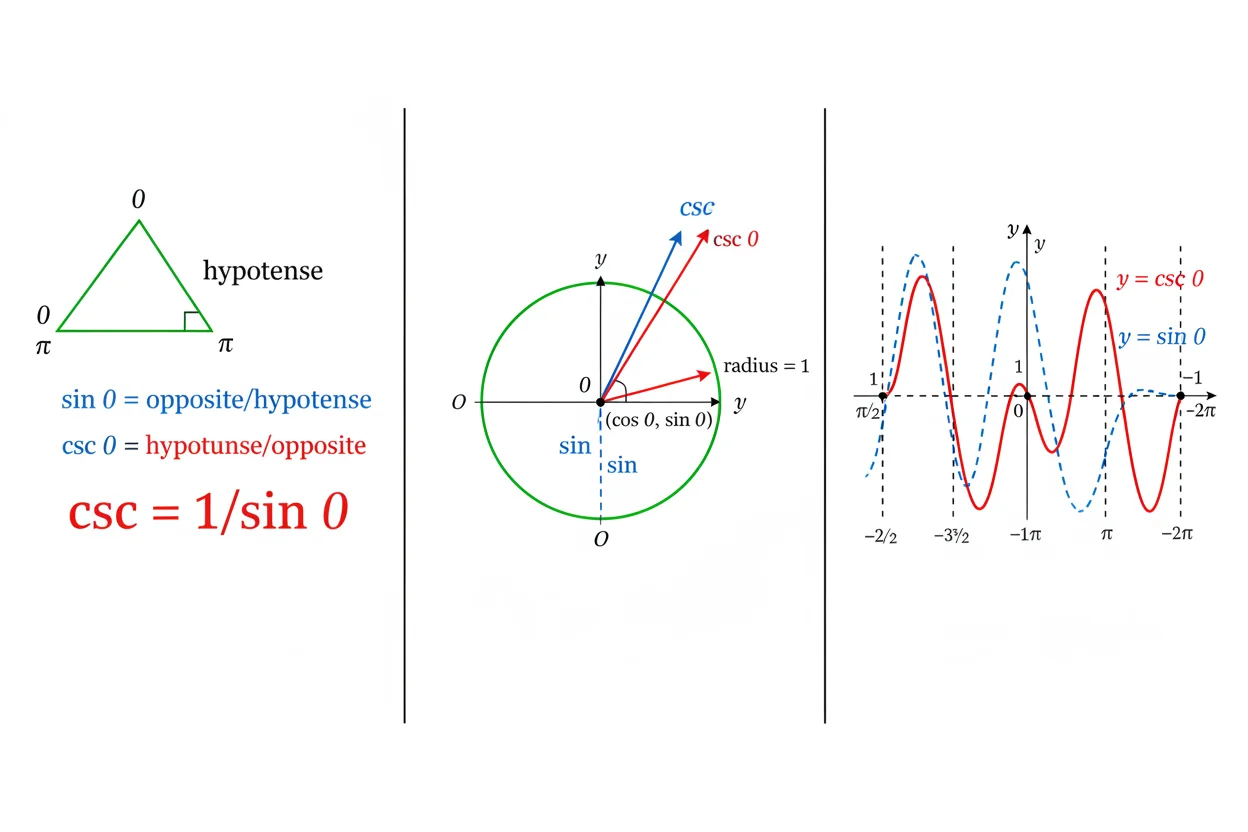

Cosecant is a trigonometric function defined as the reciprocal of sine. For an angle θ, csc θ = 1/sin θ wherever sin θ is not zero. In a right triangle, cosecant can also be written as hypotenuse/opposite relative to the chosen acute angle. Because it is reciprocal to sine, cosecant has the same sign as sine and is undefined wherever sine equals zero. Its real outputs satisfy csc θ ≤ −1 or csc θ ≥ 1, so cosecant never takes a value strictly between −1 and 1. On the unit circle, csc θ is the reciprocal of the y-coordinate. These relationships make cosecant useful in triangle calculations, identities, equations, graphs, and geometric problems where a hypotenuse-to-opposite ratio appears naturally.
What Is Cosecant?
Cosecant is one of the six standard trigonometric functions.
It is written:
csc θ
and defined by:
csc θ = 1/sin θ
The corresponding Sine relationship is:
sin θ = 1/csc θ
These reciprocal equations are valid only where the denominator is nonzero.
If:
sin θ = 1/2
then:
csc θ = 2
If:
sin θ = −1/2
then:
csc θ = −2
Cosecant therefore preserves the sign of sine while reversing its magnitude through reciprocation.
Cosecant Formula in a Right Triangle
For an acute angle θ in a right triangle:
sin θ = opposite/hypotenuse
Taking the reciprocal gives:
csc θ = hypotenuse/opposite
So if:
hypotenuse = h
and:
opposite side = o
then:
csc θ = h/o
The hypotenuse is always the side opposite the 90° angle, while the opposite side depends on which acute angle θ is being considered.
The broader relationships among sides and angles are developed in Right Triangles.
Basic Cosecant Example
Suppose a right triangle has, relative to angle θ:
opposite = 5
hypotenuse = 13
Then:
csc θ = 13/5
Therefore:
csc θ = 2.6
The corresponding sine value is:
sin θ = 5/13
and:
1/(5/13) = 13/5
which confirms the reciprocal relationship.
Find a Missing Opposite Side
Suppose:
csc θ = 5/3
and the hypotenuse is:
20
Use:
csc θ = hypotenuse/opposite
So:
5/3 = 20/o
Cross-multiply:
5o = 60
Therefore:
o = 12
The opposite side is:
12
Check:
csc θ = 20/12 = 5/3
Find the Hypotenuse
Suppose:
csc θ = 7/4
and the opposite side is:
8
Then:
7/4 = h/8
Cross-multiply:
4h = 56
Therefore:
h = 14
The hypotenuse is:
14
This is consistent with the fact that the hypotenuse must be at least as long as either leg.
Cosecant From Sine
If sine is known:
csc θ = 1/sin θ
For:
sin θ = √3/2
we obtain:
csc θ = 1/(√3/2)
= 2/√3
Rationalizing:
csc θ = 2√3/3
Either exact form represents the same value.
Sine From Cosecant
The reciprocal relationship also works backward:
sin θ = 1/csc θ
If:
csc θ = −4
then:
sin θ = −1/4
This immediately tells us that θ lies in a quadrant where sine is negative.
Cosecant and the Pythagorean Theorem
A right-triangle problem may provide the adjacent and opposite legs rather than the hypotenuse.
Use the Pythagorean Theorem:
a² + b² = c²
to find the hypotenuse before applying:
csc θ = hypotenuse/opposite
Suppose:
opposite = 8
adjacent = 15
Then:
hypotenuse = √(8² + 15²)
= √289
= 17
Therefore:
csc θ = 17/8
Exact Cosecant Values
Several common angles have exact cosecant values.
Since:
sin 30° = 1/2
we have:
csc 30° = 2
Since:
sin 45° = √2/2
then:
csc 45° = √2
Since:
sin 60° = √3/2
then:
csc 60° = 2√3/3
Since:
sin 90° = 1
then:
csc 90° = 1
These values follow directly from standard sine values.
Cosecant on the Unit Circle
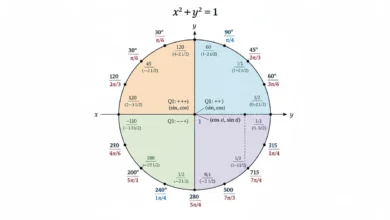
On the Unit Circle, a point corresponding to angle θ has coordinates:
(cos θ, sin θ)
Therefore the y-coordinate is:
y = sin θ
Cosecant is:
csc θ = 1/y
whenever:
y ≠ 0
This gives a geometric interpretation of cosecant as the reciprocal of the unit-circle y-coordinate.
Where Cosecant Is Undefined
Cosecant is undefined whenever:
sin θ = 0
On the unit circle, sine is zero along the x-axis.
Therefore:
θ = nπ
for any integer n
makes cosecant undefined.
In degrees, these angles are:
θ = 180°n
Examples include:
0°, 180°, 360°, −180°
At these angles, dividing by sine would require division by zero.
Domain of Cosecant
For real angles, the domain excludes:
θ = nπ
where n is any integer.
So the domain is:
all real θ except integer multiples of π
In degree measure:
all real angles except integer multiples of 180°
Every other real angle has a defined cosecant value.
Range of Cosecant
Since:
−1 ≤ sin θ ≤ 1
and cosecant is its reciprocal, real cosecant values satisfy:
csc θ ≤ −1
or:
csc θ ≥ 1
Therefore the range is:
(−∞, −1] ∪ [1, ∞)
There are no real angles for which:
−1 < csc θ < 1
Why |csc θ| Is at Least 1
Whenever sine is nonzero:
|sin θ| ≤ 1
Taking reciprocal magnitudes gives:
|1/sin θ| ≥ 1
Therefore:
|csc θ| ≥ 1
Equality occurs when:
|sin θ| = 1
such as:
θ = π/2 + nπ
At those angles:
csc θ = ±1
Signs of Cosecant by Quadrant
Because cosecant has the same sign as sine:
Quadrant I → csc positive
Quadrant II → csc positive
Quadrant III → csc negative
Quadrant IV → csc negative
This provides a quick way to determine the sign without evaluating the full function.
For example:
csc 210°
must be negative because 210° lies in Quadrant III.
Example: Cosecant of 210°
Reference angle:
210° − 180° = 30°
Since:
sin 30° = 1/2
and sine is negative in Quadrant III:
sin 210° = −1/2
Therefore:
csc 210° = −2
Period of Cosecant
Sine has period:
2π
so:
sin(θ + 2π) = sin θ
Therefore:
csc(θ + 2π) = csc θ
where both sides are defined.
The period of cosecant is:
2π radians
or:
360°
Cosecant Is an Odd Function
Sine satisfies:
sin(−θ) = −sin θ
Therefore:
csc(−θ) = 1/sin(−θ)
= −1/sin θ
so:
csc(−θ) = −csc θ
Cosecant is therefore an odd function.
Its graph has rotational symmetry about the origin.
Cosecant Graph
The graph of:
y = csc x
is built from the reciprocal of:
y = sin x
Where sine reaches:
1
cosecant reaches:
1
Where sine reaches:
−1
cosecant reaches:
−1
Where sine approaches zero, the reciprocal grows without bound in magnitude.
As a result, the cosecant graph consists of disconnected branches separated by vertical asymptotes.
Vertical Asymptotes
Because cosecant is undefined when:
sin x = 0
its vertical asymptotes occur at:
x = nπ
Examples:
…, −2π, −π, 0, π, 2π, …
Near these values, cosecant can increase toward positive infinity or decrease toward negative infinity depending on the side of the asymptote.
Cosecant and Cosine
Cosecant is reciprocal to sine, while Cosine represents the adjacent-to-hypotenuse ratio in a right triangle.
For an acute angle:
csc θ = hypotenuse/opposite
cos θ = adjacent/hypotenuse
These functions use different sides, but they interact through the Pythagorean identity:
sin²θ + cos²θ = 1
Replacing:
sin θ = 1/csc θ
gives:
1/csc²θ + cos²θ = 1
This can be rearranged when one function value is known.
Cosecant and Cotangent
The Cotangent function is:
cot θ = cos θ/sin θ
In a right triangle:
cot θ = adjacent/opposite
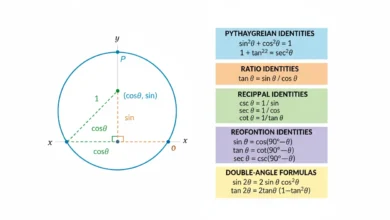
Cosecant and cotangent satisfy an important identity:
csc²θ = 1 + cot²θ
or:
csc²θ − cot²θ = 1
This identity follows from dividing:
sin²θ + cos²θ = 1
by:
sin²θ
Deriving the Cosecant-Cotangent Identity
Start with:
sin²θ + cos²θ = 1
Divide every term by:
sin²θ
Then:
sin²θ/sin²θ + cos²θ/sin²θ = 1/sin²θ
Therefore:
1 + cot²θ = csc²θ
So:
csc²θ = 1 + cot²θ
This relationship is one of the core Trigonometric Identities.
Find Cosecant From Cotangent
Suppose:
cot θ = 3
and θ is known to lie in Quadrant I.
Use:
csc²θ = 1 + cot²θ
Then:
csc²θ = 1 + 9
= 10
Therefore:
csc θ = √10
Because θ is in Quadrant I, cosecant is positive.
If the quadrant instead required negative sine, the negative square root would be selected.
Find Cotangent From Cosecant
Suppose:
csc θ = 5/3
and θ is acute.
Then:
cot²θ = csc²θ − 1
= 25/9 − 1
= 16/9
So:
cot θ = 4/3
The positive root is appropriate because an acute angle lies in Quadrant I.
Cosecant and Secant
Cosecant and Secant are both reciprocal trigonometric functions:
csc θ = 1/sin θ
sec θ = 1/cos θ
Cosecant uses the reciprocal of the vertical unit-circle coordinate.
Secant uses the reciprocal of the horizontal coordinate.
Neither function has real values strictly between −1 and 1.
Their undefined points occur at different angles because sine and cosine vanish at different locations.
Complementary-Angle Relationship
For complementary angles:
sin θ = cos(90° − θ)
Taking reciprocals gives:
csc θ = sec(90° − θ)
In radians:
csc θ = sec(π/2 − θ)
Similarly:
sec θ = csc(π/2 − θ)
These are cofunction relationships.
Cosecant and Degrees and Radians
Cosecant can be evaluated using either degrees or radians, but the angle interpretation must remain consistent.
For example:
30° = π/6
Therefore:
csc30° = csc(π/6) = 2
The Degrees and Radians conversion is:
radians = degrees × π/180
A calculator set to the wrong angle mode can produce an incorrect numerical result even when the formula is correct.
Solving a Cosecant Equation
Suppose:
csc x = 2
Then:
sin x = 1/2
On:
0 ≤ x < 2π
sine equals 1/2 at:
x = π/6
and:
x = 5π/6
Therefore the solutions are:
x = π/6, 5π/6
For all real x:
x = π/6 + 2πn
or:
x = 5π/6 + 2πn
where n is an integer.
Solving csc x = −2
Rewrite:
sin x = −1/2
On:
0 ≤ x < 2π
this occurs at:
x = 7π/6
and:
x = 11π/6
Therefore the general solutions are:
x = 7π/6 + 2πn
or:
x = 11π/6 + 2πn
No Real Solution Example
Suppose:
csc x = 1/2
This would imply:
sin x = 2
But real sine satisfies:
−1 ≤ sin x ≤ 1
Therefore there is no real solution.
The cosecant range provides an even faster check:
|csc x| ≥ 1
so:
1/2
cannot be a real cosecant value.
Inverse Problems Involving Cosecant
Many calculators do not provide a separate csc⁻¹ key.
To solve:
csc θ = k
rewrite:
sin θ = 1/k
Then use the appropriate Inverse Trigonometric Functions:
θ = sin⁻¹(1/k)
with quadrant and periodicity handled according to the problem.
For:
csc θ = 2
the principal acute angle is:
θ = sin⁻¹(1/2)
= 30°
Cosecant in Geometric Length Problems
Suppose the angle θ and the opposite side o of a right triangle are known.
Since:
csc θ = h/o
the hypotenuse is:
h = o csc θ
For:
o = 9
θ = 30°
we know:
csc30° = 2
so:
h = 18
This form can sometimes be more direct than writing sine and then rearranging.
Cosecant in Cone Geometry
A vertical cross-section of a right circular cone produces two right triangles.
If θ is the angle between the cone’s axis and its slant side, then relative to θ:
opposite = r
hypotenuse = ℓ
Therefore:
csc θ = ℓ/r
so:
ℓ = r csc θ
This can provide the slant height used in Cone Surface Area.
If the same cross-section supplies the perpendicular height h, those dimensions can then be used in Cone Volume.
Cone Example Using Cosecant
Suppose a right circular cone has:
r = 5
and the angle between its axis and slant side is:
θ = 30°
Then:
csc30° = 2
so:
ℓ = 5(2)
= 10
Using:
h = √(ℓ² − r²)
we obtain:
h = √(100 − 25)
= 5√3
Thus cosecant can supply one geometric length while the cone formulas remain responsible for surface area or volume.
Cosecant and Congruent Triangles
In symmetric geometric constructions, Congruent Triangles can establish that corresponding right-triangle pieces have equal sides and angles.
Once that geometry is established, cosecant can calculate a missing hypotenuse or opposite side within either matching triangle.
For example, splitting an isosceles triangle along its axis of symmetry creates congruent right triangles.
Cosecant then applies to either half using:
csc θ = hypotenuse/opposite
Congruence supplies the geometric equality; cosecant supplies the numerical ratio.
Cosecant and the Law of Sines
The Law of Sines states:
a/sin A = b/sin B = c/sin C
Since:
1/sin A = csc A
we can write individual ratios such as:
a csc A
when reorganizing equations.
However, the usual sine form is generally clearer because the law directly pairs each side with the sine of its opposite angle.
Cosecant is most useful when the reciprocal form simplifies a particular algebraic step.
Cosecant and Polar Coordinates
In Polar and Rectangular Form:
x = r cos θ
y = r sin θ
If:
y = r sin θ
and sin θ is nonzero, then:
r = y csc θ
This illustrates how reciprocal trigonometric functions can appear when solving coordinate equations for the radial distance.
Cosecant in Trigonometric Identities
Because:
csc θ = 1/sin θ
expressions containing cosecant can often be rewritten entirely in sine and cosine.
For example:
csc θ − sin θ
becomes:
1/sin θ − sin θ
Combine over a common denominator:
(1 − sin²θ)/sin θ
Use:
1 − sin²θ = cos²θ
Then:
csc θ − sin θ = cos²θ/sin θ
This can also be written in other equivalent forms depending on the desired result.
Simplifying csc θ / cot θ
Use:
csc θ = 1/sin θ
and:
cot θ = cos θ/sin θ
Then:
csc θ / cot θ
= (1/sin θ)/(cos θ/sin θ)
= 1/cos θ
Therefore:
csc θ / cot θ = sec θ
where all expressions are defined.
Cosecant Derivative
In calculus:
d/dx[csc x] = −csc x cot x
The negative sign is important.
This follows from treating:
csc x = 1/sin x
and differentiating the reciprocal.
Although the present focus is trigonometric meaning and calculation, this identity shows why cosecant and cotangent frequently appear together in calculus.
Cosecant Antiderivative
A standard antiderivative is:
∫csc x dx = ln|csc x − cot x| + C
An equivalent form is:
∫csc x dx = −ln|csc x + cot x| + C
These expressions differ only by an additive constant where both are defined.
The reciprocal and Pythagorean identities explain why cosecant and cotangent naturally occur together.
Common Cosecant Mistakes
A common mistake is confusing cosecant with cosine.
The abbreviations are:
cosecant = csc
cosine = cos
Cosecant is reciprocal to sine, not cosine:
csc θ = 1/sin θ
Another error is writing:
csc θ = opposite/hypotenuse
which is actually sine. The correct right-triangle ratio is:
csc θ = hypotenuse/opposite
Cosecant is undefined whenever sine is zero.
Its real range excludes values between −1 and 1.
When solving equations, convert cosecant to sine and account for all relevant quadrants.
Finally, make sure degree/radian settings match the angle unit.
Frequently Asked Questions
What is cosecant?
Cosecant is the reciprocal of sine:
csc θ = 1/sin θ
What is the right-triangle formula for cosecant?
csc θ = hypotenuse/opposite
Is cosecant the same as cosine?
No. Cosine is a separate trigonometric function.
What is the reciprocal of cosecant?
Sine:
sin θ = 1/csc θ
What is csc 30°?
csc30° = 2
What is csc 90°?
csc90° = 1
Where is cosecant undefined?
Where:
sin θ = 0
so:
θ = nπ
for integers n.
What is the range of cosecant?
(−∞, −1] ∪ [1, ∞)
What is the period of cosecant?
2π
or:
360°
Is cosecant positive in Quadrant II?
Yes, because sine is positive in Quadrant II.
What identity connects cosecant and cotangent?
csc²θ = 1 + cot²θ
How do you solve csc θ = k?
Rewrite:
sin θ = 1/k
then solve the corresponding sine equation.
Can cosecant be zero?
No. A reciprocal cannot equal zero.
How can I check a cosecant answer?
Take its reciprocal and verify that the resulting sine value lies between −1 and 1 and has the correct sign for the angle’s quadrant.