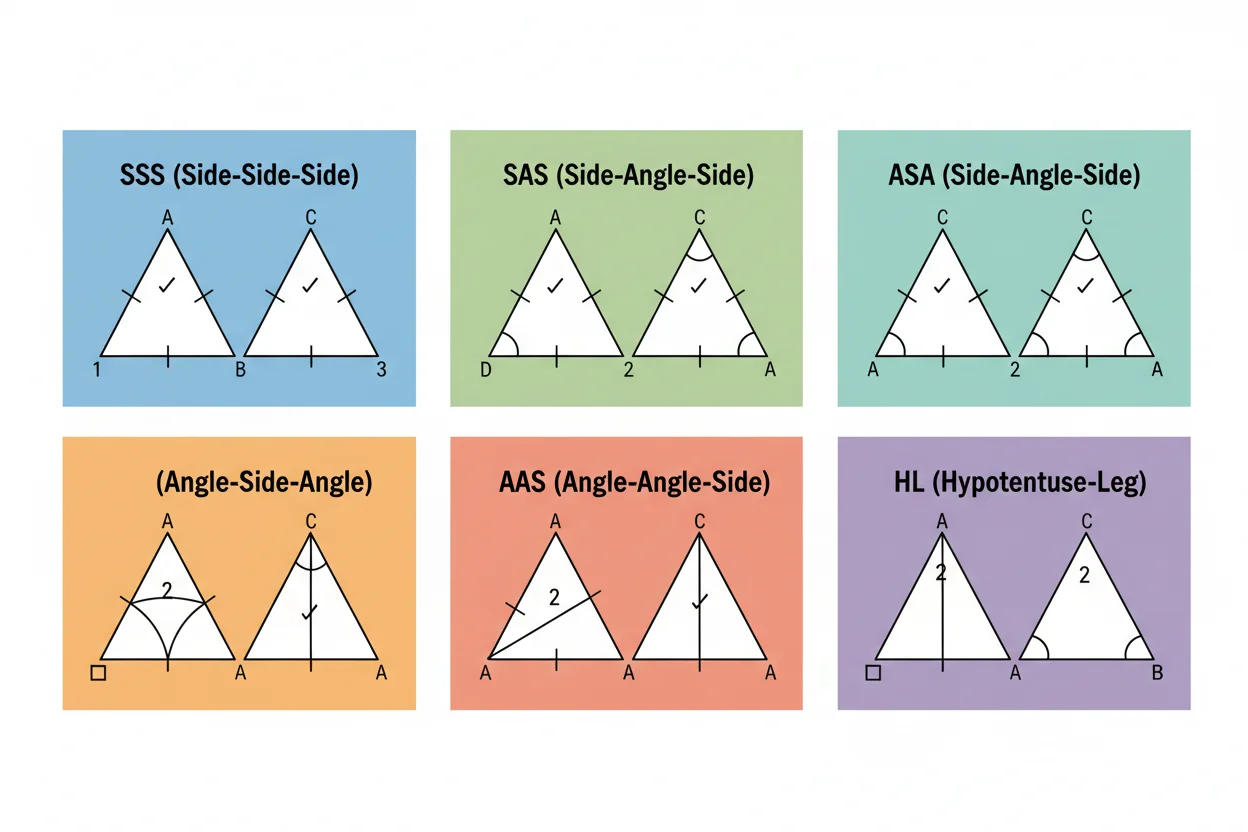

Congruent triangles are triangles with exactly the same size and shape. Their corresponding sides have equal lengths and their corresponding angles have equal measures, even if one triangle has been translated, rotated, or reflected. Triangle congruence can often be proved without checking all six corresponding measurements. The standard criteria are SSS, SAS, ASA, AAS, and the hypotenuse-leg criterion for right triangles. AAA is not a congruence test because equal angles determine shape but not size, while SSA is generally insufficient because it can produce more than one possible triangle. Once two triangles are proved congruent, corresponding parts can be declared equal using the principle commonly summarized as corresponding parts of congruent triangles are congruent. Congruence is widely used in geometric proofs, symmetry, constructions, circle theorems, coordinate geometry, and three-dimensional cross sections.
What Are Congruent Triangles?
Suppose:
△ABC ≅ △DEF
The order of the letters identifies corresponding vertices:
A ↔ D
B ↔ E
C ↔ F
Therefore corresponding sides satisfy:
AB = DE
BC = EF
AC = DF
and corresponding angles satisfy:
∠A = ∠D
∠B = ∠E
∠C = ∠F
The symbol:
≅
means congruent.
Congruence is one of the fundamental relationships within Geometry & Trigonometry.
Congruent Means Same Size and Shape
Two triangles are congruent when one can be moved onto the other using rigid transformations such as:
translation
rotation
reflection
These transformations preserve:
lengths
angle measures
area
perimeter
The triangles do not need to face the same direction on the page.
Orientation and position can change without changing congruence.
Congruence Versus Equality
Lengths and angle measures can be equal:
AB = DE
Triangles are normally described as congruent:
△ABC ≅ △DEF
The distinction reflects the type of object being compared.
Numerical measurements are equal.
Geometric figures are congruent when their corresponding structures match exactly.
Congruence Versus Similarity
Congruent triangles have the same:
shape
and:
size
Similar Triangles have the same shape but may have different sizes.
For congruent triangles, the scale factor is:
1
For similar triangles, the scale factor can be any positive value.
Thus every pair of congruent triangles is similar, but not every pair of similar triangles is congruent.
SSS Congruence
SSS stands for:
Side-Side-Side
If all three sides of one triangle equal the three corresponding sides of another triangle, the triangles are congruent.
If:
AB = DE
BC = EF
AC = DF
then:
△ABC ≅ △DEF
by SSS.
No angle measurements are required.
SSS Example
Triangle 1 has side lengths:
5, 7, 8
Triangle 2 also has:
5, 7, 8
The side correspondence is exact.
Therefore the triangles are congruent by:
SSS
Their corresponding angles must also be equal, even if those angles were not measured initially.
Why SSS Determines One Triangle Shape
Once three valid side lengths are fixed, their endpoints cannot form two geometrically different ordinary triangles, aside from reflection.
For example, if one side is fixed as a base, the third vertex must lie at the intersection of two circles whose radii are the other two side lengths.
The two possible intersection points are mirror images.
Reflection preserves congruence.
Therefore SSS uniquely determines the triangle up to rigid motion.
SAS Congruence
SAS stands for:
Side-Angle-Side
If two sides and the included angle between them are equal in two triangles, the triangles are congruent.
For example:
AB = DE
AC = DF
∠A = ∠D
where the stated angle lies between the two known sides.
Then:
△ABC ≅ △DEF
by SAS.
What Does Included Angle Mean?
The included angle is the angle formed by the two given sides.
Suppose the known sides are:
AB
and:
AC
Their included angle is:
∠A
not ∠B or ∠C.
This distinction matters because two sides and a nonincluded angle lead to the SSA situation, which is not generally a valid congruence criterion.
SAS Example
Suppose triangle ABC has:
AB = 6
AC = 9
∠A = 50°
Triangle DEF has:
DE = 6
DF = 9
∠D = 50°
The equal angle lies between the pairs of equal sides.
Therefore:
△ABC ≅ △DEF
by:
SAS
SAS and the Law of Cosines
The Law of Cosines helps explain why SAS fixes the entire triangle.
If sides a and b and included angle C are known:
c² = a² + b² − 2ab cosC
Thus the third side is determined.
Once all three sides are fixed, the triangle is fixed by SSS.
This provides an algebraic explanation for SAS congruence.
ASA Congruence
ASA stands for:
Angle-Side-Angle
If two angles and the included side are equal in two triangles, the triangles are congruent.
For example:
∠A = ∠D
AB = DE
∠B = ∠E
Then:
△ABC ≅ △DEF
by ASA.
The known side lies between the two known angles.
ASA Example
Triangle ABC has:
∠A = 40°
AB = 10
∠B = 65°
Triangle DEF has:
∠D = 40°
DE = 10
∠E = 65°
Therefore:
△ABC ≅ △DEF
by:
ASA
The third angles are also equal because every triangle’s angles sum to 180°.
AAS Congruence
AAS stands for:
Angle-Angle-Side
Two corresponding angles and a corresponding nonincluded side are enough to prove congruence.
If:
∠A = ∠D
∠B = ∠E
AC = DF
then the triangles are congruent by AAS.
Why?
The third angle is determined by:
A + B + C = 180°
so knowing two angles effectively determines all three angles.
The known side then fixes the scale.
AAS Example
Suppose:
∠A = 35°
∠B = 75°
AC = 8
and another triangle has:
∠D = 35°
∠E = 75°
DF = 8
Then:
∠C = 70°
and:
∠F = 70°
The triangles are congruent by:
AAS
HL Congruence
HL stands for:
Hypotenuse-Leg
It applies specifically to right triangles.
If two right triangles have:
equal hypotenuses
and:
one pair of equal corresponding legs
then they are congruent.
The right angle is already known in both triangles.
This is sometimes called:
RHS
for Right angle-Hypotenuse-Side.
HL Example
Two Right Triangles each have:
hypotenuse = 13
and one leg:
5
The remaining leg in each satisfies:
b² = 13² − 5²
= 169 − 25
= 144
so:
b = 12
Both triangles therefore have side lengths:
5, 12, 13
and are congruent.
Why HL Works
For right triangles:
a² + b² = c²
If hypotenuse c and one leg a are fixed:
b = √(c² − a²)
The remaining leg is uniquely determined.
Thus HL effectively becomes SSS after applying the Pythagorean theorem.
This is why it is a valid special criterion.
AAA Is Not a Congruence Test
AAA means all three corresponding angles are equal.
That guarantees the triangles have the same shape, but it does not guarantee equal size.
For example, triangles with sides:
3, 4, 5
and:
6, 8, 10
have equal corresponding angles.
But the second triangle is twice as large in every linear dimension.
They are similar, not congruent.
AAA therefore proves similarity rather than congruence.
Why SSA Usually Fails
SSA means:
Side-Side-Angle
where the angle is not included between the two known sides.
This information can sometimes produce two distinct triangles.
That is the ambiguous case.
Therefore SSA is not a general triangle congruence criterion.
Some special SSA configurations do determine a unique triangle, but ordinary congruence proofs should not treat SSA as universally valid.
The Ambiguous SSA Case
Suppose an angle A, opposite side a, and another side b are known.
The Law of Sines can produce:
sinB = b sinA/a
Because:
sinB = sin(180° − B)
two possible angle values can sometimes satisfy the same sine relationship.
That can produce two different triangles.
This is the geometric reason SSA is unreliable as a general congruence rule.
Corresponding Parts
Once:
△ABC ≅ △DEF
has been established, every pair of corresponding parts is congruent.
For example:
AB = DE
BC = EF
AC = DF
and:
∠A = ∠D
∠B = ∠E
∠C = ∠F
This principle is often used after the main congruence proof to establish an unknown side or angle equality.
Correspondence Order Matters
Suppose:
△ABC ≅ △PQR
Then:
A ↔ P
B ↔ Q
C ↔ R
Therefore:
AB ↔ PQ
BC ↔ QR
AC ↔ PR
Writing triangle names in correct corresponding order prevents mismatched conclusions.
If the order is wrong, even a valid congruence relationship can be interpreted incorrectly.
Reflexive Property
A shared side is equal to itself.
For example, if triangles ABD and ACD share segment AD:
AD = AD
This is the reflexive property.
Shared sides frequently provide one of the required equalities in:
SSS
or:
SAS
proofs.
Vertical Angles
When two lines intersect, opposite vertical angles are congruent.
If:
∠AEB
and:
∠CED
are vertical angles:
∠AEB = ∠CED
This angle equality can provide the angle needed for an ASA or SAS proof.
Recognizing automatic geometric equalities can shorten congruence arguments considerably.
Midpoints
If M is the midpoint of segment AB:
AM = MB
This equal-side relationship can be combined with:
shared sides
parallel-line angles
vertical angles
or other given information to prove triangle congruence.
A midpoint therefore supplies a length equality directly from its definition.
Angle Bisectors
If AD bisects:
∠A
then:
∠BAD = ∠DAC
That equal-angle relationship can support SAS or ASA proofs.
The Angle Bisector Theorem additionally gives the proportional side relationship:
BD/DC = AB/AC
The angle equality and side-ratio theorem are distinct consequences of the same bisector geometry.
Perpendicular Bisectors
A point on the perpendicular bisector of a segment is equidistant from the segment’s endpoints.
Suppose point P lies on the perpendicular bisector of AB.
Then:
PA = PB
This can help establish SSS congruence between triangles sharing portions of the construction.
Perpendicular bisectors are especially common in circumcenter and circle proofs.
Isosceles Triangle Congruence
Suppose triangle ABC is isosceles with:
AB = AC
and AD bisects angle A.
Then:
AB = AC
∠BAD = ∠DAC
AD = AD
Therefore:
△ABD ≅ △ACD
by SAS.
It follows that:
BD = DC
and the two base angles are equal.
This congruence proof explains several familiar isosceles-triangle properties.
Congruent Triangles in Circle Geometry
Circle proofs frequently contain congruent triangles because all radii of one circle are equal.
Suppose O is the center and A and B lie on the circle.
Then:
OA = OB
If another shared side or angle relationship is available, congruence can establish equal chords or angles.
The basic circle relationships are summarized in Circles: Radius, Diameter, Area.
Equal Chords From Congruent Triangles
Suppose:
OA = OB = OC = OD = r
and central angles:
∠AOB = ∠COD
Then triangles AOB and COD have:
OA = OC
OB = OD
included angles equal
Therefore:
△AOB ≅ △COD
by SAS.
It follows:
AB = CD
So equal central angles subtend equal chords.
Congruence and Tangent Geometry
A radius to a tangent point is perpendicular to the tangent.
This creates right triangles.
When two tangents are drawn from the same external point P to a circle at A and B:
OA = OB
OP = OP
and both triangles OAP and OBP are right triangles.
They are congruent by HL.
Therefore:
PA = PB
This proves the theorem that tangent segments from the same external point are equal.
Congruent Triangles and Cosine
The Cosine relationship can verify side or angle information used in congruence arguments.
For a triangle:
c² = a² + b² − 2ab cosC
If two triangles have the same a, b, and included angle C, they produce the same third side c.
This supports the uniqueness behind SAS.
Cosine calculations can also recover an angle when all three sides are known.
Congruent Triangles and Cosecant
Cosecant is the reciprocal of sine:
cscθ = 1/sinθ
It may appear in triangle calculations where a side ratio is written using the reciprocal of sine.
However, cosecant is not itself a triangle congruence criterion.
Congruence is established through side and angle correspondences such as SSS, SAS, ASA, AAS, or HL.
Trigonometric functions may help determine missing measurements before those criteria are applied.
Coordinate Proof of Congruence
Coordinates can establish congruence by calculating side lengths with the distance formula.
Suppose:
A = (0, 0)
B = (4, 0)
C = (0, 3)
and:
D = (5, 1)
E = (9, 1)
F = (5, 4)
For ABC:
AB = 4
AC = 3
BC = 5
For DEF:
DE = 4
DF = 3
EF = 5
Therefore:
△ABC ≅ △DEF
by SSS.
Coordinate Congruence With Transformations
The second triangle in the previous example is simply the first triangle translated by:
(5, 1)
A translation preserves all lengths and angles.
Therefore congruence can also be recognized directly through rigid transformations.
Coordinate calculations provide an algebraic verification of that geometric fact.
Rotation Preserves Congruence
A rotation changes the direction of a figure but not:
side lengths
angle measures
area
For example, rotating a triangle 90° around a point produces a congruent triangle.
The corresponding coordinates change, but distances between vertices remain the same.
Reflection Preserves Congruence
Reflection creates a mirror image.
The orientation reverses, but:
lengths remain equal
angles remain equal
Therefore the original and reflected triangles are congruent.
This explains why SSS can yield two mirror-positioned constructions while still determining congruence uniquely.
Translation Preserves Congruence
A translation adds the same displacement to every point.
If:
(x, y) → (x + a, y + b)
then differences between corresponding coordinates remain unchanged.
Therefore all distances and angles remain unchanged.
The translated triangle is congruent to the original.
Congruent Triangles and Area
Congruent triangles have equal area.
If:
△ABC ≅ △DEF
then:
Area(ABC) = Area(DEF)
This follows because corresponding bases and heights are equal.
However, equal area alone does not prove congruence.
Two differently shaped triangles can have the same area.
Same Area Does Not Mean Congruent
Consider one triangle with:
base = 10
height = 4
Its area is:
20
Another triangle with:
base = 8
height = 5
also has area:
20
The triangles need not have equal side lengths or equal angles.
Therefore area equality is a consequence of congruence, not a sufficient congruence test.
Congruent Triangles and Perimeter
Congruent triangles have equal corresponding sides.
Therefore their perimeters are equal.
If one triangle has side lengths:
5, 7, 9
its perimeter is:
21
Any congruent triangle also has perimeter:
21
As with area, equal perimeter alone does not prove congruence.
Congruent Triangles in Cone Geometry
An axial cross section of a right circular cone forms an isosceles triangle.
The perpendicular height divides it into two congruent right triangles.
Each half contains:
radius r
height h
slant height ℓ
This structure supports calculations in both Cone Volume and Cone Surface Area.
The congruence establishes that the perpendicular height bisects the cross-sectional base.
Cone Cross-Section Example
Suppose the axial cross section of a cone has:
total base = 12
slant sides = 10
The perpendicular height divides the base into:
6 and 6
The two resulting right triangles are congruent.
Their height is:
h = √(10² − 6²)
= √64
= 8
The cone therefore has:
r = 6
h = 8
This data can then be used in the appropriate cone formula.
Congruence in Polygon Proofs
Polygons can often be divided into triangles.
If corresponding triangles in two polygons are congruent, their equal parts can establish larger polygon properties.
Diagonals are frequently added to:
rectangles
parallelograms
rhombi
kites
to create triangles that can be compared by SSS or SAS.
This is one reason triangle congruence is foundational to many polygon theorems.
Congruence and Parallelograms
Draw a diagonal across a parallelogram.
The diagonal creates two triangles.
Opposite sides of a parallelogram are equal, and the diagonal is shared.
This can establish triangle congruence and then prove additional opposite-angle relationships.
Triangle congruence therefore provides a proof mechanism behind several standard parallelogram properties.
Congruence and Kites
A kite contains two pairs of adjacent equal sides.
Drawing the appropriate diagonal can create two triangles sharing that diagonal.
With the two matching side pairs:
SSS
can prove the triangles congruent.
Corresponding angle equalities then follow.
This geometric structure also supports the familiar Kite Area relationships.
Congruence and Rhombi
A rhombus has four equal sides.
Its diagonals divide it into triangles whose congruence can establish:
angle-bisecting properties
perpendicular relationships
symmetry
The Rhombus Area formula involving diagonals is closely connected to these structural properties.
Congruence Proof Strategy
A reliable proof strategy is to first mark everything already known.
Look for:
shared sides
radii of the same circle
midpoint segments
vertical angles
parallel-line angle relationships
angle bisectors
right angles
Then determine whether the information fits:
SSS
SAS
ASA
AAS
or:
HL
Only after proving congruence should corresponding-part conclusions be drawn.
Choosing Between SSS and SAS
If three side pairs are known:
use SSS
If two side pairs and the included angle are known:
use SAS
Do not search for unnecessary angle information when SSS is already available.
Likewise, if SAS is immediately established, there is no need to calculate the third side first unless the problem specifically asks for it.
Choosing Between ASA and AAS
If two angle pairs are known, inspect the known side.
If the side lies between the two known angles:
ASA
If it does not:
AAS
Both are valid congruence tests.
The distinction mainly describes the position of the known side relative to the known angles.
Triangle Congruence and Triangle Sum
If two angle pairs match:
A = D
B = E
then the third angles automatically match because:
C = 180° − A − B
and:
F = 180° − D − E
Therefore:
C = F
This is why two angles plus one matching side can determine triangle congruence.
SSS Example With Unknown Side
Suppose:
AB = DE = 8
AC = DF = 11
and:
BC = x + 2
EF = 9
If the triangles are congruent with:
BC ↔ EF
then:
x + 2 = 9
Therefore:
x = 7
Once correspondence is established, unknown measurements can be solved directly.
Angle Example After Congruence
Suppose:
△ABC ≅ △DEF
and:
∠A = 42°
Because:
A ↔ D
we know:
∠D = 42°
No trigonometric calculation is required.
Corresponding-angle equality follows immediately from congruence.
Perimeter Example After Congruence
If:
△ABC ≅ △DEF
and triangle ABC has sides:
6, 8, 11
then triangle DEF has the same side lengths.
Therefore both perimeters equal:
6 + 8 + 11
= 25
The order of the side labels determines which specific sides correspond.
Congruence Versus Triangle Type
Triangles can be classified by sides:
scalene
isosceles
equilateral
or by angles:
acute
right
obtuse
Congruence is a relationship between two triangles, not a triangle type.
Two scalene triangles can be congruent.
Two right triangles can be congruent.
Two equilateral triangles are congruent only when their side lengths are equal.
Equilateral Triangles
All equilateral triangles have angles:
60°, 60°, 60°
but they are not automatically congruent.
An equilateral triangle with side:
5
and one with side:
10
are similar but not congruent.
If one side of each is equal, then all three sides are equal and SSS proves congruence.
Congruent Right Triangles
For right triangles, ordinary criteria such as:
SSS
SAS
ASA
AAS
still work.
HL provides an additional convenient shortcut based on:
right angle
hypotenuse
one leg
The right-angle condition is essential.
HL should not be applied indiscriminately to non-right triangles.
Common Congruent Triangle Mistakes
A common mistake is using AAA to prove congruence. AAA proves only similarity.
SSA is not a general congruence criterion.
For SAS, the angle must be included between the two known sides.
For ASA, the known side is included between the two known angles.
HL applies only to right triangles.
Another error is writing corresponding vertices in the wrong order.
Do not claim corresponding sides or angles are equal until congruence has actually been established unless those equalities were already given.
Equal area or equal perimeter alone does not prove congruence.
Finally, remember that reflected triangles can still be congruent even though their orientation is reversed.
Frequently Asked Questions
What are congruent triangles?
Congruent triangles have exactly the same size and shape, with equal corresponding sides and equal corresponding angles.
What symbol means congruent?
≅
For example:
△ABC ≅ △DEF
What is SSS congruence?
If all three corresponding side pairs are equal, the triangles are congruent.
What is SAS congruence?
If two corresponding side pairs and their included angle are equal, the triangles are congruent.
What is ASA congruence?
If two corresponding angles and the included side are equal, the triangles are congruent.
What is AAS congruence?
If two corresponding angles and a nonincluded corresponding side are equal, the triangles are congruent.
What is HL congruence?
For right triangles, equal hypotenuses and one equal corresponding leg prove congruence.
Does AAA prove congruence?
No. AAA proves similarity, not equal size.
Does SSA prove congruence?
Not generally. SSA can produce an ambiguous case with more than one possible triangle.
Are congruent triangles always similar?
Yes. Their similarity scale factor is 1.
Are similar triangles always congruent?
No. Similar triangles can have different sizes.
Do congruent triangles have equal area?
Yes.
Does equal area prove triangles are congruent?
No.
Do congruent triangles have equal perimeter?
Yes, because all corresponding sides are equal.
Can mirror-image triangles be congruent?
Yes. Reflection preserves lengths and angles.
Why does correspondence order matter?
The order identifies which vertices, sides, and angles match between the triangles.
How can I check a triangle congruence proof?
List the known equal parts, verify they satisfy SSS, SAS, ASA, AAS, or HL, and then check that every later corresponding-part conclusion follows the established vertex order.