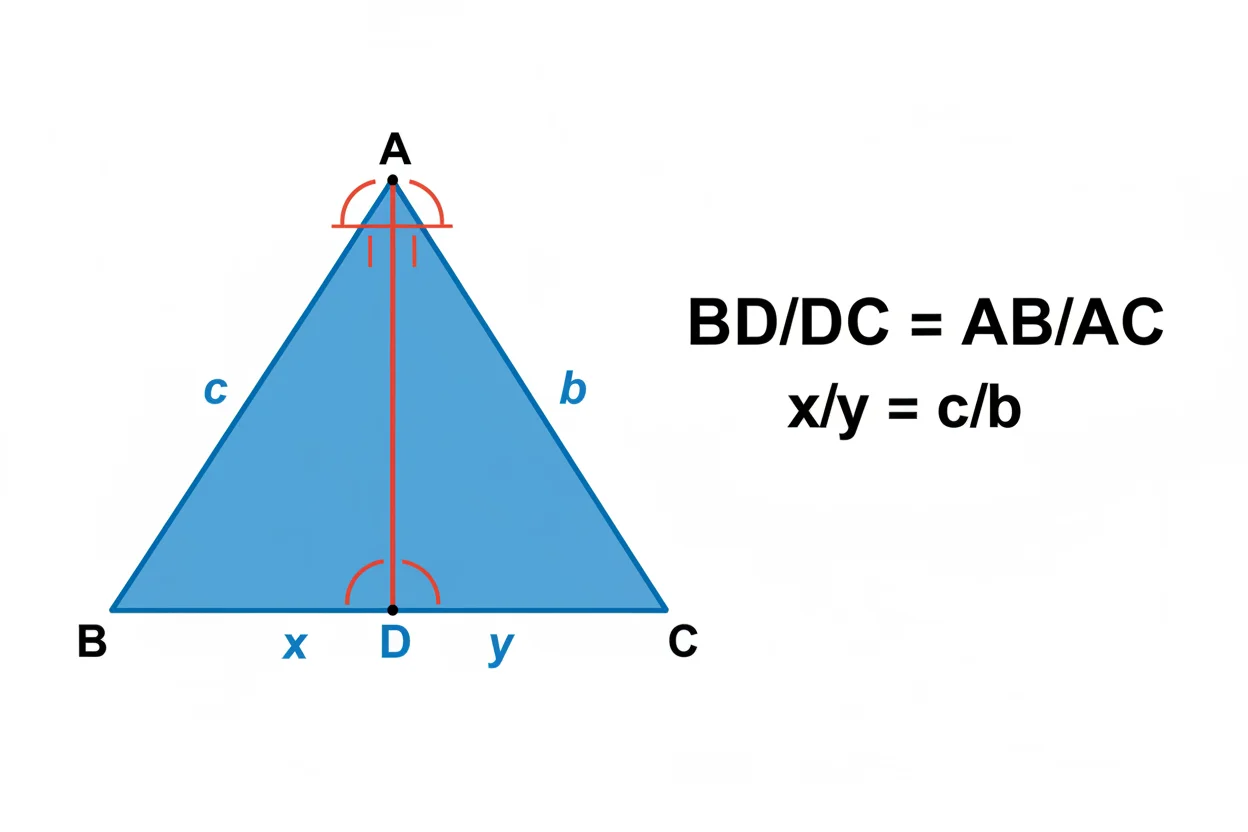

The angle bisector theorem describes how an internal angle bisector divides the opposite side of a triangle. If AD bisects angle A of triangle ABC and meets BC at D, then BD/DC = AB/AC. In other words, the two segments created on the opposite side are proportional to the two sides adjacent to the bisected angle. The theorem can be used to find unknown side lengths, segment lengths, ratios, and the location where an angle bisector meets the opposite side. It also works in reverse: if a point on a side divides that side in the same ratio as the adjacent sides, the connecting segment bisects the opposite angle. The theorem applies to any triangle, not only right, isosceles, or acute triangles. Its ratio structure connects naturally with similar-triangle reasoning, triangle areas, trigonometric laws, and coordinate geometry.
What Is the Angle Bisector Theorem?
Consider triangle ABC.
Let D lie on side BC, and suppose AD divides angle A into two equal angles:
∠BAD = ∠DAC
Then the angle bisector theorem states:
BD/DC = AB/AC
This means the angle bisector divides the opposite side proportionally to the lengths of the two adjacent sides.
If:
AB > AC
then:
BD > DC
If:
AB = AC
then:
BD = DC
The theorem therefore converts an angular condition into a side-length relationship.
It is one of the central triangle relationships within Geometry & Trigonometry.
Angle Bisector Theorem Formula
Using standard labels:
AB = c
AC = b
BC = a
and letting:
BD = m
DC = n
the theorem gives:
m/n = c/b
Since:
m + n = a
these two equations can be solved to find each segment individually.
The resulting formulas are:
BD = a·AB/(AB + AC)
and:
DC = a·AC/(AB + AC)
Using b and c notation:
m = ac/(b + c)
n = ab/(b + c)
These formulas are useful when the full opposite side length is known.
Basic Angle Bisector Example
Suppose:
AB = 8
AC = 12
and AD bisects angle A.
Then:
BD/DC = 8/12
Simplify:
BD/DC = 2/3
So the opposite side is divided in the ratio:
2 : 3
This result does not yet give the individual segment lengths unless BC is also known.
Find Both Segments From the Whole Side
Suppose:
AB = 8
AC = 12
BC = 15
Because:
BD/DC = 2/3
let:
BD = 2k
DC = 3k
Since:
BD + DC = 15
we have:
2k + 3k = 15
5k = 15
k = 3
Therefore:
BD = 6
and:
DC = 9
Check:
6/9 = 2/3
which matches:
8/12 = 2/3
Direct Segment Formula
The same calculation can be performed directly.
For BD:
BD = BC·AB/(AB + AC)
Substitute:
BD = 15(8)/(8 + 12)
= 120/20
= 6
For DC:
DC = BC·AC/(AB + AC)
= 15(12)/20
= 9
The direct formulas are simply the angle bisector theorem combined with:
BD + DC = BC
Find an Unknown Triangle Side
Suppose AD bisects angle A and:
BD = 4
DC = 6
AB = 10
Find AC.
Use:
BD/DC = AB/AC
Substitute:
4/6 = 10/AC
Simplify:
2/3 = 10/AC
Cross-multiply:
2AC = 30
Therefore:
AC = 15
The longer opposite segment corresponds to the longer adjacent side.
Find an Unknown Opposite Segment
Suppose:
AB = 9
AC = 15
BD = 6
and AD is an angle bisector.
Find DC.
Use:
BD/DC = AB/AC
So:
6/DC = 9/15
Simplify:
6/DC = 3/5
Cross-multiply:
3DC = 30
Therefore:
DC = 10
Why the Corresponding Sides Matter
The correct relationship is:
BD/DC = AB/AC
BD is adjacent to vertex B, so it corresponds to AB.
DC is adjacent to vertex C, so it corresponds to AC.
Reversing only one side of the proportion gives an incorrect result.
You may invert both ratios:
DC/BD = AC/AB
because both sides have been reversed consistently.
Angle Bisector in an Isosceles Triangle
Suppose:
AB = AC
Then the theorem gives:
BD/DC = 1
Therefore:
BD = DC
So in an isosceles triangle, the angle bisector from the vertex between the equal sides is also a median.
In this special case it is also perpendicular to the base, creating two congruent Right Triangles.
This explains why several important triangle lines coincide in an isosceles triangle.
Angle Bisector Versus Median
An angle bisector divides an angle into two equal angles.
A median divides the opposite side into two equal segments.
These are not generally the same line.
For an ordinary scalene triangle:
AB ≠ AC
so the angle bisector theorem gives:
BD ≠ DC
The angle bisector is therefore not usually a median.
They coincide when the two adjacent sides are equal.
Angle Bisector Versus Altitude
An altitude meets the opposite side at a right angle.
An angle bisector divides the vertex angle into equal parts.
The two lines generally differ.
In an isosceles triangle, however, the vertex angle bisector can simultaneously be:
an angle bisector
a median
an altitude
The Right Triangle relationships created in this special case can then be analyzed with the Pythagorean Theorem.
Converse of the Angle Bisector Theorem
The converse is also useful.
Suppose D lies on BC and:
BD/DC = AB/AC
Then:
AD
bisects:
∠BAC
Thus the proportional side division is not merely a consequence of an angle bisector; it can also prove that a segment is an angle bisector.
This form often appears in geometric proofs.
Why the Theorem Is True: Area Argument
The theorem can be understood through triangle Area.
Triangles ABD and ACD share the same altitude from A to line BC.
Therefore their area ratio equals the ratio of their bases:
Area(ABD)/Area(ACD) = BD/DC
Now calculate each area using two sides and the included angle.
Because:
∠BAD = ∠DAC
the sine factors are equal.
Thus:
Area(ABD) = 1/2 · AB · AD · sin∠BAD
and:
Area(ACD) = 1/2 · AC · AD · sin∠DAC
Taking the ratio cancels:
1/2
AD
and the equal sine values.
Therefore:
Area(ABD)/Area(ACD) = AB/AC
Combining the two area ratios gives:
BD/DC = AB/AC
This is one reason general Area Formulas are useful in geometric proofs.
Trigonometric Proof
The theorem can also be derived using the Law of Sines.
Apply the law to triangle ABD:
BD/sin∠BAD = AB/sin∠ADB
so:
BD = AB·sin∠BAD/sin∠ADB
For triangle ACD:
DC = AC·sin∠DAC/sin∠ADC
Thus:
BD/DC
= [AB·sin∠BAD·sin∠ADC] / [AC·sin∠DAC·sin∠ADB]
Because AD is an angle bisector:
sin∠BAD = sin∠DAC
Also, ∠ADB and ∠ADC are supplementary, so their sines are equal.
Everything cancels except:
BD/DC = AB/AC
Angle Bisector Length Formula
The angle bisector theorem locates D on side BC, but sometimes the length AD itself is required.
Let:
a = BC
b = AC
c = AB
and let the internal angle bisector from A have length:
ℓₐ
Then:
ℓₐ = √[bc(1 − a²/(b + c)²)]
An equivalent formula is:
ℓₐ = 2bc cos(A/2)/(b + c)
These formulas calculate the length of the bisector rather than the ratio in which it divides the opposite side.
Angle Bisector Length Example
Suppose:
a = 6
b = 5
c = 5
Then:
ℓₐ = √[25(1 − 36/100)]
= √[25(64/100)]
= √16
= 4
This agrees with the geometry of an isosceles triangle with sides:
5, 5, 6
The angle bisector divides the base into:
3 and 3
creating a 3-4-5 right triangle.
Using the Law of Cosines With an Angle Bisector
If side lengths are known but an angle is needed before using:
ℓₐ = 2bc cos(A/2)/(b + c)
the Law of Cosines can determine A:
a² = b² + c² − 2bc cosA
Therefore:
cosA = (b² + c² − a²)/(2bc)
The half-angle can then be calculated.
The alternative square-root formula for ℓₐ often avoids this extra trigonometric step.
Angle Bisectors and Similar Triangles
The angle bisector theorem produces proportional segments, which resembles the ratios found in Similar Triangles.
However, triangles ABD and ACD are not generally similar.
They share a side and have equal angles at A, but that alone does not establish similarity.
The side ratio:
BD/DC = AB/AC
comes from the angle-bisector relationship itself, not from assuming the two smaller triangles are similar.
This is an important distinction.
Angle Bisectors and Congruent Triangles
If:
AB = AC
then the theorem gives:
BD = DC
The two smaller triangles ABD and ACD then have:
AB = AC
BD = DC
AD = AD
so they satisfy SSS congruence.
The Congruent Triangles result explains why corresponding base angles and right-angle relationships emerge in the isosceles case.
In a scalene triangle, this congruence does not occur.
Coordinate Geometry Approach
The theorem can also be applied in coordinates.
Suppose:
B = (0, 0)
C = (10, 0)
and:
AB/AC = 3/2
If D is the point where the internal angle bisector meets BC, then:
BD/DC = 3/2
Since:
BC = 10
write:
BD = 3k
DC = 2k
Then:
5k = 10
so:
k = 2
Therefore:
BD = 6
and:
D = (6, 0)
The theorem locates the division point without first finding the bisector equation.
Section Ratio Interpretation
The angle bisector theorem is an example of internal division of a line segment in a specified ratio.
If:
BD : DC = m : n
then D lies:
m/(m+n)
of the way from B toward C.
For the ratio:
3 : 2
D lies:
3/5
of the distance from B to C.
This interpretation is useful in coordinate and vector geometry.
External Angle Bisector Theorem
An external angle bisector also creates a proportional relationship.
If the external bisector of angle A meets the line through BC at E, then in ordinary positive lengths:
BE/CE = AB/AC
with E lying outside segment BC when the relevant adjacent side lengths differ.
The external theorem resembles the internal angle bisector theorem, but the division occurs externally rather than between B and C.
Directed-segment notation can express the sign relationship more precisely in advanced geometry.
Internal and External Bisectors
Every non-straight angle has:
two internal/external perpendicular bisector directions
for the corresponding pair of intersecting lines.
For a triangle vertex, the internal bisector enters the triangle and meets the opposite side.
The external bisector points outside the triangle.
The internal bisectors of a triangle meet at the incenter, the center of the inscribed circle.
This gives the theorem an important role in circle-related triangle geometry.
Angle Bisectors and Circle Geometry
When an angle at the center of a circle is bisected, the two resulting central angles are equal.
Equal central angles subtend equal arcs, so their Arc Length values are equal when the radius is the same.
They also subtend equal Chord Length values.
This circle result follows from central-angle symmetry, while the triangle angle bisector theorem specifically concerns proportional division of the opposite side of a triangle.
Keeping those two settings distinct avoids applying the triangle theorem where no triangle-side ratio exists.
Angle Bisectors and Circle Area
An angle bisector through the center of a circular sector can divide the sector into equal angular portions.
Because sector area is proportional to its central angle, equal central angles create equal sector areas.
The complete Circle Area remains:
A = πr²
while individual sector areas depend on what fraction of the full angle they represent.
This is different from the triangle-side ratio formula but uses the same basic idea of dividing an angle into equal parts.
Angle Bisector and Interior Angles
The Interior Angles of a triangle sum to:
180°
If angle A has measure:
70°
its internal bisector creates two angles of:
35°
Those half-angle values can then be used in trigonometric calculations or geometric proofs.
The angle measure itself is divided equally even when the opposite side is not.
Common Angle Bisector Theorem Mistakes
A frequent mistake is assuming an angle bisector always divides the opposite side into two equal lengths. It does so only when the adjacent sides are equal.
The correct relationship is proportional:
BD/DC = AB/AC
Another mistake is pairing the wrong segments in the ratio.
BD corresponds to AB, while DC corresponds to AC.
Students may also assume triangles ABD and ACD are automatically similar. They are not generally similar.
When using the theorem to find both segments, remember:
BD + DC = BC
For an external angle bisector, the intersection lies on the extension of the opposite side rather than necessarily within the segment.
Finally, distinguish the angle bisector theorem from the angle-bisector length formula. One gives a side ratio; the other calculates the bisecting segment’s length.
Frequently Asked Questions
What is the angle bisector theorem?
If AD bisects angle A in triangle ABC and D lies on BC, then:
BD/DC = AB/AC
What does the theorem tell you?
It tells you how the angle bisector divides the side opposite the bisected angle.
Does an angle bisector divide the opposite side in half?
Not generally. It divides the side proportionally to the two adjacent side lengths.
When does an angle bisector also become a median?
When the two sides adjacent to the bisected angle are equal.
How do you find BD if BC, AB, and AC are known?
Use:
BD = BC·AB/(AB + AC)
How do you find DC?
Use:
DC = BC·AC/(AB + AC)
Can the theorem be used backward?
Yes. If:
BD/DC = AB/AC
then AD bisects angle A.
Does the theorem work for scalene triangles?
Yes. It applies to any ordinary triangle.
Is an angle bisector always perpendicular to the opposite side?
No. That occurs in special cases such as the vertex angle bisector of an isosceles triangle.
Is an angle bisector always a median?
No. A median divides the opposite side equally; an angle bisector generally divides it proportionally.
What is the angle bisector length formula?
If a = BC, b = AC, and c = AB:
ℓₐ = √[bc(1 − a²/(b + c)²)]
How can I check an angle bisector calculation?
Verify that the two opposite-side segments add to the whole side and that:
BD/DC = AB/AC
after substitution.