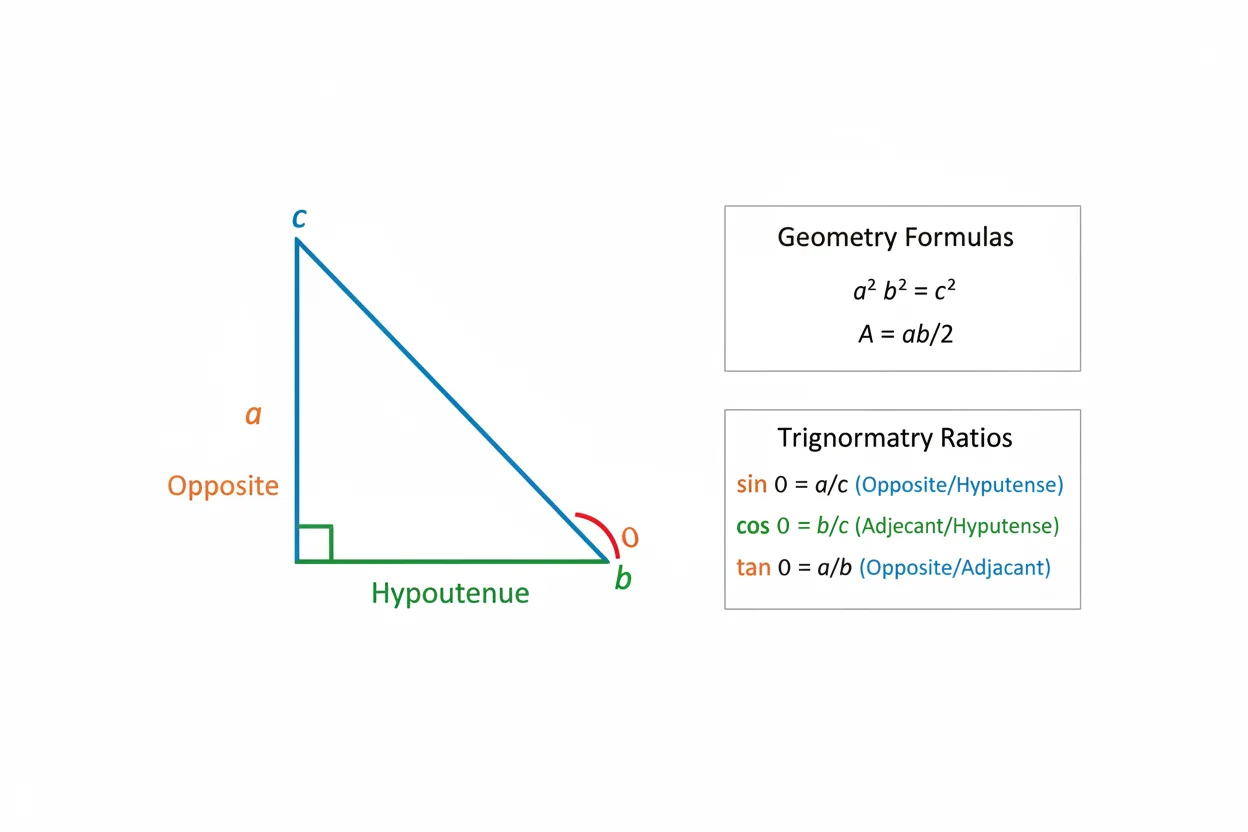

A right triangle is a triangle containing exactly one 90° angle. The two sides that meet at the right angle are called the legs, while the side opposite the right angle is the hypotenuse. If the legs are a and b and the hypotenuse is c, their fundamental relationship is a² + b² = c². The right triangle area is A = ab/2 because its legs are perpendicular, and its perimeter is P = a + b + c. Its two remaining angles are acute and complementary, so their measures add to 90°. Trigonometric ratios connect those angles with the side lengths: sine is opposite/hypotenuse, cosine is adjacent/hypotenuse, and tangent is opposite/adjacent. These relationships allow a right triangle to be solved from several combinations of known sides and angles.
What Is a Right Triangle?
A right triangle contains one angle equal to:
90°
The sides touching that angle are the:
legs
The side opposite the 90° angle is the:
hypotenuse
If the legs are:
a
and:
b
and the hypotenuse is:
c
then:
c > a
and:
c > b
because the hypotenuse is always the longest side.
Right Triangle Formula
The fundamental side relationship is the Pythagorean Theorem:
a² + b² = c²
This formula applies because a and b are perpendicular.
It can be rearranged depending on which side is unknown.
Find the Hypotenuse
If both legs are known:
c = √(a² + b²)
Suppose:
a = 6
b = 8
Then:
c = √(36 + 64)
= √100
Therefore:
c = 10
The triangle is a scaled 3-4-5 right triangle.
Find a Missing Leg
If c and one leg are known:
a = √(c² − b²)
or:
b = √(c² − a²)
Suppose:
c = 13
a = 5
Then:
b = √(169 − 25)
= √144
Therefore:
b = 12
Identify the Hypotenuse First
Before using:
a² + b² = c²
identify the side opposite the 90° angle.
That side is c.
For a right triangle with lengths:
8, 15, 17
the hypotenuse must be:
17
Check:
8² + 15² = 64 + 225
= 289
and:
17² = 289
Right Triangle Area
Because the two legs are perpendicular, one leg can be the base and the other can be the height.
Therefore:
A = ab/2
This is a special case of the general Triangle Area formula:
A = bh/2
Area Example
Suppose:
a = 9
b = 12
Then:
A = 9(12)/2
= 108/2
Therefore:
A = 54
square units.
Find a Leg From Area
Starting with:
A = ab/2
solve for a:
a = 2A/b
or:
b = 2A/a
Suppose:
A = 60
a = 10
Then:
b = 120/10
Therefore:
b = 12
Area From a Leg and Hypotenuse
If one leg a and hypotenuse c are known, first find:
b = √(c² − a²)
Then:
A = a√(c² − a²)/2
Suppose:
a = 5
c = 13
Then:
b = 12
so:
A = 5(12)/2
Therefore:
A = 30
Right Triangle Perimeter
The Perimeter is:
P = a + b + c
Suppose:
a = 3
b = 4
c = 5
Then:
P = 12
linear units.
Perimeter From Two Legs
If only the legs are known:
c = √(a² + b²)
Therefore:
P = a + b + √(a² + b²)
For:
a = 6
b = 8
we get:
P = 6 + 8 + 10
Therefore:
P = 24
Acute Angles of a Right Triangle
A triangle’s Interior Angles sum to:
180°
One angle is already:
90°
Therefore the two acute angles satisfy:
A + B = 90°
They are complementary.
If one acute angle is:
35°
the other is:
55°
Right Triangle Trigonometric Ratios
For an acute angle θ:
sinθ = opposite/hypotenuse
cosθ = adjacent/hypotenuse
tanθ = opposite/adjacent
These three ratios connect side lengths with acute angles.
The terms opposite and adjacent depend on which acute angle is being considered.
The hypotenuse remains the same.
Sine in a Right Triangle
Using Sine:
sinθ = opposite/hypotenuse
Suppose:
opposite = 5
hypotenuse = 13
Then:
sinθ = 5/13
If θ is required:
θ = sin⁻¹(5/13)
Approximately:
θ ≈ 22.62°
Cosine in a Right Triangle
Using Cosine:
cosθ = adjacent/hypotenuse
Suppose:
adjacent = 12
hypotenuse = 13
Then:
cosθ = 12/13
Therefore:
θ = cos⁻¹(12/13)
≈ 22.62°
The sine and cosine calculations describe the same angle in the 5-12-13 triangle.
Tangent in a Right Triangle
Using Tangent:
tanθ = opposite/adjacent
For:
opposite = 5
adjacent = 12
we have:
tanθ = 5/12
Therefore:
θ = tan⁻¹(5/12)
≈ 22.62°
Which Trigonometric Ratio Should You Use?
Use the ratio involving the two known or needed sides.
If you have:
opposite and hypotenuse → sine
adjacent and hypotenuse → cosine
opposite and adjacent → tangent
This avoids solving for an unnecessary third side.
Find a Leg From Hypotenuse and Angle
Suppose hypotenuse c and acute angle θ are known.
Opposite leg:
a = c sinθ
Adjacent leg:
b = c cosθ
For:
c = 10
θ = 30°
we get:
a = 10(1/2)
= 5
and:
b = 10(√3/2)
= 5√3
Find the Opposite Side From Adjacent Side and Angle
From:
tanθ = opposite/adjacent
we get:
opposite = adjacent × tanθ
Suppose:
adjacent = 12
θ = 40°
Then:
opposite = 12tan40°
Approximately:
opposite ≈ 10.07
Find the Adjacent Side
From:
tanθ = opposite/adjacent
solve:
adjacent = opposite/tanθ
If:
opposite = 8
θ = 35°
then:
adjacent = 8/tan35°
Approximately:
adjacent ≈ 11.42
Inverse Trigonometric Functions
When side lengths are known and an angle is unknown, use Inverse Trigonometric Functions.
For example:
θ = sin⁻¹(opposite/hypotenuse)
or:
θ = cos⁻¹(adjacent/hypotenuse)
or:
θ = tan⁻¹(opposite/adjacent)
For an ordinary right triangle’s acute angle, the relevant principal inverse value lies between:
0°
and:
90°
Find Both Acute Angles
Suppose a right triangle has legs:
7
and:
24
Hypotenuse:
c = 25
Let θ be opposite side 7.
Then:
θ = sin⁻¹(7/25)
Approximately:
θ ≈ 16.26°
The other acute angle is:
90° − 16.26°
Therefore:
≈ 73.74°
Degrees and Radians
Right triangle angles can be measured in either degrees or radians.
A right angle is:
90°
or:
π/2
The two acute angles satisfy:
A + B = π/2
when measured in radians.
The conversion rules in Degrees and Radians are:
radians = degrees × π/180
degrees = radians × 180/π
Radian Example
Suppose one acute angle is:
π/6
Then the other is:
π/2 − π/6
= π/3
So the triangle’s angles are:
π/6, π/3, π/2
which correspond to:
30°, 60°, 90°
45-45-90 Triangle
A 45-45-90 triangle has two equal acute angles:
45°
45°
Therefore the two legs are equal.
If each leg is x:
c = √(x² + x²)
= x√2
The side ratio is:
1 : 1 : √2
45-45-90 Example
Suppose each leg is:
8
Then:
c = 8√2
Area:
A = 8(8)/2
Therefore:
A = 32
Perimeter:
P = 16 + 8√2
Find a 45-45-90 Leg From Hypotenuse
If:
c = x√2
then:
x = c/√2
Equivalent rationalized form:
x = c√2/2
Suppose:
c = 10
Then:
x = 5√2
Each leg is:
5√2
30-60-90 Triangle
A 30-60-90 triangle has side ratio:
1 : √3 : 2
where:
shortest leg opposite 30° = x
longer leg opposite 60° = x√3
hypotenuse = 2x
These exact ratios are especially useful for geometry involving equilateral triangles and regular polygons.
30-60-90 Example
Suppose the hypotenuse is:
12
Then:
2x = 12
so:
x = 6
The longer leg is:
6√3
Thus the side lengths are:
6, 6√3, 12
Area of a 30-60-90 Triangle
Using legs:
x
and:
x√3
area is:
A = x(x√3)/2
Therefore:
A = x²√3/2
If:
x = 6
then:
A = 36√3/2
= 18√3
Pythagorean Triples
Some right triangles have integer side lengths called Pythagorean triples.
Examples include:
3-4-5
5-12-13
7-24-25
8-15-17
9-40-41
Recognizing these patterns can make right triangle calculations immediate.
Scaled Pythagorean Triples
Multiplying all sides of a right triangle by the same factor preserves the right angle.
The:
3-4-5
triangle multiplied by 2 gives:
6-8-10
Multiplying by 3 gives:
9-12-15
These triangles are Similar Triangles.
Right Triangle Similarity
Two right triangles are similar if they share one corresponding acute angle.
The other acute angle must also match because:
A + B = 90°
Therefore one equal acute angle plus the right angles is enough to establish angle-angle similarity.
Corresponding side ratios are then equal.
Similarity Example
Suppose one right triangle has sides:
3,4,5
Another has hypotenuse:
20
If they are similar:
scale factor = 20/5
= 4
Therefore the corresponding legs are:
12
and:
16
Right Triangle and Secant
The Secant ratio is the reciprocal of cosine:
secθ = hypotenuse/adjacent
If:
adjacent = 12
hypotenuse = 13
then:
secθ = 13/12
This is another way to express the same side relationship.
Cosecant and Cotangent
Likewise:
cscθ = hypotenuse/opposite
and:
cotθ = adjacent/opposite
These are reciprocals of sine and tangent.
For a 5-12-13 triangle with θ opposite 5:
cscθ = 13/5
cotθ = 12/5
The six basic trigonometric ratios all arise from the same three side lengths.
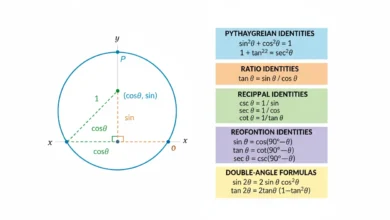
Trigonometric Identity From a Right Triangle
Take:
a² + b² = c²
Divide by:
c²
Then:
(a/c)² + (b/c)² = 1
If:
a/c = sinθ
and:
b/c = cosθ
then:
sin²θ + cos²θ = 1
This is the fundamental identity used throughout Trigonometric Identities.
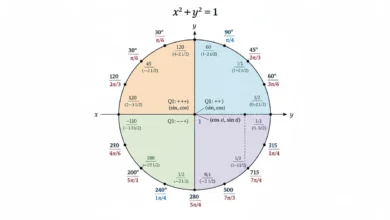
Unit Circle Connection
On the Unit Circle, radius is:
1
A point at angle θ has coordinates:
(cosθ, sinθ)
The right triangle formed with the coordinate axes satisfies:
cos²θ + sin²θ = 1
This extends right-triangle trigonometry into angles beyond the acute range.
Right Triangle From Coordinate Points
Coordinate differences can form the legs of a right triangle.
For points:
A = (x₁,y₁)
B = (x₂,y₂)
horizontal and vertical changes are:
Δx = x₂ − x₁
Δy = y₂ − y₁
The Distance Formula gives the hypotenuse-like straight-line distance:
d = √[(Δx)² + (Δy)²]
Coordinate Example
From:
A = (1,2)
to:
B = (7,10)
we have:
Δx = 6
Δy = 8
Distance:
d = √(36 + 64)
= 10
So the coordinate changes form a:
6-8-10
right triangle.
Slope and a Right Triangle
The Slope between two nonvertical points is:
m = rise/run
The rise and run can be treated as right triangle legs.
If:
rise = 3
run = 4
then:
m = 3/4
and the corresponding displacement length is:
5
The direction angle satisfies:
tanθ = 3/4
Line Direction Example
Suppose a line has:
m = 1
Then:
tanθ = 1
so:
θ = 45°
A slope triangle for such a line can use equal rise and run, forming a 45-45-90 right triangle.
This connects line geometry with the Point-Slope Form equation.
Rectangle Diagonal
A rectangle diagonal divides the rectangle into two congruent right triangles.
For length l and width w:
d = √(l² + w²)
The Rectangle Area remains:
A = lw
A diagonal problem can therefore use right triangle geometry to find a missing rectangle dimension.
Rectangle Example
Suppose:
d = 13
l = 12
Then:
w = √(169 − 144)
= 5
Rectangle area:
A = 12(5)
Therefore:
A = 60
Rhombus Diagonals Create Right Triangles
In a rhombus, the diagonals are perpendicular and bisect each other.
Therefore each of the four small triangles formed is a right triangle.
The Rhombus Area relationship:
A = d₁d₂/2
can be understood from these four right triangles.
Rhombus Example
Suppose rhombus half-diagonals are:
5
and:
12
Then its side is:
√(5² + 12²)
= 13
Full diagonals are:
10
and:
24
Area:
A = 10(24)/2
Therefore:
A = 120
Regular Polygon Right Triangles
A Regular Polygon Area problem often creates right triangles by drawing the apothem.
For side s, apothem a, and circumradius R:
a² + (s/2)² = R²
The center angle of the half-triangle is:
π/n
These relationships determine regular polygon dimensions.
Regular Hexagon Example
A regular hexagon with side:
s = 6
has circumradius:
R = 6
Half-side:
3
Apothem:
a = √(6² − 3²)
= √27
= 3√3
This creates the familiar 30-60-90 structure.
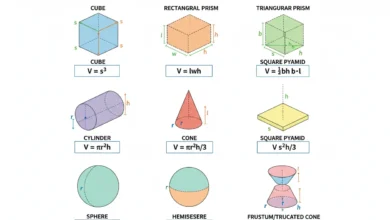
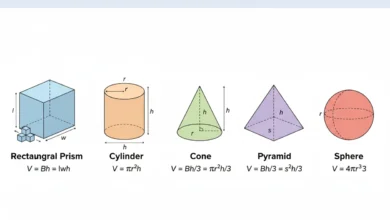
Pyramid Slant Height
A square Pyramid Volume problem may supply face slant height ℓ.
If base side is s and perpendicular pyramid height is h:
ℓ² = h² + (s/2)²
Therefore:
h = √[ℓ² − (s/2)²]
The right triangle supplies h before:
V = s²h/3
is applied.
Pyramid Example
Suppose:
s = 10
ℓ = 13
Then:
h = √(169 − 25)
= 12
Volume:
V = 100(12)/3
Therefore:
V = 400
Prism Space Diagonal
A rectangular Prism Volume problem can use right triangles in three dimensions.
For dimensions:
l, w, h
space diagonal:
d = √(l² + w² + h²)
This comes from applying the Pythagorean theorem twice.
Prism Example
Suppose:
l = 3
w = 4
h = 12
Then:
d = √(9 + 16 + 144)
= 13
The prism volume is:
3(4)(12)
= 144
Cone Cross Section
A right cone’s radius, vertical height, and slant height form a right triangle:
ℓ² = r² + h²
If:
r = 5
h = 12
then:
ℓ = 13
The slant height can then be used in cone surface calculations.
Right Triangle and Law of Cosines
The Law of Cosines states:
c² = a² + b² − 2ab cosC
For:
C = 90°
we have:
cos90° = 0
Therefore:
c² = a² + b²
So the Pythagorean theorem is the right-angle special case of the Law of Cosines.
Right Triangle and Law of Sines
The Law of Sines also applies.
If:
C = 90°
then:
sinC = 1
Therefore:
c/sin90° = c
and:
a/sinA = c
So:
sinA = a/c
which is exactly the right triangle sine ratio.
The general triangle law reduces naturally to ordinary right-triangle trigonometry.
Altitude to the Hypotenuse
Draw the altitude h from the right-angle vertex to the hypotenuse.
Suppose it divides c into segments:
p
and:
q
Then:
p + q = c
The three resulting triangles are similar.
Important relationships include:
h² = pq
a² = cp
b² = cq
These are often called geometric-mean relationships.
Altitude Example
Suppose:
p = 4
q = 9
Then:
c = 13
Altitude:
h = √(4·9)
= 6
The two legs are:
a = √(13·4)
= 2√13
and:
b = √(13·9)
= 3√13
Check:
a² + b² = 52 + 117
= 169
= 13²
Area Using Hypotenuse and Altitude
A right triangle can also use the hypotenuse as its base.
If h_c is the perpendicular altitude to c:
A = ch_c/2
This must equal:
ab/2
Therefore:
ab = ch_c
and:
h_c = ab/c
Altitude-to-Hypotenuse Example
For a 3-4-5 triangle:
h_c = 3(4)/5
Therefore:
h_c = 12/5
Area using the hypotenuse:
A = 5(12/5)/2
= 6
which matches:
3(4)/2 = 6
Inradius of a Right Triangle
For legs a, b and hypotenuse c, the inradius is:
r = (a + b − c)/2
For a 3-4-5 triangle:
r = (3 + 4 − 5)/2
Therefore:
r = 1
This can also be derived from:
Area = rs
where s is the semiperimeter.
Circumradius of a Right Triangle
A right triangle’s circumcenter is the midpoint of its hypotenuse.
Therefore the circumradius is:
R = c/2
For a:
5-12-13
triangle:
R = 13/2
This follows from the fact that the hypotenuse is a diameter of the triangle’s circumcircle.
Midpoint of the Hypotenuse
The midpoint of a right triangle’s hypotenuse is equidistant from all three vertices.
If hypotenuse endpoints are known in coordinates, the Midpoint Formula finds this circumcenter immediately.
This is a useful coordinate property of right triangles.
Example With Coordinates
Suppose a right triangle hypotenuse has endpoints:
A = (0,0)
B = (6,8)
Its midpoint is:
M = (3,4)
Hypotenuse length:
c = 10
So:
MA = MB = 5
If C is the right-angle vertex, then:
MC = 5
as well.
Right Triangle Converse
If three positive side lengths satisfy:
a² + b² = c²
with c longest, then the triangle is a right triangle.
This is the converse of the Pythagorean theorem.
For:
7,24,25
we have:
49 + 576 = 625
Therefore the triangle is right.
Distinguishing Acute and Obtuse Triangles
For longest side c:
c² < a² + b² → acute
c² = a² + b² → right
c² > a² + b² → obtuse
For:
4,5,7
we get:
49 > 16 + 25
Therefore it is obtuse rather than right.
Right Triangle Scaling
If every side is multiplied by k:
a → ka
b → kb
c → kc
Then the Pythagorean relationship remains:
(ka)² + (kb)² = (kc)²
Perimeter scales by:
k
Area scales by:
k²
All corresponding angles remain unchanged.
Scaling Example
A 3-4-5 triangle has area:
6
Scale every side by:
3
The new triangle is:
9-12-15
Area scales by:
3² = 9
Therefore:
A_new = 54
Perimeter scales from:
12
to:
36
Units
Side lengths use linear units such as:
cm
m
ft
Area uses square units such as:
cm²
m²
ft²
Angles use:
degrees
or:
radians
Keeping these measurement types distinct prevents unit errors.
Exact and Approximate Answers
A right triangle may produce irrational side lengths.
For:
a = 4
b = 7
we have:
c = √65
This is exact.
Approximately:
c ≈ 8.06
Exact radicals are often preferable until a decimal is actually required.
Common Right Triangle Mistakes
A common mistake is applying:
a² + b² = c²
without first confirming that the triangle is right.
Another is choosing the wrong hypotenuse.
The hypotenuse is always opposite the 90° angle and is the longest side.
When finding a missing leg, subtract squared values before taking the square root.
For area, use the two perpendicular legs:
A = ab/2
rather than multiplying the hypotenuse by a leg unless the correct altitude to that hypotenuse is also known.
For trigonometry, identify sides relative to the selected acute angle; “opposite” and “adjacent” change when the reference angle changes.
Keep the calculator in the correct degree or radian mode.
Finally, remember that the two acute angles must add to 90°.
Frequently Asked Questions
What is a right triangle?
A right triangle contains one 90° angle.
Which side is the hypotenuse?
The side opposite the right angle.
What is the main right triangle side formula?
a² + b² = c²
How do you find the hypotenuse?
c = √(a² + b²)
How do you find a missing leg?
a = √(c² − b²)
or:
b = √(c² − a²)
What is right triangle area?
A = ab/2
where a and b are the perpendicular legs.
What is right triangle perimeter?
P = a + b + c
What do the two acute angles add to?
90°
or:
π/2
What is sine in a right triangle?
sinθ = opposite/hypotenuse
What is cosine?
cosθ = adjacent/hypotenuse
What is tangent?
tanθ = opposite/adjacent
What is a 45-45-90 triangle ratio?
1 : 1 : √2
What is a 30-60-90 triangle ratio?
1 : √3 : 2
What is the circumradius of a right triangle?
R = c/2
What is the inradius?
r = (a + b − c)/2
How do you test whether three side lengths form a right triangle?
Put the longest side as c and check:
a² + b² = c²
How can I check a right triangle calculation?
Verify the hypotenuse is longest, confirm the Pythagorean relationship, check that the two acute angles total 90°, and use a trigonometric ratio or area calculation as a second check when enough information is available.