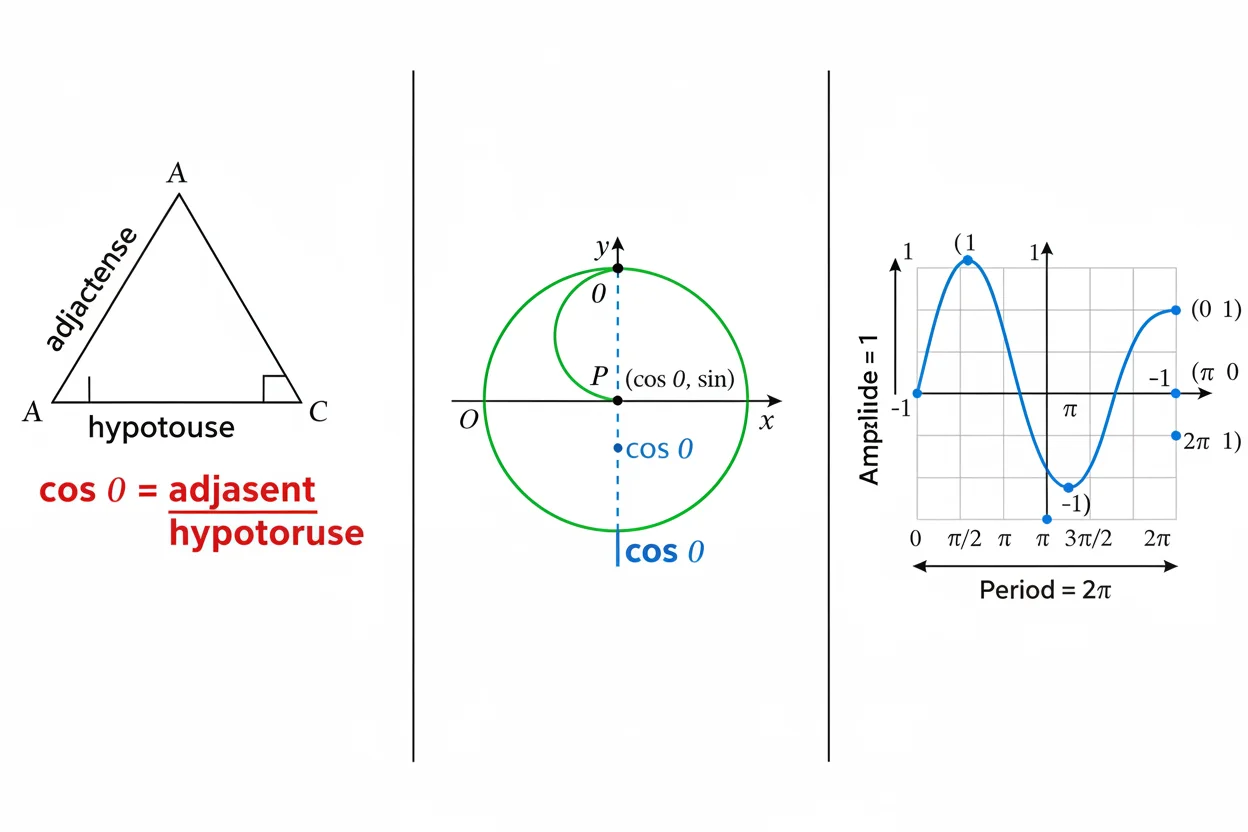

Cosine is a trigonometric function that relates an angle to horizontal position, right-triangle side ratios, and periodic motion. In a right triangle, cos θ = adjacent/hypotenuse for an acute angle θ. On the unit circle, cosine is the x-coordinate of the point reached by rotating through θ from the positive x-axis. Cosine values always lie between −1 and 1, and the function repeats every 2π radians or 360°. Cosine is positive in Quadrants I and IV and negative in Quadrants II and III. It is used to find missing triangle sides and angles, solve non-right triangles through the Law of Cosines, calculate vector angles through dot products, model waves, and resolve geometric dimensions in two and three dimensions. Understanding the connections among the triangle ratio, unit-circle definition, graph, identities, and inverse cosine makes the function useful far beyond elementary right triangles.
What Is Cosine?
Cosine is one of the six standard trigonometric functions.
It is written:
cos θ
For an acute angle in a right triangle:
cos θ = adjacent/hypotenuse
The adjacent side is the leg touching θ that is not the hypotenuse.
The hypotenuse is the longest side and lies opposite the 90° angle.
The corresponding right-triangle framework is covered more broadly in Right Triangle geometry.
Cosine Formula
For a right triangle:
cos θ = adjacent/hypotenuse
Using symbols:
cos θ = a/h
where:
a = adjacent side
h = hypotenuse
The formula can be rearranged.
To find the adjacent side:
adjacent = hypotenuse × cos θ
To find the hypotenuse:
hypotenuse = adjacent/cos θ
provided:
cos θ ≠ 0
Basic Cosine Example
Suppose:
adjacent = 8
hypotenuse = 10
Then:
cos θ = 8/10
= 4/5
= 0.8
So the cosine of θ is:
0.8
The angle itself can be found with inverse cosine.
Find a Missing Adjacent Side
Suppose:
θ = 35°
hypotenuse = 12
Use:
cos35° = adjacent/12
Therefore:
adjacent = 12cos35°
Using:
cos35° ≈ 0.81915
we obtain:
adjacent ≈ 9.83
The result is shorter than the hypotenuse, as expected.
Find the Hypotenuse
Suppose:
θ = 60°
adjacent = 7
Then:
cos60° = 7/h
Since:
cos60° = 1/2
we have:
1/2 = 7/h
Therefore:
h = 14
Find an Angle With Inverse Cosine
Suppose:
adjacent = 9
hypotenuse = 15
Then:
cos θ = 9/15
= 3/5
So:
θ = cos⁻¹(3/5)
Therefore:
θ ≈ 53.13°
The Inverse Trigonometric Functions convert known ratios back into principal angle values.
Cosine and the Pythagorean Theorem
If the opposite and adjacent legs are known, first calculate the hypotenuse using the Pythagorean Theorem:
a² + b² = c²
Suppose relative to θ:
adjacent = 12
opposite = 5
Then:
hypotenuse = √(12² + 5²)
= √169
= 13
Therefore:
cos θ = 12/13
Exact Cosine Values
Several common angles have exact cosine values.
cos0° = 1
cos30° = √3/2
cos45° = √2/2
cos60° = 1/2
cos90° = 0
In radians:
cos0 = 1
cos(π/6) = √3/2
cos(π/4) = √2/2
cos(π/3) = 1/2
cos(π/2) = 0
These exact values form the basis of many trigonometric calculations.
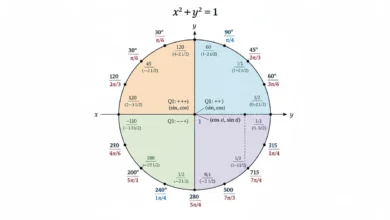
Cosine on the Unit Circle
On the Unit Circle, the point corresponding to angle θ is:
(cos θ, sin θ)
Therefore:
x = cos θ
and:
y = sin θ
This definition extends cosine beyond the acute angles of right triangles.
It gives cosine values for:
negative angles
angles greater than 90°
angles greater than 360°
and:
angles measured in radians
Why Cosine Can Be Negative
Right-triangle side lengths are positive, so elementary triangle cosine values for acute angles are positive.
On the unit circle, however, cosine is an x-coordinate.
Points on the left half of the circle have:
x < 0
Therefore cosine is negative in:
Quadrant II
and:
Quadrant III
This is how the function naturally extends beyond right-triangle ratios.
Cosine Signs by Quadrant
Cosine has these signs:
Quadrant I → positive
Quadrant II → negative
Quadrant III → negative
Quadrant IV → positive
For example:
cos120°
is negative because 120° lies in Quadrant II.
Its reference angle is:
60°
so:
cos120° = −cos60°
= −1/2
Cosine of 240°
The reference angle is:
240° − 180° = 60°
Quadrant III has negative cosine.
Therefore:
cos240° = −1/2
This shows how unit-circle signs and reference angles combine to evaluate nonacute angles.
Cosine of 330°
Reference angle:
360° − 330° = 30°
Quadrant IV has positive cosine.
Therefore:
cos330° = cos30°
= √3/2
Range of Cosine
The unit-circle x-coordinate can never be less than −1 or greater than 1.
Therefore:
−1 ≤ cos θ ≤ 1
The range of cosine is:
[−1, 1]
Any equation requiring a real cosine value outside this interval has no real solution.
Domain of Cosine
Cosine is defined for every real angle.
Therefore its real domain is:
(−∞, ∞)
Unlike reciprocal trigonometric functions such as Cosecant, cosine has no real-angle points where the function itself is undefined.
Period of Cosine
Cosine repeats after one complete revolution:
cos(θ + 2π) = cos θ
Therefore its period is:
2π radians
or:
360°
For example:
cos30° = cos390°
because:
390° = 30° + 360°
Cosine Is an Even Function
Cosine satisfies:
cos(−θ) = cos θ
This makes cosine an even function.
Geometrically, angles θ and −θ reflect across the x-axis on the unit circle.
Their y-coordinates have opposite signs, but their x-coordinates are equal.
Since cosine is the x-coordinate:
cos(−θ) = cos θ
Cosine Graph
The basic cosine function is:
y = cos x
At:
x = 0
it begins at:
y = 1
Then:
cos(π/2) = 0
cosπ = −1
cos(3π/2) = 0
cos2π = 1
This pattern repeats every:
2π
The graph oscillates smoothly between −1 and 1.
Amplitude
For:
y = A cos x
the amplitude is:
|A|
For example:
y = 3cos x
has maximum:
3
and minimum:
−3
The basic cosine graph has:
amplitude = 1
Amplitude controls vertical size, not period.
Period of a Transformed Cosine Function
For:
y = A cos(Bx)
the period is:
2π/|B|
For example:
y = cos(2x)
has period:
π
because:
2π/2 = π
A larger |B| compresses the wave horizontally.
Horizontal and Vertical Shifts
A general cosine model can be written:
y = A cos[B(x − C)] + D
where:
|A| = amplitude
2π/|B| = period
C = horizontal shift
D = vertical shift
These transformations allow cosine to model repeating phenomena with different scales and starting positions.
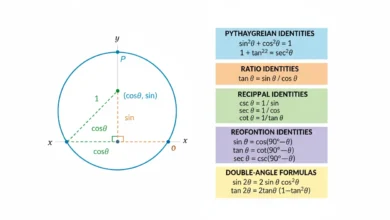
Cosine and Sine
Cosine and Sine satisfy the fundamental identity:
sin²θ + cos²θ = 1
This follows from the unit-circle equation:
x² + y² = 1
with:
x = cos θ
and:
y = sin θ
Therefore:
cos²θ + sin²θ = 1
This identity allows one function to be found from the other when the quadrant is known.
Find Cosine From Sine
Suppose:
sin θ = 3/5
and θ lies in Quadrant II.
Use:
cos²θ = 1 − sin²θ
Then:
cos²θ = 1 − 9/25
= 16/25
Therefore:
cos θ = ±4/5
Quadrant II has negative cosine, so:
cos θ = −4/5
The quadrant determines which square-root sign is correct.
Find Sine From Cosine
Suppose:
cos θ = 12/13
and θ is acute.
Then:
sin²θ = 1 − 144/169
= 25/169
Thus:
sin θ = 5/13
The positive root is appropriate for an acute angle.
Cosine and Secant
Secant is the reciprocal of cosine:
sec θ = 1/cos θ
Therefore:
cos θ = 1/sec θ
Secant is undefined wherever:
cos θ = 0
which occurs at:
θ = π/2 + nπ
Cosine itself remains defined at those angles and simply equals zero.
Cosine and Cosecant
Cosecant is reciprocal to sine:
csc θ = 1/sin θ
while:
sec θ = 1/cos θ
Cosine and cosecant therefore are not reciprocal functions of one another.
However, they can appear together through:
sin²θ + cos²θ = 1
and:
sin θ = 1/csc θ
which gives:
cos²θ + 1/csc²θ = 1
where cosecant is defined.
Cosine and Tangent
The Tangent function satisfies:
tan θ = sin θ/cos θ
where:
cos θ ≠ 0
In a right triangle:
tan θ = opposite/adjacent
Cosine contains adjacent and hypotenuse, while tangent contains opposite and adjacent.
Which function is most direct depends on the sides given in the problem.
Cosine and Cotangent
Cotangent is:
cot θ = cos θ/sin θ
For acute right-triangle angles:
cot θ = adjacent/opposite
If both cosine and sine are known, cotangent follows immediately from their ratio.
For example:
cos θ = 4/5
sin θ = 3/5
Then:
cot θ = (4/5)/(3/5)
= 4/3
Complementary-Angle Relationship
For complementary angles:
cos θ = sin(90° − θ)
In radians:
cos θ = sin(π/2 − θ)
Likewise:
sin θ = cos(π/2 − θ)
This is one of the fundamental cofunction identities.
It reflects the fact that the opposite side for one acute angle becomes the adjacent side for the other.
Degrees and Radians
Cosine works with both degree and radian measures.
For example:
60° = π/3
so:
cos60° = cos(π/3)
= 1/2
The Degrees and Radians conversion is:
radians = degrees × π/180
Always ensure a calculator’s angle mode matches the given angle unit.
Solving cos x = 1/2
On:
0 ≤ x < 2π
cosine equals 1/2 in Quadrants I and IV.
The reference angle is:
π/3
Therefore:
x = π/3
or:
x = 5π/3
For all real x:
x = 2πn ± π/3
where n is an integer.
Solving cos x = −1/2
The reference angle is:
π/3
Cosine is negative in Quadrants II and III.
Therefore on:
0 ≤ x < 2π
the solutions are:
x = 2π/3
and:
x = 4π/3
No Real Solution Example
Suppose:
cos x = 1.4
Because cosine has range:
[−1, 1]
there is no real solution.
Checking the range before performing inverse-function calculations can save unnecessary work.
Law of Cosines
The Law of Cosines extends cosine to non-right triangles.
For sides a, b, c opposite angles A, B, C:
c² = a² + b² − 2ab cosC
This formula is especially useful when:
two sides and the included angle are known
or:
all three sides are known and an angle is required
When:
C = 90°
the formula reduces to the Pythagorean theorem because:
cos90° = 0
Law of Cosines Example
Suppose:
a = 7
b = 10
C = 60°
Then:
c² = 7² + 10² − 2(7)(10)cos60°
Since:
cos60° = 1/2
we get:
c² = 49 + 100 − 70
= 79
Therefore:
c = √79
≈ 8.89
This triangle does not need to contain a right angle.
Find an Angle With the Law of Cosines
Rearrange:
c² = a² + b² − 2ab cosC
to:
cosC = (a² + b² − c²)/(2ab)
Suppose:
a = 5
b = 7
c = 8
Then:
cosC = (25 + 49 − 64)/(70)
= 10/70
= 1/7
Therefore:
C = cos⁻¹(1/7)
The inverse cosine gives the angle opposite side c.
Cosine and Congruent Triangles
The Congruent Triangles SAS criterion fixes two sides and their included angle.
The Law of Cosines shows algebraically why this determines the remaining side:
c² = a² + b² − 2ab cosC
If two triangles have identical a, b, and C, they produce the same c.
This reinforces why SAS is a valid triangle-congruence criterion.
Cosine and Similar Triangles
In Similar Triangles, corresponding sides are proportional.
For corresponding acute angles, the ratio:
adjacent/hypotenuse
is therefore unchanged.
That constant ratio is cosine.
This explains why cosine depends only on angle rather than on the absolute size of a right triangle.
Cosine and Vector Angles
The Dot Product satisfies:
u·v = |u||v|cosθ
Therefore:
cosθ = (u·v)/(|u||v|)
for nonzero vectors.
This formula extends the geometric meaning of cosine to angles between vectors in two, three, or higher dimensions.
Vector Angle Example
Let:
u = (1, 0)
v = (1, 1)
Then:
u·v = 1
Magnitudes:
|u| = 1
|v| = √2
Therefore:
cosθ = 1/√2
= √2/2
Thus:
θ = 45°
Cosine and Vector Projection
The scalar projection of vector a onto nonzero b can be interpreted as:
|a|cosθ
The Vector Projection formula is:
proj_b a = (a·b/|b|²)b
The dot product embeds cosine through:
a·b = |a||b|cosθ
So projection is fundamentally a cosine-based directional measurement.
Cosine and Chord Length
For a circle of radius r and central angle θ, Chord Length can be found through the Law of Cosines:
c² = r² + r² − 2r²cosθ
Therefore:
c = r√[2(1 − cosθ)]
This is equivalent to:
c = 2r sin(θ/2)
The cosine version comes directly from the isosceles triangle formed by two radii and the chord.
Cosine and Polar Coordinates
In Polar and Rectangular Form:
x = r cos θ
y = r sin θ
Therefore cosine determines the horizontal component of a polar position.
For:
r = 10
θ = 60°
we obtain:
x = 10cos60°
= 5
while:
y = 10sin60°
= 5√3
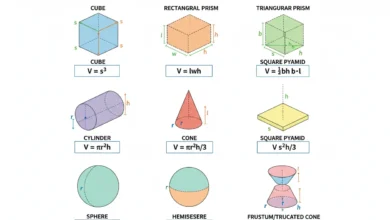
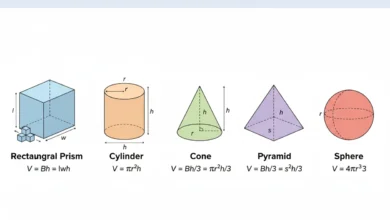
Cosine in Cone Geometry
A right circular cone’s axial cross section creates right triangles.
If θ is the angle between the cone’s axis and slant height ℓ:
cos θ = h/ℓ
Therefore:
h = ℓ cos θ
or:
ℓ = h/cos θ
The resulting perpendicular height can be used in Cone Volume, while the slant height belongs to the cone’s surface geometry.
Cone Example Using Cosine
Suppose:
ℓ = 10
and:
θ = 30°
where θ is the angle between the cone axis and slant side.
Then:
h = 10cos30°
= 10(√3/2)
= 5√3
If radius is also known, this height can be substituted into:
V = πr²h/3
Cosine provides the missing dimension; the cone formula performs the volume calculation.
Cosine in Cylinder Geometry
A cylinder’s axial cross section is a rectangle.
If the rectangle has height h and width equal to the diameter:
2r
then its diagonal d satisfies:
d² = h² + (2r)²
If θ is the angle between the diagonal and vertical side:
cos θ = h/d
Thus angle and diagonal information can determine h before applying Cylinder Surface Area:
S = 2πr² + 2πrh
Cosine is an intermediate geometric tool rather than part of the surface-area formula itself.
Cylinder Example
Suppose an axial rectangle of a cylinder has diagonal:
d = 13
and angle with the vertical side:
θ
such that:
cos θ = 12/13
Then:
h = d cos θ
= 13(12/13)
= 12
If the radius is:
r = 2.5
the total cylinder surface area can then be found from its own formula.
Cosine and Periodic Motion
Cosine frequently models repeating quantities:
y = A cos(ωt + φ) + D
Examples include idealized:
oscillations
waves
rotations
alternating signals
The function is useful when a periodic process begins at or near a maximum value because:
cos0 = 1
The amplitude, frequency, phase, and vertical offset determine the specific model.
Cosine and Circular Motion
Suppose a point moves around a circle of radius r with angular position θ.
Its horizontal coordinate is:
x = r cos θ
The vertical coordinate is:
y = r sin θ
As θ increases uniformly, x follows a cosine wave over time.
This explains why circular motion and sinusoidal graphs are closely connected.
Trigonometric Identity With Cosine
The fundamental identity is:
sin²θ + cos²θ = 1
Other identities follow from it.
For example, divide by:
cos²θ
where cosine is nonzero:
tan²θ + 1 = sec²θ
This belongs to the wider system of Trigonometric Identities.
Double-Angle Cosine
An important identity is:
cos2θ = cos²θ − sin²θ
Using:
sin²θ = 1 − cos²θ
gives:
cos2θ = 2cos²θ − 1
Alternatively:
cos2θ = 1 − 2sin²θ
These equivalent forms allow the most convenient function to be used for the information provided.
Angle-Sum Formula
Cosine satisfies:
cos(A + B) = cosA cosB − sinA sinB
For a difference:
cos(A − B) = cosA cosB + sinA sinB
These formulas can derive exact values for angles that are combinations of familiar angles.
For example:
75° = 45° + 30°
so cos75° can be evaluated exactly from known sine and cosine values.
Cosine of 75°
Use:
cos(45° + 30°)
Then:
cos75° = cos45°cos30° − sin45°sin30°
Substitute:
= (√2/2)(√3/2) − (√2/2)(1/2)
Therefore:
cos75° = (√6 − √2)/4
Common Cosine Mistakes
A common error is choosing the wrong adjacent side. The adjacent side is the leg next to the chosen angle, excluding the hypotenuse.
Another mistake is writing:
cos θ = opposite/hypotenuse
which is sine.
Cosine values must stay between −1 and 1.
For nonacute angles, use unit-circle signs rather than assuming side-ratio values remain positive.
When using inverse cosine, distinguish:
cos⁻¹x
from:
1/cos x
The first is inverse cosine; the second is secant.
For Law of Cosines calculations, match each angle to its opposite side correctly.
Finally, verify calculator degree or radian mode before evaluating a numerical angle.
Frequently Asked Questions
What is cosine?
Cosine is a trigonometric function that represents the adjacent-to-hypotenuse ratio in a right triangle and the x-coordinate on the unit circle.
What is the right-triangle cosine formula?
cos θ = adjacent/hypotenuse
What is cosine on the unit circle?
It is the x-coordinate:
x = cos θ
What is the range of cosine?
−1 ≤ cos θ ≤ 1
What is the domain of cosine?
All real numbers.
What is cos 0°?
1
What is cos 30°?
√3/2
What is cos 45°?
√2/2
What is cos 60°?
1/2
What is cos 90°?
0
In which quadrants is cosine positive?
Quadrants I and IV.
What is the period of cosine?
2π radians
or:
360°
Is cosine an even or odd function?
Even:
cos(−θ) = cos θ
How do you find an angle from cosine?
Use inverse cosine:
θ = cos⁻¹(value)
then interpret the result within the required domain or quadrant.
How is cosine related to sine?
sin²θ + cos²θ = 1
What is the Law of Cosines?
c² = a² + b² − 2ab cosC
How can I check a cosine result?
Confirm the value lies between −1 and 1, verify its sign from the angle’s quadrant, and compare it with a right-triangle or unit-circle relationship when possible.