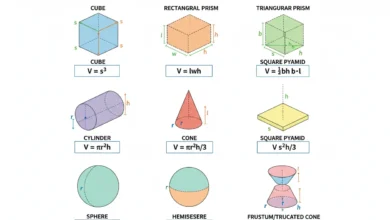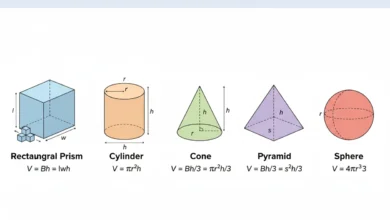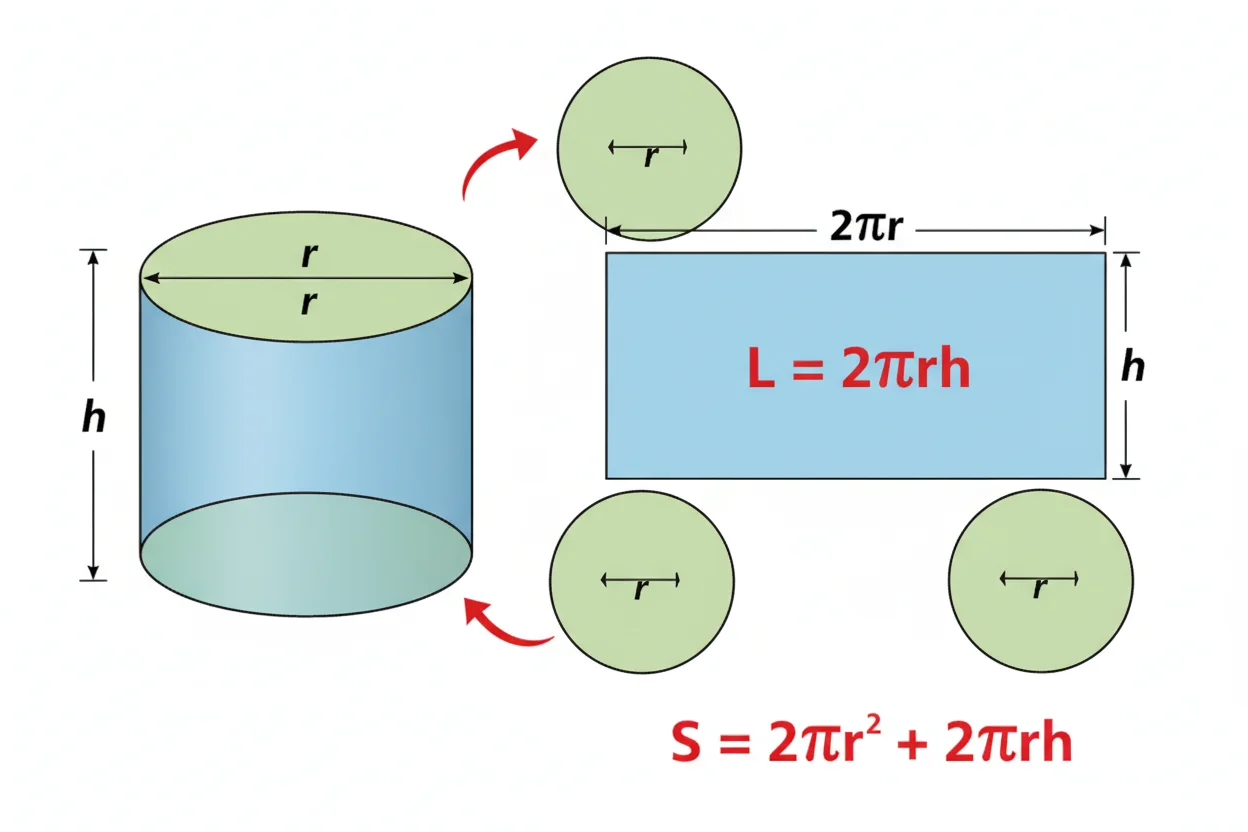

Cylinder surface area measures the total two-dimensional boundary covering a cylinder. For a closed right circular cylinder with radius r and height h, total surface area is S = 2πr² + 2πrh. The term 2πr² represents the two circular bases, while 2πrh represents the curved lateral surface. If only the curved side is required, the lateral surface area is L = 2πrh. An open cylinder may contain only one circular base or no bases, so its formula must match the surfaces actually present. A cylinder net makes the formulas easy to understand: the curved side unwraps into a rectangle whose width is the base circumference 2πr and whose height is h. Cylinder surface area is measured in square units and should not be confused with cylinder volume, which measures interior space using πr²h.
What Is Cylinder Surface Area?
A closed right circular cylinder has three boundary pieces:
top circular base
bottom circular base
curved lateral surface
Each circle has area:
πr²
so the two bases contribute:
2πr²
The lateral surface contributes:
2πrh
Therefore total cylinder surface area is:
S = 2πr² + 2πrh
The formula can be factored:
S = 2πr(r + h)
The underlying circle measurements come from Circles: Radius, Diameter, Area.
Total Cylinder Surface Area Formula
For a closed right circular cylinder:
S = 2πr² + 2πrh
where:
S = total surface area
r = radius
h = perpendicular cylinder height
An equivalent form is:
S = 2πr(r + h)
Both formulas give the same result.
Use the expanded form when you want to see the separate base and lateral contributions.
Use the factored form when algebraically solving for a dimension.
Lateral Cylinder Surface Area Formula
The lateral surface area is:
L = 2πrh
This measures only the curved side.
It excludes:
top base
and:
bottom base
For example, if:
r = 4
h = 10
then:
L = 2π(4)(10)
= 80π
square units.
Basic Total Surface Area Example
Suppose:
r = 3
h = 8
The two circular bases have total area:
2πr² = 2π(9)
= 18π
The lateral surface area is:
2πrh = 2π(3)(8)
= 48π
Add them:
S = 18π + 48π
Therefore:
S = 66π
Approximately:
S ≈ 207.35
square units.
Why Lateral Area Is 2πrh
Imagine cutting the cylinder’s curved surface vertically and unrolling it.
It becomes a rectangle.
The rectangle’s height is:
h
Its width equals the circumference of the circular base:
2πr
Therefore:
L = width × height
= (2πr)h
so:
L = 2πrh
The Circle Circumference formula is therefore built directly into cylinder lateral area.
Cylinder Net
A closed cylinder net consists of:
two circles
and:
one rectangle
The circles each have area:
πr²
The rectangle has dimensions:
2πr × h
so its area is:
2πrh
Add the three pieces:
S = πr² + πr² + 2πrh
Therefore:
S = 2πr² + 2πrh
The net provides a direct geometric derivation rather than requiring the formula to be memorized in isolation.
Base Area
Each cylinder base is a circle.
Using Circle Area:
B = πr²
Two identical bases therefore contribute:
2B = 2πr²
If a cylinder is open at one end, only one base contributes.
If both ends are open, no circular-base area is included.
Closed Cylinder
A closed cylinder includes:
two bases + lateral surface
Therefore:
S_closed = 2πr² + 2πrh
For:
r = 5
h = 12
we get:
S = 2π(25) + 2π(5)(12)
= 50π + 120π
Therefore:
S = 170π
Cylinder Open at One End
If one circular end is missing:
S = πr² + 2πrh
For:
r = 5
h = 12
we have:
S = 25π + 120π
Therefore:
S = 145π
This is smaller than the closed-cylinder area by exactly one base:
25π
Cylinder Open at Both Ends
If both circular ends are absent:
S = 2πrh
This is simply the lateral area.
For:
r = 5
h = 12
we obtain:
S = 120π
The surface specification must therefore be identified before selecting a formula.
Cylinder Surface Area From Diameter
If diameter d is given:
r = d/2
Substitute into the total formula:
S = 2π(d/2)² + 2π(d/2)h
Simplify:
S = πd²/2 + πdh
This direct formula is valid for a closed cylinder.
However, converting to radius first often reduces mistakes.
Diameter Example
Suppose:
d = 10
h = 8
Then:
r = 5
Use:
S = 2π(25) + 2π(5)(8)
= 50π + 80π
Therefore:
S = 130π
Using d = 10 as though it were the radius would produce a much larger incorrect value.
Find Height From Lateral Surface Area
Starting with:
L = 2πrh
solve for h:
h = L/(2πr)
Suppose:
L = 96π
r = 4
Then:
h = 96π/[2π(4)]
= 96/8
Therefore:
h = 12
Find Radius From Lateral Surface Area
Rearrange:
L = 2πrh
to:
r = L/(2πh)
Suppose:
L = 60π
h = 6
Then:
r = 60π/(12π)
= 5
The base diameter is therefore:
10
Find Height From Total Surface Area
Start with:
S = 2πr² + 2πrh
Subtract:
2πr²
Then:
S − 2πr² = 2πrh
Therefore:
h = [S − 2πr²]/(2πr)
This can also be written:
h = S/(2πr) − r
Total-Area Height Example
Suppose:
S = 160π
r = 5
Then:
h = 160π/(10π) − 5
= 16 − 5
Therefore:
h = 11
Check:
2π(25) + 2π(5)(11)
= 50π + 110π
= 160π
Find Radius From Total Surface Area
For a closed cylinder:
S = 2πr² + 2πrh
Divide by:
2π
to obtain:
S/(2π) = r² + hr
Rearrange:
r² + hr − S/(2π) = 0
This is a quadratic equation in r.
The positive solution is the physical radius.
Radius Example
Suppose:
S = 96π
h = 8
Then:
48 = r² + 8r
so:
r² + 8r − 48 = 0
Factor:
(r + 12)(r − 4) = 0
Therefore:
r = 4
or:
r = −12
Reject the negative value.
Thus:
r = 4
Cylinder Volume
The Cylinder Volume formula is:
V = πr²h
Volume uses:
base area × height
Surface area instead measures the exterior:
S = 2πr² + 2πrh
The formulas should not be interchanged.
Volume is measured in cubic units.
Surface area is measured in square units.
Surface Area and Volume Example
Suppose:
r = 3
h = 10
Total surface area:
S = 2π(9) + 2π(3)(10)
= 18π + 60π
= 78π
Volume:
V = π(9)(10)
= 90π
The numerical values are not directly comparable because they measure different dimensions.
Find Height From Volume, Then Surface Area
Suppose:
V = 200π
r = 5
Use:
V = πr²h
Then:
200π = 25πh
so:
h = 8
Now calculate surface area:
S = 2π(25) + 2π(5)(8)
= 50π + 80π
Therefore:
S = 130π
This combines cylinder volume information with surface geometry without confusing the two formulas.
Find Radius From Volume, Then Surface Area
Suppose:
V = 144π
h = 4
Then:
πr²(4) = 144π
so:
r² = 36
r = 6
Total surface area:
S = 2π(36) + 2π(6)(4)
= 72π + 48π
Therefore:
S = 120π
Surface Area From Base Circumference
Let base circumference be C.
Since:
C = 2πr
the lateral area is:
L = Ch
For total area:
S = 2πr² + Ch
Because:
r = C/(2π)
the two bases can also be expressed in terms of C if necessary.
This form is useful when circumference is measured directly.
Circumference Example
Suppose:
C = 14π
h = 10
Then:
r = 7
Lateral area:
L = Ch
= 14π(10)
= 140π
Two bases:
2π(49)
= 98π
Therefore:
S = 238π
Surface Area From Base Area
Suppose base area is known:
B = πr²
For a closed cylinder:
S = 2B + 2πrh
If r can be obtained from:
r = √(B/π)
then the lateral component follows.
For example, if:
B = 36π
then:
r = 6
If:
h = 5
then:
S = 72π + 60π
= 132π
Surface Area From a Circle Equation
Suppose each circular base is described by:
(x − 2)² + (y + 1)² = 25
The Circle Equation gives:
r = 5
If cylinder height is:
h = 12
then:
S = 2π(25) + 2π(5)(12)
= 50π + 120π
Therefore:
S = 170π
The base center coordinates do not affect surface area.
Cylinder Surface Area and Area Formulas
The cylinder net is an application of elementary Area Formulas.
The two bases use:
circle area = πr²
The side uses:
rectangle area = length × width
with:
length = 2πr
width = h
The total three-dimensional boundary is therefore assembled entirely from two-dimensional areas.
Cylinder Surface Area and General Surface Area
Surface Area is the total area of a solid’s exposed boundary.
For a cylinder, this means determining exactly which surfaces are present.
A closed cylinder has three exposed pieces.
A cylinder attached to another solid may have one or both bases hidden.
A hollow tube may also introduce inner curved surfaces.
The correct calculation must match the physical boundary rather than apply the closed formula automatically.
Composite Cylinder With One Hidden Base
Suppose a cylinder sits flush on a larger solid.
If its bottom circular base is completely covered by the attachment, that base is not exposed.
The cylinder contributes:
top base + curved lateral area
Therefore:
S_exposed = πr² + 2πrh
This is the same algebraic form as a cylinder open at one end, although the physical reason is different.
Two Cylinders Joined End to End
Suppose two cylinders of equal radius are joined along one circular base from each cylinder.
Those shared circles become internal.
The exposed area consists of:
two outer end circles
plus:
both lateral surfaces
If their heights are h₁ and h₂:
S = 2πr² + 2πr(h₁ + h₂)
This is equivalent to one longer cylinder of height:
h₁ + h₂
when the radii are equal.
Hollow Cylinder
A hollow cylinder, or tube, may have:
outer radius R
inner radius r
height h
Its outer curved area is:
2πRh
Its inner curved area is:
2πrh
If both annular ends are exposed, each has area:
π(R² − r²)
so total surface area is:
S = 2πRh + 2πrh + 2π(R² − r²)
This is different from the solid-cylinder formula.
Scaling Cylinder Surface Area
If every linear dimension is multiplied by scale factor k:
r → kr
h → kh
Then:
S_new = 2π(kr)² + 2π(kr)(kh)
= k²[2πr² + 2πrh]
Therefore:
S_new = k²S_old
Cylinder surface area scales with the square of the linear scale factor.
Scaling Example
Suppose a cylinder has total surface area:
50π
and every dimension is doubled.
Then:
k = 2
so:
S_new = 4(50π)
= 200π
Surface area quadruples.
Cylinder volume, by comparison, becomes eight times as large because volume scales with k³.
Radius Changes While Height Stays Fixed
If radius changes but height remains fixed, the two components scale differently.
Base area:
2πr²
depends on r².
Lateral area:
2πrh
depends linearly on r.
Therefore doubling only r does not necessarily multiply total surface area by one simple universal factor independent of h/r.
You must recompute both terms.
Height Changes While Radius Stays Fixed
If height doubles while radius remains fixed:
base area remains unchanged
while:
lateral area doubles
Therefore total surface area does not generally double.
For example, with:
r = 5
h = 4
we have:
S = 50π + 40π
= 90π
Doubling h to 8 gives:
S = 50π + 80π
= 130π
not:
180π
Similar Cylinders
Similar cylinders have a common linear scale factor.
If:
r₂/r₁ = h₂/h₁ = k
then their total surface areas satisfy:
S₂/S₁ = k²
and volumes satisfy:
V₂/V₁ = k³
This allows comparison without calculating every surface separately.
Surface Area and Degrees and Radians
Most standard cylinder surface-area problems require no angular measure because a full circular base always has circumference:
2πr
However, a partial cylinder or cylindrical sector may involve an angular fraction.
The Degrees and Radians relationship can determine what fraction of the full circumference contributes to the curved surface.
For example, a half-cylinder uses a 180° portion rather than a full 360° wrap.
Partial Cylindrical Surface
Suppose a cylindrical surface represents central angle θ degrees rather than a full revolution.
Its curved width is the corresponding arc length:
s = (θ/360°)2πr
Therefore curved area is:
L_partial = sh
so:
L_partial = (θ/360°)2πrh
For:
θ = 180°
this becomes:
L_partial = πrh
before any additional cut faces are considered.
Cylinder Dimensions From an Axial Cross Section
A plane through the axis of a right cylinder produces a rectangle.
Its width is:
2r
and its height is:
h
If its diagonal d is known:
d² = (2r)² + h²
This right-triangle relationship can provide a missing radius or height before surface area is calculated.
Axial-Diagonal Example
Suppose:
d = 10
h = 8
Then:
(2r)² = 10² − 8²
= 100 − 64
= 36
Therefore:
2r = 6
so:
r = 3
Total surface area:
S = 2π(9) + 2π(3)(8)
= 18π + 48π
= 66π
Cylinder Geometry and Cosine
If the axial rectangle’s diagonal d makes angle θ with the height, Cosine gives:
cos θ = h/d
so:
h = d cos θ
The horizontal diameter can then be calculated using the Pythagorean theorem or sine.
Once r and h are known, the surface-area formula remains:
S = 2πr² + 2πrh
Cosine Example
Suppose:
d = 10
and:
θ = 36.87°
with:
cos θ ≈ 0.8
Then:
h ≈ 10(0.8)
= 8
The remaining horizontal dimension is approximately 6, so:
r ≈ 3
This recovers the previous 6-8-10 axial rectangle.
Cylinder Geometry and Cotangent
If the same diagonal makes angle θ with the horizontal diameter, Cotangent can relate:
diameter
and:
height
directly.
For example:
cot θ = diameter/height
when the diameter is adjacent to θ and height is opposite.
Thus:
2r = h cot θ
This can be useful when an angle and one axial dimension are provided.
Cylinder Geometry and Cosecant
Cosecant may appear if the diagonal of the axial rectangle acts as a hypotenuse and one perpendicular side is opposite the chosen angle.
For example:
csc θ = diagonal/opposite
This can recover the diagonal or an axial dimension.
Cosecant is therefore an intermediate trigonometric tool; it is not part of the cylinder surface-area formula itself.
Cylinder Surface Area Versus Cone Surface Area
A closed cylinder has:
S_cylinder = 2πr² + 2πrh
A closed right cone has:
S_cone = πr² + πrℓ
The cylinder has two circular bases, while a cone has one.
The cylinder’s lateral surface unwraps to a rectangle.
The cone’s lateral surface unwraps to a sector.
These geometric differences explain the different formulas.
Cylinder and Cone With the Same Base
Suppose a cylinder and cone share radius r.
The cylinder base contributes two circles if closed:
2πr²
The cone contributes one:
πr²
Their lateral areas depend on different lengths:
cylinder → h
cone → ℓ
so comparing total surface areas requires more information than radius alone.
Minimum Material Questions
Some geometric design problems seek dimensions that minimize surface area for a fixed volume.
Because:
V = πr²h
we can write:
h = V/(πr²)
Substitute into:
S = 2πr² + 2πrh
to obtain a one-variable expression in r.
That can then be analyzed with Optimization methods.
The geometric formulas define the constraint and objective.
Units of Cylinder Surface Area
If radius and height are measured in centimeters:
r² → cm²
and:
rh → cm²
Therefore:
S → cm²
Surface area always uses square units.
By contrast:
V = πr²h
uses:
cm³
for volume.
Converting Surface-Area Units
Area conversions require squaring the linear conversion factor.
Since:
1 m = 100 cm
then:
1 m² = 10,000 cm²
So:
2.5 m² = 25,000 cm²
Do not use only a factor of 100 when converting square meters to square centimeters.
Exact and Approximate Answers
Suppose:
S = 74π
This is an exact answer.
Using:
π ≈ 3.14159
gives:
S ≈ 232.48
If a decimal is needed, round only after the full expression has been evaluated.
Keeping π through intermediate steps prevents unnecessary rounding error.
Checking With the Net
A useful verification is to calculate the three net pieces separately.
For a closed cylinder:
top = πr²
bottom = πr²
rectangle = 2πrh
Then check:
top + bottom + rectangle
equals:
2πr² + 2πrh
This can catch omitted bases and incorrect lateral-area calculations.
Common Cylinder Surface Area Mistakes
A common mistake is calculating only:
2πrh
when total surface area is required.
That gives lateral area only.
Another error is adding two bases when the cylinder is open at one or both ends.
Radius and diameter must not be confused.
The rectangle formed by unrolling the side has width:
2πr
not:
πr²
Surface area uses square units, not cubic units.
Do not substitute the volume formula:
πr²h
for surface area.
In composite solids, exclude surfaces hidden where objects are joined.
For hollow cylinders, include both inner and outer curved surfaces when they are exposed.
Finally, if dimensions are obtained from an angled axial cross section, determine which side is the radius, diameter, height, or diagonal before applying the final formula.
Frequently Asked Questions
What is the total cylinder surface area formula?
For a closed right circular cylinder:
S = 2πr² + 2πrh
What is the lateral surface area formula?
L = 2πrh
Why is lateral area 2πrh?
The curved surface unwraps into a rectangle with width equal to the base circumference 2πr and height h.
What does 2πr² represent?
The combined area of the two circular bases.
What is the formula for a cylinder open at one end?
S = πr² + 2πrh
What is the formula when both ends are open?
S = 2πrh
How do you find height from lateral area?
h = L/(2πr)
How do you find radius from lateral area?
r = L/(2πh)
How do you find height from total surface area?
h = S/(2πr) − r
for a closed cylinder.
What if diameter is given?
Use:
r = d/2
before applying the standard formula.
What is the difference between cylinder surface area and cylinder volume?
Surface area measures the boundary in square units. Volume measures interior space in cubic units.
What is the cylinder volume formula?
V = πr²h
If every cylinder dimension doubles, what happens to surface area?
It becomes:
2² = 4
times as large.
Does doubling only the height double total surface area?
No. It doubles the lateral area, but the two base areas remain unchanged.
How can I check a cylinder surface-area answer?
Verify which surfaces are exposed, calculate the two circular bases and rectangular lateral surface separately, confirm radius and height, and make sure the final units are squared.