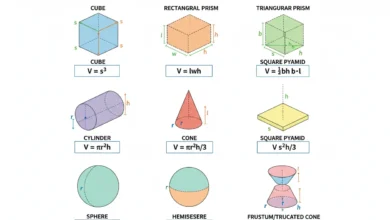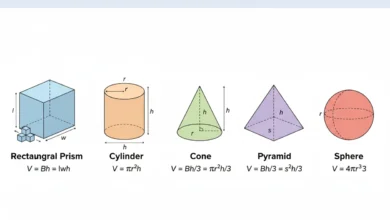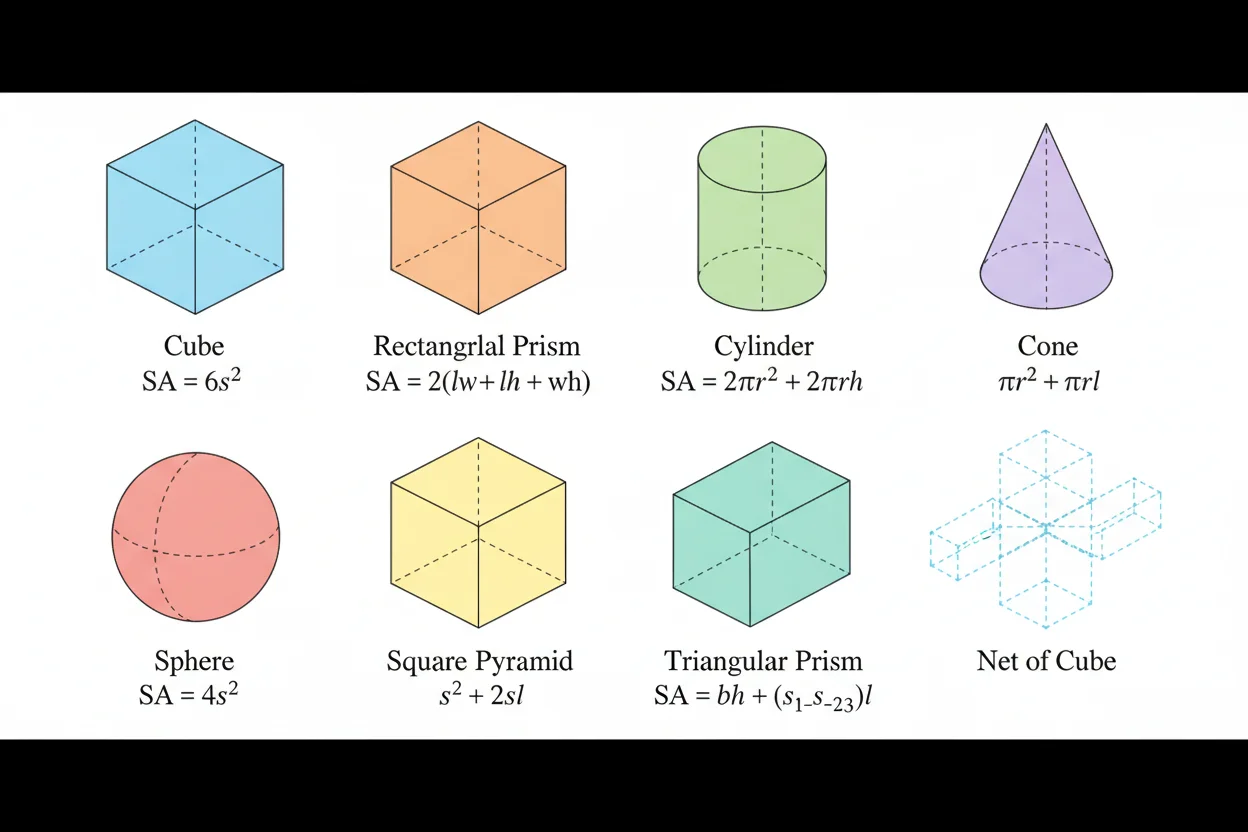

Surface area is the total area covering the outside of a three-dimensional object. To calculate it, identify every exposed face or curved surface, find each area, and add those areas without counting internal faces. A rectangular prism uses SA = 2(lw + lh + wh), a cylinder uses SA = 2πr² + 2πrh, a cone uses SA = πr² + πrℓ, and a sphere uses SA = 4πr². For prisms and many pyramids, surface area can also be understood through a net that unfolds the solid into two-dimensional regions. Although flat two-dimensional figures do not technically have surface area by themselves, their area formulas are essential because every flat face of a three-dimensional solid is a 2D shape. Surface area is measured in square units and should be distinguished from volume, which measures enclosed three-dimensional space.
What Is Surface Area?
Surface area is the combined area of all exposed surfaces of a solid.
For a polyhedron with faces:
F₁, F₂, F₃, …, Fₙ
the general principle is:
SA = A₁ + A₂ + A₃ + … + Aₙ
where each A represents the area of one exposed face.
For solids with curved surfaces, such as:
cylinders
cones
spheres
the corresponding curved-area formulas are included as part of the total.
Surface Area Versus Area
The general Area of a two-dimensional shape measures the region inside its boundary.
Examples include:
rectangle area = lw
triangle area = bh/2
circle area = πr²
Surface area extends this idea to three dimensions by adding the areas of the surfaces forming the solid’s exterior.
A cube, for example, has six square faces. Its surface area is the sum of those six square areas.
Do 2D Shapes Have Surface Area?
A purely two-dimensional shape is normally described simply by its:
area
not surface area.
A rectangle has area:
A = lw
A circle has area:
A = πr²
However, these same 2D formulas become building blocks for three-dimensional surface area.
For example, each face of a rectangular prism is a rectangle, and the two bases of a cylinder are circles.
Surface Area Uses Square Units
Because surface area is fundamentally an area measurement, it uses units such as:
mm²
cm²
m²
in²
ft²
It does not use cubic units.
Cubic units are reserved for volume.
Cube Surface Area
A cube has six congruent square faces.
If each edge has length s, one face has:
A_face = s²
There are six faces, so:
SA = 6s²
Cube Example
Suppose:
s = 5 cm
Then:
SA = 6(5²)
= 6(25)
Therefore:
SA = 150 cm²
Find Cube Edge From Surface Area
From:
SA = 6s²
solve:
s² = SA/6
Therefore:
s = √(SA/6)
Suppose:
SA = 294
Then:
s = √49
Therefore:
s = 7
Rectangular Prism Surface Area
A rectangular prism has three pairs of congruent rectangular faces.
For:
length = l
width = w
height = h
the face areas are:
lw
lh
wh
Each occurs twice.
Therefore:
SA = 2lw + 2lh + 2wh
Factor:
SA = 2(lw + lh + wh)
Rectangular Prism Example
Suppose:
l = 8
w = 5
h = 3
Then:
SA = 2[8(5) + 8(3) + 5(3)]
= 2(40 + 24 + 15)
= 2(79)
Therefore:
SA = 158
square units.
Why Face Identification Matters
A rectangular prism does not have six unrelated face areas.
Its opposite faces occur in matching pairs.
That is why:
lw
lh
and:
wh
are each multiplied by 2.
A sketch or net helps prevent a face from being omitted or counted twice.
General Right-Prism Surface Area
For a right prism with:
base area = B
base perimeter = P
prism height = h
the surface area is:
SA = 2B + Ph
The two congruent bases contribute:
2B
The lateral faces together contribute:
Ph
because the rectangular lateral faces unfold into a rectangle with dimensions:
P × h
Prism Example
Suppose a right prism has:
B = 30 cm²
P = 22 cm
h = 8 cm
Then:
SA = 2(30) + 22(8)
= 60 + 176
Therefore:
SA = 236 cm²
The corresponding Prism Volume is calculated differently:
V = Bh
Triangular Prism Surface Area
For a right triangular prism:
SA = 2B + Ph
where B is the triangular base area and P is the triangle’s perimeter.
If the triangular base has side lengths:
a, b, c
then:
P = a + b + c
If one side b has corresponding altitude h_t:
B = bh_t/2
Triangular Prism Example
Suppose the triangular base is a:
3-4-5
right triangle.
Base area:
B = 3(4)/2
= 6
Base perimeter:
P = 3 + 4 + 5
= 12
If prism length is:
10
then:
SA = 2(6) + 12(10)
Therefore:
SA = 132
square units.
Cylinder Surface Area
A closed cylinder consists of:
two circular bases
and:
one curved lateral surface
Each base has area:
πr²
The curved surface unwraps into a rectangle with:
width = circumference = 2πr
height = h
Therefore lateral area is:
2πrh
Total Cylinder Surface Area is:
SA = 2πr² + 2πrh
or:
SA = 2πr(r + h)
Cylinder Example
Suppose:
r = 4
h = 10
Then:
SA = 2π(16) + 2π(4)(10)
= 32π + 80π
Therefore:
SA = 112π
square units.
Open Cylinder
If one circular base is missing, subtract one:
πr²
from the closed-cylinder formula.
Therefore:
SA_open = πr² + 2πrh
If both circular ends are open:
SA_lateral = 2πrh
The problem must specify which surfaces actually exist or are exposed.
Cone Surface Area
A closed cone consists of:
one circular base
and:
one curved lateral surface
If:
r = radius
ℓ = slant height
then lateral area is:
πrℓ
Total Cone Surface Area is:
SA = πr² + πrℓ
Factor:
SA = πr(r + ℓ)
Cone Example
Suppose:
r = 5
ℓ = 13
Then:
SA = π(25) + π(5)(13)
= 25π + 65π
Therefore:
SA = 90π
square units.
Find Cone Slant Height
If radius r and perpendicular height h are known:
ℓ² = r² + h²
Using the Pythagorean Theorem:
ℓ = √(r² + h²)
Suppose:
r = 5
h = 12
Then:
ℓ = 13
and:
SA = 90π
Sphere Surface Area
The Sphere Surface Area formula is:
SA = 4πr²
Using diameter:
SA = πd²
because:
d = 2r
A sphere has no flat faces, edges, or vertices.
Its entire exterior is one continuous curved surface.
Sphere Example
Suppose:
r = 7
Then:
SA = 4π(49)
Therefore:
SA = 196π
square units.
Hemisphere Surface Area
A hemisphere’s curved surface area is:
2πr²
If its circular base is included, add:
πr²
Therefore total hemisphere surface area is:
3πr²
The wording must distinguish:
curved surface area
from:
total surface area
Hemisphere Example
Suppose:
r = 4
Curved area:
2π(16) = 32π
Base area:
16π
Total:
48π
square units.
Square Pyramid Surface Area
A regular square pyramid has:
square base side = s
face slant height = ℓ
Base area:
s²
Each triangular face has:
sℓ/2
There are four triangular faces.
Lateral area:
4(sℓ/2)
= 2sℓ
Therefore:
SA = s² + 2sℓ
Square Pyramid Example
Suppose:
s = 8
ℓ = 5
Then:
SA = 8² + 2(8)(5)
= 64 + 80
Therefore:
SA = 144
square units.
General Regular Pyramid Surface Area
For a regular pyramid with:
base area = B
base perimeter = P
slant height = ℓ
lateral surface area is:
L = Pℓ/2
Therefore:
SA = B + Pℓ/2
The slant height must be the altitude of a lateral triangular face.
Pyramid Example
Suppose:
B = 100
P = 40
ℓ = 13
Then:
SA = 100 + 40(13)/2
= 100 + 260
Therefore:
SA = 360
square units.
The corresponding Pyramid Volume uses perpendicular height rather than slant height:
V = Bh/3
Slant Height Versus Perpendicular Height
Surface-area calculations for pyramids and cones often require:
slant height
Volume calculations generally require:
perpendicular height
These are different measurements.
For a right square pyramid:
ℓ² = h² + (s/2)²
where:
ℓ = face slant height
h = perpendicular height
Find Pyramid Slant Height
Suppose:
h = 12
s = 10
Then:
s/2 = 5
So:
ℓ = √(12² + 5²)
= √169
Therefore:
ℓ = 13
Surface area becomes:
SA = 100 + 2(10)(13)
Therefore:
SA = 360
Frustum Surface Area
A frustum can have a lateral surface plus two bases.
For a right circular conical frustum:
L = π(R + r)ℓ
where:
R = larger radius
r = smaller radius
ℓ = slant height
Total surface area:
SA = πR² + πr² + π(R + r)ℓ
Volume uses a different formula, as described by Frustum Volume.
Nets and Surface Area
A net unfolds a three-dimensional solid into connected two-dimensional regions.
The total area of the net equals the solid’s surface area, provided:
every exterior face appears exactly once
and:
no overlap is counted twice
For polyhedra, nets are often the most intuitive way to understand surface area.
Cube Net
A cube net consists of:
6 congruent squares
If each square has side s:
total net area = 6s²
This is precisely the cube surface-area formula.
Different valid cube nets look different but have the same total area.
Rectangular Prism Net
A rectangular prism net contains:
2 rectangles of area lw
2 rectangles of area lh
2 rectangles of area wh
Adding:
SA = 2lw + 2lh + 2wh
The net exposes why all three face-pair types are required.
Surface Area of Composite Solids
A composite solid is built from two or more simpler solids.
The safest method is:
calculate exposed surfaces only
When two solids are joined, their shared contact surfaces become internal and should not be included.
Joined-Prism Example
Suppose two cubes of side:
s
are joined face-to-face.
Two separate cubes would have combined surface area:
12s²
But the two joined faces become internal.
Each has area:
s²
Subtract both:
SA = 12s² − 2s²
Therefore:
SA = 10s²
Shared-Surface Principle
If solids with surface areas:
SA₁
and:
SA₂
are joined over contact area C, then:
SA_combined = SA₁ + SA₂ − 2C
The shared surface was originally counted once on each solid, so it must be removed twice.
Cylinder With Hemisphere
Suppose a hemisphere is attached to one end of a cylinder with matching radius.
The shared circular face becomes internal.
Exposed area is:
cylinder lateral area
plus:
one exposed cylinder base
plus:
hemisphere curved area
Therefore:
SA = 2πrh + πr² + 2πr²
So:
SA = 2πrh + 3πr²
Example of Cylinder With Hemisphere
Suppose:
r = 3
h = 10
Then:
SA = 2π(3)(10) + 3π(9)
= 60π + 27π
Therefore:
SA = 87π
square units.
Surface Area With a Hole or Opening
If a face is removed from a closed solid, its area must usually be subtracted.
If a new interior wall becomes exposed because of the opening, that new surface may need to be added.
The key question is not merely what shape exists, but:
which surfaces are exposed?
Surface Area and Trapezoids
A prism or composite solid may contain trapezoidal faces.
The Trapezoid Area formula is:
A = (b₁ + b₂)h/2
If a solid has congruent trapezoidal bases, those 2D areas become part of its surface-area sum.
Trapezoidal Prism Example
Suppose each trapezoidal base has:
b₁ = 6
b₂ = 10
trapezoid height = 4
Then:
B = (6 + 10)(4)/2
= 32
If the remaining rectangular lateral faces have areas totaling:
120
then:
SA = 2(32) + 120
Therefore:
SA = 184
square units.
Triangle Faces
Many pyramids have triangular lateral faces.
The Triangle Area formula:
A = bh/2
is therefore fundamental to surface-area calculations.
For regular pyramids, all lateral triangles are congruent, allowing:
lateral area = Pℓ/2
instead of calculating every face individually.
Triangle Altitudes in Surface Area
A triangular face requires a perpendicular altitude to its chosen base.
If that altitude is not given, Triangle Altitudes may be needed to determine it.
For an isosceles triangular face with equal sides e and base s:
face altitude = √[e² − (s/2)²]
Then:
face area = s × face altitude / 2
Triangular Face Example
Suppose a lateral triangular face has:
equal sides = 13
base = 10
Half-base:
5
Altitude:
√(13² − 5²)
= 12
Face area:
10(12)/2
Therefore:
60
If four congruent faces surround a square base, lateral area is:
240
Area Versus Perimeter in Surface Problems
A face’s Perimeter is not the same as its area.
However, perimeter often helps calculate lateral surface area.
For a right prism:
lateral area = base perimeter × prism height
For a regular pyramid:
lateral area = base perimeter × slant height / 2
Thus a linear boundary measurement can contribute to a total area formula.
Surface Area From Base Perimeter
Suppose a right prism has:
base perimeter P = 30
base area B = 40
prism height h = 8
Then:
SA = 2B + Ph
= 80 + 240
Therefore:
SA = 320
Surface Area and Volume
Surface area and volume answer different questions.
Surface area measures:
exterior covering
Volume measures:
enclosed space
A large-volume solid does not necessarily have proportionally large surface area.
For similar solids:
surface area scales as k²
volume scales as k³
This distinction becomes increasingly important as size changes.
Scaling Surface Area
If every linear dimension of a solid is multiplied by k:
SA_new = k²SA_old
For example, doubling every dimension gives:
SA_new = 4SA_old
Tripling every dimension gives:
SA_new = 9SA_old
This rule applies to geometrically similar solids.
Scaling Example
Suppose a model has surface area:
72 cm²
A similar model is made with every length:
2.5
times as large.
Then:
SA_new = 2.5²(72)
= 6.25(72)
Therefore:
SA_new = 450 cm²
Surface-Area and Volume Scaling Together
If scale factor is k:
SA ratio = k²
volume ratio = k³
Suppose:
k = 3
Then:
surface area becomes 9 times as large
while:
volume becomes 27 times as large
This explains why surface-area-to-volume ratio decreases as similar solids get larger.
Find Scale Factor From Surface-Area Ratio
If:
SA₂/SA₁ = R
then:
k = √R
Suppose:
SA₂/SA₁ = 16
Then:
k = 4
The larger solid’s corresponding lengths are four times as large.
Its volume is:
4³ = 64
times as large.
Surface-Area-to-Volume Ratio
For any solid:
SA/V
compares exterior area with enclosed volume.
The exact expression depends on shape.
For a sphere:
SA/V = 3/r
For a cube:
SA = 6s²
V = s³
so:
SA/V = 6/s
In both examples, larger similar solids have smaller surface area relative to volume.
Cube Surface-Area-to-Volume Example
For:
s = 2
we have:
SA/V = 6/2
= 3
For:
s = 10
we have:
SA/V = 6/10
= 0.6
The larger cube encloses more volume relative to its exterior area.
Surface Area From Volume of a Cube
For a cube:
V = s³
Therefore:
s = ∛V
Then:
SA = 6(∛V)²
or:
SA = 6V^(2/3)
Suppose:
V = 125
Then:
s = 5
and:
SA = 150
Surface Area From Sphere Volume
For a sphere:
V = 4πr³/3
Find:
r = ∛[3V/(4π)]
Then use:
SA = 4πr²
The Sphere Volume relationship can therefore supply the radius needed for surface area.
Example From Sphere Volume
Suppose:
V = 36π
Then:
36π = 4πr³/3
Therefore:
r³ = 27
so:
r = 3
Surface area:
SA = 4π(9)
Therefore:
SA = 36π
square units.
Find a Missing Dimension From Surface Area
Surface-area equations can be rearranged to determine an unknown dimension.
For a rectangular prism:
SA = 2(lw + lh + wh)
Suppose SA, l, and w are known and h is missing.
Then:
SA/2 = lw + h(l + w)
So:
h = [SA/2 − lw]/(l + w)
Rectangular Prism Inverse Example
Suppose:
SA = 148
l = 4
w = 5
Then:
74 = 20 + 9h
Therefore:
54 = 9h
so:
h = 6
Check:
2(20 + 24 + 30) = 148
Find Cylinder Height From Surface Area
For a closed cylinder:
SA = 2πr² + 2πrh
Rearrange:
SA − 2πr² = 2πrh
Therefore:
h = [SA − 2πr²]/(2πr)
Cylinder Inverse Example
Suppose:
SA = 96π
r = 4
Then:
96π = 32π + 8πh
So:
64π = 8πh
Therefore:
h = 8
Find Sphere Radius From Surface Area
For a sphere:
SA = 4πr²
Therefore:
r = √[SA/(4π)]
If:
SA = 324π
then:
r = √81
Therefore:
r = 9
Surface Area and Coordinate Geometry
For polyhedra whose vertices are defined by coordinates, side lengths may first be found with the Distance Formula.
Those lengths then feed the appropriate face-area formulas.
Coordinate geometry is therefore often an intermediate step rather than a separate surface-area method.
Coordinate Rectangle Face Example
Suppose one rectangular face has adjacent vertices:
A = (0,0)
B = (6,0)
D = (0,8)
Then:
AB = 6
AD = 8
Face area:
48
If that rectangle is one of several exposed faces, its 48 square units are included in the overall surface-area sum.
Surface Area and Slope
The mapped Slope of an edge or cross-sectional line describes direction, not area.
Slope can help establish:
perpendicularity
parallelism
slanted dimensions
or:
coordinate face geometry
but surface area ultimately requires lengths and two-dimensional areas.
A slope value by itself is generally insufficient to determine surface area.
Tangent and Surface Geometry
The trigonometric Tangent function can help determine missing heights or slant dimensions.
For example, if a right-triangle cross section has horizontal run a and angle θ:
tanθ = h/a
Therefore:
h = a tanθ
That recovered h may then be used to calculate a face area or slant height.
Trigonometric Surface-Area Example
Suppose a triangular face has:
base = 10
and its altitude forms angle:
40°
with a horizontal run of:
4
Then:
h = 4tan40°
Once h is known:
A_face = 10h/2
The trigonometry determines a missing face dimension; the area formula determines the surface contribution.
Sphere Surface Area Versus General Surface Area
The broad surface-area principle varies by solid.
A sphere uses:
4πr²
A rectangular prism uses:
2(lw + lh + wh)
A cylinder uses:
2πr² + 2πrh
The specialist sphere page develops spherical geometry more deeply, while the general concept here is:
add all exposed surface regions using the correct formula for each region.
Exact Versus Approximate Surface Area
Expressions involving π or radicals are often best kept exact.
For example:
SA = 112π
is exact.
Approximately:
SA ≈ 351.86
If later calculations use the result, retaining π avoids unnecessary rounding.
Unit Conversion for Surface Area
Because surface area uses square units:
1 m = 100 cm
implies:
1 m² = 10,000 cm²
Therefore:
2.5 m² = 25,000 cm²
The linear conversion factor must be squared.
Mixed-Unit Example
Suppose a rectangular face measures:
2 m × 50 cm
Convert:
2 m = 200 cm
Then:
A = 200(50)
Therefore:
A = 10,000 cm²
or:
1 m²
Do not multiply measurements expressed in incompatible units without conversion.
Common Surface Area Mistakes
A common mistake is confusing surface area with volume.
Surface area uses:
square units
while volume uses:
cubic units
Another error is counting internal shared faces in composite solids.
For an open container, do not include a missing lid or base.
For cylinders and cones, distinguish curved lateral surface from total surface area.
For pyramids and cones, do not confuse slant height with perpendicular height.
When a diameter is provided for a circle or sphere, convert it correctly to radius unless using a diameter-based formula.
For irregular polyhedra, label every exposed face and count each exactly once.
Finally, square unit-conversion factors when changing measurement systems.
Frequently Asked Questions
What is surface area?
Surface area is the total area of all exposed surfaces of a three-dimensional object.
Do 2D shapes have surface area?
A flat 2D shape is normally described by its area. Its area formula may become part of a 3D solid’s surface-area calculation.
What is cube surface area?
SA = 6s²
What is rectangular prism surface area?
SA = 2(lw + lh + wh)
What is the general right-prism formula?
SA = 2B + Ph
What is cylinder surface area?
For a closed cylinder:
SA = 2πr² + 2πrh
What is cone surface area?
SA = πr² + πrℓ
What is sphere surface area?
SA = 4πr²
What is a hemisphere’s curved surface area?
2πr²
What is a hemisphere’s total surface area?
3πr²
What is regular pyramid surface area?
SA = B + Pℓ/2
What is the difference between surface area and volume?
Surface area measures exterior covering; volume measures enclosed space.
How does surface area scale?
If every length is multiplied by k:
surface area is multiplied by k²
How do you find surface area of a composite solid?
Add the exposed component surfaces and remove surfaces that become internal where solids join.
Why are nets useful?
A net unfolds the exterior into 2D faces, making it easier to identify and add every surface exactly once.
What units does surface area use?
Square units such as cm², m², ft², or in².
How can I check a surface-area calculation?
Identify every exposed face, verify the correct 2D formula for each surface, exclude internal or missing faces, check square units, and compare the result with a net or alternative formula when available.