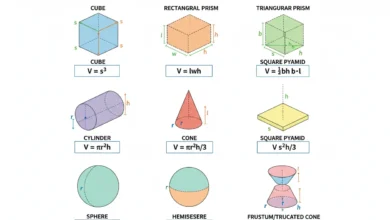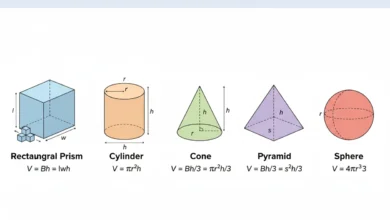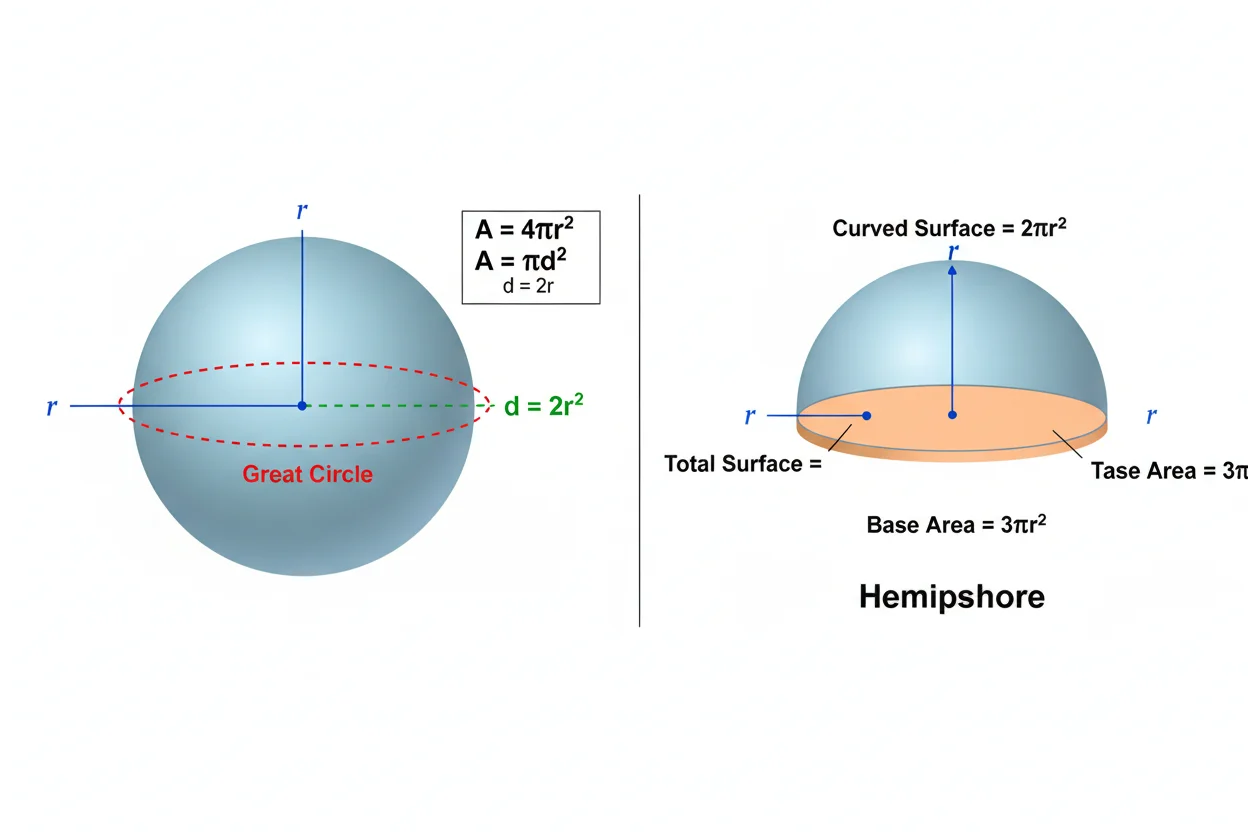

Sphere surface area measures the total area covering the outside of a sphere. For a sphere with radius r, the formula is A = 4πr². Because the diameter is d = 2r, the same formula can be written A = πd². Surface area uses square units because it measures a two-dimensional boundary wrapped around a three-dimensional object. If the radius doubles, the sphere surface area becomes four times as large; if the radius triples, the surface area becomes nine times as large. A hemisphere has curved surface area 2πr², while its total surface area including the circular base is 3πr². These relationships are useful for solving radius, diameter, covering, coating, scaling, and comparison problems involving spheres.
Sphere Surface Area Formula
For a sphere with radius r:
A = 4πr²
where:
A = surface area
r = radius
π ≈ 3.14159
The radius is the distance from the center of the sphere to any point on its surface.
Formula Using Diameter
Because:
d = 2r
we have:
r = d/2
Substitute into:
A = 4πr²
Then:
A = 4π(d/2)²
= 4π(d²/4)
Therefore:
A = πd²
So the two equivalent formulas are:
A = 4πr²
and:
A = πd²
Basic Sphere Surface Area Example
Suppose:
r = 5 cm
Then:
A = 4π(5²)
= 4π(25)
Therefore:
A = 100π cm²
Approximately:
A ≈ 314.16 cm²
The exact answer is:
100π cm²
Example Using Diameter
Suppose a sphere has:
d = 12 m
Use:
A = πd²
Then:
A = π(12²)
Therefore:
A = 144π m²
Approximately:
A ≈ 452.39 m²
The radius would be:
r = 6 m
and:
4π(6²) = 144π
confirms the same result.
Why Sphere Surface Area Uses Square Units
The sphere itself is three-dimensional, but its surface is a two-dimensional boundary.
If radius is measured in centimeters:
r² → cm²
Therefore:
4πr²
has units:
cm²
Typical sphere surface-area units include:
mm²
cm²
m²
in²
ft²
Volume, by contrast, uses cubic units.
Surface Area Versus Sphere Volume
The Sphere Volume formula is:
V = 4πr³/3
while sphere surface area is:
A = 4πr²
The exponent is important:
surface area depends on r²
volume depends on r³
Therefore surface area and volume scale differently as a sphere becomes larger.
Find Radius From Surface Area
Start with:
A = 4πr²
Divide by:
4π
Then:
r² = A/(4π)
Take the nonnegative square root:
r = √[A/(4π)]
Radius Example
Suppose:
A = 196π
Then:
r = √[196π/(4π)]
= √49
Therefore:
r = 7
Find Diameter From Surface Area
Using:
A = πd²
solve:
d² = A/π
Therefore:
d = √(A/π)
For:
A = 225π
we obtain:
d = √225
Therefore:
d = 15
The radius is:
7.5
Check an Inverse Calculation
Suppose:
A = 400π
Then:
r = √[400π/(4π)]
= √100
= 10
Substitute back:
A = 4π(10²)
= 400π
The original surface area is recovered.
Surface Area of a Hemisphere
A hemisphere is half of a sphere.
The curved portion therefore has:
A_curved = 2πr²
However, a solid hemisphere also has a flat circular base.
The base area is:
πr²
Therefore total surface area is:
A_total = 2πr² + πr²
So:
A_total = 3πr²
Curved Versus Total Hemisphere Surface Area
The wording of a problem matters.
If it asks for:
curved surface area
use:
2πr²
If it asks for:
total surface area
including the circular base, use:
3πr²
These are not interchangeable.
Hemisphere Example
Suppose:
r = 6
Curved surface area:
A_curved = 2π(36)
= 72π
Base area:
A_base = 36π
Total:
A_total = 108π
square units.
Two Hemispheres Make a Sphere
Two hemispherical curved surfaces together have:
2(2πr²)
Therefore:
4πr²
which is the surface area of a complete sphere.
If two solid hemispheres are joined along their circular bases, the bases become internal and do not contribute to the outside surface.
Sphere Surface Area and Circle Area
A great circle of a sphere has the same radius r as the sphere.
Its Circle Area is:
A_circle = πr²
Sphere surface area is:
A_sphere = 4πr²
Therefore:
A_sphere = 4A_circle
A sphere’s total surface area is exactly four times the area of one of its great-circle disks.
Great Circle Example
Suppose a sphere has radius:
8
Great-circle area:
π(8²) = 64π
Sphere surface area:
4(64π)
Therefore:
256π
The ratio is:
4 : 1
Sphere Surface Area and Circumference
A great circle has Circle Circumference:
C = 2πr
Solve:
r = C/(2π)
Substitute into:
A = 4πr²
Then:
A = 4π[C/(2π)]²
Simplify:
A = C²/π
So if great-circle circumference is known:
A = C²/π
Circumference Example
Suppose great-circle circumference is:
C = 10π
Then:
A = (10π)²/π
= 100π
The radius is:
5
which confirms:
4π(5²) = 100π
Surface Area and Diameter
Because:
A = πd²
sphere surface area has an especially simple relationship with diameter.
If diameter doubles:
d → 2d
then:
A_new = π(2d)²
= 4πd²
Therefore the surface area quadruples.
Scaling Sphere Surface Area
If radius changes by scale factor k:
r_new = kr
Then:
A_new = 4π(kr)²
Therefore:
A_new = k²A
Sphere surface area follows the standard area scaling rule.
Scaling Example
Suppose a sphere has surface area:
50π
and its radius triples.
Then:
A_new = 3²(50π)
Therefore:
A_new = 450π
The surface area becomes nine times as large.
Find Radius Scale Factor From Area Ratio
For two spheres:
A₂/A₁ = (r₂/r₁)²
Therefore:
r₂/r₁ = √(A₂/A₁)
If one sphere has four times the surface area of another:
r₂/r₁ = √4
Therefore:
r₂/r₁ = 2
Its radius is twice as large.
Surface-Area Ratio Example
Sphere 1:
r₁ = 4
Sphere 2:
r₂ = 10
Then:
A₂/A₁ = 10²/4²
= 100/16
Therefore:
A₂/A₁ = 25/4
The larger sphere has:
6.25
times as much surface area.
Similar Spheres
All spheres are geometrically similar.
If their radius ratio is:
k
then:
diameter ratio = k
circumference ratio = k
surface-area ratio = k²
volume ratio = k³
This follows the same scaling logic seen in Similar Triangles and other similar figures.
Surface Area and Volume Ratio
For a sphere:
A = 4πr²
and:
V = 4πr³/3
Divide:
A/V = (4πr²)/(4πr³/3)
Simplify:
A/V = 3/r
Therefore:
surface-area-to-volume ratio = 3/r
As radius increases, surface area becomes smaller relative to volume.
Example of Surface-Area-to-Volume Ratio
If:
r = 2
then:
A/V = 3/2
If:
r = 10
then:
A/V = 3/10
The larger sphere has less surface area per unit of volume.
Find Radius From the Surface-Area-to-Volume Ratio
If:
A/V = q
then:
q = 3/r
Therefore:
r = 3/q
For:
A/V = 0.5
we get:
r = 6
This relationship is useful when comparing geometric efficiency across differently sized spheres.
Sphere Surface Area From Volume
If volume V is known:
r = ∛[3V/(4π)]
Then:
A = 4πr²
Combining:
A = 4π[3V/(4π)]^(2/3)
Usually it is cleaner to find r first and then calculate surface area.
Example From Volume
Suppose:
V = 36π
Use:
36π = 4πr³/3
Multiply by 3:
108π = 4πr³
Therefore:
r³ = 27
so:
r = 3
Surface area:
A = 4π(9)
Therefore:
A = 36π
In this particular example, the numerical π expressions for volume and area happen to match, but their units are different.
Surface Area From a Cross Section
If a plane passes through the sphere’s center, the cross section is a great circle.
Suppose its area is:
K
Then:
K = πr²
Sphere surface area is:
4πr²
Therefore:
A_sphere = 4K
If the great-circle cross-sectional area is:
25π
then sphere surface area is:
100π
Find Radius From Great-Circle Area
If:
K = πr²
then:
r = √(K/π)
Once r is found:
A_sphere = 4K
The multiplication-by-four relationship is often faster than solving radius explicitly.
Surface Area of a Spherical Zone
A spherical zone is the portion of a sphere between two parallel planes.
For sphere radius R and zone height h:
A_zone = 2πRh
This formula depends only on:
sphere radius R
and:
perpendicular zone height h
It does not directly depend on the radii of the two boundary circles.
Spherical Zone Example
Suppose:
R = 10
h = 4
Then:
A_zone = 2π(10)(4)
Therefore:
A_zone = 80π
square units.
Hemisphere as a Spherical Zone
For a hemisphere:
h = R
Using:
A_zone = 2πRh
we obtain:
A = 2πR²
This is exactly the curved surface area of a hemisphere.
The flat circular base is not part of the spherical zone.
Entire Sphere as a Zone
For the complete sphere, the vertical height from one pole to the other is:
h = 2R
Then:
A = 2πR(2R)
Therefore:
A = 4πR²
The zone formula recovers the full sphere surface-area formula.
Spherical Cap Surface Area
A spherical cap is the portion of a sphere cut off by a single plane.
If its vertical cap height is h on a sphere of radius R:
A_cap = 2πRh
This measures only the curved spherical surface.
If the circular cut face must also be included, its area must be added separately.
Surface Area of Revolution Connection
A sphere can be generated by rotating a semicircle about its diameter.
The upper semicircle is:
y = √(r² − x²)
Rotating it about the x-axis creates a sphere.
The Surface Area of Revolution formula is:
A = 2π ∫ y√[1 + (dy/dx)²] dx
from:
x = −r
to:
x = r
For the semicircle, the expression simplifies to:
4πr²
This provides a calculus derivation of the sphere formula.
Why the Sphere Formula Is Not πr²
The formula:
πr²
describes the area of a flat circle.
A sphere contains an entire curved surface around all directions.
Its area is:
4πr²
A great-circle disk is useful for comparison, but it is not the same geometric object as the sphere’s boundary.
Sphere Versus Cylinder Surface Area
A cylinder with radius r and height h has total Cylinder Surface Area:
A = 2πr² + 2πrh
For a cylinder whose:
radius = r
height = 2r
the total surface area is:
2πr² + 4πr²
= 6πr²
The sphere of radius r has:
4πr²
Therefore the cylinder has:
3/2
times the total surface area of the sphere.
Sphere Versus Cone Surface Area
A cone uses:
curved area = πrℓ
and:
total area = πr² + πrℓ
where ℓ is slant height.
The Cone Surface Area therefore depends on an additional linear measurement.
A sphere needs only its radius:
A = 4πr²
Sphere and General Surface Area
The broader Surface Area concept measures the complete exterior boundary of a three-dimensional object.
For polyhedra, individual face areas are often added.
For a sphere, there are no flat faces or edges to sum.
Its continuous curved boundary is captured directly by:
4πr²
Surface Area of a Hollow Spherical Shell
Suppose a hollow shell has:
outer radius R
inner radius r
If both the outside and inside curved surfaces are exposed, total surface area is:
A = 4πR² + 4πr²
Therefore:
A = 4π(R² + r²)
This differs from the shell’s material volume, which involves a difference of cubes.
Hollow Shell Example
Suppose:
R = 6
r = 5
Then:
A = 4π(36 + 25)
Therefore:
A = 244π
square units
if both inner and outer surfaces are counted.
Coating a Sphere
If a uniform coating covers a spherical surface, the amount needed per unit thickness is often based on:
A = 4πr²
For example, if one unit of coating covers:
2 m²
and a sphere has area:
50 m²
the idealized amount required is:
25 units
The geometry determines the surface to be covered.
Percentage of a Sphere’s Surface
If a region occupies fraction f of the complete spherical surface:
A_region = f(4πr²)
For:
f = 1/4
we get:
A_region = πr²
A quarter of a sphere’s surface has the same numerical area as one great-circle disk.
Find Surface Fraction
If a region has area A_region and sphere radius r:
fraction = A_region/(4πr²)
Percentage:
100A_region/(4πr²)
For:
A_region = 20π
r = 5
total surface area is:
100π
so the region covers:
20%
of the sphere.
Latitude-Style Zone Area
A spherical band can also be described using angular positions.
If its vertical height h can be determined from Sine or cosine relationships, then:
A_zone = 2πRh
For a sphere of radius R, vertical coordinate relative to the equatorial plane can be represented using trigonometric components.
The angular geometry determines h; the zone formula then determines area.
Polar Coordinate Perspective
In Polar and Rectangular Form, a great-circle cross section can be described radially.
A sphere requires an additional third dimension, but its radius remains constant in every direction from the center.
This radial symmetry explains why sphere formulas depend only on r rather than orientation or slope.
Does Slope Affect Sphere Surface Area?
No.
The mapped Slope of a tangent line or cross-sectional curve can describe local direction, but the sphere’s total surface area depends only on radius:
A = 4πr²
Changing the coordinate orientation does not change r or A.
Tangent Geometry at a Sphere
In a two-dimensional great-circle cross section, a tangent to the circle is perpendicular to the radius at the point of tangency.
This right-angle relationship can help determine distances or angles involving the sphere.
However, tangent-line measurements do not alter the surface-area formula.
Scaling With Diameter
Because:
A = πd²
if diameter changes from d₁ to d₂:
A₂/A₁ = (d₂/d₁)²
For:
d₁ = 6
d₂ = 15
we get:
A₂/A₁ = 225/36
Therefore:
A₂/A₁ = 25/4
Percentage Increase in Radius
Suppose radius increases by:
20%
Then:
r_new = 1.2r
Surface area becomes:
A_new = (1.2)²A
Therefore:
A_new = 1.44A
The surface area increases by:
44%
A 20% radius increase does not produce merely a 20% surface-area increase.
Percentage Decrease in Radius
If radius decreases by:
10%
then:
r_new = 0.9r
Therefore:
A_new = 0.9²A
= 0.81A
The surface area decreases by:
19%
Converting Surface-Area Units
Because surface area is squared, conversion factors must also be squared.
Since:
1 m = 100 cm
then:
1 m² = 10,000 cm²
Therefore:
3 m² = 30,000 cm²
Do not use the linear factor 100 by itself when converting square units.
Mixed-Unit Problems
If diameter is given in centimeters but the requested surface area is in square meters, convert either before or after calculation consistently.
For example:
d = 200 cm = 2 m
Then:
A = π(2²)
Therefore:
A = 4π m²
This is equivalent to calculating in cm² and converting afterward.
Exact Versus Approximate Answers
Suppose:
A = 196π
This is exact.
Using:
π ≈ 3.14159
gives:
A ≈ 615.75
Both forms are valid, but exact π form is preferable when further symbolic calculations follow.
Common Sphere Surface Area Mistakes
A common mistake is using:
πr²
instead of:
4πr²
The former is circle area.
Another error is using diameter as though it were radius in:
4πr²
If diameter is given, either divide it by 2 first or use:
A = πd²
For a hemisphere, distinguish curved surface area:
2πr²
from total surface area:
3πr²
Do not report cubic units.
When scaling a sphere, surface area changes with the square of the scale factor, not the cube.
For hollow shells, determine whether the problem asks for the outside surface only or both inside and outside surfaces.
Finally, keep exact π values until a decimal approximation is actually useful.
Frequently Asked Questions
What is the sphere surface area formula?
A = 4πr²
What is the formula using diameter?
A = πd²
How do you find radius from surface area?
r = √[A/(4π)]
How do you find diameter from surface area?
d = √(A/π)
What is the curved surface area of a hemisphere?
2πr²
What is the total surface area of a hemisphere?
3πr²
How is sphere surface area related to great-circle area?
A_sphere = 4A_great-circle
How is surface area related to volume?
A/V = 3/r
What is the surface area of a spherical zone?
A = 2πRh
What is the curved area of a spherical cap?
A = 2πRh
where h is cap height.
How does sphere surface area scale?
If radius is multiplied by k:
surface area is multiplied by k²
What happens if radius doubles?
Surface area becomes:
4 times
as large.
What happens if diameter triples?
Surface area becomes:
9 times
as large.
Is sphere surface area measured in square or cubic units?
Square units.
How can I check a sphere surface area calculation?
Verify whether the given measurement is radius or diameter, calculate with both A = 4πr² and A = πd² when possible, confirm square units, and check that scaling follows the square of the radius ratio.