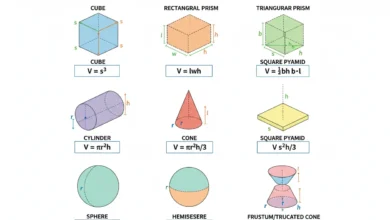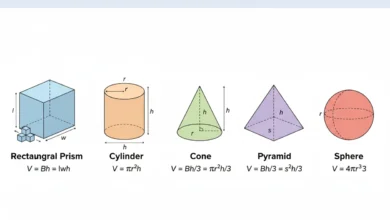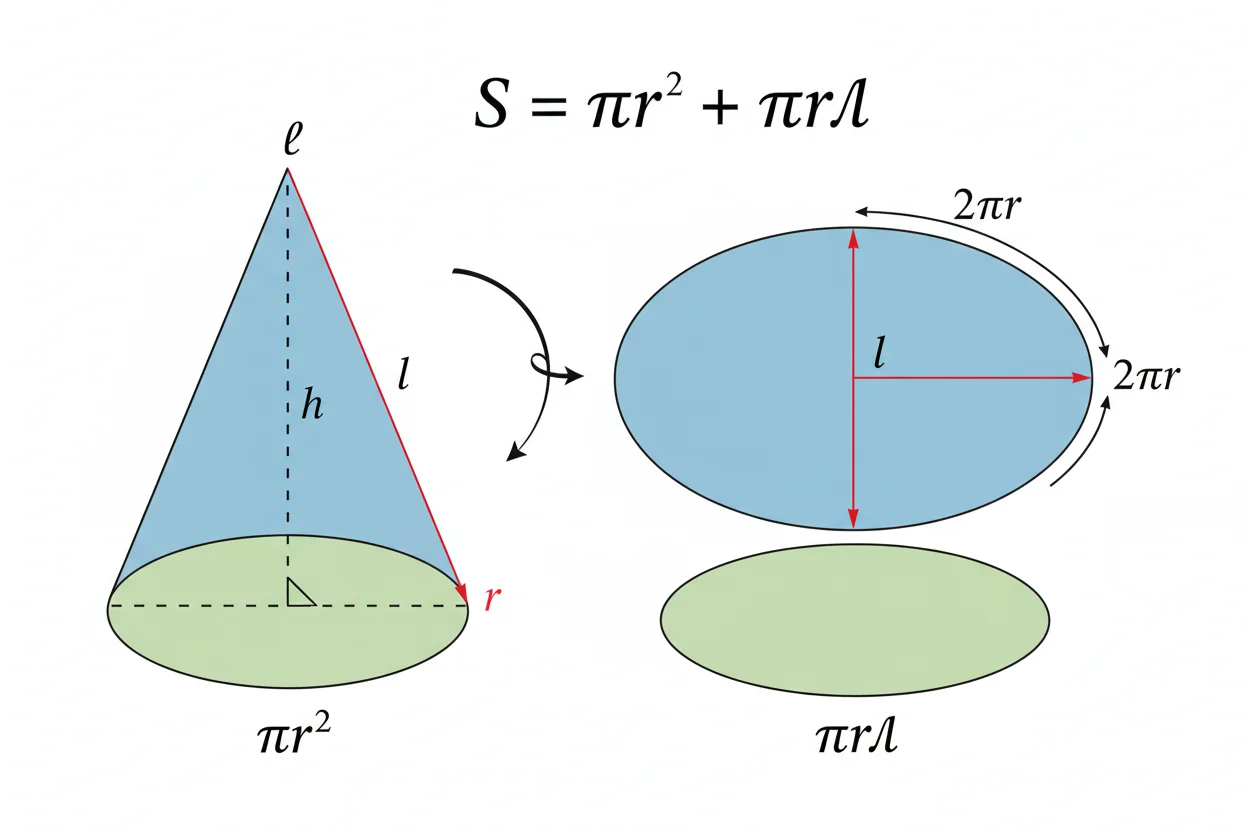

Cone surface area measures the two-dimensional boundary covering a cone. For a right circular cone with radius r and slant height ℓ, the total surface area is S = πr² + πrℓ. The first term is the area of the circular base, while the second term is the curved lateral surface area. If only the curved surface is required, use L = πrℓ. When radius r and perpendicular height h are known instead of slant height, calculate ℓ = √(r² + h²) before applying the surface-area formula. The slant height is not normally interchangeable with the perpendicular height because they represent different segments of the cone. Cone surface area is measured in square units and differs from cone volume, which measures interior space in cubic units. Understanding the cone’s net—a circular base plus a sector—makes both surface-area formulas easier to interpret.
What Is Cone Surface Area?
A right circular cone has two main boundary parts:
a circular base
and:
a curved lateral surface
The base contributes:
πr²
The curved surface contributes:
πrℓ
Therefore total cone surface area is:
S = πr² + πrℓ
Factor πr:
S = πr(r + ℓ)
where:
r = base radius
ℓ = slant height
This formula applies to a complete closed cone including its base.
The circle relationships underlying the base are summarized in Circles: Radius, Diameter, Area.
Total Cone Surface Area Formula
For a right circular cone:
S = πr² + πrℓ
or:
S = πr(r + ℓ)
The components are:
base area = πr²
lateral area = πrℓ
If the problem asks for total surface area, include both.
If it asks only for curved or lateral surface area, omit the base term.
Lateral Cone Surface Area Formula
The lateral surface area is:
L = πrℓ
This measures only the curved side.
For example, if:
r = 5
ℓ = 12
then:
L = π(5)(12)
= 60π
If the base is also included:
S = 25π + 60π
= 85π
The wording of the problem determines which quantity is required.
Slant Height
The slant height:
ℓ
runs from the cone’s apex to a point on the edge of its circular base along the surface.
The perpendicular height:
h
runs directly from the apex to the center of the base.
For a right circular cone:
ℓ > h
whenever:
r > 0
These lengths form a right triangle with the radius.
Slant Height Formula
A cross section through the cone’s axis creates a right triangle with legs:
r
and:
h
and hypotenuse:
ℓ
By the Pythagorean Theorem:
ℓ² = r² + h²
Therefore:
ℓ = √(r² + h²)
The positive root is used because length is nonnegative.
Find Slant Height Example
Suppose:
r = 5
h = 12
Then:
ℓ = √(5² + 12²)
= √(25 + 144)
= √169
= 13
The cone therefore contains a familiar:
5-12-13
right-triangle cross section.
Total Surface Area From Radius and Height
Using:
ℓ = √(r² + h²)
the total formula becomes:
S = πr² + πr√(r² + h²)
or:
S = πr[r + √(r² + h²)]
This is useful when the problem supplies:
radius
and:
perpendicular height
rather than slant height.
Basic Cone Surface Area Example
Suppose:
r = 3
ℓ = 5
Lateral area:
L = π(3)(5)
= 15π
Base area:
B = π(3²)
= 9π
Total:
S = 15π + 9π
= 24π
Approximately:
S ≈ 75.40
square units.
Example With Radius and Height
Suppose:
r = 6
h = 8
First calculate slant height:
ℓ = √(6² + 8²)
= √100
= 10
Then:
S = π(6²) + π(6)(10)
= 36π + 60π
Therefore:
S = 96π
Approximately:
S ≈ 301.59
square units.
Curved Surface Only
For the same cone:
r = 6
ℓ = 10
the lateral area is:
L = πrℓ
= 60π
The total area is:
96π
The difference:
36π
is exactly the circular base area.
This is a useful check:
S − L = πr²
Why the Lateral Formula Is πrℓ
Cut the cone’s curved surface along one slant line and flatten it.
The lateral surface becomes a sector of a larger circle.
The sector radius is:
ℓ
because every line from the cone apex to the base edge has slant length ℓ.
The sector’s arc length equals the Circle Circumference of the cone’s base:
s = 2πr
For a sector with radius ℓ and arc length s, its area is:
A = ℓs/2
Therefore:
L = ℓ(2πr)/2
= πrℓ
This geometric derivation explains the lateral-area formula.
Cone Net
A cone net consists of:
one circle
and:
one sector
The circle has radius:
r
and area:
πr²
The sector has radius:
ℓ
and arc length:
2πr
Its area is:
πrℓ
Adding them gives:
S = πr² + πrℓ
A net makes the otherwise curved surface easier to analyze as ordinary planar area.
Sector Angle of a Cone Net
Let α be the sector’s central angle in radians.
The sector arc length is:
s = ℓα
But that arc must equal the base circumference:
2πr
Therefore:
ℓα = 2πr
and:
α = 2πr/ℓ
In degrees:
α = 360°r/ℓ
Because:
r ≤ ℓ
the sector angle is at most 360°.
Cone Net Angle Example
Suppose:
r = 4
ℓ = 10
Then:
α = 360°(4/10)
= 144°
So the flattened curved surface is a sector of radius 10 with central angle:
144°
Its arc length is:
(144/360)2π(10)
= 8π
which matches the base circumference:
2π(4) = 8π
Cone Base Area
The base is a circle.
Its area is:
B = πr²
The specialist Circle Area relationship supplies this component directly.
For:
r = 7
the base area is:
49π
Any total cone surface-area calculation must include this term unless the base is explicitly excluded.
Cone Base Circumference
The base circumference is:
C = 2πr
This quantity determines the arc length of the cone’s unfolded lateral sector.
For:
r = 7
the base circumference is:
14π
The curved surface must wrap exactly once around this boundary.
This is why circumference, rather than circle area, appears in the derivation of:
L = πrℓ
Find Radius From Lateral Surface Area
Start with:
L = πrℓ
If ℓ is known:
r = L/(πℓ)
Suppose:
L = 84π
ℓ = 12
Then:
r = 84π/(12π)
= 7
Therefore the base radius is:
7
Find Slant Height From Lateral Surface Area
Rearrange:
L = πrℓ
to:
ℓ = L/(πr)
If:
L = 48π
r = 6
then:
ℓ = 48π/(6π)
= 8
The curved surface therefore has slant height 8.
Find Radius From Total Surface Area and Slant Height
From:
S = πr² + πrℓ
divide by π:
S/π = r² + ℓr
Rearrange:
r² + ℓr − S/π = 0
This is a quadratic equation in r.
The physically meaningful solution is the positive root.
For some values, the factorization is simple.
Example of Solving for Radius
Suppose:
S = 60π
and:
ℓ = 7
Then:
60 = r² + 7r
so:
r² + 7r − 60 = 0
Factor:
(r + 12)(r − 5) = 0
Thus:
r = 5
or:
r = −12
Reject the negative length.
Therefore:
r = 5
Check:
S = 25π + 35π
= 60π
Find Height After Finding Slant Height
Suppose:
r = 5
and:
ℓ = 13
Use:
ℓ² = r² + h²
Then:
h² = ℓ² − r²
= 169 − 25
= 144
Therefore:
h = 12
This relationship is useful when a surface-area problem eventually asks for another cone dimension.
Surface Area Versus Cone Volume
The Cone Volume formula is:
V = πr²h/3
Cone surface area is:
S = πr² + πrℓ
The formulas use different cone lengths.
Volume uses:
perpendicular height h
Lateral surface area uses:
slant height ℓ
This distinction is one of the most common sources of cone errors.
Surface Area and Volume Example
Suppose:
r = 3
h = 4
Then:
ℓ = 5
Surface area:
S = 9π + 15π
= 24π
Volume:
V = π(3²)(4)/3
= 12π
Even though both formulas contain π and radius, they describe different quantities and use different units.
Surface Area Versus Base Area
The base area alone is:
πr²
The total cone surface area also contains:
πrℓ
Therefore:
total surface area > base area
for any nondegenerate cone.
If a calculated total surface area equals or falls below πr², the lateral component has probably been omitted or miscalculated.
Open Cone Surface Area
Some practical objects shaped like cones do not include a base.
For an open cone:
surface area = lateral area
so:
S_open = πrℓ
Examples can include certain funnels or conical coverings.
A closed solid cone includes:
S_closed = πrℓ + πr²
Always determine whether the circular base is part of the surface being measured.
Cone Without Tip Versus Full Cone
A cone with its top removed is a frustum.
Its lateral area is not calculated with the full-cone formula using only one radius.
A frustum has:
two radii
and its own lateral geometry.
If a problem explicitly describes a truncated cone, use the appropriate frustum relationships rather than treating it as a complete cone.
Scaling Cone Surface Area
Suppose every linear dimension of a cone is multiplied by:
k
Then:
r → kr
h → kh
ℓ → kℓ
Surface area becomes:
S_new = π(kr)² + π(kr)(kℓ)
= k²[πr² + πrℓ]
Therefore:
S_new = k²S
Cone surface area scales with the square of the linear scale factor.
Scaling Example
Suppose a cone has total surface area:
50π
and every length is doubled.
Then:
k = 2
so:
S_new = 2²(50π)
= 200π
Surface area quadruples.
By comparison, cone volume scales by:
k³
so doubling every dimension multiplies volume by 8.
Similar Cones
Geometrically similar cones have proportional corresponding lengths.
If radius ratio is:
r₁/r₂ = k
then slant heights and perpendicular heights have the same ratio:
ℓ₁/ℓ₂ = k
h₁/h₂ = k
Surface-area ratio is:
S₁/S₂ = k²
Volume ratio is:
V₁/V₂ = k³
These relationships can solve comparison problems without computing each surface area separately.
Cone Cross Section Through the Axis
A vertical plane through the cone’s axis produces an isosceles triangle.
Its base is:
2r
Its equal sides are:
ℓ
Its altitude is:
h
The altitude divides the cross section into two Congruent Triangles, specifically congruent right triangles for a right circular cone.
This is why:
r² + h² = ℓ²
appears naturally.
Congruent Right-Triangle Structure
In the axial cross section, each half has sides:
r
h
ℓ
Because the two halves share h, each has horizontal leg r, and both have slant side ℓ, they are congruent.
This symmetry ensures the apex lies directly over the center of the base in a right circular cone.
The surface-area formula in this article assumes this standard right-cone geometry.
Cone Surface Area and Circle Equation
If a cone’s base lies in a coordinate plane, its circular base may be described by the Circle Equation:
(x − a)² + (y − b)² = r²
The right side gives:
r²
which can be used in the base-area term:
πr²
For example:
(x − 2)² + (y + 1)² = 36
has:
r = 6
so any cone built on that circular base uses radius 6 in its surface-area formula.
Example From a Circle Equation
Suppose the base circle is:
x² + y² = 25
and cone slant height is:
ℓ = 13
Then:
r = 5
Total surface area:
S = π(5²) + π(5)(13)
= 25π + 65π
Therefore:
S = 90π
This is a natural connection between coordinate-circle information and solid geometry.
Cone Surface Area and Arc Length
The lateral surface becomes a sector when unfolded.
The outer curved edge of that sector has length:
2πr
which is an Arc Length of a circle whose radius is ℓ.
If the sector angle is α radians:
ℓα = 2πr
This relationship determines how much of a full radius-ℓ circle is needed to wrap around the cone.
Sector Area Derivation
For sector radius ℓ and angle α:
A_sector = ℓ²α/2
Using:
α = 2πr/ℓ
substitute:
A_sector = ℓ²(2πr/ℓ)/2
Simplify:
A_sector = πrℓ
Thus the Sector Area formula gives the lateral cone surface directly.
Surface Area From Diameter
If base diameter d is given:
r = d/2
Then:
S = π(d/2)² + π(d/2)ℓ
Simplify:
S = πd²/4 + πdℓ/2
It is often safer to first calculate the radius and use the standard formula.
Diameter Example
Suppose:
d = 10
ℓ = 8
Then:
r = 5
Total surface area:
S = 25π + 40π
= 65π
Using diameter directly as r would produce a substantially incorrect result.
Surface Area From Circumference and Slant Height
If base circumference C is known:
r = C/(2π)
Lateral area:
L = πrℓ
Substitute:
L = π[C/(2π)]ℓ
Therefore:
L = Cℓ/2
This makes sense from the flattened-sector formula:
sector area = arc length × radius / 2
where arc length is the base circumference.
Example From Base Circumference
Suppose:
C = 18π
ℓ = 10
Then:
r = 9
Lateral area:
L = Cℓ/2
= (18π)(10)/2
= 90π
Base area:
B = 81π
Therefore:
S = 171π
Find Surface Area From Base Area
If the base area is:
B = πr²
then:
r = √(B/π)
If slant height is known:
S = B + πℓ√(B/π)
For values expressed neatly as multiples of π, it is often easier to recover r first.
For example:
B = 36π
implies:
r = 6
Units of Cone Surface Area
Cone surface area is measured in square units.
If r and ℓ are measured in centimeters:
πr² → cm²
and:
πrℓ → cm²
Therefore:
S → cm²
A result in cubic units belongs to volume rather than surface area.
Exact Versus Approximate Answers
Suppose:
S = 72π
The exact answer is:
72π
Using:
π ≈ 3.14159
gives:
S ≈ 226.19
If the problem does not specifically request a decimal, the π-form preserves exactness.
Round only after completing the full calculation.
Composite Cone Surfaces
A cone may be attached to another solid.
In such cases, do not automatically count surfaces hidden inside the composite object.
For example, if the circular base of a cone is attached completely to the top of a cylinder, that shared circular face is internal.
The exposed cone contribution may then be only:
πrℓ
rather than:
πr² + πrℓ
Surface-area calculations should include only the boundary actually exposed.
Cone and Cylinder Comparison
A cone and cylinder with the same radius can have very different surface areas because their lateral geometries differ.
Cylinder lateral area is:
2πrh
Cone lateral area is:
πrℓ
A cone’s slant height ℓ cannot generally be replaced by cylinder height h.
The comparison illustrates why visually similar round solids still require distinct formulas.
Common Cone Surface Area Mistakes
A frequent mistake is using perpendicular height h in:
πrℓ
The formula requires slant height.
If h is given:
ℓ = √(r² + h²)
must usually be found first.
Another error is forgetting the circular base when total surface area is requested.
Conversely, adding the base when the problem asks only for lateral area gives too large a result.
Radius and diameter should not be confused.
For a cone net, the sector radius is ℓ, not r, while its arc length equals the base circumference 2πr.
Do not use the volume formula when surface area is requested.
Finally, check whether any surfaces are hidden in a composite solid before adding every face mechanically.
Frequently Asked Questions
What is the total cone surface area formula?
S = πr² + πrℓ
What is the lateral cone surface area formula?
L = πrℓ
What does r represent?
r is the radius of the circular base.
What does ℓ represent?
ℓ is the slant height from the apex to the edge of the base.
Is slant height the same as perpendicular height?
No. For a right cone:
ℓ = √(r² + h²)
How do you find cone surface area from radius and height?
First calculate:
ℓ = √(r² + h²)
Then use:
S = πr² + πrℓ
Does total surface area include the base?
Yes, unless the problem explicitly describes an open cone or asks only for lateral area.
Why is lateral area πrℓ?
The flattened lateral surface is a sector with radius ℓ and arc length equal to the base circumference 2πr.
What is the base area?
πr²
What is the base circumference?
2πr
How do you find radius from lateral area?
r = L/(πℓ)
How do you find slant height from lateral area?
ℓ = L/(πr)
How does cone surface area scale?
If every length scales by k:
surface area scales by k²
What is the difference between cone surface area and cone volume?
Surface area measures the cone’s boundary in square units. Volume measures its interior space in cubic units.
How can I check a cone surface-area calculation?
Verify the radius, distinguish slant height from vertical height, check whether the base is included, and confirm the final units are squared.