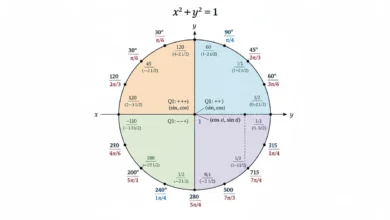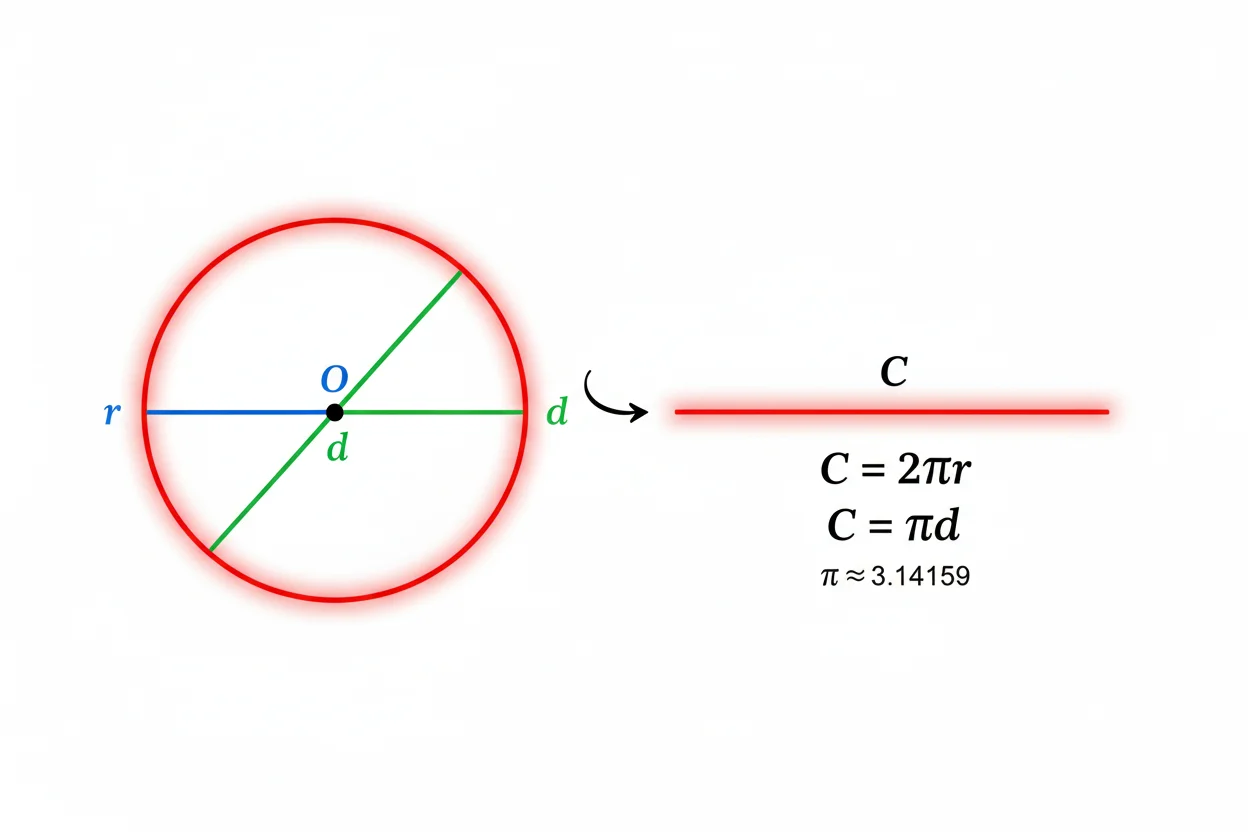

Circle circumference is the total distance around a circle. For radius r, the circumference formula is C = 2πr. Because the diameter is d = 2r, the same relationship can be written C = πd. Circumference is a one-dimensional measurement, so its units are linear units such as centimeters, meters, feet, or inches rather than square units. The formula can be reversed to find radius or diameter when circumference is known. Circumference also provides the full-length reference for circular arcs: an arc with central angle θ degrees has length s = (θ/360°)C. Because every circle has the same ratio of circumference to diameter, C/d = π, the constant π appears naturally in every circumference calculation.
What Is Circle Circumference?
Circumference is the perimeter of a circle.
For polygons, the word Perimeter describes the total boundary length. Because a circle has a continuous curved boundary rather than straight sides, that boundary length is conventionally called circumference.
The basic formulas are:
C = 2πr
and:
C = πd
where:
C = circumference
r = radius
d = diameter
π ≈ 3.14159
The underlying radius and diameter relationships are part of Circles: Radius, Diameter, Area.
Circle Circumference Formula Using Radius
If radius is known:
C = 2πr
Suppose:
r = 5 cm
Then:
C = 2π(5)
= 10π cm
Approximately:
C ≈ 31.42 cm
The exact value is:
10π cm
Keeping π in the answer preserves exactness.
Circle Circumference Formula Using Diameter
Because:
d = 2r
substitute into:
C = 2πr
to get:
C = πd
Suppose:
d = 14 m
Then:
C = π(14)
= 14π m
Approximately:
C ≈ 43.98 m
This form is often more convenient when the diameter is supplied directly.
Why π Appears in Circumference
For every circle:
circumference/diameter = π
Therefore:
C/d = π
Multiply both sides by d:
C = πd
Since:
d = 2r
we also obtain:
C = 2πr
The ratio remains π regardless of the circle’s size.
A small coin and a large circular track have very different circumferences, but the ratio:
C/d
is the same.
Radius Versus Diameter
The radius measures from the center to the circle.
The diameter crosses the circle through its center from one boundary point to another.
Their relationship is:
d = 2r
and:
r = d/2
Confusing the two produces a factor-of-two error in circumference.
For example, if:
d = 20
then:
r = 10
Using:
C = 2π(20)
would incorrectly treat the diameter as the radius.
The correct result is:
C = π(20) = 20π
Find Circumference From Radius
Suppose:
r = 8
Use:
C = 2πr
Therefore:
C = 16π
Approximately:
C ≈ 50.27
If the radius has units of centimeters:
C ≈ 50.27 cm
Circumference keeps the same linear unit as the radius.
Find Circumference From Diameter
Suppose:
d = 9
Then:
C = πd
= 9π
Approximately:
C ≈ 28.27
No radius calculation is required when diameter is already known.
Find Radius From Circumference
Start with:
C = 2πr
Divide by:
2π
to obtain:
r = C/(2π)
Suppose:
C = 24π
Then:
r = 24π/(2π)
= 12
Therefore:
r = 12
and:
d = 24
Find Diameter From Circumference
From:
C = πd
divide by π:
d = C/π
Suppose:
C = 18π
Then:
d = 18π/π
= 18
The radius is:
r = 9
Circumference From Circle Area
The Circle Area formula is:
A = πr²
Solve for radius:
r = √(A/π)
Substitute into circumference:
C = 2π√(A/π)
This can be simplified to:
C = 2√(πA)
Therefore:
C = 2√(πA)
finds circumference directly from circle area.
Example From Area
Suppose:
A = 49π
Then:
r = √(49π/π)
= 7
Therefore:
C = 2π(7)
= 14π
Using the direct relationship:
C = 2√[π(49π)]
= 14π
gives the same result.
Area From Circumference
The relationship also works in reverse.
From:
r = C/(2π)
substitute into:
A = πr²
Then:
A = π[C/(2π)]²
Simplify:
A = C²/(4π)
Suppose:
C = 10π
Then:
A = (10π)²/(4π)
= 100π²/(4π)
= 25π
The radius is 5, confirming:
A = π(5²) = 25π
Circumference and Area Measure Different Things
Circumference measures boundary length:
C = 2πr
Area measures enclosed two-dimensional space:
A = πr²
If:
r = 6 cm
then:
C = 12π cm
while:
A = 36π cm²
Even when the numerical values look related, the units make clear that they represent different quantities.
The broader Area Formulas framework covers area calculations for circles and other shapes.
Circumference and Arc Length
An Arc Length is only part of a circle’s circumference.
If an arc has central angle θ degrees:
s = (θ/360°)C
Since:
C = 2πr
this becomes:
s = (θ/360°)2πr
When θ is measured in radians:
s = rθ
A full revolution has:
θ = 2π
so:
s = r(2π)
= 2πr
which is the full circumference.
Arc Length Example From Circumference
Suppose:
C = 40π
and an arc represents:
90°
Since:
90°/360° = 1/4
the arc length is:
s = (1/4)(40π)
= 10π
The quarter-circle arc is one quarter of the circumference.
Semicircle Curved Length
A semicircle contains half the circular boundary.
Therefore:
s = C/2
Using:
C = 2πr
we obtain:
s = πr
For:
r = 7
the curved semicircular arc is:
7π
If a problem asks for the entire perimeter of a semicircular region, include the diameter:
P = πr + 2r
The diameter is not part of the curved arc.
Quarter-Circle Arc Length
A quarter circle contains:
1/4
of the complete circumference.
Therefore:
s = C/4
or:
s = πr/2
For:
r = 12
we get:
s = 6π
Again, a quarter-circle region’s full perimeter would also include its two radii.
Circumference and Chord Length
A Chord Length connects two points on a circle through a straight segment.
Circumference follows the curved boundary.
For radius r and central angle θ:
chord = 2r sin(θ/2)
while the corresponding minor arc in radians is:
s = rθ
The chord is normally shorter than the corresponding nonzero minor arc because a straight segment gives the shortest path between its endpoints.
Chord and Circumference Example
Suppose:
r = 10
and:
θ = 60°
The circumference is:
C = 20π
The chord is:
c = 20sin30°
= 10
The corresponding arc is:
s = (60/360)(20π)
= 10π/3
Approximately:
s ≈ 10.47
The full circumference, chord, and arc are therefore three distinct length measurements.
Circumference From Chord and Central Angle
If chord c and central angle θ are known:
c = 2r sin(θ/2)
so:
r = c/[2sin(θ/2)]
Then:
C = 2πr
Substitute:
C = πc/sin(θ/2)
This relationship can determine the entire circle’s circumference from one chord and its central angle.
Circumference and Circle Equation
The Circle Equation in center-radius form is:
(x − h)² + (y − k)² = r²
The right side directly provides:
r²
so the radius is:
r = √(right-side value)
Then:
C = 2πr
For example:
(x − 3)² + (y + 2)² = 64
has:
r = 8
Therefore:
C = 16π
The center position does not affect circumference.
Example From a Circle Equation
Given:
x² + y² = 25
we identify:
r² = 25
so:
r = 5
Then:
C = 2π(5)
= 10π
The circle’s center is at the origin, but only the radius is needed for circumference.
Circumference From an Expanded Circle Equation
Suppose:
x² + y² − 6x + 4y − 12 = 0
Complete the square:
x² − 6x + y² + 4y = 12
Add 9 and 4:
(x − 3)² + (y + 2)² = 25
Thus:
r = 5
and:
C = 10π
The equation must first be rewritten into a form where the radius is visible.
Circumference From Diameter Endpoints
Suppose the endpoints of a diameter are:
A = (1, 2)
and:
B = (7, 10)
Using the Distance Formula:
d = √[(7 − 1)² + (10 − 2)²]
= √(36 + 64)
= 10
Therefore:
C = πd
= 10π
This approach does not require finding the center first.
Circumference From Radius Point and Center
Suppose the center is:
C = (2, 3)
and a point on the circle is:
P = (8, 11)
Radius is the distance CP:
r = √[(8 − 2)² + (11 − 3)²]
= √(36 + 64)
= 10
Therefore:
C_circle = 20π
Here the letter C can represent either circumference or a center point depending on notation, so context should make the meaning clear.
Circumference Scaling
If radius is multiplied by factor k:
r_new = kr
then:
C_new = 2πkr
Therefore:
C_new = kC_old
Circumference scales linearly with radius.
If radius doubles:
circumference doubles
If radius triples:
circumference triples
This differs from circle area, which scales with k².
Example: Radius Increases by 25%
Suppose:
r_new = 1.25r
Then:
C_new = 2π(1.25r)
= 1.25C_old
Circumference increases by:
25%
The same percentage change applies because circumference is directly proportional to radius.
Diameter and Circumference Scale Together
Since:
C = πd
the circumference-to-diameter relationship is linear.
If diameter increases by:
40%
then circumference also increases by:
40%
The ratio remains:
C/d = π
for both circles.
Circumference Ratio of Two Circles
For radii r₁ and r₂:
C₁/C₂ = r₁/r₂
Likewise:
C₁/C₂ = d₁/d₂
Suppose:
r₁ : r₂ = 3 : 5
Then:
C₁ : C₂ = 3 : 5
But their area ratio is:
9 : 25
because area depends on the square of radius.
Find Radius Ratio From Circumference Ratio
If:
C₁/C₂ = 7/4
then:
r₁/r₂ = 7/4
and:
d₁/d₂ = 7/4
No π calculation is necessary because the common factor cancels.
This is useful in similarity and scale problems.
Circumference of Concentric Circles
Suppose two concentric circles have radii:
R
and:
r
Their circumferences are:
C_outer = 2πR
C_inner = 2πr
The difference is:
ΔC = 2π(R − r)
This linear relationship differs from annulus area:
A = π(R² − r²)
which depends on squared radii.
Example of Concentric Circumferences
Let:
R = 10
r = 7
Then:
C_outer = 20π
C_inner = 14π
Difference:
ΔC = 6π
The radial separation is:
3
and the circumference difference is:
2π(3) = 6π
Circumference and Regular Polygons
The circumference of a circle can be approximated by the perimeters of polygons.
Inscribed regular polygons lie inside the circle and produce polygonal boundary lengths approaching the circumference as the number of sides grows.
Circumscribed regular polygons approximate it from outside.
This geometric viewpoint helped motivate increasingly precise approximations of π.
Circumference and Sector Geometry
A sector represents a fraction of a circle.
If its central angle is θ degrees, the curved sector boundary has length:
s = (θ/360°)C
The Sector Area for the same angle is:
A_sector = (θ/360°)πr²
Thus the same angular fraction controls both:
fraction of circumference
and:
fraction of circle area
although the resulting measurements have different dimensions.
Circumference in Polar Geometry
In Polar and Rectangular Form, a circle centered at the origin can often be expressed as:
r = constant
As the angular coordinate moves through:
0 ≤ θ ≤ 2π
the point completes one revolution.
A small angular change dθ corresponds to arc distance:
ds = r dθ
Integrating through the full revolution gives:
C = ∫₀²π r dθ
= 2πr
This provides a calculus interpretation of circumference.
Circumference and Cylinders
A cylinder’s circular base has circumference:
2πr
If the curved lateral surface of a cylinder is cut vertically and unrolled, it becomes a rectangle whose width equals that circumference.
Therefore lateral area is:
2πr × h
or:
2πrh
This helps explain the lateral term in cylinder surface-area calculations.
Circumference and Cone Surface Area
The Cone Surface Area formula contains:
πrℓ
for lateral area.
When the curved cone surface is unfolded, it forms a sector of a larger circle.
The cone base circumference:
2πr
becomes the arc length of that sector.
Circumference therefore plays an important geometric role in deriving cone lateral area.
Circumference and Units
Circumference has linear units.
If:
r = 5 cm
then:
C = 10π cm
not:
cm²
If radius is measured in meters, circumference is in meters.
Because π is dimensionless, multiplying radius by 2π does not change the type of unit.
Converting Circumference Units
Suppose:
C = 2.4 m
Convert to centimeters.
Since:
1 m = 100 cm
we have:
C = 240 cm
Unlike area conversion, the linear conversion factor is not squared.
This distinction is important when circumference and circle area appear in the same problem.
Exact Versus Approximate Circumference
For:
r = 9
the exact circumference is:
18π
Using:
π ≈ 3.14159
gives:
C ≈ 56.55
Both are valid depending on the requested format.
Keeping π until the final step minimizes rounding error.
Measuring Circumference Experimentally
If a physical circular object is available, its circumference can be estimated by wrapping a flexible measuring tape or string around its edge.
Dividing the measured circumference by the measured diameter should produce a value close to:
π
Measurement error, object imperfections, and tape thickness can cause small discrepancies.
The theoretical relationship remains:
C = πd
Common Circle Circumference Mistakes
A common mistake is confusing radius and diameter.
Remember:
d = 2r
Another error is using:
πr²
which calculates circle area rather than circumference.
Circumference uses linear units, not square units.
When calculating an arc, multiply circumference by the appropriate fraction of the full 360° rotation rather than treating the arc as the whole boundary.
If circumference is known and radius is requested, divide by:
2π
not merely π.
When using approximate π values, avoid rounding too early.
Finally, if circumference is derived from a circle equation, make sure the equation is in a form that reveals r² correctly.
Frequently Asked Questions
What is circle circumference?
Circle circumference is the total distance around a circle.
What is the circumference formula using radius?
C = 2πr
What is the circumference formula using diameter?
C = πd
Why are both formulas equivalent?
Because:
d = 2r
How do you find radius from circumference?
r = C/(2π)
How do you find diameter from circumference?
d = C/π
What is circumference if the radius is 10?
C = 20π
which is approximately:
62.83
Is circumference the same as area?
No. Circumference measures boundary length; area measures enclosed two-dimensional space.
What units does circumference use?
Linear units such as cm, m, ft, or in.
How is arc length related to circumference?
In degrees:
s = (θ/360°)C
What is the curved length of a semicircle?
πr
If radius doubles, what happens to circumference?
Circumference doubles.
How is circumference related to diameter?
C/d = π
for every circle.
How can I check a circumference answer?
Verify that radius and diameter were not confused, make sure the result has linear units, and confirm that:
C/d ≈ 3.14159
when a decimal check is appropriate.