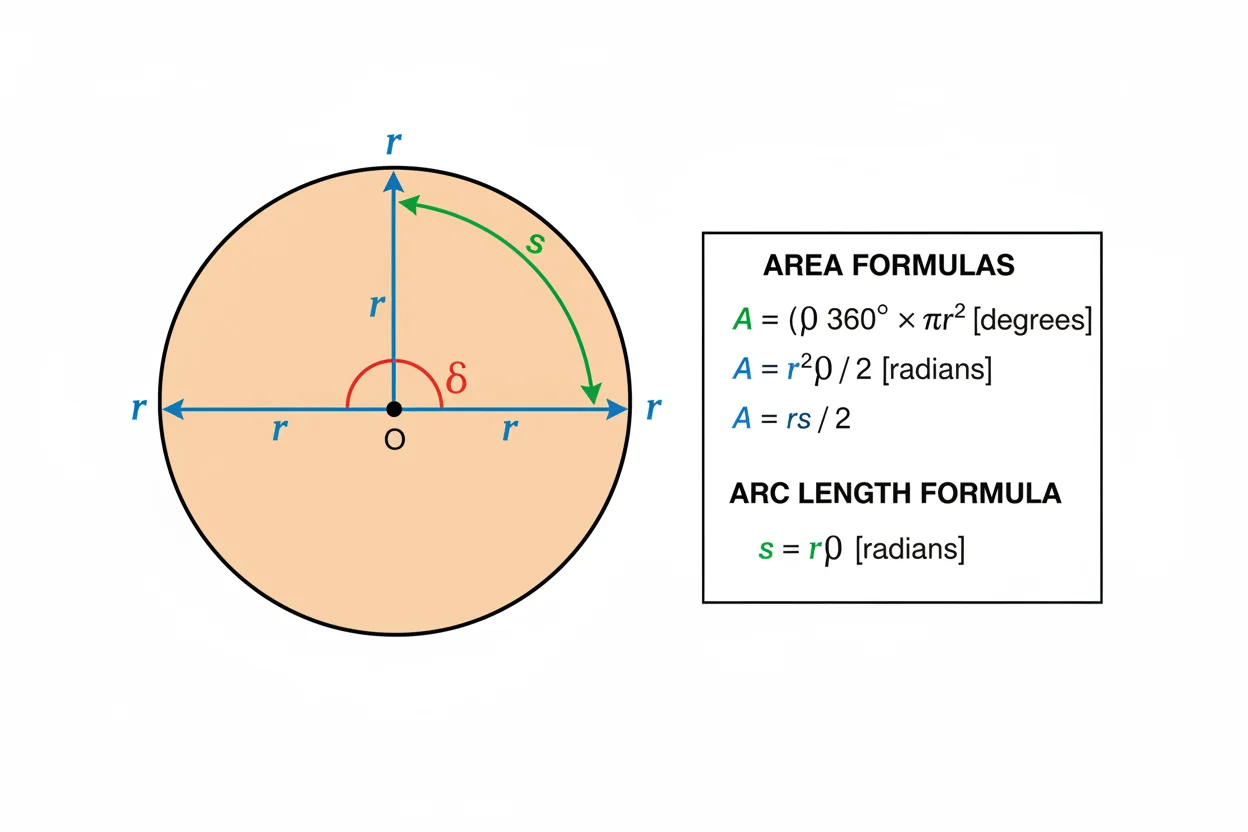

Sector area measures the portion of a circle enclosed by two radii and the arc between them. If the central angle θ is measured in degrees, the sector area formula is A = (θ/360°)πr². If θ is measured in radians, the formula simplifies to A = r²θ/2. A sector therefore occupies the same fraction of a circle’s area that its central angle occupies of one complete revolution. A 90° sector contains one quarter of the circle, a 180° sector contains one half, and a 60° sector contains one sixth. If arc length s is known instead of the angle, sector area can also be calculated with A = rs/2. These relationships can be rearranged to find an unknown angle, radius, arc length, or fraction of a circle.
What Is a Sector?
A sector is the region of a circle bounded by:
two radii
and:
the arc connecting their endpoints
It resembles a slice cut from a circular disk.
The two radii meet at the center and form the sector’s:
central angle θ
The curved boundary is an arc.
The full circle relationships in Circles: Radius, Diameter, Area provide the foundation for sector calculations.
Sector Area Formula in Degrees
If θ is measured in degrees:
A = (θ/360°)πr²
where:
A = sector area
θ = central angle
r = circle radius
The fraction:
θ/360°
tells what proportion of the complete circle belongs to the sector.
Why the Degree Formula Works
The complete Circle Area is:
πr²
A full revolution is:
360°
Therefore a sector with central angle θ occupies:
θ/360°
of the entire circle.
Multiplying gives:
A = (θ/360°)πr²
For example, a 90° sector uses:
90°/360° = 1/4
of the circle.
Basic Sector Area Example
Suppose:
r = 8 cm
θ = 90°
Then:
A = (90°/360°)π(8²)
= 1/4 × 64π
Therefore:
A = 16π cm²
Approximately:
A ≈ 50.27 cm²
60° Sector Example
Suppose:
r = 12
θ = 60°
Then:
A = (60/360)π(12²)
= 1/6 × 144π
Therefore:
A = 24π
square units.
A 60° sector contains exactly:
1/6
of the circle.
120° Sector Example
For:
r = 6
θ = 120°
we get:
A = (120/360)π(36)
= 1/3 × 36π
Therefore:
A = 12π
The central angle uses one-third of a full revolution, so the area is also one-third of the circle.
Sector Area Formula in Radians
When θ is measured in radians:
A = r²θ/2
This formula is often more convenient because the fraction-of-a-circle calculation is already built into radian measure.
The angle θ must be in radians for this version.
Deriving the Radian Formula
One complete revolution is:
2π radians
So:
A = [θ/(2π)]πr²
Cancel π:
A = θr²/2
Therefore:
A = r²θ/2
The formulas in Degrees and Radians explain why this is equivalent to the degree version.
Radian Example
Suppose:
r = 10
θ = π/3
Then:
A = 10²(π/3)/2
= 100π/6
Therefore:
A = 50π/3
Approximately:
A ≈ 52.36
square units.
Another Radian Example
Suppose:
r = 5
θ = 2π/5
Then:
A = 25(2π/5)/2
The factors of 2 cancel:
A = 5π
square units.
Degrees Versus Radians
Use:
A = (θ/360°)πr²
when θ is in degrees.
Use:
A = r²θ/2
when θ is in radians.
Do not insert a degree measure such as:
60
directly into:
r²θ/2
unless it has first been converted to radians.
Since:
60° = π/3
the two formulas give identical results when used consistently.
Semicircle Area
A semicircle has central angle:
180°
Therefore:
A = (180/360)πr²
So:
A = πr²/2
A semicircle contains exactly half the area of its circle.
Quarter-Circle Area
A quarter circle has:
θ = 90°
Therefore:
A = πr²/4
For:
r = 6
we obtain:
A = 36π/4
Therefore:
A = 9π
Three-Quarter Sector
For:
θ = 270°
the sector occupies:
270/360 = 3/4
of the circle.
Therefore:
A = 3πr²/4
If:
r = 4
then:
A = 12π
Find the Central Angle From Sector Area
Starting with:
A = (θ/360°)πr²
solve for θ:
θ = 360°A/(πr²)
Suppose:
A = 25π
r = 10
Then:
θ = 360°(25π)/(100π)
= 90°
So the sector is one quarter of the circle.
Find the Angle in Radians
From:
A = r²θ/2
solve:
θ = 2A/r²
Suppose:
A = 18
r = 6
Then:
θ = 36/36
Therefore:
θ = 1 radian
Find the Radius From Sector Area
In degrees:
A = (θ/360°)πr²
Rearrange:
r² = 360°A/(πθ)
Therefore:
r = √[360°A/(πθ)]
Use the positive square root because radius is nonnegative.
Radius Example
Suppose:
A = 16π
θ = 90°
Then:
r = √[360(16π)/(90π)]
= √64
Therefore:
r = 8
Radius From the Radian Formula
Starting with:
A = r²θ/2
we obtain:
r² = 2A/θ
Therefore:
r = √(2A/θ)
Suppose:
A = 36π
θ = π/2
Then:
r = √[72π/(π/2)]
= √144
Therefore:
r = 12
Arc Length and Sector Area
The Arc Length of a sector with θ in radians is:
s = rθ
The sector area is:
A = r²θ/2
Substitute:
θ = s/r
Then:
A = r²(s/r)/2
Therefore:
A = rs/2
This is a very useful formula when radius and arc length are known.
Sector Area From Radius and Arc Length
Use:
A = rs/2
Suppose:
r = 9
s = 8
Then:
A = 9(8)/2
Therefore:
A = 36
square units.
No angle calculation is required.
Find Arc Length From Sector Area
From:
A = rs/2
solve:
s = 2A/r
Suppose:
A = 45
r = 9
Then:
s = 90/9
Therefore:
s = 10
Find Radius From Area and Arc Length
Similarly:
r = 2A/s
Suppose:
A = 60
s = 12
Then:
r = 120/12
Therefore:
r = 10
Sector Area and Circumference Fractions
The fraction of circumference represented by the sector arc is:
s/C = θ/360°
The fraction of circle area represented by the sector is:
A/(πr²) = θ/360°
Therefore:
s/C = A/(πr²)
for the same sector.
The Circle Circumference and circle area are divided in exactly the same angular proportion.
Example Using a Fraction of the Circle
Suppose an arc is:
1/5
of the full circumference.
Then the associated sector is:
1/5
of the circle area.
If:
r = 10
the circle area is:
100π
Therefore:
sector area = 20π
The corresponding angle is:
360°/5 = 72°
Sector Perimeter
Sector area and sector perimeter are different quantities.
A sector boundary consists of:
two radii
plus:
one arc
Therefore:
P = 2r + s
If θ is in radians:
s = rθ
so:
P = 2r + rθ
Factor:
P = r(θ + 2)
The general Perimeter principle still applies: add the complete outer boundary.
Sector Perimeter Example
Suppose:
r = 6
θ = π/3
Arc length:
s = 6(π/3)
= 2π
Therefore sector perimeter is:
P = 12 + 2π
The area is separately:
A = 6²(π/3)/2
= 6π
Minor and Major Sectors
Two radii generally divide a circle into two sectors.
The smaller one is the:
minor sector
The larger one is the:
major sector
If the minor central angle is θ:
major angle = 360° − θ
The two sector areas add to:
πr²
Major Sector Example
Suppose:
r = 10
and minor angle:
80°
Major angle:
280°
Minor area:
A_minor = (80/360)100π
= 200π/9
Major area:
A_major = 100π − 200π/9
Therefore:
A_major = 700π/9
Find a Major Sector Directly
Instead of subtracting areas, use:
A_major = [(360° − θ)/360°]πr²
For:
θ = 80°
this becomes:
A_major = (280/360)100π
= 700π/9
Both methods agree.
Sector Versus Circular Segment
A sector is bounded by:
two radii and an arc
A circular segment is bounded by:
a chord and an arc
The segment area is usually found by subtracting a triangle from a sector.
If central angle θ and radius r are known:
segment area = sector area − triangle area
For θ in radians:
A_segment = r²(θ − sinθ)/2
for a minor segment with the standard central-triangle setup.
Deriving Segment Area
The central triangle has two sides:
r and r
with included angle θ.
Its area is:
A_triangle = r²sinθ/2
The sector area is:
A_sector = r²θ/2
Therefore:
A_segment = r²θ/2 − r²sinθ/2
Factor:
A_segment = r²(θ − sinθ)/2
The Sine function appears because the triangle is determined by two radii and their included angle.
Segment Example
Suppose:
r = 6
θ = π/3
Sector area:
A_sector = 36(π/3)/2
= 6π
Triangle area:
A_triangle = 36sin(π/3)/2
= 9√3
Therefore:
A_segment = 6π − 9√3
Chord Length in a Sector
The two radius endpoints define a chord.
For central angle θ:
c = 2r sin(θ/2)
The Chord Length can therefore be found from the same radius and angle used for sector area.
Sector area measures a region.
Chord length measures the straight segment connecting the arc endpoints.
Chord Example
Suppose:
r = 10
θ = 60°
Then:
c = 20sin30°
= 10
The sector area is:
A = (60/360)100π
= 50π/3
The same angle-radius data provide both a linear and an areal quantity.
Right Triangles Inside Sectors
Dropping a perpendicular from the center or bisecting an isosceles central triangle often creates Right Triangles.
For half-angle:
θ/2
the half-chord relationship is:
c/2 = r sin(θ/2)
and center-to-chord distance is:
d = r cos(θ/2)
These right-triangle relationships can recover missing dimensions before sector or segment calculations.
Right-Triangle Example
Suppose:
r = 13
and center-to-chord distance:
d = 5
Then half-chord:
c/2 = √(13² − 5²)
= 12
so:
c = 24
The half central angle α satisfies:
cosα = 5/13
Then:
θ = 2α
Once θ is known, the corresponding sector area can be found.
Secant in Sector Geometry
The reciprocal relationship on the same right triangle is:
secα = r/d
When:
r = 13
d = 5
we have:
secα = 13/5
The Secant ratio can therefore describe the radius relative to its adjacent projection in circular constructions.
Sector area itself still depends on the resulting central angle and radius.
Similar Sectors
Two sectors with equal central angles are similar figures.
If their radii have ratio:
k
then all corresponding linear measurements, including arc lengths, have ratio:
k
while their areas have ratio:
k²
This follows from the general Similar Triangles and similar-figure scaling principle.
Similar Sector Example
Two 60° sectors have radii:
4
and:
10
Radius ratio:
10/4 = 5/2
Area ratio:
(5/2)²
Therefore:
A₂/A₁ = 25/4
The larger sector has:
6.25
times the area.
Sector Area and Regular Polygons
A Regular Polygon Area can be compared with sectors of its circumcircle.
A regular n-gon divides a circle into n equal central angles:
θ = 2π/n
Each polygon side is a chord.
The corresponding circular sector has area:
A_sector = R²(2π/n)/2
Therefore:
A_sector = πR²/n
Each of the n equal sectors contains exactly:
1/n
of the circle area.
Regular Hexagon Example
A regular hexagon inscribed in a circle divides it into:
6
equal 60° sectors.
If:
R = 6
each sector area is:
36π/6
Therefore:
6π
The triangular piece of the regular hexagon inside each sector has area:
9√3
The difference between them forms a circular segment.
Sector Area and Exterior Angles
A regular n-gon’s central angle equals its regular Exterior Angles:
E = 360°/n
Therefore the sector between consecutive radii to adjacent vertices has:
θ = E
Its area is:
A = (E/360°)πR²
Since:
E/360° = 1/n
we again obtain:
A = πR²/n
Sector Area in Polar Coordinates
Polar coordinates describe points by:
radius r
and:
angle θ
so circular sectors are naturally expressed in Polar and Rectangular Form.
A sector:
0 ≤ r ≤ R
α ≤ θ ≤ β
has angular width:
β − α
Its area is:
A = R²(β − α)/2
when the angles are in radians.
This is exactly the ordinary sector formula.
Annular Sector
An annular sector is a sector of a ring rather than a full disk.
Suppose:
outer radius = R
inner radius = r
central angle = θ
in radians.
Outer sector area:
R²θ/2
Inner sector area:
r²θ/2
Subtract:
A = θ(R² − r²)/2
Annular Sector Example
Suppose:
R = 10
r = 6
θ = π/3
Then:
A = (π/3)(100 − 36)/2
= 32π/3
square units.
In degrees, the equivalent formula is:
A = (θ/360°)π(R² − r²)
Find Angle From Annular Sector Area
Using radians:
A = θ(R² − r²)/2
solve:
θ = 2A/(R² − r²)
This is useful for ring-shaped sectors where both radii are known.
Composite Circular Figures
A composite figure may contain:
sectors
semicircles
rectangles
triangles
or other regions.
Calculate each component separately, then add or subtract according to the figure.
The general Area principle remains:
whole area = sum of nonoverlapping component areas
Composite Example
Suppose a square has side:
10
and a quarter-circle sector of radius:
10
is removed.
Square area:
100
Quarter-circle area:
25π
Remaining area:
100 − 25π
square units.
Sector Area From Percentage of a Circle
If a sector represents p% of a circle:
A = (p/100)πr²
The angle is:
θ = (p/100)360°
Suppose a sector is:
30%
of a radius-10 circle.
Then:
A = 0.30(100π)
Therefore:
A = 30π
and:
θ = 108°
Percentage From Sector Area
If sector area A and total circle area πr² are known:
percentage = 100A/(πr²)
Suppose:
A = 18π
r = 6
Total circle area:
36π
Therefore:
percentage = 50%
The sector is a semicircle.
Scaling Sector Area
If the central angle remains fixed and radius is multiplied by k:
A = θr²/2
becomes:
A_new = θ(kr)²/2
Therefore:
A_new = k²A_old
Sector area scales with the square of radius.
Scaling Example
Suppose a 45° sector has area:
20
Double the radius while keeping:
45°
Then:
A_new = 4(20)
Therefore:
A_new = 80
Changing Only the Angle
For fixed radius:
A ∝ θ
Doubling the central angle doubles sector area.
For example, with a fixed radius:
a 120° sector
has twice the area of:
a 60° sector
because:
120/60 = 2
Area Ratio for Equal Radii
If two sectors have the same radius:
A₁/A₂ = θ₁/θ₂
Suppose:
θ₁ = 30°
θ₂ = 75°
Then:
A₁/A₂ = 30/75
= 2/5
The first sector has two-fifths the area of the second.
Area Ratio for Different Radii and Angles
For sectors:
A = θr²/2
with angles in the same unit system.
Therefore:
A₁/A₂ = θ₁r₁²/(θ₂r₂²)
This relationship can compare sectors without finding either area separately.
Ratio Example
Sector 1:
r₁ = 4
θ₁ = 60°
Sector 2:
r₂ = 6
θ₂ = 40°
Then:
A₁/A₂ = [60(16)]/[40(36)]
= 960/1440
Therefore:
A₁/A₂ = 2/3
Units of Sector Area
Sector area uses square units:
mm²
cm²
m²
in²
ft²
Radius and arc length are linear measurements, but area is two-dimensional.
Mixed Units
Convert lengths before using them together.
Suppose:
r = 2 m
and arc length:
s = 50 cm
Convert:
2 m = 200 cm
Then:
A = rs/2
= 200(50)/2
Therefore:
A = 5000 cm²
which equals:
0.5 m²
Exact Versus Approximate Sector Area
If a formula gives:
A = 24π
that is exact.
Using:
π ≈ 3.14159
gives:
A ≈ 75.40
Exact π expressions are generally preferable until a decimal is required.
Common Sector Area Mistakes
A frequent mistake is using the full circle area:
πr²
without multiplying by the angle fraction.
For degrees, use:
θ/360°
For radians, use:
θ/2
inside:
A = r²θ/2
Do not mix degree values with the radian formula.
Another common error is confusing sector area with arc length. Arc length is linear; sector area is square.
When calculating sector perimeter, remember to add the two radii.
If a problem describes a circular segment rather than a sector, the central triangle must usually be subtracted.
Use the radius, not the diameter, in πr².
Finally, keep square units on the final area.
Frequently Asked Questions
What is the sector area formula in degrees?
A = (θ/360°)πr²
What is the sector area formula in radians?
A = r²θ/2
What is the formula using arc length?
A = rs/2
How do you find the central angle from sector area?
In degrees:
θ = 360°A/(πr²)
In radians:
θ = 2A/r²
How do you find radius from sector area?
In radians:
r = √(2A/θ)
What is the area of a semicircle?
A = πr²/2
What is the area of a quarter circle?
A = πr²/4
How is arc length related to sector area?
For θ in radians:
s = rθ
and:
A = rs/2
What is sector perimeter?
P = 2r + s
What is the difference between a sector and a segment?
A sector is bounded by two radii and an arc. A circular segment is bounded by a chord and an arc.
How do you find an annular sector area?
For θ in radians:
A = θ(R² − r²)/2
How does sector area scale?
For a fixed angle, multiplying radius by k multiplies area by k².
If two sectors have the same radius, how do their areas compare?
Their areas are proportional to their central angles.
What units does sector area use?
Square units such as cm², m², or ft².
How can I check a sector area answer?
Compare the central-angle fraction with the full circle area, verify that the sector area does not exceed πr² for angles up to one full revolution, and confirm that degree or radian units were used consistently.