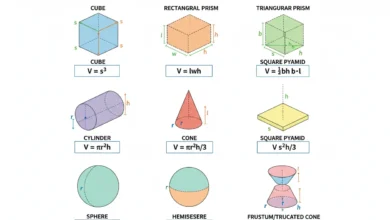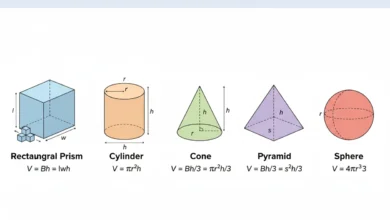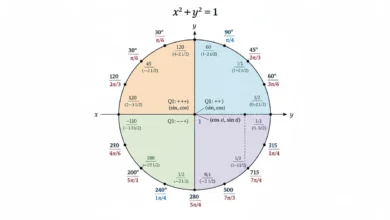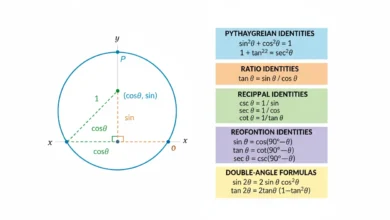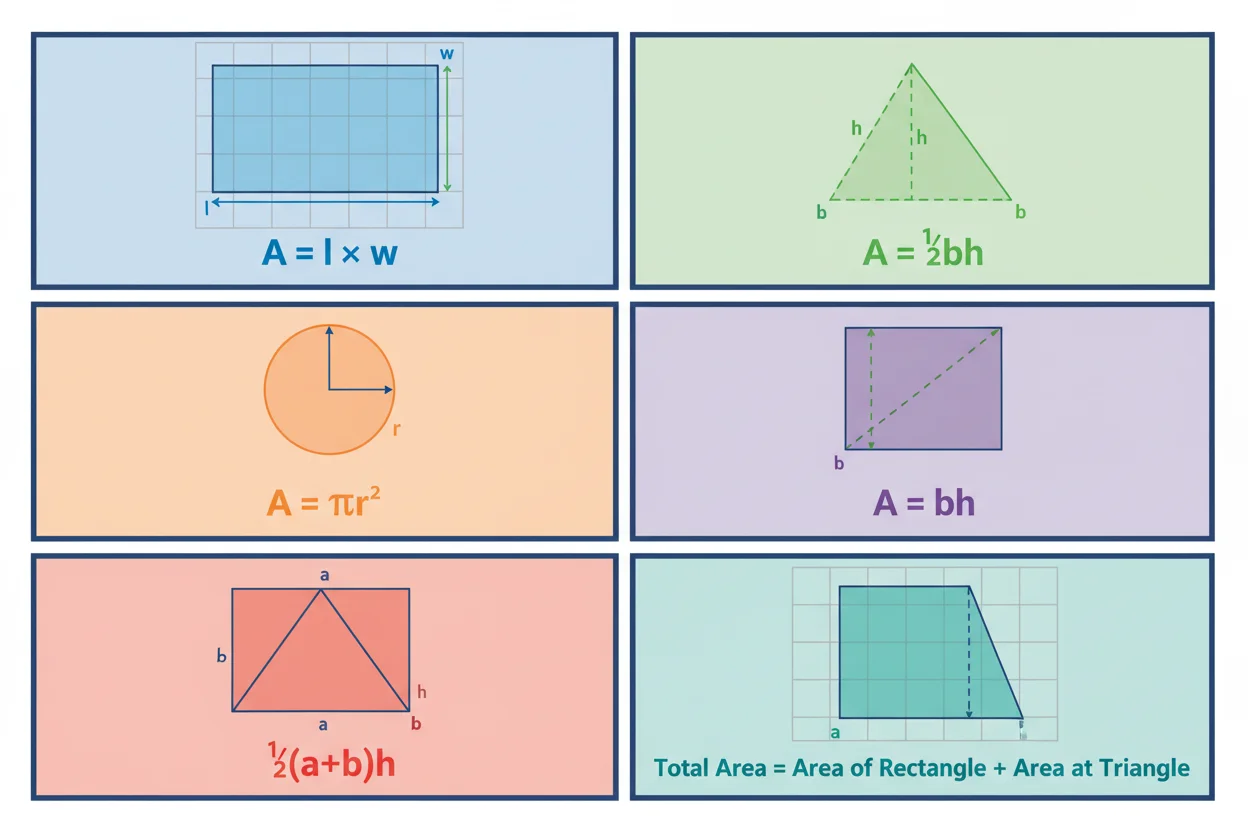

Area measures the amount of two-dimensional space inside a closed boundary. It is expressed in square units such as cm², m², ft², or in² because area describes two independent dimensions. The exact area formula depends on the shape: a rectangle uses length × width, a triangle uses 1/2 × base × perpendicular height, and a circle uses πr². More complicated figures can often be divided into familiar shapes, calculated separately, and added or subtracted. Similar figures also reveal an important scaling rule: if every length is multiplied by k, area is multiplied by k². Area should not be confused with perimeter, which measures boundary length, or surface area, which measures the exposed boundary of a three-dimensional object. Understanding what dimensions define the region is the first step toward choosing the correct calculation.
What Is Area?
Area is the size of a flat region.
If a shape covers:
20 unit squares
its area is:
20 square units
A square unit is the area of a square whose side length is one unit.
For example:
1 cm²
is the area of a square measuring:
1 cm × 1 cm
Similarly:
1 m² = 1 m × 1 m
Area therefore measures coverage rather than boundary length.
The larger Geometry & Trigonometry framework applies this idea to triangles, circles, polygons, coordinate figures, and many other shapes.
General Idea Behind an Area Formula
For many simple figures, area can be interpreted as:
base measure × perpendicular height
possibly multiplied by an adjustment factor.
For a rectangle:
A = bh
For a triangle:
A = bh/2
For a parallelogram:
A = bh
For a trapezoid:
A = (b₁ + b₂)h/2
Other shapes, particularly circles and irregular figures, require formulas derived from their geometry.
A broader collection appears in Area Formulas.
Area of a Rectangle
For a rectangle with length l and width w:
A = lw
If:
l = 8 m
and:
w = 5 m
then:
A = 8 × 5
= 40 m²
The dedicated Rectangle Area calculation also works backward when area and one dimension are known.
For example:
l = A/w
if width and area are given.
Why Rectangle Area Is Length × Width
Imagine covering a rectangle with one-unit squares.
A rectangle 8 units long and 5 units wide contains:
8 squares per row
and:
5 rows
So the number of unit squares is:
8 × 5 = 40
That counting interpretation is the foundation for many other area formulas.
Area of a Square
A square is a rectangle with equal side lengths.
If each side has length s:
A = s²
For:
s = 7 cm
we get:
A = 7²
= 49 cm²
If area is known, the side length is:
s = √A
For:
A = 81
the positive geometric side length is:
s = 9
Triangle Area
For a triangle:
A = bh/2
where b is a chosen base and h is its perpendicular height.
If:
b = 12
and:
h = 7
then:
A = 12(7)/2
= 42
The specialist Triangle Area topic includes additional formulas when different triangle measurements are known.
Why Triangle Area Has a Factor of 1/2
Two congruent copies of many triangles can be arranged to form a parallelogram.
The parallelogram has area:
bh
Each triangle occupies half of it.
Therefore:
A_triangle = bh/2
The height must be perpendicular to the base. A slanted side cannot automatically substitute for h.
Triangle Area With Three Sides
If side lengths a, b, and c are known but no height is available, Heron Formula uses the semiperimeter:
s = (a + b + c)/2
Then:
A = √[s(s − a)(s − b)(s − c)]
For sides:
3, 4, 5
the semiperimeter is:
s = 6
and:
A = √[6(3)(2)(1)]
= 6
Triangle Area With Two Sides and an Angle
If sides a and b enclose angle C:
A = ab sinC/2
For:
a = 8
b = 10
C = 30°
we have:
A = 8(10)sin30°/2
Since:
sin30° = 1/2
the area is:
A = 20
This formula connects geometric area with the Sine function.
Area and the Angle Bisector Theorem
Area ratios can help explain the Angle Bisector Theorem.
If an angle bisector divides triangle ABC into triangles ABD and ACD, both smaller triangles share the same altitude to line BC.
Therefore:
Area(ABD)/Area(ACD) = BD/DC
Their included-angle area formulas also produce:
Area(ABD)/Area(ACD) = AB/AC
Hence:
BD/DC = AB/AC
This shows how area can reveal proportional structure even when the problem does not initially appear to ask for area.
Parallelogram Area
For a parallelogram:
A = bh
where h is perpendicular to the selected base.
The Parallelogram Area formula does not generally equal the product of two slanted side lengths.
If adjacent sides a and b meet at angle θ:
A = ab sinθ
This alternative formula is useful when side lengths and an included angle are known.
Trapezoid Area
For parallel sides b₁ and b₂ and perpendicular height h:
A = (b₁ + b₂)h/2
The Trapezoid Area formula can be interpreted as:
average parallel-side length × height
For:
b₁ = 6
b₂ = 10
h = 4
we obtain:
A = (6 + 10)(4)/2
= 32
Rhombus Area
A rhombus can use the parallelogram formula:
A = bh
When its diagonals d₁ and d₂ are known, Rhombus Area can also be calculated with:
A = d₁d₂/2
For:
d₁ = 8
d₂ = 6
the area is:
24
Kite Area
For a kite with perpendicular diagonals d₁ and d₂:
A = d₁d₂/2
The Kite Area calculation therefore resembles the diagonal formula for a rhombus.
For:
d₁ = 12
d₂ = 5
we obtain:
A = 30
Regular Polygon Area
For a regular polygon with apothem a and perimeter P:
A = aP/2
The Regular Polygon Area formula comes from splitting the polygon into congruent triangles whose common height is the apothem.
For:
a = 5
P = 36
the area is:
A = 5(36)/2
= 90
Circle Area
A circle of radius r has:
A = πr²
The dedicated Circle Area calculation depends on radius rather than circumference directly.
For:
r = 6
we get:
A = 36π
Approximately:
A ≈ 113.10
square units.
Radius Versus Diameter in Circle Area
If diameter d is known:
r = d/2
Therefore:
A = π(d/2)²
which simplifies to:
A = πd²/4
For:
d = 10
the radius is:
5
so:
A = 25π
Using the diameter directly as r would make the answer four times too large.
Sector Area
A sector is a fraction of a circle.
If central angle θ is measured in radians:
A_sector = r²θ/2
If θ is measured in degrees:
A_sector = (θ/360°)πr²
The specialist Sector Area relationship shows that sector area is proportional to central angle.
A 90° sector has:
1/4
of the full circle’s area.
Arc Length and Area
Arc Length measures curved boundary distance rather than enclosed region.
For a circle:
s = rθ
when θ is in radians.
Combining this with the sector formula:
A_sector = r²θ/2
gives:
A_sector = rs/2
This useful relationship connects the sector’s area directly with its radius and arc length.
Chord Length and Area
A Chord Length is a straight segment joining two points on a circle.
For radius r and central angle θ:
c = 2r sin(θ/2)
A chord can divide a circle into circular segments.
The area of such a segment can be found by subtracting an appropriate triangle area from a sector area.
Thus the chord itself is a length, but it can help determine an enclosed area.
Area Versus Perimeter
Perimeter measures the length of a shape’s boundary.
Area measures the space enclosed inside it.
For a rectangle:
P = 2l + 2w
while:
A = lw
For:
l = 8
w = 5
we have:
P = 26 units
but:
A = 40 square units
The numerical values can differ substantially because the quantities have different dimensions.
Same Perimeter, Different Area
Shapes can have equal perimeter but different areas.
Consider rectangles with perimeter:
20
A:
1 × 9
rectangle has area:
9
A:
5 × 5
square has area:
25
Both have perimeter 20.
This demonstrates that knowing perimeter alone usually does not uniquely determine area.
Same Area, Different Perimeter
Likewise, different shapes can have the same area but different boundaries.
A:
1 × 12
rectangle has area:
12
and perimeter:
26
A:
3 × 4
rectangle also has area:
12
but perimeter:
14
Area and perimeter should therefore be treated as separate measurements.
Area Versus Surface Area
Surface Area measures the combined two-dimensional boundary of a three-dimensional object.
For example, the area of one rectangular face is:
lw
but a rectangular prism has several faces whose areas must be added.
Both quantities use square units, yet:
area → one planar region
surface area → exposed boundary of a 3D solid
The context determines which measurement is required.
Composite Shape Area
Many irregular-looking figures can be divided into familiar shapes.
A common method is:
total area = sum of component areas
or:
desired area = large enclosing area − removed areas
Suppose an L-shaped region can be enclosed in a:
10 × 8
rectangle with a:
4 × 3
rectangle removed.
Then:
A = 10(8) − 4(3)
= 80 − 12
= 68
square units.
Avoid Overlapping Components
When adding component areas, make sure regions do not overlap.
If two component shapes overlap and both full areas are added, the overlapping section is counted twice.
A correct decomposition should partition the figure into nonoverlapping pieces or explicitly correct for overlap.
This principle is important for floor plans, irregular polygons, and combined circular-rectangular figures.
Area From Coordinates
Coordinate geometry can calculate area even when a diagram does not directly provide base and height.
For a triangle with vertices:
(x₁, y₁)
(x₂, y₂)
(x₃, y₃)
one formula is:
A = 1/2 |x₁(y₂ − y₃) + x₂(y₃ − y₁) + x₃(y₁ − y₂)|
The absolute value ensures nonnegative area.
Coordinate methods become especially useful when vertices are known numerically.
Rectangle Area From Coordinates
Suppose an axis-aligned rectangle has opposite corners:
(2, 3)
and:
(9, 8)
Its width is:
9 − 2 = 7
Its height is:
8 − 3 = 5
Therefore:
A = 7(5)
= 35
The Distance Formula becomes useful when sides are not horizontal or vertical.
Scale Factor and Area
If every length in a figure is multiplied by:
k
then area is multiplied by:
k²
Suppose a triangle has area:
20
and all side lengths are doubled.
The new scale factor is:
k = 2
Therefore:
new area = 2²(20)
= 80
The area becomes four times as large.
Why Area Scales With k²
Area involves two independent dimensions.
If a rectangle has dimensions:
l × w
and each is multiplied by k:
new area = (kl)(kw)
= k²lw
Thus:
A_new = k²A_old
This squared scaling extends to all similar two-dimensional figures.
Area Conversion Between Units
Unit conversion for area must also be squared.
Since:
1 m = 100 cm
we have:
1 m² = (100 cm)²
= 10,000 cm²
It is incorrect to convert:
1 m²
to:
100 cm²
because both dimensions must be converted.
Example of Area Unit Conversion
Convert:
3.5 m²
to square centimeters.
Use:
1 m² = 10,000 cm²
Therefore:
3.5 m² = 3.5(10,000)
= 35,000 cm²
This squared conversion factor is one of the most common sources of measurement errors.
Area and Similar Triangles
For Similar Triangles, corresponding side lengths have a common scale factor k.
Their areas have ratio:
k²
If corresponding side ratio is:
3 : 5
then area ratio is:
9 : 25
This remains true even though the triangles may have different actual side lengths.
Area and the Pythagorean Theorem
The Pythagorean Theorem can help calculate missing dimensions before area is found.
For a right triangle:
a² + b² = c²
If:
c = 13
and:
a = 5
then:
b² = 169 − 25
= 144
so:
b = 12
The triangle area is then:
A = 5(12)/2
= 30
Area Under a Curve
In calculus, Area Under A Curve extends area beyond elementary geometric shapes.
For a nonnegative continuous function:
y = f(x)
on:
[a, b]
the area is:
A = ∫ₐᵇ f(x)dx
A Definite Integral can therefore measure regions whose boundaries are not straight lines or familiar geometric curves.
This is an extension of the same underlying idea: accumulating two-dimensional space.
Area Between Curves
If:
f(x) ≥ g(x)
on an interval:
[a, b]
then the Area Between Curves is:
A = ∫ₐᵇ[f(x) − g(x)]dx
The vertical distance:
f(x) − g(x)
acts like a continuously changing height.
Integration accumulates those thin strips across the interval.
Area Must Be Nonnegative
Geometric area cannot be negative.
However, a definite integral can be negative when a function lies below the x-axis because the integral measures signed accumulation.
If the goal is geometric area, regions below the axis require appropriate absolute values or interval splitting.
This distinction becomes important when moving from elementary geometry to calculus.
Area and Optimization
Some Optimization problems ask for the largest or smallest possible area subject to constraints.
For example, if a rectangle has fixed perimeter P:
2l + 2w = P
one dimension can be expressed in terms of the other.
Then:
A = lw
becomes a one-variable objective function.
For a fixed rectangular perimeter, the maximum area occurs when the rectangle is a square.
Common Area Mistakes
A common error is confusing area with perimeter.
Area requires square units.
Another mistake is using a slanted side as the height when a formula requires perpendicular height.
For circles, use radius in:
A = πr²
not diameter unless it is first converted.
When converting area units, square the linear conversion factor.
For composite shapes, avoid double-counting overlapping pieces.
For similar shapes, area scales with the square of the length scale factor.
Finally, when a calculus integral represents signed area, distinguish its sign from the nonnegative geometric area of a region.
Frequently Asked Questions
What is area?
Area is the amount of two-dimensional space enclosed by a boundary.
What units are used for area?
Area uses square units such as:
cm², m², ft², in²
What is the area of a rectangle?
A = lw
What is the area of a square?
A = s²
What is the area of a triangle?
A = bh/2
What is the area of a circle?
A = πr²
What is the area of a parallelogram?
A = bh
What is the area of a trapezoid?
A = (b₁ + b₂)h/2
How do you find the area of an irregular shape?
Divide it into familiar nonoverlapping shapes, calculate each component, and add or subtract the results as appropriate.
What is the difference between area and perimeter?
Area measures the enclosed region. Perimeter measures the boundary length.
What is the difference between area and surface area?
Area usually measures one planar region. Surface area measures the exposed boundary of a three-dimensional object.
How does area change with scale?
If lengths scale by k:
area scales by k²
Can area be negative?
Geometric area is nonnegative. A definite integral can be negative because it represents signed accumulation.
How can I check an area answer?
Check the formula, dimensions, units, scale, and whether the result is reasonable compared with a simple enclosing shape.