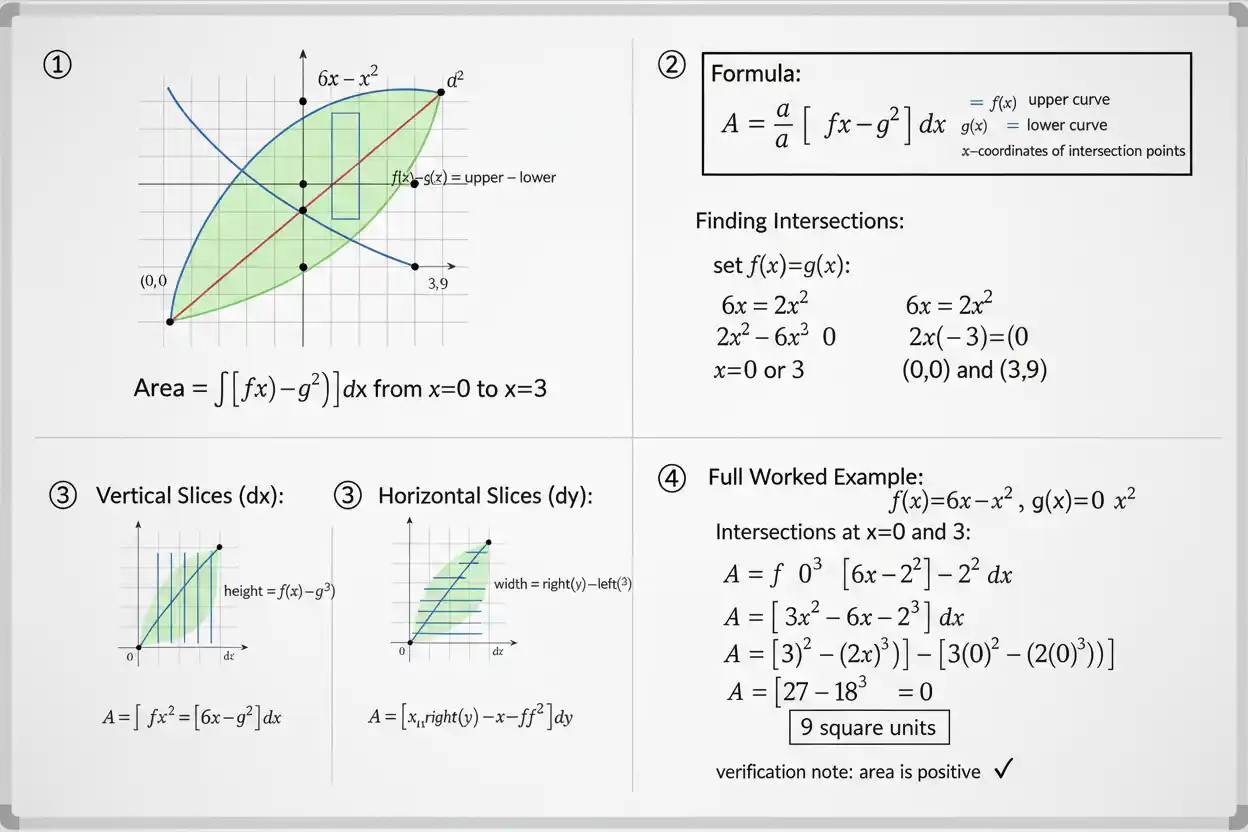

The area between curves measures the geometric region enclosed by two functions over a specified interval.
When:
f(x) ≥ g(x)
throughout:
a ≤ x ≤ b
the area is:
A = ∫ₐᵇ [f(x) − g(x)] dx
Here:
f(x) = upper curveg(x) = lower curvea, b = horizontal boundaries
For example, find the area between:
y = x
and:
y = x²
from:
x = 0
to:
x = 1
On this interval:
x ≥ x²
so:
A = ∫₀¹(x − x²) dx
An antiderivative is:
x²/2 − x³/3
Evaluate:
A = [x²/2 − x³/3]₀¹
= 1/2 − 1/3
= 1/6
Therefore:
Area = 1/6 square unit
The central skill is not merely integration. You must first identify the region correctly and determine which function is above, below, right, or left.
What Does Area Between Curves Mean?
Suppose two graphs form the top and bottom boundaries of a region.
A thin vertical strip has approximate height:
Upper Function − Lower Function
and width:
dx
So its tiny area is:
dA ≈ [Upper − Lower]dx
Adding infinitely many such strips gives:
A = ∫[Upper − Lower]dx
This extends the ordinary area under a curve concept. Instead of measuring from a curve to the horizontal axis, the second curve becomes the reference boundary.
Main Formula With Vertical Slices
If:
y = f(x)
is above:
y = g(x)
from:
x = a
to:
x = b
then:
A = ∫ₐᵇ [f(x) − g(x)] dx
The order matters.
Using:
lower − upper
would produce a negative definite integral even though geometric area must be nonnegative.
Formula With Horizontal Slices
Sometimes it is easier to describe the curves as:
x = R(y)
and:
x = L(y)
where:
R(y) ≥ L(y)
from:
y = c
to:
y = d
Then:
A = ∫c^d [R(y) − L(y)] dy
The rule becomes:
right − left
rather than:
upper − lower.
Choose the orientation that makes the region easiest to describe.
Step 1: Find the Intersection Points
If the problem asks for the area enclosed by two curves but does not provide bounds, solve:
f(x) = g(x)
to locate their intersections.
For example:
y = x²
and:
y = 2x
Intersect where:
x² = 2x
Move all terms:
x² − 2x = 0
Factor:
x(x−2)=0
So:
x = 0
or:
x = 2
These become the integration boundaries.
Step 2: Determine Which Curve Is Above
For:
y = 2x
and:
y = x²
between:
0 and 2
test:
x = 1
Then:
2x = 2
and:
x² = 1
Therefore:
2x
is above:
x²
through that interval.
So:
A = ∫₀²(2x−x²)dx
Example: Area Between y = 2x and y = x²
Calculate:
A = ∫₀²(2x−x²)dx
Integrate:
∫2x dx = x²
∫x² dx = x³/3
Therefore:
A = [x²−x³/3]₀²
Evaluate:
= 4−8/3
= 12/3−8/3
= 4/3
Therefore:
Area = 4/3 square units
Why Intersection Points Matter
An enclosed region needs boundaries.
When two curves cross, their intersection points frequently supply those boundaries.
But intersections can also indicate that the identity of the upper and lower functions changes.
For example, if:
f(x)−g(x)
changes sign at an intersection inside the interval, a single unsplit integral may calculate signed cancellation rather than geometric area.
When the Curves Switch Positions
Suppose:
f(x) > g(x)
on one portion of an interval but:
g(x) > f(x)
on another.
Then split the area:
A = ∫[f−g]dx + ∫[g−f]dx
over the appropriate subintervals.
Equivalently, conceptually:
A = ∫ |f(x)−g(x)| dx
but in elementary calculations it is usually clearer to locate the crossing points and split the integral.
Example With a Position Change
Find the area between:
y = x
and:
y = x³
from:
x = -1
to:
x = 1
Intersections satisfy:
x = x³
So:
x³−x = 0
x(x−1)(x+1)=0
Thus:
x=-1,0,1
On:
-1 < x < 0
we have:
x³ > x
On:
0 < x < 1
we have:
x > x³
Therefore:
A = ∫₋₁⁰(x³−x)dx + ∫₀¹(x−x³)dx
By symmetry, the two areas are equal.
Compute the second:
∫₀¹(x−x³)dx
= [x²/2−x⁴/4]₀¹
= 1/2−1/4
= 1/4
Therefore:
A = 2(1/4)
= 1/2
So:
Area = 1/2 square unit
Area Between a Curve and a Horizontal Line
Suppose the boundaries are:
y = 9
and:
y = x²
The curves intersect where:
x² = 9
so:
x = ±3
The horizontal line is above the parabola between these points.
Therefore:
A = ∫₋₃³(9−x²)dx
Integrate:
9x−x³/3
Evaluate:
[9x−x³/3]₋₃³
At 3:
27−9 = 18
At -3:
-27+9 = -18
Difference:
18−(-18)
= 36
Therefore:
Area = 36 square units
Symmetry Can Simplify the Calculation
In the previous example:
9−x²
is an even function.
So instead of integrating from:
-3 to 3
you can write:
A = 2∫₀³(9−x²)dx
This gives the same answer:
36
Recognizing symmetry can reduce arithmetic while preserving the exact region.
Area Between Two Lines
Find the area between:
y = 3x+4
and:
y = x+2
from:
x = 0
to:
x = 5
The first line is above because:
(3x+4)−(x+2)
= 2x+2
which is positive for:
x ≥ 0
Therefore:
A = ∫₀⁵(2x+2)dx
Antiderivative:
x²+2x
Evaluate:
25+10
= 35
Therefore:
Area = 35 square units
Area Between a Parabola and the x-Axis
The x-axis can be treated as:
y = 0
Suppose:
y = 4−x²
between its x-intercepts.
Solve:
4−x² = 0
so:
x = ±2
The curve is above the x-axis on:
[-2,2]
Therefore:
A = ∫₋₂²[(4−x²)−0]dx
This is also an area-under-a-curve problem, illustrating how the two topics overlap mathematically while differing in their intended boundary setup.
Vertical vs. Horizontal Slicing
A region that requires several vertical integrals may require only one horizontal integral.
Suppose the left and right boundaries are naturally described as:
x = g(y)
and:
x = f(y)
Then using:
right − left
can be cleaner than solving both equations for y.
The best variable is the one that describes each slice continuously across the whole region.
Horizontal-Slice Example
Consider:
x = y²
and:
x = 2y
Their intersections satisfy:
y² = 2y
giving:
y = 0
and:
y = 2
For:
0≤y≤2
we have:
2y ≥ y²
So:
right = 2y
left = y²
Area:
A = ∫₀²(2y−y²)dy
This is algebraically identical to the earlier parabola-line example:
A = 4/3
The orientation changed, but the geometric region did not.
Definite Integrals and Area Between Curves
The computational foundation is the definite integral.
Once the correct difference function is established:
h(x)=f(x)−g(x)
the area calculation becomes:
∫ₐᵇ h(x)dx
provided:
h(x)≥0
on that interval.
The geometric setup and the definite-integral evaluation are separate stages. An accurate integral of the wrong difference still gives the wrong area.
Fundamental Theorem of Calculus
After establishing:
A = ∫ₐᵇ[f(x)−g(x)]dx
find an antiderivative:
H′(x)=f(x)−g(x)
Then the fundamental theorem of calculus gives:
A = H(b)−H(a)
This converts the accumulated region into endpoint evaluation.
Example Using the Fundamental Theorem
Find the area between:
y = x+2
and:
y = x²
from:
x = 0
to:
x = 1
Upper:
x+2
Lower:
x²
So:
A = ∫₀¹(x+2−x²)dx
An antiderivative is:
x²/2+2x−x³/3
Evaluate at 1:
1/2+2−1/3
Common denominator 6:
3/6+12/6−2/6
= 13/6
At 0:
0
Therefore:
Area = 13/6 square units
Derivatives May Be Needed Before Integration
Some problems do not give both boundaries directly.
A curve may need to be constructed from tangent information, optimization conditions, or another derivative-based relationship.
The derivative then determines part of the boundary before the area calculation begins.
This is different from arc length calculus, where the derivative appears directly inside the length formula:
√[1+(f′)²]
For area between curves, the usual vertical-slice integrand is simply:
upper − lower.
Chain Rule in Area Problems
The mapped chain rule may enter when a boundary function must be differentiated for an intermediate step or when the eventual integral is checked by differentiation.
For instance, if an antiderivative contains:
(x²+1)⁴
checking it requires:
4(x²+1)³(2x)
The chain rule itself does not define area between curves, but it supports the derivative and antiderivative work that can appear inside more complex examples.
Integration by Substitution
Suppose the area setup leads to:
∫2x√(x²+1)dx
The region has already been modeled correctly; the remaining challenge is integration.
The integration by substitution method uses:
u=x²+1
du=2x dx
giving:
∫√u du
This demonstrates an important distinction:
geometry determines the integrand,
while:
integration technique evaluates it.
Area Between Curves in Several Dimensions
In multivariable settings, the idea of measuring a region generalizes to double integration.
A planar region R can have area:
A = ∬ᴿ 1 dA
The double integral handles regions that may be more naturally described by two-dimensional bounds.
The familiar one-variable formula:
∫[upper−lower]dx
can itself be viewed as the result of integrating:
1
vertically first.
Connection to Basis and Dimension
The mapped basis and dimension topic belongs to linear algebra rather than elementary planar integration, but it provides the language for describing coordinate spaces in which geometric regions live.
A conventional area-between-curves problem lies in:
R²
which is two-dimensional.
The integration itself is calculus, while the coordinate framework is part of the broader linear-algebra structure of multidimensional mathematics.
Integrals as Accumulation
The broader integrals concept explains why area can be built from thin slices.
Each vertical strip has approximate area:
height × width
or:
[f(x)−g(x)]Δx
The integral is the limit of the corresponding sums as strip widths shrink.
That limiting accumulation is what turns a geometric picture into an exact formula.
Area Must Be Nonnegative
Geometric area satisfies:
A ≥ 0
If your final result is negative, check:
whether upper and lower functions were reversed,
whether curves cross inside the interval,
whether the bounds were entered backward.
A negative definite integral may be mathematically valid as signed accumulation, but it is not a valid final geometric area.
The Absolute-Difference Principle
Conceptually, area between two graphs over:
[a,b]
can be written:
A = ∫ₐᵇ |f(x)−g(x)|dx
This automatically keeps the integrand nonnegative.
However, evaluating an absolute-value integral usually requires locating the points where:
f(x)=g(x)
and splitting the interval there.
Thus intersection analysis remains necessary.
Area Between Curves With More Than Two Boundaries
Some enclosed regions are bounded by portions of several curves.
The upper boundary may change from:
f₁(x)
to:
f₂(x)
at some point.
Then split:
A = A₁+A₂+…
Each piece should have a consistent top and bottom function across its interval.
Trying to force a multi-boundary region into one expression often produces the wrong geometry.
Example With a Changing Top Boundary
Suppose a region has:
y=0
as its lower boundary,
but the upper boundary is:
y=x
for:
0≤x≤1
and:
y=2−x
for:
1≤x≤2
Then:
A = ∫₀¹x dx + ∫₁²(2−x)dx
First:
= 1/2
Second:
= 1/2
Total:
A=1
This is the area of a triangle with base 2 and height 1.
Geometric Checks
Whenever possible, compare the calculus result with elementary geometry.
For a triangle:
Area = base×height/2
For a rectangle:
Area = base×height
For a simple semicircle:
Area = πr²/2
If the region has a recognizable shape, this provides a strong verification.
Example: Triangle Check
Curves:
y=x
y=0
between:
x=0 and x=4
Integral:
∫₀⁴x dx
= [x²/2]₀⁴
= 8
Geometric triangle:
base=4
height=4
Area:
4×4/2
= 8
The methods agree.
Units
If:
x
and:
y
are measured in centimeters, then:
[f(x)−g(x)]
has units of centimeters
and:
dx
has units of centimeters.
Therefore:
Area units = cm × cm
= cm²
Area between curves always has squared length units when both axes represent length.
Common Mistake: Lower Minus Upper
Incorrect:
∫(lower−upper)dx
for geometric area.
Correct:
∫(upper−lower)dx
when using vertical slices.
If the functions switch order, split the integral.
Common Mistake: Forgetting to Find Intersections
If a problem says:
“Find the area enclosed by…”
the limits may not be given explicitly.
Solve the boundary equations first.
Without the correct intersections, the integral may cover the wrong region.
Common Mistake: Assuming One Curve Is Always on Top
Two functions can cross inside the requested interval.
Test representative points or analyze:
f(x)−g(x)
to determine where each is larger.
Ignoring an internal crossing can cause positive and negative parts to cancel.
Common Mistake: Using Upper Minus Lower With dy
For horizontal slices, the relevant length is:
right − left
not:
upper − lower.
Match the subtraction rule to the slice orientation.
Common Mistake: Solving for the Wrong Variable
A vertical-slice integral usually needs:
y=f(x)
A horizontal-slice integral usually needs:
x=g(y)
If the equations are in an inconvenient form, algebraically rearrange them before setting up the integral.
Common Mistake: Integrating Before Understanding the Region
An integral should be the consequence of a geometric model.
Before integrating, identify:
boundaries,
intersections,
slice direction,
upper/lower or right/left order.
This often takes more reasoning than the antiderivative itself.
Common Mistake: Reporting Signed Area as Geometric Area
For:
f(x)<g(x)
a direct integral of:
f−g
is negative.
Geometric area is positive.
Reverse the order or split the region correctly.
How to Check an Area Between Curves Answer
A reliable check asks:
Does the result satisfy:
A ≥ 0?
Do the limits match actual boundaries?
Was the larger function subtracted from the smaller one correctly?
If curves cross, was the interval split?
Are the final units squared?
For simple shapes, does the result agree with elementary geometry?
Frequently Asked Questions
What is the area between curves formula?
For vertical slices:
A = ∫ₐᵇ [Upper − Lower]dx
What is the formula with horizontal slices?
A = ∫c^d [Right − Left]dy
How do I find the bounds?
If they are not given, solve the curve equations simultaneously to find their intersection points.
Why do I subtract the lower curve?
The difference gives the vertical height of each infinitesimal strip.
What happens if the curves cross?
Split the integral at the crossing point and use the correct upper/lower order on each interval.
Can I use an absolute value?
Conceptually:
A = ∫|f−g|dx
but you usually still need to locate where the difference changes sign.
Is area between curves always positive?
Geometric area is nonnegative.
What is the difference between area under a curve and area between curves?
Area under a curve usually measures relative to an axis. Area between curves measures the separation between two functional boundaries.
When should I integrate with respect to y?
Use horizontal slices when right-minus-left gives a simpler description than upper-minus-lower.
Do I always need intersections?
Not when the integration bounds are already specified independently, but intersections are essential when they define the enclosed region.
Can area between curves require several integrals?
Yes. If boundaries change or curves switch positions, split the region into appropriate pieces.
What units does area have?
Square units, such as m² or cm², when both axes measure length.
Final Example
Find the area enclosed by:
y = x²
and:
y = 6x−x²
First find intersections:
x² = 6x−x²
Move terms:
2x²−6x=0
Factor:
2x(x−3)=0
Therefore:
x=0
and:
x=3
Determine the upper curve.
At:
x=1
we have:
6x−x² = 5
and:
x² = 1
So:
upper = 6x−x²
lower = x²
Set up:
A = ∫₀³[(6x−x²)−x²]dx
Simplify:
A = ∫₀³(6x−2x²)dx
Antiderivative:
3x²−(2/3)x³
Evaluate at 3:
3(9)−(2/3)(27)
=27−18
=9
At 0:
0
Therefore:
Area = 9 square units
The central rules are:
Vertical slices: A = ∫(upper−lower)dx
Horizontal slices: A = ∫(right−left)dy
Split the integral whenever the boundary order changes
The integral evaluates the area, but the decisive step is constructing the correct geometric difference before integration begins.