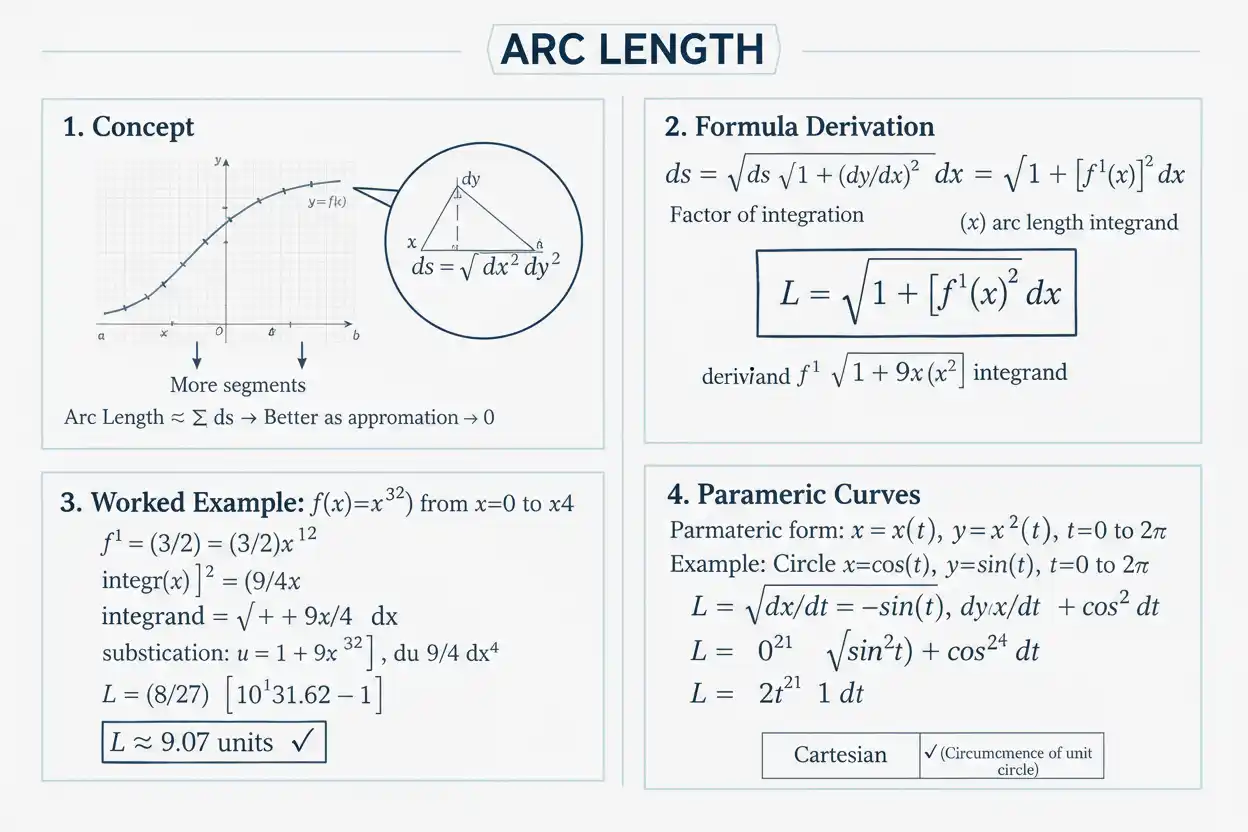

Arc length calculus finds the distance measured along a curve rather than the straight-line distance between its endpoints.
For a differentiable curve:
y=f(x)
from:
x=a
to:
x=b
the arc length is:
L = ∫ₐᵇ √[1+(f′(x))²] dx
For a parametric curve:
x=x(t)
y=y(t)
from:
t=α
to:
t=β
the formula becomes:
L = ∫α^β √[(dx/dt)²+(dy/dt)²] dt
These formulas come from approximating a curve with many short straight segments and taking a limit.
The derivative captures the local slope; the integral accumulates the resulting tiny lengths.
What Is Arc Length?
Arc length measures distance along a curve.
Consider two points on a curved path.
The straight-line distance between them is the shortest connection.
The arc length follows the curve itself and is therefore generally at least as large.
For a straight line, the two measures coincide.
For a curved path, arc length is larger unless the relevant section is effectively straight.
Arc Length Formula for y = f(x)
For:
y=f(x)
the formula is:
L = ∫ₐᵇ √[1+(dy/dx)²] dx
or:
L = ∫ₐᵇ √[1+(f′(x))²] dx
The interval:
[a,b]
specifies which portion of the curve is measured.
The derivative:
f′(x)
describes the local slope.
The square root converts horizontal and vertical differential changes into a local distance.
Why the Formula Contains √[1+(f′)²]
For a very small portion of a curve, horizontal change is:
dx
Vertical change is approximately:
dy
By the Pythagorean relationship:
ds² = dx²+dy²
where:
ds
represents a tiny arc-length element.
Take the square root:
ds = √(dx²+dy²)
Factor out:
dx²
to obtain:
ds = √[1+(dy/dx)²] |dx|
For an integration with increasing x:
ds = √[1+(dy/dx)²] dx
Adding all these infinitesimal lengths produces:
L = ∫ₐᵇ ds
Straight-Line Check
Take:
y=mx+c
Then:
y′=m
Arc length from:
x=a
to:
x=b
is:
L=∫ₐᵇ√(1+m²)dx
The integrand is constant:
√(1+m²)
Therefore:
L=(b−a)√(1+m²)
For the endpoints, horizontal change is:
b−a
and vertical change is:
m(b−a)
Straight-line distance is:
√[(b−a)²+m²(b−a)²]
= (b−a)√(1+m²)
The formulas agree.
Example: Length of y = x
Find the length of:
y=x
from:
x=0
to:
x=3
Derivative:
y′=1
Use:
L=∫₀³√(1+1²)dx
= ∫₀³√2 dx
= 3√2
Therefore:
L=3√2
Approximately:
L≈4.243
The direct endpoint distance:
√(3²+3²)
also gives:
3√2
because the graph is a straight line.
Example With a Convenient Antiderivative
Consider:
y=(2/3)x^(3/2)
on:
0≤x≤3
Differentiate:
y′=√x
Then:
(y′)²=x
Arc-length formula:
L=∫₀³√(1+x)dx
Use an antiderivative:
∫√(1+x)dx = (2/3)(1+x)^(3/2)
Evaluate:
L = (2/3)[(4)^(3/2)−(1)^(3/2)]
Since:
4^(3/2)=8
we get:
L=(2/3)(8−1)
=14/3
Therefore:
L=14/3
or approximately:
4.667
Arc Length Requires a Derivative First
A standard arc-length problem for:
y=f(x)
usually follows this order:
Find:
f′(x)
Square:
[f′(x)]²
Add:
1
Take the square root.
Integrate over the required interval.
This means a derivative error changes the entire arc-length integrand.
The specialist derivative rules therefore form the first computational stage.
Arc Length and the Chain Rule
The chain rule often appears when differentiating the curve before constructing the length integral.
Suppose:
y=(x²+1)^(3/2)
Then:
y′=(3/2)(x²+1)^(1/2)(2x)
= 3x√(x²+1)
That derivative must be squared inside:
√[1+(y′)²]
before integration.
Thus an arc-length problem may require several calculus techniques even before the final definite integral begins.
Arc Length Is a Definite Integral
Arc length is an accumulated quantity, so its standard formula uses a definite integral:
L=∫ₐᵇ√[1+(f′(x))²]dx
Unlike an indefinite integral, the final arc length is normally a nonnegative number with distance units.
The integration bounds define the specific segment of the curve being measured.
Units of Arc Length
If both:
x
and:
y
are measured in meters, then arc length is measured in:
meters.
If coordinates are in centimeters:
arc length is in centimeters.
Arc length is a one-dimensional measure, even though the curve may exist in two- or three-dimensional space.
Arc Length vs. Area Under a Curve
Arc length and area under a curve both use definite integrals but measure different quantities.
Area under:
y=f(x)
typically uses:
A=∫ₐᵇ f(x)dx
Arc length uses:
L=∫ₐᵇ√[1+(f′(x))²]dx
Area depends directly on function height.
Arc length depends on the derivative because it measures how the curve moves horizontally and vertically.
Arc Length vs. Area Between Curves
The area between curves usually uses a difference such as:
upper function − lower function
inside the integral.
Arc length does not subtract two curves.
Instead, it constructs a local length element from slope:
√[1+(f′(x))²]
This distinction matters because similar-looking definite-integral problems can represent completely different geometric quantities.
Arc Length for x = g(y)
Sometimes a curve is easier to describe with x as a function of y.
If:
x=g(y)
from:
y=c
to:
y=d
then:
L = ∫c^d √[1+(dx/dy)²] dy
This is the same geometry expressed with vertical rather than horizontal slicing.
Use whichever variable makes the derivative and integral simpler.
Example: x as a Function of y
Take:
x=2y
from:
y=0
to:
y=4
Then:
dx/dy=2
Therefore:
L=∫₀⁴√(1+4)dy
=∫₀⁴√5dy
=4√5
So:
L=4√5
Again, the result agrees with ordinary straight-line distance.
Parametric Arc Length
A curve parameterized by:
x=x(t)
y=y(t)
has local changes:
dx=(dx/dt)dt
dy=(dy/dt)dt
Therefore:
ds=√[(dx/dt)²+(dy/dt)²]dt
and:
L=∫α^β√[(dx/dt)²+(dy/dt)²]dt
This formula is especially useful for circles, ellipses, cycloids, and curves that are awkward to express as a single function y=f(x).
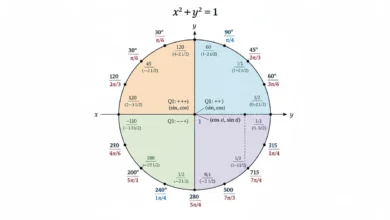
Parametric Circle Example
A circle of radius:
R
can be parameterized:
x=R cos t
y=R sin t
for:
0≤t≤2π
Differentiate:
dx/dt=-R sin t
dy/dt=R cos t
Then:
(dx/dt)²+(dy/dt)²
= R²sin²t+R²cos²t
= R²
because:
sin²t+cos²t=1
Therefore:
ds=Rdt
and:
L=∫₀^(2π)Rdt
=2πR
So the circumference is:
L=2πR
The familiar circle formula emerges directly from calculus.
Half-Circle Length
Using the same parameterization but:
0≤t≤π
gives:
L=∫₀^πRdt
=πR
Therefore:
Half-circle arc length = πR
Quarter-Circle Length
For:
0≤t≤π/2
we get:
L=R(π/2)
Therefore:
Quarter-circle arc length = πR/2
These results provide useful checks for parametric arc-length calculations.
Three-Dimensional Parametric Arc Length
For a spatial curve:
r(t)=(x(t),y(t),z(t))
the arc-length formula becomes:
L=∫α^β √[(dx/dt)²+(dy/dt)²+(dz/dt)²]dt
Equivalently:
L=∫α^β ||r′(t)||dt
The derivative vector describes instantaneous movement through space, while its magnitude gives the local speed along the curve.
Example: A Helix
Consider:
r(t)=(cos t, sin t, t)
from:
t=0
to:
t=2π
Differentiate:
r′(t)=(-sin t, cos t, 1)
Magnitude:
||r′(t)||
= √(sin²t+cos²t+1)
= √2
Therefore:
L=∫₀^(2π)√2dt
=2π√2
So:
Helix length = 2π√2
over this parameter interval.
Arc Length as Integral of Speed
For a parameterized curve:
r(t)
the quantity:
||r′(t)||
acts like speed along the path.
Therefore:
Arc Length = ∫ Speed dt
This parallels the basic motion relationship:
distance = speed × time
when speed is constant.
When speed varies continuously, integration replaces simple multiplication.
Reparameterization
A geometric curve can often be described by different parameters.
Arc length should not depend on how fast the parameter runs through the curve, provided the parameterization traces the same curve segment appropriately.
The parametric formula accounts for this through:
√[(dx/dt)²+(dy/dt)²]
which adjusts for the local parameter speed.
Arc Length Parameter
A curve can itself be parameterized by accumulated arc length s.
Under a regular arc-length parameterization:
||dr/ds||=1
This means that increasing the parameter by one unit moves one unit of distance along the curve.
Arc-length parameterization is important in advanced geometry because it separates path shape from arbitrary parameter speed.
Polar Arc Length
For a polar curve:
r=r(θ)
the arc length from:
θ=α
to:
θ=β
is:
L=∫α^β √[r²+(dr/dθ)²]dθ
This follows by converting differential movement in radial and angular directions into a local distance.
Polar Circle Check
For a circle:
r=R
we have:
dr/dθ=0
Therefore:
L=∫α^β√(R²)dθ
=R(β−α)
For:
α=0
β=2π
we recover:
L=2πR
When Arc-Length Integrals Are Difficult
A curve can have a simple equation but a difficult arc-length integral.
For example:
y=x²/2
gives:
y′=x
so:
L=∫√(1+x²)dx
This integral is not a simple power-rule calculation.
Its antiderivative involves logarithmic or inverse-hyperbolic structure.
Therefore a simple-looking graph does not guarantee a simple exact arc-length formula.
Exact Arc Length for y = x²/2 From 0 to 1
Start with:
y=x²/2
Derivative:
y′=x
Then:
L=∫₀¹√(1+x²)dx
A standard antiderivative is:
(1/2)[x√(1+x²)+ln(x+√(1+x²))]
Evaluate from:
0 to 1
At 1:
(1/2)[√2+ln(1+√2)]
At 0:
0
Therefore:
L = [√2+ln(1+√2)]/2
This is an exact result.
Numerically:
L≈1.14779
The curve is slightly longer than the horizontal interval length:
1
as expected.
Numerical Arc Length
Some arc-length integrals cannot be expressed conveniently in elementary functions.
In such cases, numerical integration can approximate:
∫ₐᵇ√[1+(f′(x))²]dx
Methods may approximate the integrand over many small intervals.
The resulting value should be reported to precision appropriate to the data and calculation.
Polygonal Approximation
Before calculus, a curved path can be approximated by many short line segments.
For points:
P₀,P₁,…,Pₙ
an approximate length is:
L≈Σ distance(Pᵢ₋₁,Pᵢ)
As the segments become sufficiently fine for a smooth curve, this polygonal length approaches the calculus arc length.
This provides the intuitive foundation of the integral formula.
Arc Length and Continuity
A usable arc-length formula normally requires enough regularity for the derivative and integral to behave properly.
If:
f′(x)
is continuous on a closed interval, then:
√[1+(f′(x))²]
is continuous there and the ordinary definite arc-length integral is well behaved.
The broader continuity concept therefore supports the standard smooth-curve setting.
Corners and Piecewise Curves
A curve can still have finite length even if it has a corner where one derivative does not exist.
For example, a V-shaped piecewise-linear graph consists of two straight segments.
Its total length can be found by calculating each smooth segment separately and adding:
L=L₁+L₂
Arc length is additive across adjacent curve segments.
Cusps and Singular Points
At a cusp or point where one derivative representation becomes problematic, another parameterization may be more useful.
A curve that is awkward as:
y=f(x)
may become manageable parametrically.
Thus choosing the right representation is an important part of arc-length calculus.
Avoid Double-Counting a Parametric Curve
A parameter interval can trace the same geometric path more than once.
The arc-length integral measures the length traveled according to the parameterization.
If a circle is traced twice, the integral gives twice the circumference.
Therefore verify that the parameter range represents the intended curve segment exactly once.
Orientation Does Not Change Geometric Length
Traversing the same curve in the opposite direction reverses the sign of parameter derivatives, but they are squared:
(dx/dt)²
(dy/dt)²
Therefore arc length remains nonnegative and unchanged.
This is appropriate because geometric length has no direction.
Arc Length Is Nonnegative
The integrand:
√[1+(f′(x))²]
is always at least:
1
for a graph over x.
Therefore, if:
b>a
we have:
L≥b−a
The curve cannot be shorter than the horizontal separation of its endpoints.
This gives an immediate reasonableness check.
Equality Case
For:
L=b−a
we need:
√[1+(f′(x))²]=1
throughout the interval.
That requires:
f′(x)=0
everywhere.
So the curve must be horizontal.
For a nonhorizontal straight line, its length is larger than its horizontal interval.
Arc Length and Straight-Line Endpoint Distance
For any curve connecting endpoints:
P and Q
its arc length satisfies:
L ≥ distance(P,Q)
A curve cannot provide a path shorter than the direct Euclidean segment between the same endpoints.
If your calculated arc length is smaller than the endpoint distance, an error has occurred.
Arc Length and Vector Spaces
In higher-dimensional mathematics, a parameterized curve has coordinate vectors whose representation depends on the ambient vector space. Concepts such as basis and dimension determine how many independent coordinates are required to describe that space.
In:
R²
arc-length speed contains two derivative components.
In:
R³
it contains three.
In an n-dimensional Euclidean coordinate space:
L=∫√[(dx₁/dt)²+…+(dxₙ/dt)²]dt
The number of coordinate components reflects the space’s dimension.
Arc Length and the Calculus–Linear Algebra Connection
The Calculus & Linear Algebra framework becomes visible in parametric arc length.
The derivative:
r′(t)
is a vector.
Its Euclidean magnitude:
||r′(t)||
uses the linear-algebra notion of vector length.
Integration then accumulates that magnitude:
L=∫||r′(t)||dt
So the calculation combines:
vector differentiation
with:
norm-based geometry
and:
definite integration.
Step-by-Step Arc Length Method
For:
y=f(x)
a reliable workflow is:
Identify the correct interval.
Differentiate:
f′(x)
Compute:
[f′(x)]²
Form:
√[1+(f′(x))²]
Simplify the integrand before integrating.
Evaluate the definite integral.
Then check:
units,
nonnegativity,
and:
whether the result exceeds the straight-line endpoint distance.
Worked Example: y = (1/3)x^(3/2)
Find arc length from:
x=0
to:
x=4
Differentiate:
y′=(1/2)√x
Square:
(y′)²=x/4
Then:
L=∫₀⁴√(1+x/4)dx
Rewrite:
√(1+x/4)=1/2√(x+4)
So:
L=(1/2)∫₀⁴√(x+4)dx
Antiderivative:
(1/2)(2/3)(x+4)^(3/2)
= (1/3)(x+4)^(3/2)
Evaluate:
L=(1/3)[8^(3/2)−4^(3/2)]
Now:
8^(3/2)=16√2
and:
4^(3/2)=8
Therefore:
L=(16√2−8)/3
Approximately:
L≈4.876
Check the Previous Example
Endpoints are:
At:
x=0
y=0
At:
x=4
y=(1/3)(8)
=8/3
Straight-line distance:
√[4²+(8/3)²]
= √(16+64/9)
= √(208/9)
≈4.807
The calculated arc length:
≈4.876
is slightly larger.
That is consistent with the geometric requirement.
Common Mistake: Forgetting to Square the Derivative
The formula is:
√[1+(f′(x))²]
not:
√[1+f′(x)]
The derivative must be squared before addition.
Common Mistake: Squaring the Function Instead of Its Derivative
For:
y=f(x)
arc length uses:
f′(x)
It does not use:
f(x)²
unless that expression happens to arise from the derivative.
The curve’s slope determines local path length.
Common Mistake: Using the Area Formula
Incorrect for length:
∫f(x)dx
Correct:
∫√[1+(f′(x))²]dx
The two integrals measure different geometric quantities and have different units.
Common Mistake: Forgetting the Square Root
From:
ds²=dx²+dy²
we need:
ds=√(dx²+dy²)
Therefore the arc-length integrand includes a square root.
Using:
1+(f′)²
without the root gives the wrong dimension and value.
Common Mistake: Using Wrong Bounds
For:
y=f(x)
the bounds are usually:
x-values.
For:
x=g(y)
they are:
y-values.
For a parametric curve:
parameter values.
Bounds must correspond to the variable of integration.
Common Mistake: Assuming Every Arc-Length Integral Has a Simple Formula
Some integrals simplify beautifully.
Others require:
advanced antiderivatives,
special functions,
or:
numerical methods.
A difficult integral does not mean the arc-length setup is wrong.
Common Mistake: Taking an Absolute Value of the Whole Definite Integral Unnecessarily
The standard arc-length integrand is already nonnegative because it is a square root of a sum of squares.
Therefore:
L≥0
automatically for correctly ordered bounds.
The geometry is built into the formula.
How to Check an Arc Length Answer
Use several tests.
First:
L≥0
Second, compare with endpoint straight-line distance:
L≥distance between endpoints
For a graph over:
[a,b]
also check:
L≥|b−a|
For known shapes such as circles or lines, compare with established geometric formulas.
Finally, verify the derivative and integration separately.
Frequently Asked Questions
What is the arc length calculus formula?
For:
y=f(x)
L=∫ₐᵇ√[1+(f′(x))²]dx
What is the formula when x is a function of y?
L=∫c^d√[1+(dx/dy)²]dy
What is the parametric arc length formula?
L=∫α^β√[(dx/dt)²+(dy/dt)²]dt
Why is there a square root in the formula?
It comes from the Pythagorean relationship:
ds²=dx²+dy²
Why do we differentiate the curve?
The derivative gives the local slope, which determines how much vertical movement accompanies a small horizontal movement.
Is arc length the same as area under a curve?
No. Arc length measures distance along a curve; area measures a two-dimensional region.
Is arc length always positive?
Geometric arc length is nonnegative.
Can arc length be less than the distance between endpoints?
No. It must be at least the straight-line endpoint distance.
What is the arc length of y=mx+c from a to b?
For:
b≥a
L=(b−a)√(1+m²)
What is the arc length of a full circle?
2πR
Can arc length be calculated parametrically?
Yes, and parametric form is often the best representation for circles and more complicated curves.
Can an arc-length integral require numerical methods?
Yes. Many valid arc-length integrals do not have simple elementary antiderivatives.
What is arc length in three dimensions?
For:
r(t)=(x(t),y(t),z(t))
L=∫√[(x′)²+(y′)²+(z′)²]dt
Final Example
Find the arc length of:
y=(2/3)x^(3/2)
from:
x=0
to:
x=8
Differentiate:
y′=√x
Square:
(y′)²=x
Build the arc-length integrand:
√[1+(y′)²]
=√(1+x)
Therefore:
L=∫₀⁸√(1+x)dx
An antiderivative is:
(2/3)(1+x)^(3/2)
Evaluate:
L=(2/3)[9^(3/2)−1^(3/2)]
Since:
9^(3/2)=27
we get:
L=(2/3)(27−1)
=(2/3)(26)
=52/3
Therefore:
L=52/3
or:
L≈17.333
The central arc-length formulas are:
L=∫ₐᵇ√[1+(dy/dx)²]dx
and, parametrically:
L=∫α^β√[(dx/dt)²+(dy/dt)²]dt
Differentiate first, build the local distance expression correctly, integrate over the intended curve segment, and verify that the resulting length is geometrically reasonable.