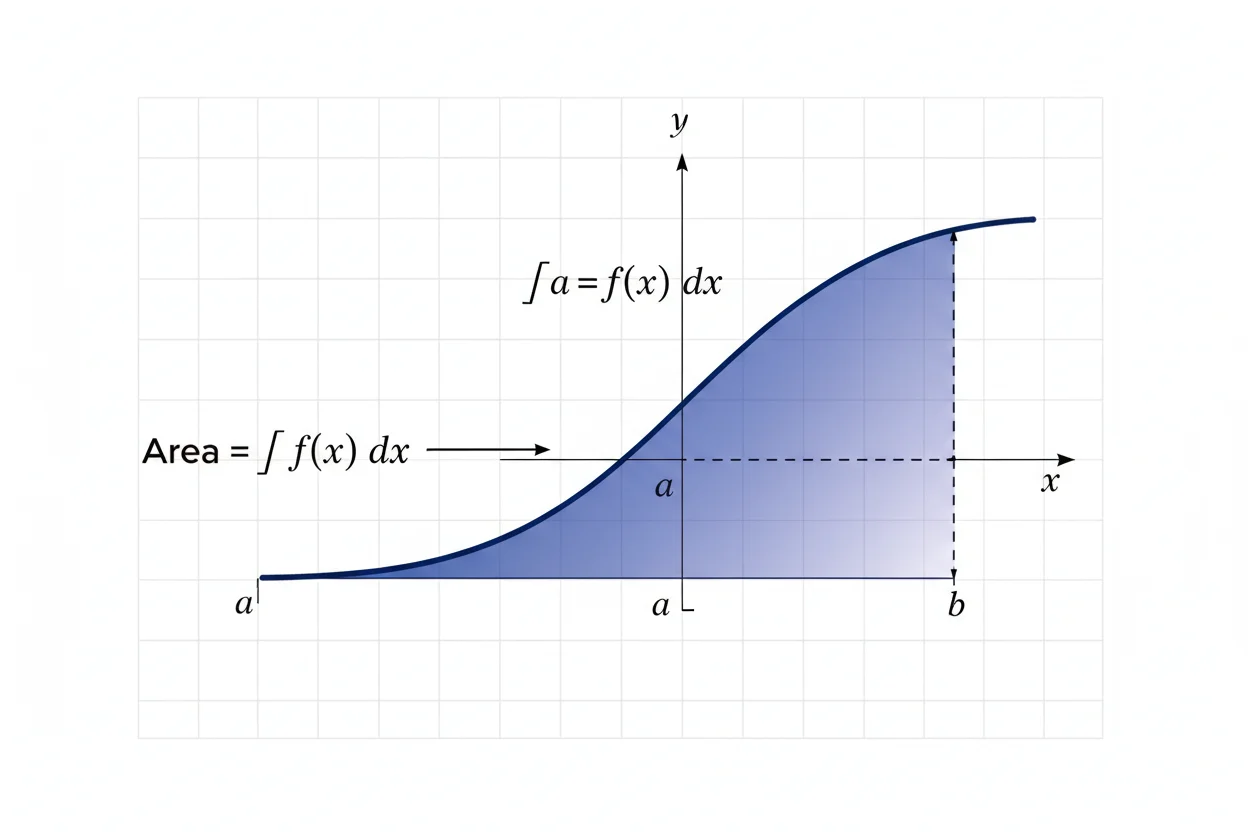

A definite integral measures the accumulated net value of a function over a specified interval. It is written with a lower limit and an upper limit, such as ∫ₐᵇ f(x) dx, and its result is a number rather than a family of functions. When f(x) represents height above the x-axis, the definite integral can represent signed area: regions above the axis contribute positively, while regions below it contribute negatively. The most common exact evaluation method is to find an antiderivative F(x) and calculate F(b) − F(a). This relationship is one of the central ideas connecting differentiation and integration. A definite integral can represent much more than geometric area, including displacement, accumulated change, total quantity, probability, work, and other continuous accumulations. Correct interpretation therefore depends on the function, its units, and the meaning of the interval.
What Is a Definite Integral?
For a function f(x) on an interval from x = a to x = b, the definite integral is written:
∫ₐᵇ f(x) dx
Here:
- a is the lower limit of integration.
- b is the upper limit of integration.
- f(x) is the integrand.
- x is the variable of integration.
- dx indicates integration with respect to x.
If F is an antiderivative of f, meaning:
F′(x) = f(x)
then the definite integral can usually be evaluated as:
∫ₐᵇ f(x) dx = F(b) − F(a)
This connection between accumulation and differentiation is formalized by the Fundamental Theorem of Calculus.
Definite Integral Formula
The standard evaluation formula is:
∫ₐᵇ f(x) dx = F(b) − F(a)
where:
F′(x) = f(x)
A compact notation sometimes used during evaluation is:
[F(x)]ₐᵇ = F(b) − F(a)
For example:
∫₁³ 2x dx
An antiderivative of 2x is:
F(x) = x²
Therefore:
∫₁³ 2x dx = [x²]₁³
= 3² − 1²
= 9 − 1
= 8
So the definite integral equals:
8
The related antiderivative concept explains how functions such as F(x) are obtained, while the definite integral specifically evaluates accumulated change between fixed limits.
How to Calculate a Definite Integral
A basic exact evaluation usually follows four steps.
First, identify the integrand and the limits. Next, find an antiderivative. Then substitute the upper and lower limits into that antiderivative. Finally, subtract the lower-limit value from the upper-limit value.
Consider:
∫₂⁵ 3x² dx
An antiderivative of 3x² is:
F(x) = x³
Now evaluate:
∫₂⁵ 3x² dx = [x³]₂⁵
= 5³ − 2³
= 125 − 8
= 117
Therefore:
∫₂⁵ 3x² dx = 117
Why Upper Minus Lower Matters
A common mistake is to add the endpoint values or reverse the subtraction.
The rule is always:
F(b) − F(a)
not:
F(a) − F(b)
For example:
∫₀² (x + 1) dx
An antiderivative is:
F(x) = x²/2 + x
Evaluate at x = 2:
F(2) = 2²/2 + 2 = 2 + 2 = 4
Evaluate at x = 0:
F(0) = 0
Therefore:
∫₀² (x + 1) dx = 4 − 0 = 4
Reversing the subtraction would incorrectly produce −4.
Geometric Meaning of a Definite Integral
A definite integral can represent signed area between a function and the x-axis.
For a function that remains nonnegative on [a, b]:
∫ₐᵇ f(x) dx
equals the geometric area between y = f(x), the x-axis, and the vertical lines x = a and x = b.
This interpretation is closely related to finding the area under a curve, but a definite integral is fundamentally an accumulation operator rather than only an area formula.
If the graph falls below the x-axis, the integral measures net signed area.
Positive and Negative Areas
Suppose a function lies above the x-axis on one portion of an interval and below it on another.
If:
A₁ = area above the x-axis
and:
A₂ = geometric area below the x-axis
then:
∫ₐᵇ f(x) dx = A₁ − A₂
This means a definite integral may equal zero even when substantial geometric area exists.
For example, consider:
f(x) = x
on:
[−2, 2]
The negative triangular region from −2 to 0 has area 2, while the positive triangular region from 0 to 2 also has area 2.
Therefore:
∫₋₂² x dx = −2 + 2 = 0
The net integral is zero, but the total geometric area is:
2 + 2 = 4
Example: Definite Integral of a Polynomial
Evaluate:
∫₀² (3x² + 2x − 1) dx
Integrate each term:
∫ 3x² dx = x³
∫ 2x dx = x²
∫ −1 dx = −x
So an antiderivative is:
F(x) = x³ + x² − x
Evaluate at 2:
F(2) = 8 + 4 − 2 = 10
Evaluate at 0:
F(0) = 0
Therefore:
∫₀² (3x² + 2x − 1) dx = 10
Example With a Negative Result
Evaluate:
∫₀³ (x − 4) dx
An antiderivative is:
F(x) = x²/2 − 4x
At x = 3:
F(3) = 9/2 − 12
= 4.5 − 12
= −7.5
At x = 0:
F(0) = 0
Therefore:
∫₀³ (x − 4) dx = −7.5
The negative answer makes sense because x − 4 remains below the x-axis throughout the interval [0, 3].
Constant Multiple Rule
A constant can be moved outside a definite integral.
∫ₐᵇ c f(x) dx = c ∫ₐᵇ f(x) dx
For example:
∫₀² 5x² dx = 5∫₀² x² dx
Since:
∫ x² dx = x³/3
we get:
5[x³/3]₀²
= 5(8/3)
= 40/3
Sum and Difference Rules
Integrals distribute over addition and subtraction.
∫ₐᵇ [f(x) + g(x)] dx = ∫ₐᵇ f(x) dx + ∫ₐᵇ g(x) dx
Similarly:
∫ₐᵇ [f(x) − g(x)] dx = ∫ₐᵇ f(x) dx − ∫ₐᵇ g(x) dx
This makes polynomial and multi-term expressions easier to integrate term by term.
Reversing the Limits
Reversing the integration limits changes the sign.
∫ₐᵇ f(x) dx = −∫ᵦᵃ f(x) dx
For example, if:
∫₁⁴ f(x) dx = 7
then:
∫₄¹ f(x) dx = −7
The interval is traversed in the opposite orientation.
Equal Integration Limits
When the upper and lower limits are equal:
∫ₐᵃ f(x) dx = 0
There is no interval across which to accumulate a value.
For example:
∫₅⁵ (x² + 1) dx = 0
No antiderivative calculation is necessary.
Splitting an Interval
If c lies between a and b, then:
∫ₐᵇ f(x) dx = ∫ₐᶜ f(x) dx + ∫𝚌ᵇ f(x) dx
For example:
∫₀⁵ f(x) dx = ∫₀² f(x) dx + ∫₂⁵ f(x) dx
This rule is especially useful when a function changes formula, sign, or behavior within an interval.
The requirement that functions behave appropriately over an interval is closely connected with continuity, although some discontinuous functions can also be integrated.
Definite Integral of a Constant
If:
f(x) = c
then:
∫ₐᵇ c dx = c(b − a)
Geometrically, this represents the signed area of a rectangle with height c and width b − a.
For example:
∫₂⁷ 4 dx = 4(7 − 2)
= 20
Definite Integral of xⁿ
For n ≠ −1:
∫ₐᵇ xⁿ dx = [xⁿ⁺¹/(n + 1)]ₐᵇ
Therefore:
∫ₐᵇ xⁿ dx = (bⁿ⁺¹ − aⁿ⁺¹)/(n + 1)
For example:
∫₁³ x² dx
= [x³/3]₁³
= 27/3 − 1/3
= 26/3
≈ 8.67
Example With a Square Root
Evaluate:
∫₀⁴ √x dx
Write:
√x = x¹ᐟ²
Apply the power rule for integration:
∫ x¹ᐟ² dx = x³ᐟ²/(3/2)
= (2/3)x³ᐟ²
Then:
∫₀⁴ √x dx = [(2/3)x³ᐟ²]₀⁴
Since:
4³ᐟ² = (√4)³ = 8
we get:
(2/3)(8) − 0
= 16/3
So:
∫₀⁴ √x dx = 16/3 ≈ 5.33
Definite Integrals and Derivatives
Integration and differentiation are inverse processes under suitable conditions.
If:
F′(x) = f(x)
then:
∫ₐᵇ f(x) dx = F(b) − F(a)
The derivative measures instantaneous change, while a definite integral accumulates quantities over an interval.
The broader study of derivatives develops multiple differentiation forms and rules, while integration moves in the complementary direction from rates toward accumulated totals.
Definite Integral and the Chain Rule
Some integrands contain composite functions whose structure reflects differentiation patterns.
For example:
∫₀¹ 2x(x² + 1)³ dx
The inner function is:
u = x² + 1
and:
du = 2x dx
The integrand contains both the composite expression and the derivative of its inner expression. This structure is closely related to the chain rule operating in reverse.
Using substitution:
u = x² + 1
When x = 0:
u = 1
When x = 1:
u = 2
So:
∫₀¹ 2x(x² + 1)³ dx = ∫₁² u³ du
= [u⁴/4]₁²
= 16/4 − 1/4
= 15/4
The dedicated integration by substitution method handles this technique in detail.
Definite Integral Versus Indefinite Integral
A definite integral has fixed limits:
∫ₐᵇ f(x) dx
and produces a numerical accumulated value.
An indefinite integral has no fixed endpoints:
∫ f(x) dx = F(x) + C
and represents a family of antiderivatives.
For example:
∫ 2x dx = x² + C
but:
∫₁³ 2x dx = 8
The constant of integration C is unnecessary in a definite integral because it cancels:
[F(b) + C] − [F(a) + C]
= F(b) − F(a)
Integration by Parts and Definite Integrals
Some definite integrals contain products that do not simplify naturally through basic antiderivative rules.
For these, integration by parts may be appropriate.
Its standard form is:
∫ u dv = uv − ∫ v du
With fixed limits, it can be written:
∫ₐᵇ u dv = [uv]ₐᵇ − ∫ₐᵇ v du
The method should be chosen based on the integrand’s structure rather than used automatically.
Improper Definite Integrals
Ordinary definite integrals use finite bounds and integrands that remain suitably behaved on their intervals.
If an interval is infinite or the function becomes unbounded at an endpoint or within the interval, the problem becomes an improper integral.
For example:
∫₁∞ 1/x² dx
cannot be evaluated by simply substituting ∞ as an ordinary number. Instead, a limit is required.
This distinction is important because some improper integrals converge to finite numbers while others diverge.
Definite Integral and Multiple Variables
A single definite integral accumulates with respect to one variable.
In multivariable settings, a double integral extends accumulation over a two-dimensional region.
The underlying idea remains accumulation, but the geometry and bounds become more complex.
Definite Integral as Accumulated Change
Suppose v(t) represents velocity.
Then:
∫ₐᵇ v(t) dt
represents displacement over the interval from t = a to t = b.
If v(t) becomes negative, that negative portion reduces net displacement.
Distance traveled is different because negative velocity must contribute positive distance. That usually requires integrating:
|v(t)|
rather than v(t) directly.
This illustrates why interpreting a definite integral requires attention to sign and physical meaning.
Units of a Definite Integral
The units of a definite integral combine the units of the integrand with the units of the integration variable.
If velocity is measured in meters per second and time is measured in seconds:
velocity × time = meters
so:
∫ v(t) dt
has units of meters.
Likewise, if a density is measured in kilograms per meter and integration occurs over meters, the result has units of kilograms.
Units provide a useful check on whether an interpretation is reasonable.
Symmetry Rules
Symmetry can simplify definite integrals.
If f is an odd function:
f(−x) = −f(x)
then over a symmetric interval:
∫₋ₐᵃ f(x) dx = 0
For example:
∫₋₃³ x³ dx = 0
If f is even:
f(−x) = f(x)
then:
∫₋ₐᵃ f(x) dx = 2∫₀ᵃ f(x) dx
For example:
∫₋₂² x² dx = 2∫₀² x² dx
= 2[x³/3]₀²
= 16/3
Recognizing symmetry can reduce unnecessary calculation.
Estimating a Definite Integral
A definite integral can also be understood as the limit of increasingly fine sums.
Divide [a, b] into many small subintervals. If each small width is Δx and a sample function value is f(xᵢ*), an approximation is:
Σ f(xᵢ*)Δx
As the largest subinterval width approaches zero, these sums approach the exact integral under suitable conditions:
∫ₐᵇ f(x) dx = lim Σ f(xᵢ*)Δx
This limiting interpretation explains why an integral measures accumulation rather than merely applying an antiderivative formula.
When a Definite Integral Equals Zero
A zero result can arise in several ways.
The function may be zero across the entire interval, the limits may be equal, or positive and negative contributions may cancel.
For example:
∫₋₁¹ x dx = 0
Yet x is not zero throughout [−1, 1]. The negative and positive signed areas cancel because the function is odd.
Therefore, a zero definite integral does not automatically mean the function itself is zero.
Can a Definite Integral Be Negative?
Yes.
A definite integral represents net signed accumulation. If negative contributions dominate, the result is negative.
For example:
∫₀² (x − 3) dx
An antiderivative is:
F(x) = x²/2 − 3x
Evaluate:
F(2) − F(0)
= 2 − 6
= −4
The integral equals −4 because the graph remains below the x-axis over the entire interval.
Common Mistakes
One of the most common errors is forgetting to evaluate both endpoints. Finding an antiderivative is only part of the calculation.
Another error is calculating:
F(a) − F(b)
instead of:
F(b) − F(a)
Students may also add a constant +C to a final definite-integral answer. The arbitrary constant belongs to indefinite integration and cancels when endpoints are evaluated.
A further mistake is treating every definite integral as geometric area. The integral measures signed accumulation, so regions below the x-axis reduce the result.
When a function changes sign, calculating total geometric area may require splitting the interval at each zero and treating each region appropriately.
Finally, advanced-looking integrands should not automatically be attacked with complicated techniques. Sometimes algebraic simplification reveals a much easier antiderivative.
The distinction between scalar accumulation here and vector operations such as the cross product is also important: both appear in advanced mathematics, but they perform fundamentally different tasks.
Frequently Asked Questions
What is the formula for a definite integral?
If F′(x) = f(x), then:
∫ₐᵇ f(x) dx = F(b) − F(a)
What does a definite integral represent?
It represents net accumulated value over an interval. Depending on context, this may correspond to signed area, displacement, total change, mass, probability, work, or another accumulated quantity.
Does a definite integral always represent area?
Not exactly. It represents signed accumulation. Geometric area is always nonnegative, while a definite integral can be positive, zero, or negative.
Why is there no +C in a definite integral?
Any constant cancels when evaluating the endpoints:
[F(b) + C] − [F(a) + C] = F(b) − F(a)
What happens if the limits are reversed?
The sign changes:
∫ₐᵇ f(x) dx = −∫ᵦᵃ f(x) dx
What happens when both limits are the same?
The integral equals zero:
∫ₐᵃ f(x) dx = 0
Can a definite integral be negative?
Yes. A negative result means negative contributions dominate the net accumulation over the interval.
Can a definite integral equal zero when the function is not zero?
Yes. Positive and negative contributions can cancel, as they do for many odd functions integrated over symmetric intervals.
What is the difference between a definite and an indefinite integral?
A definite integral has fixed limits and produces an accumulated numerical value. An indefinite integral represents a family of antiderivatives and includes an arbitrary constant.
How can I check a definite integral answer?
Differentiate the antiderivative to confirm that it returns the original integrand, then carefully recheck the upper-minus-lower endpoint evaluation. The sign and approximate size should also agree with the graph or practical context.