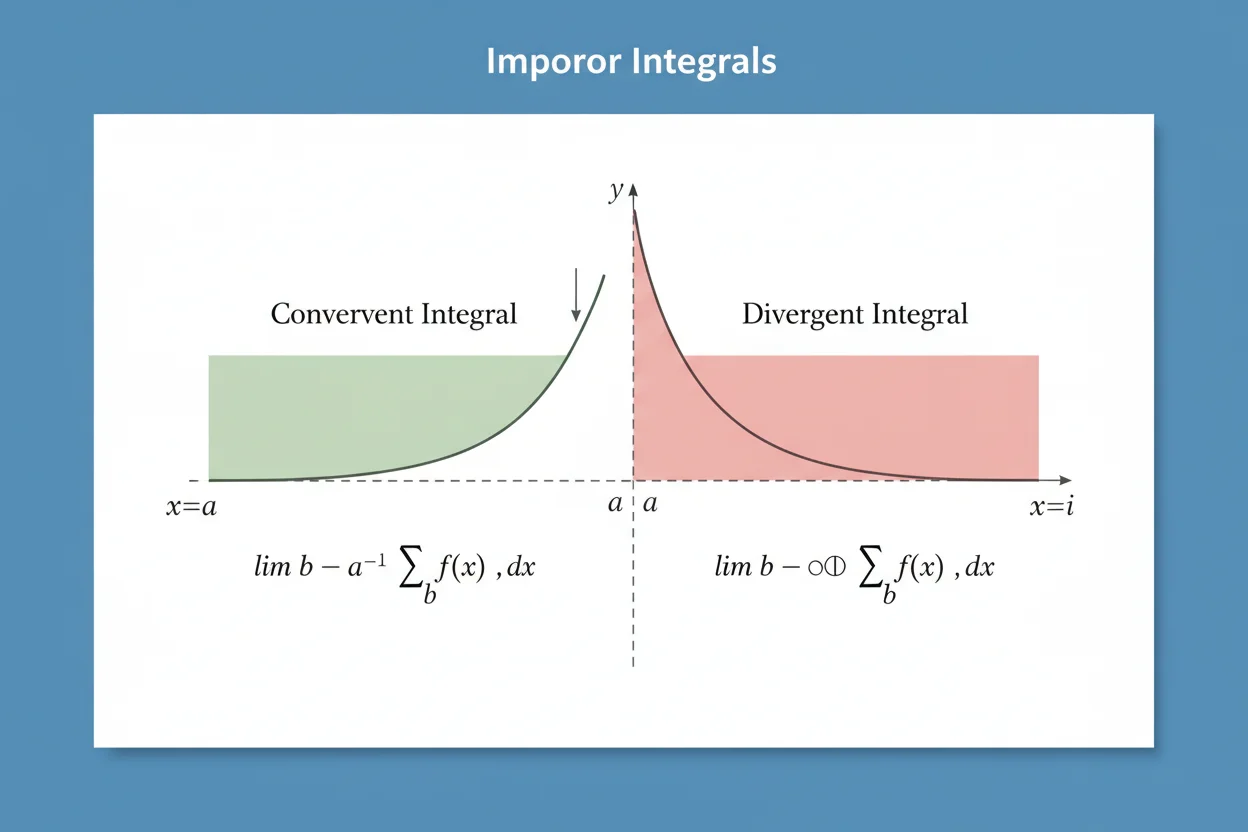

An improper integral is a definite integral whose interval is unbounded or whose integrand becomes unbounded somewhere on the interval. Because infinity is not an ordinary number and a function cannot simply be evaluated at a vertical singularity, these integrals are defined using limits. An improper integral converges when the required limit exists as a finite real number; otherwise, it diverges. For example, ∫₁∞ 1/x² dx converges to 1, while ∫₁∞ 1/x dx diverges even though both functions approach zero as x approaches infinity. Improper behavior can occur at an infinite endpoint, at a finite endpoint such as x = 0, or at an interior point that splits the interval into separate pieces. Every improper point must be handled independently, and all required pieces must converge for the entire integral to converge. This makes convergence analysis just as important as finding an antiderivative. The method builds on ordinary integration but adds a limiting step that cannot be skipped.
What Is an Improper Integral?
An ordinary definite integral has finite limits and a suitably bounded integrand over its interval.
An improper integral arises when one of those conditions fails.
Two main situations occur:
An interval may extend indefinitely:
∫ₐ∞ f(x) dx
or:
∫₋∞ᵇ f(x) dx
Alternatively, the function may become unbounded at an endpoint or inside a finite interval:
∫ₐᵇ f(x) dx
where f(x) approaches infinity or negative infinity near some point.
In either case, the integral is defined through one or more limits rather than by treating the improper endpoint as an ordinary substitution value.
Improper Integral With an Infinite Upper Bound
For:
∫ₐ∞ f(x) dx
define:
∫ₐ∞ f(x) dx = lim as b → ∞ of ∫ₐᵇ f(x) dx
If this limit exists and is finite, the integral converges.
If the limit fails to exist or is infinite, the integral diverges.
The symbol ∞ therefore describes the limiting behavior of the interval. It is not a number inserted into an antiderivative.
Example: Convergent Integral to Infinity
Evaluate:
∫₁∞ 1/x² dx
Replace infinity with b:
∫₁∞ 1/x² dx = lim as b → ∞ of ∫₁ᵇ x⁻² dx
An antiderivative is:
−1/x
Therefore:
∫₁ᵇ x⁻² dx = [−1/x]₁ᵇ
= −1/b − (−1)
= 1 − 1/b
Take the limit:
lim as b → ∞ of (1 − 1/b) = 1
Therefore:
∫₁∞ 1/x² dx = 1
The improper integral converges.
Example: Divergent Integral to Infinity
Consider:
∫₁∞ 1/x dx
Replace infinity with b:
∫₁∞ 1/x dx = lim as b → ∞ of ∫₁ᵇ 1/x dx
An indefinite integral of 1/x is:
ln x
So:
∫₁ᵇ 1/x dx = ln b − ln 1
= ln b
As:
b → ∞
we have:
ln b → ∞
Therefore:
∫₁∞ 1/x dx
diverges.
The fact that:
1/x → 0
does not guarantee convergence.
Why Approaching Zero Is Not Enough
For an improper integral:
∫ₐ∞ f(x) dx
it is generally necessary for f(x) to approach zero if the integral is to converge under common nonnegative settings.
But:
f(x) → 0
is not sufficient.
Both:
1/x
and:
1/x²
approach zero.
Yet:
∫₁∞ 1/x dx
diverges, while:
∫₁∞ 1/x² dx
converges.
The rate at which the function decays matters.
p-Test for Integrals to Infinity
A fundamental convergence rule is:
∫₁∞ 1/xᵖ dx
For real p:
converges if p > 1
diverges if p ≤ 1
For example:
∫₁∞ 1/x³ dx
converges because:
3 > 1
while:
∫₁∞ 1/√x dx
has:
p = 1/2
and diverges because:
1/2 ≤ 1
This p-test provides a useful benchmark for comparison with more complicated functions.
Deriving the p-Test for p > 1
For:
p ≠ 1
an antiderivative of x⁻ᵖ is:
x¹⁻ᵖ/(1 − p)
Thus:
∫₁ᵇ x⁻ᵖ dx = [x¹⁻ᵖ/(1 − p)]₁ᵇ
When p > 1:
1 − p < 0
so:
b¹⁻ᵖ → 0
as:
b → ∞
The limiting value is finite.
When p < 1, the power b¹⁻ᵖ grows without bound.
The case p = 1 gives the logarithmic divergence already seen.
Infinite Lower Bound
For:
∫₋∞ᵇ f(x) dx
define:
∫₋∞ᵇ f(x) dx = lim as a → −∞ of ∫ₐᵇ f(x) dx
For example:
∫₋∞⁰ eˣ dx
becomes:
lim as a → −∞ of ∫ₐ⁰ eˣ dx
Evaluate:
[eˣ]ₐ⁰ = 1 − eᵃ
As:
a → −∞
we have:
eᵃ → 0
Therefore:
∫₋∞⁰ eˣ dx = 1
The integral converges.
Both Bounds Infinite
An integral over the entire real line:
∫₋∞∞ f(x) dx
must be split at a finite point c:
∫₋∞ᶜ f(x) dx + ∫𝚌∞ f(x) dx
Both pieces must converge separately.
For convenience, c is often chosen as:
c = 0
so:
∫₋∞∞ f(x) dx = ∫₋∞⁰ f(x) dx + ∫₀∞ f(x) dx
If either piece diverges, the ordinary improper integral diverges.
Example Over the Whole Real Line
Consider:
∫₋∞∞ e^(−|x|) dx
Split at zero:
∫₋∞⁰ eˣ dx + ∫₀∞ e^(−x) dx
The first integral equals:
1
The second also equals:
1
Therefore:
∫₋∞∞ e^(−|x|) dx = 2
Both pieces converge, so the full improper integral converges.
Improper Integral at a Finite Endpoint
Improper behavior can also occur without any infinite interval.
Consider:
∫₀¹ 1/√x dx
The function:
1/√x
becomes unbounded as:
x → 0⁺
Define:
∫₀¹ 1/√x dx = lim as a → 0⁺ of ∫ₐ¹ x⁻¹ᐟ² dx
An antiderivative is:
2√x
Therefore:
∫ₐ¹ x⁻¹ᐟ² dx = 2 − 2√a
Take the limit:
lim as a → 0⁺ of (2 − 2√a) = 2
So:
∫₀¹ 1/√x dx = 2
The integrand becomes infinite near zero, but the accumulated area remains finite.
Divergence at a Finite Endpoint
Now consider:
∫₀¹ 1/x dx
Define:
∫₀¹ 1/x dx = lim as a → 0⁺ of ∫ₐ¹ 1/x dx
Evaluate:
[ln x]ₐ¹
= ln 1 − ln a
= −ln a
As:
a → 0⁺
we have:
ln a → −∞
so:
−ln a → ∞
Therefore:
∫₀¹ 1/x dx
diverges.
A finite interval does not guarantee a finite integral if the integrand has a sufficiently strong singularity.
p-Test Near Zero
For:
∫₀¹ 1/xᵖ dx
the convergence condition reverses relative to the infinite-interval p-test:
converges if p < 1
diverges if p ≥ 1
For example:
∫₀¹ 1/x¹ᐟ² dx
converges because:
1/2 < 1
while:
∫₀¹ 1/x² dx
diverges because:
2 ≥ 1
This rule is useful for comparing endpoint singularities.
Interior Singularities
Suppose a function becomes unbounded at:
x = c
where:
a < c < b
Then:
∫ₐᵇ f(x) dx
must be split:
∫ₐᶜ f(x) dx + ∫𝚌ᵇ f(x) dx
Each piece requires its own one-sided limit.
The entire integral converges only if both pieces converge.
You cannot cancel infinities from opposite sides and call the ordinary improper integral convergent.
Example With an Interior Singularity
Consider:
∫₋₁¹ 1/x² dx
The integrand is undefined at:
x = 0
Split:
∫₋₁⁰ 1/x² dx + ∫₀¹ 1/x² dx
For the right side:
∫₀¹ 1/x² dx
already diverges.
Therefore the entire integral diverges.
There is no need to calculate the left side once one required piece has been shown to diverge.
Why You Must Split at Every Singularity
Suppose you attempted to use one antiderivative across a discontinuity.
That can hide the fact that the original integral is not defined in the ordinary sense.
The Fundamental Theorem Of Calculus applies directly under suitable regularity conditions on the interval. A vertical singularity violates those ordinary conditions.
The interval must first be separated into regions where the integrand behaves appropriately, and each resulting improper limit must be tested.
Cauchy Principal Value Is Different
Consider:
∫₋₁¹ 1/x dx
The symmetric expression:
lim as a → 0⁺ of [∫₋₁⁻ᵃ 1/x dx + ∫ₐ¹ 1/x dx]
equals zero because the two logarithmic contributions cancel.
However, the ordinary improper integral diverges because:
∫₋₁⁰ 1/x dx
and:
∫₀¹ 1/x dx
do not converge separately.
The symmetric value is called a Cauchy principal value.
It must not be confused with ordinary convergence of an improper integral.
Improper Integrals and Continuity
A continuous function on a finite closed interval is bounded, so its ordinary integral does not have an interior blow-up of the type considered here.
When continuity fails because a function becomes unbounded, limiting definitions may be necessary.
Not every discontinuity creates an improper integral. A bounded jump discontinuity, for example, can still be handled by standard integration methods under familiar settings.
Improperness specifically concerns unbounded intervals or problematic unbounded behavior of the integrand.
Comparison Test
Suppose:
0 ≤ f(x) ≤ g(x)
for sufficiently large x.
If:
∫ₐ∞ g(x) dx
converges, then:
∫ₐ∞ f(x) dx
also converges.
Conversely, if:
0 ≤ g(x) ≤ f(x)
and:
∫ₐ∞ g(x) dx
diverges, then:
∫ₐ∞ f(x) dx
also diverges.
The p-test functions:
1/xᵖ
are common comparison benchmarks.
Comparison Example
Determine the convergence of:
∫₁∞ 1/(x² + 1) dx
For x ≥ 1:
x² + 1 ≥ x²
Therefore:
1/(x² + 1) ≤ 1/x²
and both functions are nonnegative.
Since:
∫₁∞ 1/x² dx
converges, the comparison test shows that:
∫₁∞ 1/(x² + 1) dx
also converges.
In this particular case, an exact antiderivative exists, but comparison establishes convergence without needing it.
Limit Comparison
When two positive functions behave similarly at infinity, compare their ratio.
If:
lim as x → ∞ of f(x)/g(x) = L
with:
0 < L < ∞
then f and g have the same convergence behavior for the corresponding improper integrals.
For example:
f(x) = (3x + 1)/(x³ + 4)
For large x, the dominant behavior is:
3x/x³ = 3/x²
Compare with:
g(x) = 1/x²
The ratio approaches:
3
Since:
∫₁∞ 1/x² dx
converges, the integral of f also converges.
Convergence Before Exact Evaluation
In many problems, the first question is whether the improper integral converges.
If it clearly diverges, there is no finite value to calculate.
If it converges, an exact value may be found through an antiderivative or another integration technique.
The broader integrals framework contains those integration tools, while the defining feature here is the additional convergence limit.
Improper Integral and Integration by Substitution
Sometimes a convergent improper integral becomes easier after integration by substitution.
For example:
∫₀∞ 2x e^(−x²) dx
Let:
u = x²
Then:
du = 2x dx
The bounds become:
x = 0 → u = 0
x → ∞ → u → ∞
So:
∫₀∞ 2x e^(−x²) dx = ∫₀∞ e^(−u) du
Evaluate:
lim as b → ∞ of [−e^(−u)]₀ᵇ
= lim as b → ∞ of [1 − e^(−b)]
= 1
The integral converges to 1.
Improper Integral and Integration by Parts
An improper integral may also require integration by parts.
The safest procedure is generally to replace the improper endpoint with a finite parameter first, perform integration by parts on the finite interval, and only then take the required limit.
For example, expressions involving:
xe^(−x)
over:
[0, ∞)
can be handled this way.
The limiting definition remains primary; the integration technique is applied inside that definition.
Example: ∫₀∞ xe^(−x) dx
Write:
∫₀∞ xe^(−x) dx = lim as b → ∞ of ∫₀ᵇ xe^(−x) dx
Use integration by parts:
u = x
dv = e^(−x) dx
Then:
du = dx
v = −e^(−x)
So:
∫ xe^(−x) dx = −xe^(−x) − e^(−x)
Evaluate from 0 to b:
[−xe^(−x) − e^(−x)]₀ᵇ
= −be^(−b) − e^(−b) + 1
As:
b → ∞
both:
be^(−b) → 0
and:
e^(−b) → 0
Therefore:
∫₀∞ xe^(−x) dx = 1
Rational Functions and Partial Fractions
A rational improper integral may first need algebraic decomposition.
For suitable rational functions, partial fraction integration can expose logarithmic or reciprocal terms whose limiting behavior is then analyzed.
The decomposition does not itself prove convergence.
After obtaining an antiderivative, the improper endpoint or singularity still has to be handled through the defining limit.
Absolute Convergence
An improper integral:
∫ₐ∞ f(x) dx
is absolutely convergent if:
∫ₐ∞ |f(x)| dx
converges.
Absolute convergence guarantees convergence of the original integral.
This is especially relevant for oscillating functions whose positive and negative contributions may partially cancel.
There are also conditionally convergent improper integrals, where the original integral converges but the integral of the absolute value diverges.
Oscillation Does Not Automatically Mean Divergence
An integrand does not need to remain positive to converge.
Oscillatory functions can produce convergent improper integrals because positive and negative contributions may decrease sufficiently.
However, cancellation must arise through a valid limiting process.
It is not acceptable to combine separately divergent pieces and simply declare that they cancel.
This is why the distinction between ordinary convergence and principal-value symmetry matters.
Improper Integral and Limits
The defining operation is a limit.
For an infinite upper bound:
∫ₐ∞ f(x) dx
means:
lim as b → ∞ of ∫ₐᵇ f(x) dx
For a singular lower endpoint a:
∫ₐᵇ f(x) dx
means:
lim as t → a⁺ of ∫ₜᵇ f(x) dx
The ordinary integration happens first on a proper finite interval. The limit then determines whether those finite integrals approach a finite value.
Improper Integral Versus Indefinite Integral
An indefinite integral seeks a family of antiderivatives:
∫ f(x) dx = F(x) + C
An improper integral seeks a numerical accumulated value, subject to convergence:
∫ₐ∞ f(x) dx
The antiderivative may be used inside the calculation, but it does not remove the need for a limit.
For example, knowing:
∫ 1/x dx = ln|x| + C
does not make:
∫₁∞ 1/x dx
finite. The limiting logarithm still diverges.
Improper Integral Versus Ordinary Definite Integral
For an ordinary definite integral:
∫ₐᵇ f(x) dx
both endpoints are finite and the integrand satisfies the conditions needed for standard evaluation.
An improper integral violates an endpoint or boundedness condition and must first be redefined through a limit.
This distinction is essential because writing:
F(∞) − F(a)
is not valid arithmetic.
Infinity is not an ordinary input value.
Improper Integral and Area
A convergent nonnegative improper integral can represent a finite area extending over an infinite interval or approaching a vertical asymptote.
For example:
∫₁∞ 1/x² dx = 1
shows that an infinitely long region can have finite area under a curve.
Infinite width does not necessarily imply infinite area because the height may shrink quickly enough.
Likewise, infinite height near one point does not necessarily imply infinite area if the singularity is sufficiently mild.
Infinite Width, Finite Area
The region under:
y = 1/x²
from x = 1 to infinity extends indefinitely to the right.
Yet its area is:
1
The shrinking function values compensate for the unbounded horizontal interval.
This is one of the most important geometric insights provided by improper integrals.
Infinite Height, Finite Area
The graph:
y = 1/√x
becomes arbitrarily large near:
x = 0⁺
Yet:
∫₀¹ 1/√x dx = 2
So an unbounded function can still enclose a finite accumulated area near its singularity.
The strength of the singularity determines the outcome.
Improper Integrals in Multivariable Settings
Improper behavior can also occur in higher-dimensional integration.
A double integral may extend over an unbounded region or contain a singular integrand.
The same core principle survives: replace the problematic part by a suitable limiting family of proper regions or bounds and analyze convergence.
The detailed setup is more complicated because the geometry of the multidimensional region matters.
Gradient and Improper Integrals
A gradient measures local multivariable change and does not determine improper-integral convergence by itself.
A scalar field may have a gradient while an integral involving the field is improper because its domain is unbounded or the field has a singularity.
Thus differentiation and convergence address different questions.
They may appear together in advanced applications, but the convergence test remains an integral problem.
Implicit Differentiation and Improper Integrals
Implicit differentiation finds rates such as dy/dx from relations between variables.
Improper integration evaluates accumulated quantities in the presence of infinite bounds or unbounded integrands.
An implicit relation could define a curve or substitution used in an integration problem, but implicit differentiation is not a test for whether an improper integral converges.
The two methods occupy distinct roles within the broader Calculus & Linear Algebra framework.
Common Mistakes
The most serious mistake is substituting infinity directly into an antiderivative.
Instead of:
F(∞) − F(a)
write:
lim as b → ∞ of [F(b) − F(a)]
Another common error is failing to split an integral at an interior singularity. Each side requires its own one-sided limit.
Students sometimes assume that f(x) → 0 guarantees convergence. The divergent integral:
∫₁∞ 1/x dx
shows that it does not.
It is also incorrect to cancel two divergent improper pieces and call the result convergent.
For singular endpoints, the direction of the limit matters:
x → a⁺
or:
x → b⁻
depending on which side lies inside the interval.
Finally, an antiderivative calculation and a convergence conclusion are separate steps. A perfectly valid antiderivative can still lead to an infinite or nonexistent limiting value.
Frequently Asked Questions
What is an improper integral?
An improper integral is a definite integral with an infinite interval or an integrand that becomes unbounded at an endpoint or inside the interval.
How do you evaluate an improper integral with infinity?
Replace infinity by a finite variable and take a limit. For example:
∫ₐ∞ f(x) dx = lim as b → ∞ of ∫ₐᵇ f(x) dx
What does it mean for an improper integral to converge?
It converges when every required defining limit exists as a finite real number.
What does divergence mean?
The integral diverges if a required limit is infinite, fails to exist, or if any necessary piece of a split improper integral diverges.
Does f(x) → 0 guarantee that ∫ₐ∞ f(x) dx converges?
No. The function 1/x approaches zero, but:
∫₁∞ 1/x dx
diverges.
What is the p-test at infinity?
∫₁∞ 1/xᵖ dx
converges for:
p > 1
and diverges for:
p ≤ 1
What is the p-test near zero?
∫₀¹ 1/xᵖ dx
converges for:
p < 1
and diverges for:
p ≥ 1
What if the integrand is undefined inside the interval?
Split the integral at the singular point and evaluate each side with a separate one-sided limit. Every piece must converge.
Can an unbounded function have a convergent improper integral?
Yes. For example:
∫₀¹ 1/√x dx = 2
even though 1/√x becomes unbounded near zero.
Can an infinite interval produce a finite integral?
Yes. For example:
∫₁∞ 1/x² dx = 1
What is the difference between an improper integral and a principal value?
An ordinary improper integral requires the separate pieces around a singularity or across infinite directions to converge individually. A principal value may use symmetric cancellation even when those separate pieces diverge.
How do you check whether an improper integral converges?
Identify every improper endpoint or singularity, rewrite each problematic piece as a limit of proper integrals, evaluate or compare those limits, and confirm that every required limit is finite.