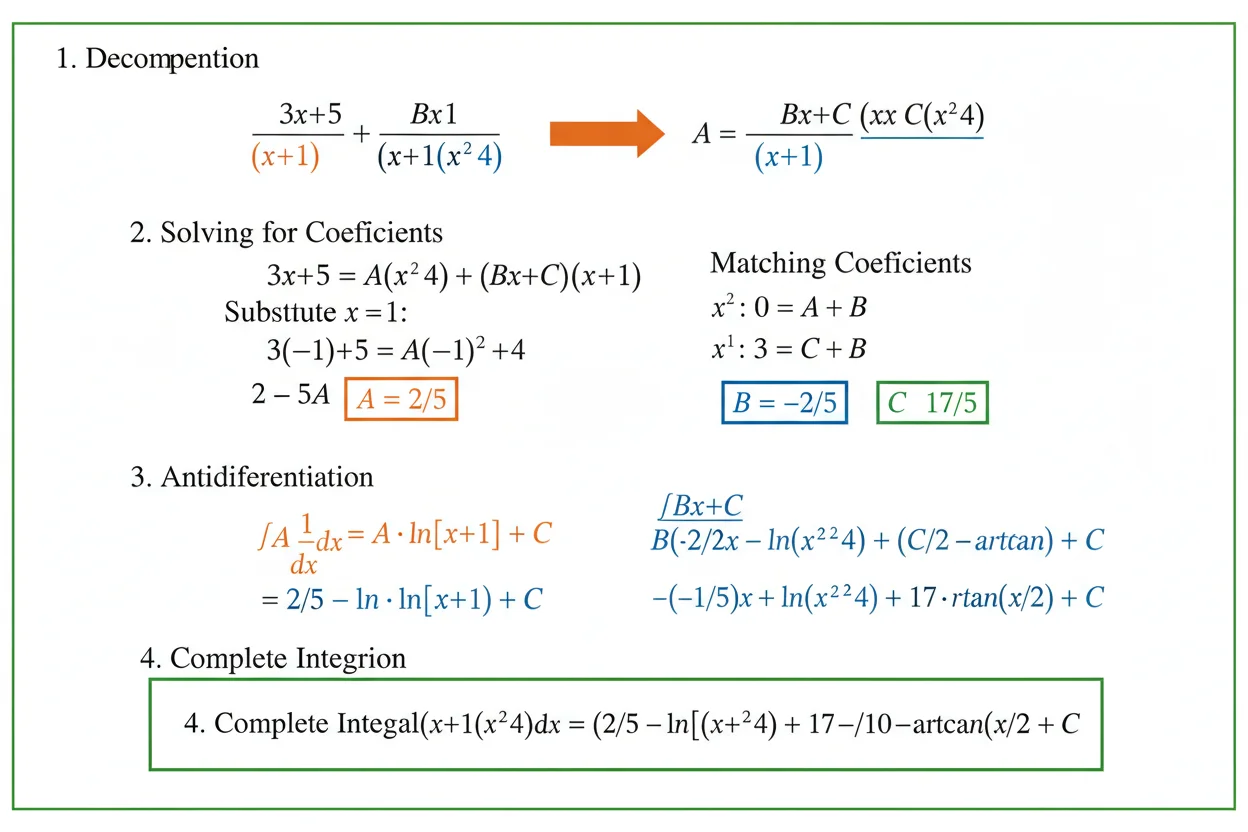

Partial fraction integration is a method for integrating rational functions by decomposing one complicated fraction into a sum of simpler fractions. It applies when the integrand can be written as P(x)/Q(x), where P and Q are polynomials and the denominator can be factored over the relevant number system. If the degree of the numerator is at least as large as the degree of the denominator, polynomial division is performed first. The remaining proper rational function is then decomposed according to the denominator’s linear, repeated linear, irreducible quadratic, or repeated quadratic factors. Unknown coefficients are determined by substitution, comparing coefficients, or a combination of both. Once the decomposition is known, the resulting terms usually integrate through logarithmic, reciprocal-power, substitution, or arctangent formulas. Partial fractions do not change the value of the rational function; they rewrite it into a form whose antiderivative is easier to recognize. The method is especially useful when direct integration of the original rational expression has no obvious simple rule.
What Is Partial Fraction Integration?
Suppose an integral contains a rational function:
∫ P(x)/Q(x) dx
where P(x) and Q(x) are polynomials.
If:
degree of P < degree of Q
the fraction is called proper.
When Q can be factored, the rational function can often be expressed as a sum such as:
P(x)/Q(x) = A/(x − a) + B/(x − b)
or a more complicated version involving repeated and quadratic factors.
The integral then becomes a sum of simpler integrals.
For example:
1/[(x + 1)(x + 2)]
can be written:
1/(x + 1) − 1/(x + 2)
The corresponding integral becomes:
∫1/(x + 1) dx − ∫1/(x + 2) dx
which is straightforward.
When to Use Partial Fraction Integration
Partial fraction integration is useful when the integrand is a rational function:
P(x)/Q(x)
and the denominator factors into manageable polynomial factors.
A typical workflow is:
- Check whether the fraction is proper.
- If necessary, perform polynomial division.
- Factor the denominator completely.
- Write the correct partial fraction form.
- Solve for the unknown constants.
- Integrate each resulting term.
- Differentiate the result when practical to verify it.
The decomposition stage is algebraic. The final stage is an indefinite integral calculation.
Proper and Improper Rational Functions
A rational function is proper when:
degree P < degree Q
For example:
(2x + 1)/(x² − 4)
is proper because:
degree numerator = 1
and:
degree denominator = 2
By contrast:
(x² + 1)/(x + 1)
is improper because:
degree numerator = 2
is greater than:
degree denominator = 1
An improper rational function must first be divided so that the remaining fractional part is proper.
Why Polynomial Division Comes First
Consider:
∫(x² + 1)/(x + 1) dx
Polynomial division gives:
(x² + 1)/(x + 1) = x − 1 + 2/(x + 1)
because:
(x + 1)(x − 1) = x² − 1
leaving remainder:
2
Therefore:
∫(x² + 1)/(x + 1) dx
becomes:
∫(x − 1) dx + 2∫1/(x + 1) dx
Now integrate:
= x²/2 − x + 2ln|x + 1| + C
Trying to perform a partial fraction decomposition before removing the polynomial part would unnecessarily complicate the problem.
Distinct Linear Factors
If the denominator contains distinct linear factors:
(x − a)(x − b)
use:
P(x)/[(x − a)(x − b)] = A/(x − a) + B/(x − b)
For three distinct factors:
(x − a)(x − b)(x − c)
use:
A/(x − a) + B/(x − b) + C/(x − c)
Every distinct linear factor receives one constant numerator.
Basic Partial Fraction Example
Evaluate:
∫1/[(x + 1)(x + 2)] dx
Write:
1/[(x + 1)(x + 2)] = A/(x + 1) + B/(x + 2)
Multiply by:
(x + 1)(x + 2)
to obtain:
1 = A(x + 2) + B(x + 1)
Set:
x = −1
Then:
1 = A(1)
so:
A = 1
Set:
x = −2
Then:
1 = B(−1)
so:
B = −1
Therefore:
1/[(x + 1)(x + 2)]
= 1/(x + 1) − 1/(x + 2)
Integrate:
∫1/[(x + 1)(x + 2)] dx
= ln|x + 1| − ln|x + 2| + C
Combining the Logarithms
The preceding answer can also be written:
ln|(x + 1)/(x + 2)| + C
because:
ln|a| − ln|b| = ln|a/b|
Both forms represent the same antiderivative on an interval that does not cross a denominator zero.
Keeping the terms separate is often clearer during the calculation.
Example With a Nonconstant Numerator
Evaluate:
∫(3x + 5)/[(x + 1)(x + 2)] dx
Write:
(3x + 5)/[(x + 1)(x + 2)]
= A/(x + 1) + B/(x + 2)
Multiply through:
3x + 5 = A(x + 2) + B(x + 1)
Set:
x = −1
Then:
2 = A
So:
A = 2
Set:
x = −2
Then:
−1 = −B
so:
B = 1
Therefore:
(3x + 5)/[(x + 1)(x + 2)]
= 2/(x + 1) + 1/(x + 2)
Integrate:
= 2ln|x + 1| + ln|x + 2| + C
Solving Coefficients by Comparing Powers
Instead of choosing convenient x-values, coefficients can be compared.
From:
3x + 5 = A(x + 2) + B(x + 1)
expand:
3x + 5 = (A + B)x + (2A + B)
Therefore:
A + B = 3
and:
2A + B = 5
Subtract the first equation from the second:
A = 2
Then:
B = 1
Both methods produce the same decomposition.
Substitution is often faster for distinct linear factors, while coefficient comparison becomes useful when no simple substitution isolates every unknown.
Repeated Linear Factors
If the denominator contains:
(x − a)ᵏ
include every power from 1 through k.
For example, if the denominator contains:
(x + 1)³
the decomposition must contain:
A/(x + 1) + B/(x + 1)² + C/(x + 1)³
Leaving out an intermediate power produces an incomplete decomposition.
Repeated Linear Factor Example
Evaluate:
∫1/[x(x + 1)²] dx
Write:
1/[x(x + 1)²]
= A/x + B/(x + 1) + C/(x + 1)²
Multiply by:
x(x + 1)²
to obtain:
1 = A(x + 1)² + Bx(x + 1) + Cx
Set:
x = 0
Then:
1 = A
so:
A = 1
Set:
x = −1
Then:
1 = −C
so:
C = −1
To find B, compare the x² coefficients.
Expanding gives:
1 = (A + B)x² + (2A + B + C)x + A
Since A = 1:
A + B = 0
Therefore:
B = −1
So:
1/[x(x + 1)²]
= 1/x − 1/(x + 1) − 1/(x + 1)²
Integrating the Repeated-Factor Example
Integrate term by term:
∫1/x dx = ln|x|
∫−1/(x + 1) dx = −ln|x + 1|
For the final term:
∫−(x + 1)⁻² dx
Using the reverse form of the power rule:
= 1/(x + 1)
Therefore:
∫1/[x(x + 1)²] dx
= ln|x| − ln|x + 1| + 1/(x + 1) + C
Differentiating the result recovers the original rational function.
Irreducible Quadratic Factors
A quadratic factor that cannot be factored over the real numbers requires a linear numerator.
For an irreducible quadratic:
x² + bx + c
use:
(Ax + B)/(x² + bx + c)
rather than:
A/(x² + bx + c)
in general.
The numerator must have degree one less than the quadratic denominator.
For example:
x² + 1
is irreducible over the real numbers, so the corresponding numerator has form:
Ax + B
Quadratic Example
Evaluate:
∫(x + 3)/(x² + 1) dx
Split the numerator:
∫x/(x² + 1) dx + 3∫1/(x² + 1) dx
For the first integral, let:
u = x² + 1
Then:
du = 2x dx
so:
∫x/(x² + 1) dx = 1/2 ln(x² + 1)
The second standard integral is:
∫1/(x² + 1) dx = arctan x
Therefore:
∫(x + 3)/(x² + 1) dx
= 1/2 ln(x² + 1) + 3 arctan x + C
The first term uses the reverse-chain-rule structure developed in integration by substitution.
Linear and Quadratic Factors Together
Suppose:
Q(x) = (x + 1)(x² + 1)
The correct decomposition has form:
A/(x + 1) + (Bx + C)/(x² + 1)
The linear factor receives a constant numerator.
The quadratic factor receives a first-degree numerator.
This structural rule should be determined before solving any coefficients.
Example With a Linear and Quadratic Factor
Evaluate:
∫(3x² + 5x + 4)/[(x + 1)(x² + 1)] dx
Write:
(3x² + 5x + 4)/[(x + 1)(x² + 1)]
= A/(x + 1) + (Bx + C)/(x² + 1)
Multiply through:
3x² + 5x + 4
= A(x² + 1) + (Bx + C)(x + 1)
Expand:
= Ax² + A + Bx² + Bx + Cx + C
Collect powers:
= (A + B)x² + (B + C)x + (A + C)
Compare coefficients:
A + B = 3
B + C = 5
A + C = 4
Solving gives:
A = 1
B = 2
C = 3
Therefore:
(3x² + 5x + 4)/[(x + 1)(x² + 1)]
= 1/(x + 1) + (2x + 3)/(x² + 1)
Integrating the Linear-Quadratic Example
Now integrate:
∫1/(x + 1) dx
- ∫2x/(x² + 1) dx
- 3∫1/(x² + 1) dx
These give:
ln|x + 1|
- ln(x² + 1)
- 3 arctan x
Therefore:
∫(3x² + 5x + 4)/[(x + 1)(x² + 1)] dx
= ln|x + 1| + ln(x² + 1) + 3 arctan x + C
Repeated Irreducible Quadratic Factors
If an irreducible quadratic appears repeatedly, every power must be represented.
For:
(x² + 1)³
use:
(A₁x + B₁)/(x² + 1)
- (A₂x + B₂)/(x² + 1)²
- (A₃x + B₃)/(x² + 1)³
This is the quadratic counterpart of the repeated-linear-factor rule.
Each numerator remains linear.
General Partial Fraction Templates
For distinct linear factors:
A/(x − a) + B/(x − b) + …
For a repeated linear factor:
A₁/(x − a) + A₂/(x − a)² + … + Aₖ/(x − a)ᵏ
Also, For an irreducible quadratic:
(Ax + B)/(x² + px + q)
For a repeated irreducible quadratic:
(A₁x + B₁)/(quadratic)
- (A₂x + B₂)/(quadratic)²
- …
Writing the correct template is often the most important step.
Factoring the Denominator Completely
Before decomposing:
P(x)/Q(x)
factor Q as completely as possible over the real numbers if a real-variable antiderivative is desired.
For example:
x² − 9
factors as:
(x − 3)(x + 3)
while:
x² + 1
does not factor into real linear factors.
A denominator such as:
x³ − x
should first be written:
x(x² − 1)
and then:
x(x − 1)(x + 1)
Only after complete factorization can the correct decomposition be written.
Example With Three Linear Factors
Consider:
1/[x(x − 1)(x + 1)]
Write:
A/x + B/(x − 1) + C/(x + 1)
Multiply by:
x(x − 1)(x + 1)
to get:
1 = A(x − 1)(x + 1) + Bx(x + 1) + Cx(x − 1)
Set:
x = 0
Then:
1 = −A
so:
A = −1
Set:
x = 1
Then:
1 = 2B
so:
B = 1/2
Set:
x = −1
Then:
1 = 2C
so:
C = 1/2
Therefore:
1/[x(x − 1)(x + 1)]
= −1/x + 1/[2(x − 1)] + 1/[2(x + 1)]
Integrating gives a combination of logarithms.
Cover-Up Substitution
For distinct linear factors, strategically substituting roots can isolate coefficients quickly.
If:
P(x)/[(x − a)(x − b)]
= A/(x − a) + B/(x − b)
then multiplying through and choosing:
x = a
eliminates the B-term.
Choosing:
x = b
eliminates the A-term.
This method is convenient but should be understood as a consequence of the full coefficient identity rather than as a separate integration rule.
Repeated factors and irreducible quadratics usually require additional algebra.
Checking a Partial Fraction Decomposition
Before integrating, recombine the decomposition.
Suppose you obtained:
2/(x + 1) + 1/(x + 2)
Combine:
[2(x + 2) + (x + 1)]/[(x + 1)(x + 2)]
The numerator is:
2x + 4 + x + 1
= 3x + 5
So:
2/(x + 1) + 1/(x + 2)
= (3x + 5)/[(x + 1)(x + 2)]
The decomposition is correct.
This algebraic check can prevent an incorrect coefficient from propagating into the final antiderivative.
Partial Fractions and Logarithms
Every term of form:
A/(x − a)
integrates to:
A ln|x − a| + C
The absolute value is necessary because:
x − a
may be positive or negative on different domain intervals.
Differentiation verifies:
d/dx[ln|x − a|] = 1/(x − a)
for:
x ≠ a
This is why logarithms occur so frequently after partial fraction decomposition.
Higher Reciprocal Powers
For:
A/(x − a)ⁿ
with:
n > 1
write:
A(x − a)⁻ⁿ
The ordinary reverse-power formula gives:
∫A(x − a)⁻ⁿ dx
= A(x − a)¹⁻ⁿ/(1 − n) + C
because the inner derivative of x − a is 1.
Only the exponent:
n = 1
produces the logarithmic case.
Completing the Square
An irreducible quadratic may need to be rewritten by completing the square.
For example:
x² + 4x + 5
becomes:
(x + 2)² + 1
A resulting term:
1/[(x + 2)² + 1]
integrates to:
arctan(x + 2) + C
A numerator containing the derivative of the quadratic can produce a logarithmic term, while the remaining constant component can lead to an arctangent.
Example With Completing the Square
Consider:
∫1/(x² + 4x + 5) dx
Complete the square:
x² + 4x + 5
= (x + 2)² + 1
Let:
u = x + 2
Then:
du = dx
The integral becomes:
∫1/(u² + 1) du
Therefore:
∫1/(x² + 4x + 5) dx
= arctan(x + 2) + C
This is the type of elementary integral that can arise from the quadratic portion of a partial fraction decomposition.
Partial Fractions Versus Substitution
Partial fraction integration is most natural when a rational denominator factors into simpler pieces.
Substitution is more natural when the numerator resembles the derivative of the denominator.
For example:
∫2x/(x² + 5) dx
does not need partial fractions.
Let:
u = x² + 5
and the integral becomes logarithmic immediately.
By contrast:
∫1/[(x + 1)(x + 2)] dx
contains no single inner derivative that simplifies the entire denominator, making partial fractions the natural approach.
Partial Fractions Versus Integration by Parts
Integration by parts reverses the product rule and is useful for products such as:
xeˣ
or:
x ln x
Partial fraction integration handles rational functions through algebraic decomposition.
Applying parts to a rational expression whose denominator factors cleanly often makes the calculation longer rather than simpler.
Choosing the method from the integrand’s structure is more effective than applying techniques mechanically.
Partial Fractions and the Product Rule
The product rule is a differentiation rule and does not perform the decomposition itself.
However, products of factors in a denominator determine the form of a partial fraction decomposition.
For example:
Q(x) = (x − 1)(x + 2)
leads to separate terms associated with each factor.
The multiplication structure is therefore algebraically important even though the integration method is not a reversal of the product rule.
Partial Fractions and the Quotient Rule
A rational function is a quotient of polynomials, but quotient rule differentiation is not the method used to integrate it.
For example:
(3x + 5)/[(x + 1)(x + 2)]
is first decomposed algebraically.
The resulting logarithmic antiderivative can later be checked by differentiation, where quotient or chain-rule ideas may appear if the result is rewritten into a combined form.
Integration and differentiation methods should not be confused merely because the original expression is a quotient.
Partial Fraction Integration and Definite Integrals
A partial fraction decomposition can also simplify a definite integral.
After decomposing the rational function, find an antiderivative and evaluate at the endpoints.
However, denominator zeros inside the integration interval must be checked before ordinary endpoint evaluation.
If a denominator factor vanishes inside the interval, the problem may instead be an improper integral.
Singularities and Improper Integrals
Suppose a decomposition contains:
1/(x − 1)
and the integration interval crosses:
x = 1
The integrand has a vertical singularity there.
The corresponding improper integral must be split and evaluated with one-sided limits.
Partial fractions simplify the algebra but do not make a divergent singularity disappear.
For example:
∫₀² 1/(x − 1) dx
does not become a valid ordinary finite integral merely because an antiderivative:
ln|x − 1|
can be written.
The convergence behavior must be checked independently.
Partial Fractions and the Fundamental Theorem
For a proper definite integral on an interval where the decomposed function remains continuous, the Fundamental Theorem Of Calculus allows the antiderivative to be evaluated at the endpoints.
Partial fractions help find that antiderivative.
The theorem handles the endpoint accumulation.
If a singularity breaks the interval, improper-limit analysis must occur first.
Partial Fraction Integration and the Power Rule
The mapped power rule primarily describes differentiation:
d/dx[xⁿ] = nxⁿ⁻¹
After partial fraction decomposition, reciprocal powers may instead be integrated by reversing the corresponding power relationship.
For example:
∫(x + 1)⁻² dx = −(x + 1)⁻¹ + C
So power-function structure frequently appears after repeated-factor decomposition.
Partial Fraction Integration and Partial Derivatives
A partial derivative measures change in a multivariable function with respect to one variable.
Despite sharing the word “partial,” it is a different concept from partial fraction integration.
Partial fractions split a one-variable rational expression into simpler rational terms.
Partial differentiation holds other independent variables constant while differentiating one variable.
The similarity in terminology does not imply a shared calculation method.
Partial Fraction Integration and Optimization
Optimization uses derivatives to locate maxima and minima.
Partial fraction integration instead finds antiderivatives of suitable rational functions.
They can occur in the same broader model if, for example, an accumulated rational quantity must be integrated before an objective function is analyzed.
But decomposition into partial fractions does not itself identify an optimum.
The operations answer different questions.
Partial Fractions in Multivariable Calculus
Partial fraction decomposition is fundamentally an algebraic technique for rational expressions, usually within one integration variable.
In multivariable calculus, an iterated integral can sometimes produce a rational one-variable integral at an intermediate stage.
Partial fractions may then simplify that inner or outer integration step.
The multivariable geometry determines the bounds, while partial fractions handle the rational algebra in the active variable.
Domain Restrictions
When:
Q(x) = 0
the rational function:
P(x)/Q(x)
is undefined.
The decomposition has the same excluded points as the original rational expression.
For example:
1/[(x + 1)(x + 2)]
is undefined at:
x = −1
and:
x = −2
Its decomposition:
1/(x + 1) − 1/(x + 2)
has exactly the same singularities.
The algebraic rewrite does not extend the domain.
Differentiating to Check the Final Result
After integration, differentiate the proposed antiderivative.
For:
F(x) = ln|x + 1| − ln|x + 2|
we have:
F′(x) = 1/(x + 1) − 1/(x + 2)
Combine:
= [(x + 2) − (x + 1)]/[(x + 1)(x + 2)]
= 1/[(x + 1)(x + 2)]
The original integrand is recovered.
This derivative check is especially effective because coefficient errors in a decomposition become immediately visible.
Common Partial Fraction Integration Mistakes
A common mistake is attempting partial fractions before checking whether the rational function is proper.
Another is failing to factor the denominator completely.
Repeated factors require every intermediate power:
1/(x − a), 1/(x − a)², …, 1/(x − a)ᵏ
An irreducible quadratic requires a linear numerator:
Ax + B
rather than only a constant.
Students may also solve the decomposition correctly and then forget absolute values in logarithms from linear denominator factors.
Another error is assuming every quadratic term produces only an arctangent. A numerator related to the derivative of the quadratic often produces a logarithmic component as well.
Finally, a denominator zero inside a definite integration interval must be treated as an improper point. Algebraic decomposition does not justify integrating straight across a singularity.
Frequently Asked Questions
What is partial fraction integration?
Partial fraction integration rewrites a rational function as a sum of simpler rational fractions and integrates those simpler terms separately.
When can partial fractions be used?
They are primarily used for rational functions P(x)/Q(x) whose denominator can be factored into linear and irreducible quadratic factors.
What should I do if the numerator degree is too large?
If:
degree P ≥ degree Q
perform polynomial division first.
What is the form for distinct linear factors?
For:
(x − a)(x − b)
use:
A/(x − a) + B/(x − b)
What is the form for a repeated linear factor?
For:
(x − a)ᵏ
include:
A₁/(x − a) + A₂/(x − a)² + … + Aₖ/(x − a)ᵏ
What numerator is used over an irreducible quadratic?
Use a linear numerator:
Ax + B
How do you solve the unknown coefficients?
Multiply by the common denominator and then use convenient substitutions, compare polynomial coefficients, or combine both methods.
Why do logarithms appear in partial fraction integrals?
Because:
∫1/(x − a) dx = ln|x − a| + C
Why do arctangent terms sometimes appear?
Irreducible quadratic expressions can reduce to forms involving:
∫1/(u² + 1) du = arctan u + C
Does partial fraction decomposition change the rational function?
No. It is an algebraically equivalent representation wherever the original denominators are nonzero.
Can partial fractions be used for definite integrals?
Yes, provided any denominator singularities are handled correctly. If a singularity lies inside the interval, improper-integral analysis may be required.
How can I check a partial fraction decomposition?
Recombine the decomposed terms over a common denominator and verify that the original numerator is recovered.
How can I check the final integral?
Differentiate the antiderivative and simplify. It should reproduce the original rational function on its domain.