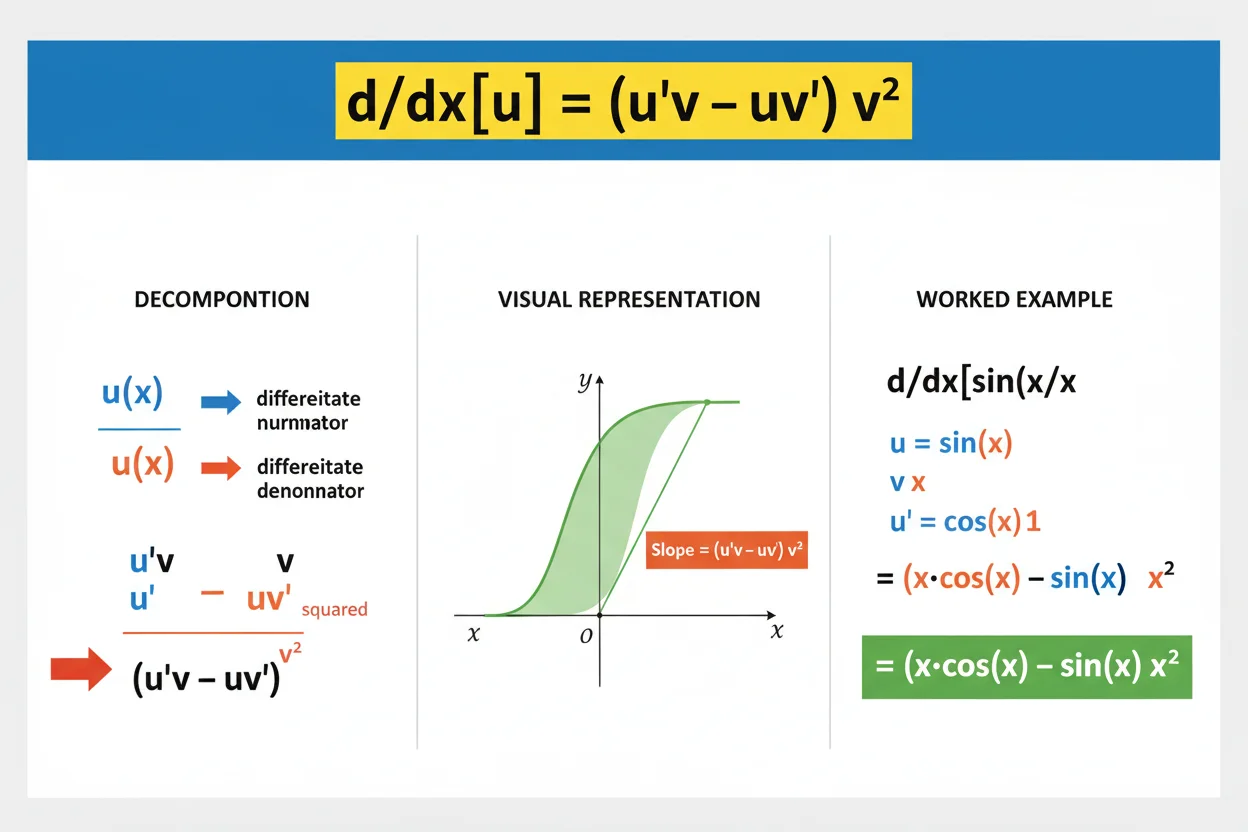

The quotient rule is a differentiation formula used when one differentiable function is divided by another differentiable function. If y = u(x)/v(x), with v(x) ≠ 0, then y′ = [u′v − uv′]/v². A common verbal pattern is “bottom times derivative of top minus top times derivative of bottom, all over bottom squared.” The order of the two numerator terms matters because subtraction is involved. The quotient rule is useful for rational functions, ratios involving trigonometric or exponential functions, and expressions where rewriting the denominator with a negative exponent would not make differentiation simpler. It can be combined with the power rule, product rule, and chain rule when the numerator or denominator has additional structure. Domain restrictions must also be preserved because the derivative formula is meaningful only where the original denominator is nonzero. Although some quotients simplify before differentiation, the quotient rule provides a systematic method when numerator and denominator both vary with the independent variable.
What Is the Quotient Rule?
Suppose:
y = u(x)/v(x)
where:
v(x) ≠ 0
The quotient rule states:
y′ = [u′v − uv′]/v²
or:
d/dx[u/v] = [v(du/dx) − u(dv/dx)]/v²
This formula differentiates both numerator and denominator while accounting for the fact that changing the denominator changes the entire ratio.
It is not correct to write:
(u/v)′ = u′/v′
in general.
Quotient Rule Formula
The standard form is:
(u/v)′ = (u′v − uv′)/v²
An equivalent form is:
(v u′ − u v′)/v²
A common memory aid is:
denominator × derivative of numerator − numerator × derivative of denominator, divided by denominator²
The subtraction order is important.
Reversing the numerator terms changes the sign of the derivative.
Basic Quotient Rule Example
Differentiate:
f(x) = x²/(x + 1)
Let:
u = x²
and:
v = x + 1
Then:
u′ = 2x
v′ = 1
Apply the quotient rule:
f′(x) = [(x + 1)(2x) − x²(1)]/(x + 1)²
Simplify the numerator:
2x² + 2x − x²
= x² + 2x
Therefore:
f′(x) = (x² + 2x)/(x + 1)²
Factor:
f′(x) = x(x + 2)/(x + 1)²
The derivative is valid for:
x ≠ −1
which is also the domain restriction of the original function.
Why You Cannot Divide the Derivatives
Consider:
f(x) = x²/x
for:
x ≠ 0
The original expression simplifies to:
f(x) = x
so:
f′(x) = 1
But dividing the derivatives would produce:
(2x)/1 = 2x
which is not correct.
The quotient rule instead gives:
f′(x) = [x(2x) − x²(1)]/x²
= (2x² − x²)/x²
= 1
for x ≠ 0.
Quotient Rule Derived From the Product Rule
The quotient rule can be derived using the product rule.
Suppose:
y = u/v
Then:
yv = u
Differentiate:
y′v + yv′ = u′
Solve for y′:
y′v = u′ − yv′
Therefore:
y′ = [u′ − yv′]/v
Substitute:
y = u/v
Then:
y′ = [u′ − (u/v)v′]/v
Put over a common denominator:
y′ = (u′v − uv′)/v²
This gives the quotient rule.
Quotient Rule Using Negative Powers
The same formula can be obtained by rewriting:
u/v = uv⁻¹
Differentiate with the product rule:
(uv⁻¹)′ = u′v⁻¹ + u(−v⁻²v′)
Therefore:
= u′/v − uv′/v²
Put over the common denominator v²:
= (u′v − uv′)/v²
This derivation shows how the quotient rule connects product, power, and chain differentiation.
Rational Function Example
Differentiate:
f(x) = (3x + 2)/(x² + 1)
Set:
u = 3x + 2
v = x² + 1
Then:
u′ = 3
v′ = 2x
Apply:
f′(x) = [3(x² + 1) − (3x + 2)(2x)]/(x² + 1)²
Expand:
= [3x² + 3 − 6x² − 4x]/(x² + 1)²
Simplify:
f′(x) = (−3x² − 4x + 3)/(x² + 1)²
The denominator x² + 1 is never zero for real x, so this function is differentiable for every real x.
Polynomial Over Polynomial Example
Differentiate:
f(x) = (x³ − 2x)/(x² + 4)
Let:
u = x³ − 2x
v = x² + 4
Then:
u′ = 3x² − 2
v′ = 2x
Therefore:
f′(x) = [(3x² − 2)(x² + 4) − (x³ − 2x)(2x)]/(x² + 4)²
Expand the first product:
3x⁴ + 12x² − 2x² − 8
= 3x⁴ + 10x² − 8
The second product is:
2x⁴ − 4x²
Subtract:
3x⁴ + 10x² − 8 − 2x⁴ + 4x²
= x⁴ + 14x² − 8
Thus:
f′(x) = (x⁴ + 14x² − 8)/(x² + 4)²
Quotient With an Exponential Numerator
Differentiate:
f(x) = eˣ/(x + 1)
Let:
u = eˣ
v = x + 1
Then:
u′ = eˣ
v′ = 1
So:
f′(x) = [(x + 1)eˣ − eˣ]/(x + 1)²
Factor eˣ:
f′(x) = eˣ[(x + 1) − 1]/(x + 1)²
Therefore:
f′(x) = xeˣ/(x + 1)²
for:
x ≠ −1
Quotient With a Logarithm
Differentiate:
f(x) = ln x/x
for:
x > 0
Set:
u = ln x
v = x
Then:
u′ = 1/x
v′ = 1
Apply:
f′(x) = [x(1/x) − ln x]/x²
Simplify:
f′(x) = (1 − ln x)/x²
The domain remains:
x > 0
because the logarithm requires positive x.
Quotient With Trigonometric Functions
Differentiate:
f(x) = sin x/x
for:
x ≠ 0
Let:
u = sin x
v = x
Then:
u′ = cos x
v′ = 1
Therefore:
f′(x) = [x cos x − sin x]/x²
This expression appears in many calculus contexts involving the function:
sin x/x
The original quotient is undefined at zero unless it is extended separately by continuity.
Quotient With Two Trigonometric Functions
Differentiate:
f(x) = sin x/cos x
where:
cos x ≠ 0
Using the quotient rule:
f′(x) = [cos x(cos x) − sin x(−sin x)]/cos²x
So:
f′(x) = [cos²x + sin²x]/cos²x
Using:
sin²x + cos²x = 1
we obtain:
f′(x) = 1/cos²x
Therefore:
f′(x) = sec²x
This recovers the derivative of tan x because:
tan x = sin x/cos x
Simplify Before Using the Quotient Rule
Not every visible quotient needs the quotient rule.
Consider:
f(x) = x⁵/x²
for:
x ≠ 0
Simplify:
f(x) = x³
Then:
f′(x) = 3x²
The original domain restriction:
x ≠ 0
should still be remembered if the derivative is being discussed as the derivative of the original expression.
Using the power rule after simplification is much shorter.
Rewrite as Negative Powers
Consider:
f(x) = 1/x⁴
Rewrite:
f(x) = x⁻⁴
Then:
f′(x) = −4x⁻⁵
= −4/x⁵
The quotient rule would work, but it is unnecessary.
This illustrates a useful principle: choose the simplest valid derivative method rather than forcing the quotient rule whenever a fraction is visible.
Quotient Rule With Composite Functions
Differentiate:
f(x) = (x² + 1)³/(2x − 5)⁴
Let:
u = (x² + 1)³
and:
v = (2x − 5)⁴
Each factor needs the chain rule.
For u:
u′ = 3(x² + 1)²(2x)
= 6x(x² + 1)²
For v:
v′ = 4(2x − 5)³(2)
= 8(2x − 5)³
Now apply the quotient rule:
f′(x) = [u′v − uv′]/v²
So:
f′(x) = [6x(x² + 1)²(2x − 5)⁴ − (x² + 1)³8(2x − 5)³]/(2x − 5)⁸
Factor common terms:
f′(x) = (x² + 1)²(2x − 5)³[6x(2x − 5) − 8(x² + 1)]/(2x − 5)⁸
Cancel powers where valid:
f′(x) = (x² + 1)²[6x(2x − 5) − 8(x² + 1)]/(2x − 5)⁵
Further simplification is optional.
Quotient Rule and the Chain Rule
The quotient rule tells you how to combine numerator and denominator derivatives.
It does not replace the chain rule inside those derivatives.
For:
sin(x²)/(x³ + 1)
the numerator derivative is:
2x cos(x²)
and the denominator derivative is:
3x²
Therefore:
f′(x) = [(x³ + 1)(2x cos(x²)) − sin(x²)(3x²)]/(x³ + 1)²
Both structures must be recognized correctly.
Quotient Rule and Product Rule Together
An expression can contain products in its numerator or denominator.
Consider:
f(x) = [xeˣ]/(x² + 1)
The numerator:
u = xeˣ
requires the product rule:
u′ = eˣ + xeˣ
= eˣ(1 + x)
The denominator:
v = x² + 1
has:
v′ = 2x
Then:
f′(x) = [(x² + 1)eˣ(1 + x) − xeˣ(2x)]/(x² + 1)²
Factor eˣ if desired.
The outer quotient rule and inner product rule operate at different structural levels.
Quotient Rule and Partial Derivatives
The quotient rule also applies to a partial derivative.
Suppose:
f(x, y) = x/(x + y)
Find:
fₓ
Treat y as constant.
The numerator derivative is:
1
The denominator derivative with respect to x is:
1
Therefore:
fₓ = [(x + y)(1) − x(1)]/(x + y)²
Simplify:
fₓ = y/(x + y)²
provided:
x + y ≠ 0
Partial Derivative With Respect to y
For the same function:
f(x, y) = x/(x + y)
treat x as constant.
The numerator derivative is:
0
The denominator derivative is:
1
Therefore:
fᵧ = [(x + y)(0) − x(1)]/(x + y)²
So:
fᵧ = −x/(x + y)²
The same quotient rule works coordinate by coordinate.
Quotient Rule in Multivariable Calculus
In multivariable calculus, if:
h = f/g
then for an appropriate coordinate xᵢ:
∂h/∂xᵢ = [g(∂f/∂xᵢ) − f(∂g/∂xᵢ)]/g²
where:
g ≠ 0
The same scalar quotient structure therefore survives in several variables.
These partial derivatives can then become components of a gradient.
Quotient Rule and the Gradient
For scalar fields:
h = f/g
the gradient satisfies:
∇(f/g) = [g∇f − f∇g]/g²
where g is nonzero.
This is essentially the quotient rule applied to every coordinate partial derivative simultaneously.
The formula is useful when both numerator and denominator vary across space.
Quotient Rule in Implicit Differentiation
Implicit differentiation often produces a derivative as a quotient even if the original relation was not written as one.
For:
F(x, y) = 0
a compact formula is:
dy/dx = −Fₓ/Fᵧ
where:
Fᵧ ≠ 0
This quotient is the result of algebraically solving the differentiated equation for dy/dx.
If you later differentiate that slope again, the quotient rule may become necessary.
Second Derivative of an Implicit Curve
For the circle:
x² + y² = 25
the first derivative is:
y′ = −x/y
To find y″, differentiate:
−x/y
using the quotient rule while remembering that y depends on x.
Let:
u = −x
v = y
Then:
u′ = −1
v′ = y′
Therefore:
y″ = [y(−1) − (−x)y′]/y²
= (−y + xy′)/y²
Substitute:
y′ = −x/y
giving:
y″ = [−y − x²/y]/y²
Combine:
y″ = −(x² + y²)/y³
Using:
x² + y² = 25
we obtain:
y″ = −25/y³
This example combines implicit differentiation and the quotient rule.
Quotient Rule in Related Rates
A related rates problem may contain a ratio of time-dependent quantities.
Suppose:
R = A/B
where A and B vary with time.
Then:
dR/dt = [B(dA/dt) − A(dB/dt)]/B²
For example, let:
A = 10
B = 5
dA/dt = 3
dB/dt = 1
Then:
dR/dt = [5(3) − 10(1)]/25
= (15 − 10)/25
= 1/5
So the ratio increases at:
0.2
per unit time at that instant.
Quotient Rule and Optimization
Ratios frequently appear in optimization.
For example:
f(x) = x/(x² + 1)
Differentiate:
f′(x) = [(x² + 1)(1) − x(2x)]/(x² + 1)²
Simplify:
f′(x) = (1 − x²)/(x² + 1)²
Critical points satisfy:
1 − x² = 0
so:
x = ±1
Because the denominator is always positive, the sign of f′ is controlled entirely by:
1 − x²
This makes classification straightforward.
Quotient Rule and Linear Approximation
A linear approximation requires a derivative at the reference point.
If:
f(x) = u(x)/v(x)
then:
f′(a) = [u′(a)v(a) − u(a)v′(a)]/[v(a)]²
provided:
v(a) ≠ 0
The tangent-line estimate is then:
f(x) ≈ f(a) + f′(a)(x − a)
Thus the quotient rule supplies the local slope for ratio functions.
Quotient Rule and Differentials
For:
z = u/v
the differential form is:
dz = [v du − u dv]/v²
This differentials formula approximates the first-order change in a ratio when numerator and denominator both vary.
It is especially useful for sensitivity analysis.
The denominator appears squared because changes in v affect both the scaling and the ratio’s reciprocal structure.
Relative Change Interpretation
For nonzero u and v:
z = u/v
Taking logarithmic differentials informally gives:
dz/z ≈ du/u − dv/v
for small relative changes.
This means a ratio’s relative change is approximately the numerator’s relative change minus the denominator’s relative change.
For example, if u increases by about 3% while v increases by about 1%, the ratio increases by roughly:
3% − 1% = 2%
for sufficiently small changes.
Quotient Rule and Limits
The quotient law for limits states that if:
f(x) → L
and:
g(x) → M
with:
M ≠ 0
then:
f(x)/g(x) → L/M
This is not the quotient rule for derivatives, but the conditions are related conceptually: a denominator approaching or equaling zero requires special care.
The derivative quotient rule is applied only where the original denominator is nonzero.
Quotient Rule and Continuity
If u and v are differentiable at a point and:
v ≠ 0
then u/v is differentiable there and therefore continuous there.
At denominator zeros, the original quotient is undefined unless a separate extension has been introduced.
Simplifying a common factor can reveal a removable discontinuity, but it does not make the original expression defined at the cancelled point.
Cancellation Before Differentiation
Consider:
f(x) = (x² − 1)/(x − 1)
For:
x ≠ 1
factor:
x² − 1 = (x − 1)(x + 1)
so:
f(x) = x + 1
Therefore:
f′(x) = 1
for:
x ≠ 1
The quotient rule gives the same result wherever the original function is defined.
But cancellation does not change the original domain: x = 1 remains excluded unless the function is explicitly redefined there.
Quotient Rule and Partial Fraction Integration
Partial fraction integration deals with rational functions too, but it solves an integration problem rather than a differentiation problem.
For example:
1/[(x + 1)(x + 2)]
may be decomposed before integration.
To differentiate that same rational function, the quotient rule or algebraic simplification can be used directly.
The shared rational-function appearance should not blur the distinction between differentiation and integration methods.
Quotient Rule and Reduced Row Echelon Form
Reduced row echelon form is a matrix-elimination procedure, not a derivative rule.
The quotient rule applies to functions written as ratios.
RREF applies row operations to matrices in order to expose pivots, solve systems, and analyze linear dependence.
The two techniques belong to different branches of the broader Calculus & Linear Algebra framework and should remain conceptually separate.
Quotient Rule and Power Rule
Sometimes the power rule can replace a quotient calculation after rewriting.
For:
f(x) = 1/x³
write:
f(x) = x⁻³
Then:
f′(x) = −3x⁻⁴
This is simpler than treating the numerator as 1 and denominator as x³.
But for:
(x² + 1)/(x³ − x + 5)
there is no similarly convenient single-power rewrite, so the quotient rule is the natural systematic method.
Quotient Rule and Product Rule
A quotient can be written:
u/v = u · v⁻¹
so the quotient rule can always be connected to product and chain differentiation.
In practice, the dedicated formula:
(u/v)′ = (u′v − uv′)/v²
is often less error-prone for complicated ratios.
The product rule remains useful inside the numerator or denominator if either contains multiplied factors.
Domain Restrictions
Always identify points where:
v(x) = 0
because the quotient:
u(x)/v(x)
is undefined there.
For example:
f(x) = (x + 2)/(x² − 9)
has denominator zeros at:
x = 3
and:
x = −3
Its derivative formula may contain:
(x² − 9)²
in the denominator, but the original domain exclusions remain:
x ≠ ±3
A squared derivative denominator does not remove those restrictions.
Common Quotient Rule Mistakes
A frequent mistake is writing:
(u/v)′ = u′/v′
which is generally false.
Another is reversing the subtraction order. The correct numerator is:
u′v − uv′
or equivalently:
v u′ − u v′
The denominator must be:
v²
not merely v.
Students may also differentiate the numerator correctly but forget a product or chain rule inside the denominator.
Another common error is applying the quotient rule to an expression that simplifies immediately to powers or a polynomial.
Finally, domain restrictions must be carried through the calculation. Cancelling a factor may simplify nearby behavior but does not retroactively define the original quotient at a denominator zero.
Frequently Asked Questions
What is the quotient rule?
For:
y = u/v
the quotient rule is:
y′ = (u′v − uv′)/v²
where v ≠ 0.
How can I remember the quotient rule?
A common pattern is:
denominator × derivative of numerator − numerator × derivative of denominator, all over denominator squared
Is the derivative of u/v equal to u′/v′?
No. The quotient rule must account for both changing functions and the denominator’s reciprocal effect.
Why is the denominator squared?
The quotient can be viewed as u·v⁻¹. Differentiating v⁻¹ introduces v⁻², which produces the squared denominator.
Can I simplify before using the quotient rule?
Yes. Simplifying first is often better if the quotient reduces to powers or another easier form.
Can the quotient rule be combined with the chain rule?
Yes. If the numerator or denominator is composite, use the chain rule while finding u′ or v′.
Can the quotient rule be combined with the product rule?
Yes. A numerator or denominator may itself contain a product that requires the product rule.
Does the quotient rule work for partial derivatives?
Yes. Apply the same formula with respect to the selected variable while holding other independent variables constant.
How is the quotient rule used in related rates?
If u and v depend on time:
d/dt[u/v] = [v(du/dt) − u(dv/dt)]/v²
What happens when the denominator equals zero?
The original quotient is undefined there, so the ordinary quotient-rule derivative is not defined at that point.
Is the quotient rule related to partial fraction integration?
Both can involve rational expressions, but they solve different problems. The quotient rule differentiates ratios; partial fractions rewrite rational functions for integration.
Can the quotient rule be derived from the product rule?
Yes. Differentiate yv = u and solve algebraically for y′.
How can I check a quotient-rule derivative?
Simplify the original function first when possible and differentiate using another method, or numerically compare the derivative with a small difference quotient at a point in the function’s domain.