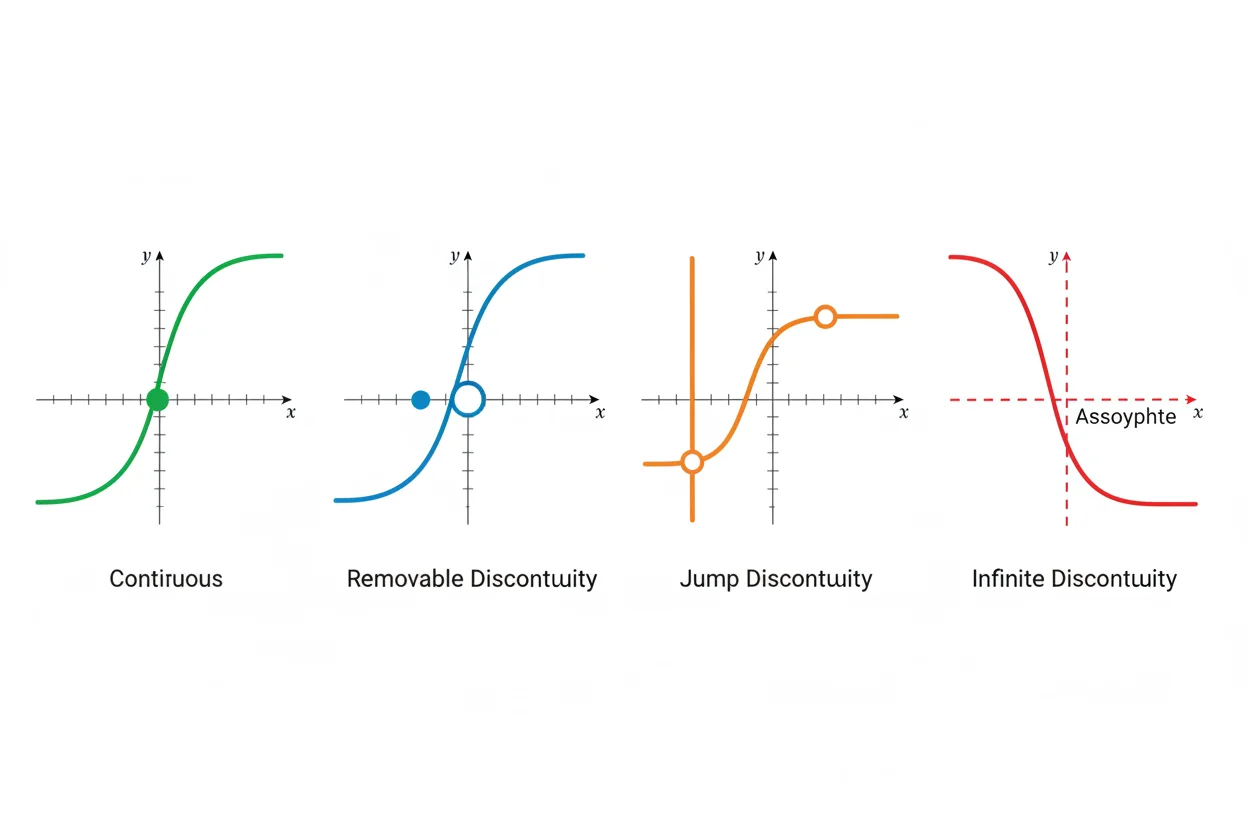

Continuity describes whether a function behaves without a break, jump, or hole at a point or across an interval. Informally, a function is continuous if its graph can be traced locally without lifting your pencil, although the formal definition is based on limits rather than appearance alone. For a function f(x) to be continuous at x = a, the function must be defined at a, its limit as x approaches a must exist, and that limit must equal f(a). If any one of those conditions fails, the function is discontinuous at that point. Continuity is fundamental to calculus because many results about derivatives, definite integrals, and other limiting processes depend on functions behaving continuously over specified domains. Polynomial functions are continuous everywhere, while rational, radical, logarithmic, piecewise, and trigonometric functions may have domain restrictions or special points that require inspection. Understanding continuity therefore means checking both the value of a function and its behavior arbitrarily close to the point in question.
What Is Continuity?
A function f is continuous at x = a when its actual value at a agrees with the value that the function approaches from both sides.
The central condition is:
lim f(x) as x → a = f(a)
This compact statement contains three separate requirements:
- f(a) exists.
- lim f(x) as x → a exists.
- lim f(x) as x → a = f(a).
The concept is closely tied to a limit, because continuity asks whether the limiting behavior and the actual function value agree.
For example, consider:
f(x) = x² + 3x − 4
At x = 2:
f(2) = 2² + 3(2) − 4
f(2) = 4 + 6 − 4 = 6
Because a polynomial is continuous throughout the real numbers:
lim f(x) as x → 2 = 6
Therefore:
lim f(x) as x → 2 = f(2)
So f is continuous at x = 2.
The Three Conditions for Continuity
Checking continuity at a point can be treated as a three-stage test.
1. The Function Must Be Defined
First determine whether f(a) exists.
If the formula creates division by zero, the square root of a negative real number, the logarithm of a nonpositive value, or another undefined operation, continuity fails unless the function has been defined separately at that point.
For example:
f(x) = 1/(x − 4)
At x = 4:
f(4) = 1/0
The value is undefined, so the function cannot be continuous at x = 4.
2. The Limit Must Exist
The function must approach a single finite value as x approaches a from both sides.
In other words:
lim f(x) as x → a⁻ = lim f(x) as x → a⁺
The study of limits develops this idea more broadly, including one-sided limits and limiting behavior at infinity.
If the left-hand and right-hand limits differ, the two-sided limit does not exist.
3. The Limit Must Equal the Function Value
Even when both f(a) and the limit exist, they must be equal.
For example, suppose:
f(x) = x + 2 for x ≠ 3
and:
f(3) = 10
As x approaches 3:
lim f(x) = 5
But:
f(3) = 10
Because:
5 ≠ 10
the function is not continuous at x = 3.
Continuity Formula
The standard point-continuity condition is:
lim f(x) as x → a = f(a)
An equivalent expanded form is:
lim f(x) as x → a⁻ = lim f(x) as x → a⁺ = f(a)
This form is particularly useful for piecewise functions.
It confirms that the value approached from the left, the value approached from the right, and the actual function value are all identical.
How to Check Continuity at a Point
Suppose you need to determine whether a function is continuous at x = a.
Start by evaluating f(a). Then find the left-hand and right-hand limits. If those limits match each other, compare the common limit with f(a).
For many familiar functions, direct substitution is sufficient as long as the point belongs to the function’s domain.
Consider:
f(x) = 3x² − 5x + 1
Check continuity at x = 2.
First:
f(2) = 3(2²) − 5(2) + 1
f(2) = 12 − 10 + 1 = 3
Because this is a polynomial:
lim f(x) as x → 2 = 3
Therefore:
lim f(x) as x → 2 = f(2) = 3
The function is continuous at x = 2.
Continuity of a Piecewise Function
Piecewise functions require special attention at the points where the formula changes.
Consider:
f(x) = 2x + 1, for x < 3
f(x) = kx − 2, for x ≥ 3
Find k so that f is continuous at x = 3.
From the left:
lim f(x) as x → 3⁻ = 2(3) + 1 = 7
From the right:
lim f(x) as x → 3⁺ = 3k − 2
For continuity:
3k − 2 = 7
Add 2:
3k = 9
Therefore:
k = 3
Checking the function value:
f(3) = 3(3) − 2 = 7
The left-hand limit, right-hand limit, and actual value are all 7, so choosing k = 3 makes the function continuous.
Types of Discontinuity
A discontinuity occurs wherever a function fails the continuity test. The reason for failure determines the type.
Removable Discontinuity
A removable discontinuity is usually represented by a hole in a graph.
Consider:
f(x) = (x² − 9)/(x − 3)
Factor the numerator:
f(x) = [(x − 3)(x + 3)]/(x − 3)
For x ≠ 3:
f(x) = x + 3
At x = 3, however, the original expression is undefined.
The limit exists:
lim f(x) as x → 3 = 6
but f(3) does not exist.
The discontinuity can be removed by defining:
f(3) = 6
After that definition, the function becomes continuous at 3.
Jump Discontinuity
A jump occurs when the left-hand and right-hand limits exist but are different.
For example:
f(x) = 1, for x < 0
f(x) = 4, for x ≥ 0
Then:
lim f(x) as x → 0⁻ = 1
and:
lim f(x) as x → 0⁺ = 4
Because:
1 ≠ 4
the two-sided limit does not exist. The function has a jump discontinuity at x = 0.
Infinite Discontinuity
An infinite discontinuity occurs when function values grow without bound near a point.
For:
f(x) = 1/(x − 2)
the denominator approaches zero as x approaches 2.
From the right, values increase toward positive infinity; from the left, they decrease toward negative infinity.
The vertical line:
x = 2
is a vertical asymptote, and the function is discontinuous there.
Continuity on an Interval
A function can also be described as continuous throughout an interval.
If f is continuous at every point between a and b, then it is continuous on the open interval:
(a, b)
For a closed interval:
[a, b]
the function must satisfy ordinary two-sided continuity at every interior point, right-hand continuity at a, and left-hand continuity at b.
At the left endpoint:
lim f(x) as x → a⁺ = f(a)
At the right endpoint:
lim f(x) as x → b⁻ = f(b)
This endpoint distinction matters when applying results such as the Fundamental Theorem of Calculus on closed intervals.
Continuity Rules
Continuity is preserved by many common operations.
If f and g are continuous at x = a, then their sum is continuous:
f(x) + g(x)
Their difference is continuous:
f(x) − g(x)
Their product is continuous:
f(x)g(x)
A constant multiple is continuous:
cf(x)
Their quotient is continuous provided the denominator is nonzero:
f(x)/g(x), provided g(a) ≠ 0
Compositions of continuous functions are also continuous whenever the composition is defined.
If g is continuous at a and f is continuous at g(a), then:
f(g(x))
is continuous at a.
This composition property is important when working with the chain rule, although continuity itself does not guarantee differentiability.
Common Continuous Functions
Several standard function families are continuous throughout their natural domains.
Polynomial Functions
Every polynomial is continuous for all real x.
Examples include:
f(x) = x³ − 2x + 7
and:
g(x) = 5x⁴ + x² − 9
No denominator, radical restriction, or logarithmic restriction creates a gap in their real domains.
Rational Functions
A rational function is continuous wherever its denominator is nonzero.
For:
f(x) = (x + 1)/(x² − 9)
factor the denominator:
x² − 9 = (x − 3)(x + 3)
The function is continuous for all real x except:
x = −3 and x = 3
Radical Functions
Square-root functions are continuous wherever the radicand is nonnegative.
For:
f(x) = √(x − 4)
the real domain is:
x ≥ 4
The function is continuous throughout that domain.
Exponential and Logarithmic Functions
Exponential functions such as:
f(x) = 2ˣ
are continuous for all real x.
Logarithmic functions are continuous only where their arguments are positive.
For:
f(x) = ln(x − 3)
the domain is:
x > 3
and the function is continuous throughout that interval.
Continuity and Differentiability
Continuity and differentiability are related, but they are not equivalent.
If a function has a derivative at x = a, then the function must be continuous at a.
Therefore:
differentiable at a ⇒ continuous at a
The reverse implication is false.
A function can be continuous but not differentiable.
A classic example is:
f(x) = |x|
The function is continuous at x = 0 because:
lim |x| as x → 0 = 0 = f(0)
However, the graph has a sharp corner there, so the left-hand and right-hand derivatives disagree.
Thus:
continuous at a ⇏ differentiable at a
This distinction prevents a common error when applying derivative rules.
Continuity and Definite Integrals
Continuity is especially useful when integrating.
A function that is continuous on a closed interval [a, b] is integrable there under the standard elementary calculus framework. Its definite integral represents accumulated signed area:
∫ₐᵇ f(x) dx
Geometrically, this relates to calculations involving the area under a curve.
Not every integrable function must be continuous everywhere, however. Functions can have certain discontinuities and still possess a definite integral. More delicate behavior is treated separately when considering an improper integral.
The Intermediate Value Property
One of the most important consequences of continuity is that a continuous function cannot skip intermediate output values.
Suppose f is continuous on [a, b]. If a number N lies between f(a) and f(b), then there is at least one c in [a, b] such that:
f(c) = N
For example, suppose:
f(1) = −3
and:
f(4) = 5
If f is continuous on [1, 4], then it must take the value 0 somewhere between 1 and 4 because 0 lies between −3 and 5.
This principle is often used to prove that an equation has at least one solution even when the exact solution is difficult to calculate.
Example: Find Where a Rational Function Is Continuous
Consider:
f(x) = (x + 5)/(x² − x − 6)
Factor the denominator:
x² − x − 6 = (x − 3)(x + 2)
The denominator equals zero at:
x = 3
and:
x = −2
A rational function is continuous everywhere in its domain, so f is continuous on:
(−∞, −2)
(−2, 3)
(3, ∞)
The function is discontinuous at x = −2 and x = 3.
Example: Determine a Missing Function Value
Suppose:
f(x) = (x² − 16)/(x − 4), for x ≠ 4
and f(4) has not yet been defined.
What value should be assigned to f(4) to make f continuous?
Factor:
x² − 16 = (x − 4)(x + 4)
Therefore, for x ≠ 4:
f(x) = x + 4
Find the limit:
lim f(x) as x → 4 = 8
So define:
f(4) = 8
The resulting function is continuous at 4.
Continuity in Several Variables
Continuity also extends to functions with more than one input variable, an important topic in multivariable calculus.
For a function:
f(x, y)
continuity at (a, b) means that f(x, y) approaches f(a, b) whenever (x, y) approaches (a, b), regardless of the path used.
A failure to obtain the same limiting value along different paths is enough to prove discontinuity.
The underlying idea remains the same: nearby inputs must produce outputs that approach the function’s actual value.
Continuity Compared With Linear Algebra Concepts
The Calculus & Linear Algebra framework contains topics from two related but distinct mathematical areas. Continuity primarily describes limiting behavior of functions. By contrast, basis and dimension describe the structure of vector spaces, while the cross product is a three-dimensional vector operation.
These topics can interact in advanced mathematics, but they answer different fundamental questions. Keeping those distinctions clear is useful when moving from elementary calculus into vector and multivariable analysis.
Common Mistakes With Continuity
A frequent mistake is checking only f(a). A defined function value does not prove continuity because the surrounding limit may fail to exist or may approach a different number.
Another error is finding a two-sided limit without confirming that the original function is defined at the point. A removable hole can have a perfectly valid limit while the function remains discontinuous.
With piecewise functions, it is also easy to evaluate only the formula that contains the equality sign. Continuity at the joining point requires checking behavior from both sides.
Students sometimes assume that every continuous function is differentiable. The implication actually works only in the other direction: differentiability guarantees continuity, but continuity does not guarantee differentiability.
Finally, continuity should always be considered relative to the function’s domain. A logarithmic or radical function can be perfectly continuous on its domain even though the formula is not defined for every real number.
Frequently Asked Questions
What is the formula for continuity?
A function f is continuous at x = a when:
lim f(x) as x → a = f(a)
Equivalently, the left-hand limit, right-hand limit, and actual function value must all agree.
What are the three conditions for continuity?
The function value f(a) must exist, the limit as x approaches a must exist, and that limit must equal f(a).
How do you know if a function is continuous from its equation?
Identify the function type and its domain first. Polynomials are continuous everywhere, rational functions are continuous where their denominators are nonzero, and radical or logarithmic functions are continuous throughout their valid domains. Piecewise functions usually require direct checking at boundary points.
Can a function have a limit but still be discontinuous?
Yes. A removable discontinuity can have a finite limit even though the function is undefined at the point or has been assigned a different value.
Can a continuous function have a corner?
Yes. Continuity does not require smoothness. The function f(x) = |x| is continuous at 0 even though its graph has a corner and is not differentiable there.
Does differentiability imply continuity?
Yes. If a function is differentiable at a point, it is necessarily continuous at that point.
Does continuity imply differentiability?
No. A continuous function can have a corner, cusp, vertical tangent, or other behavior that prevents a derivative from existing.
Is every polynomial continuous?
Yes. Every polynomial function is continuous for every real input.
Where is a rational function continuous?
A rational function is continuous everywhere its denominator is not zero.
What causes a jump discontinuity?
A jump discontinuity occurs when the left-hand and right-hand limits at a point are finite but unequal.
Can discontinuity be removed?
A removable discontinuity can be repaired when a finite limit exists by defining or redefining the function value to equal that limit. Jump and infinite discontinuities cannot be repaired simply by changing one isolated function value.