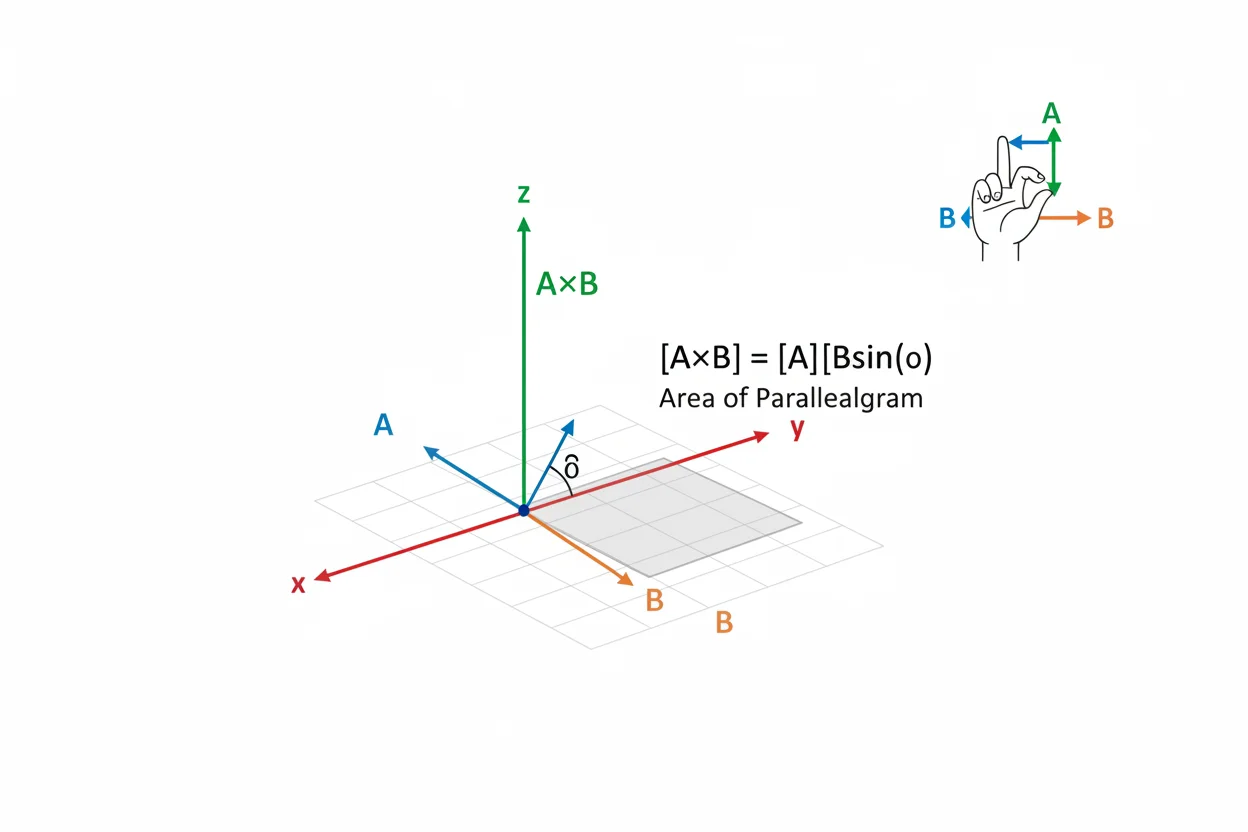

The cross product is a vector operation that takes two three-dimensional vectors and produces a third vector perpendicular to both of them. If vectors a and b lie in the same plane, a × b points normal to that plane, with its direction determined by the right-hand rule. Its magnitude equals the area of the parallelogram formed by the two original vectors. The operation is therefore useful for finding normal vectors, areas, orientations, torque-like quantities, and geometric relationships in three dimensions. Unlike the dot product, which produces a scalar, the cross product produces another vector. Its value depends on the order of the operands, so a × b and b × a point in opposite directions. If the two vectors are parallel, their cross product is the zero vector. The component formula makes the calculation straightforward once the vector coordinates are known.
What Is the Cross Product?
For two vectors:
a = (a₁, a₂, a₃)
and:
b = (b₁, b₂, b₃)
their cross product is written:
a × b
The result is a vector perpendicular to both a and b.
Its component formula is:
a × b = (a₂b₃ − a₃b₂, a₃b₁ − a₁b₃, a₁b₂ − a₂b₁)
The three resulting components correspond to the x-, y-, and z-directions.
Vectors and coordinate representations are closely connected to concepts such as basis and dimension, because vector components are expressed relative to an underlying coordinate basis.
Cross Product Formula
For:
a = (a₁, a₂, a₃)
b = (b₁, b₂, b₃)
the formula is:
a × b = (a₂b₃ − a₃b₂, a₃b₁ − a₁b₃, a₁b₂ − a₂b₁)
An equivalent determinant-style mnemonic uses the standard basis directions i, j, and k:
a × b = i(a₂b₃ − a₃b₂) − j(a₁b₃ − a₃b₁) + k(a₁b₂ − a₂b₁)
The middle term is where sign errors commonly occur. Writing the final second component directly as:
a₃b₁ − a₁b₃
often reduces mistakes.
How to Calculate a Cross Product
Suppose:
a = (2, −1, 3)
and:
b = (1, 4, −2)
Use the component formula.
First Component
a₂b₃ − a₃b₂
Substitute:
(−1)(−2) − (3)(4)
2 − 12 = −10
Second Component
a₃b₁ − a₁b₃
Substitute:
(3)(1) − (2)(−2)
3 + 4 = 7
Third Component
a₁b₂ − a₂b₁
Substitute:
(2)(4) − (−1)(1)
8 + 1 = 9
Therefore:
a × b = (−10, 7, 9)
This result is perpendicular to both original vectors.
Verifying the Answer
A useful way to verify a cross product is to take the dot product of the result with each original vector.
Let:
c = (−10, 7, 9)
Check c · a:
(−10)(2) + (7)(−1) + (9)(3)
−20 − 7 + 27 = 0
Now check c · b:
(−10)(1) + (7)(4) + (9)(−2)
−10 + 28 − 18 = 0
Because both dot products equal zero, c is orthogonal to both a and b, confirming the expected geometric property.
Magnitude of the Cross Product
The magnitude of a cross product has a geometric interpretation.
If θ is the angle between a and b, then:
|a × b| = |a||b| sin θ
This equation shows that the magnitude depends on both vector lengths and the sine of the included angle.
If θ = 90°, then:
sin 90° = 1
so:
|a × b| = |a||b|
The magnitude is largest when the vectors are perpendicular.
If θ = 0° or 180°, then:
sin θ = 0
and:
a × b = 0
This occurs when the vectors are parallel or antiparallel.
Example: Magnitude of a Cross Product
From the previous calculation:
a × b = (−10, 7, 9)
Its magnitude is:
|a × b| = √[(-10)² + 7² + 9²]
|a × b| = √(100 + 49 + 81)
|a × b| = √230
Numerically:
√230 ≈ 15.17
Therefore the magnitude of the cross product is approximately 15.17.
Cross Product and Area
One of the most useful geometric applications of the cross product is finding area.
For vectors a and b, the area of the parallelogram they span is:
A = |a × b|
Using the previous example:
A = √230 ≈ 15.17
If the same vectors form two sides of a triangle, the triangle occupies half the parallelogram.
Therefore:
A_triangle = |a × b|/2
So:
A_triangle = √230/2
A_triangle ≈ 7.58
This is a three-dimensional geometric area calculation and is conceptually different from finding area under a curve, which is normally obtained through integration.
Direction of the Cross Product
The cross product has both magnitude and direction.
The direction is determined using the right-hand rule.
Imagine curling the fingers of your right hand from a toward b through the smaller angle. Your thumb points in the direction of:
a × b
Reversing the vector order reverses the direction.
Therefore:
b × a = −(a × b)
This property is called anti-commutativity.
It means that, unlike ordinary multiplication:
a × b ≠ b × a
except in cases where the cross product is the zero vector.
Cross Product of Standard Basis Vectors
Using the standard three-dimensional basis vectors:
i = (1, 0, 0)
j = (0, 1, 0)
k = (0, 0, 1)
the fundamental cross products are:
i × j = k
j × k = i
k × i = j
Reversing the order changes the sign:
j × i = −k
k × j = −i
i × k = −j
These identities are useful when expanding vectors in component form.
Cross Product of Parallel Vectors
Suppose:
a = (1, 2, 3)
and:
b = (2, 4, 6)
Because:
b = 2a
the vectors are parallel.
Calculate:
a × b = (2·6 − 3·4, 3·2 − 1·6, 1·4 − 2·2)
a × b = (12 − 12, 6 − 6, 4 − 4)
a × b = (0, 0, 0)
This agrees with the magnitude rule because the angle between parallel vectors is 0°:
|a × b| = |a||b| sin 0°
|a × b| = 0
Cross Product of Perpendicular Vectors
Suppose:
a = (3, 0, 0)
and:
b = (0, 5, 0)
Then:
a × b = (0, 0, 15)
Its magnitude is:
|a × b| = 15
The individual magnitudes are:
|a| = 3
|b| = 5
Because the angle is 90°:
|a||b| sin 90° = 3 × 5 × 1 = 15
The component and geometric formulas agree.
Finding a Unit Normal Vector
Because a × b is perpendicular to both input vectors, it can be normalized to obtain a unit normal vector.
If:
n = a × b
then a unit normal is:
n̂ = n/|n|
For the earlier example:
n = (−10, 7, 9)
and:
|n| = √230
Therefore:
n̂ = (−10/√230, 7/√230, 9/√230)
The opposite vector is also a valid unit normal:
−n̂ = (10/√230, −7/√230, −9/√230)
Which one is appropriate depends on the required orientation.
Normal vectors are important in vector geometry and multivariable calculus, particularly when describing planes and surfaces.
Finding the Angle Between Two Vectors
Although the dot product is usually the most direct tool for finding the angle between vectors, the magnitude of the cross product can also be used.
From:
|a × b| = |a||b| sin θ
solve for sin θ:
sin θ = |a × b|/(|a||b|)
Then:
θ = sin⁻¹(|a × b|/(|a||b|))
This method determines the sine of the angle, so extra care may be required when distinguishing supplementary angles. The dot product provides cosine information and often resolves the angle more directly.
Algebraic Properties of the Cross Product
The cross product follows several useful rules.
Anti-Commutative Property
a × b = −(b × a)
Changing the order reverses the direction.
Distributive Property
a × (b + c) = a × b + a × c
Similarly:
(a + b) × c = a × c + b × c
Scalar Multiplication
For scalar k:
(ka) × b = k(a × b)
and:
a × (kb) = k(a × b)
Cross Product With Itself
Any vector crossed with itself gives the zero vector:
a × a = 0
The angle between a vector and itself is 0°, so the sine factor is zero.
Zero Vector
a × 0 = 0
and:
0 × a = 0
Is the Cross Product Associative?
No.
In general:
(a × b) × c ≠ a × (b × c)
This is an important distinction because ordinary scalar multiplication is associative.
Expressions containing several cross products therefore need explicit parentheses.
Cross Product and the Dot Product
The cross product and dot product both combine two vectors, but their outputs and geometric meanings differ.
For a dot product:
a · b = |a||b| cos θ
The result is a scalar.
For a cross product:
|a × b| = |a||b| sin θ
The result is a vector.
The dot product measures alignment along the same direction. The cross product measures perpendicular orientation and produces a normal vector.
These two operations frequently complement each other when analyzing vector geometry.
Cross Product and Coordinate Systems
The usual component formula assumes a right-handed orthonormal coordinate system.
The coordinates of a vector depend on the basis used to represent it. This is why the structural ideas behind basis and dimension matter when vector operations are generalized beyond elementary three-dimensional Cartesian coordinates.
Under changes of coordinates, vectors can also be studied using linear transformations. The elementary cross product formula, however, is most naturally interpreted in ordinary three-dimensional Euclidean space.
Cross Product as a Matrix Operation
For:
a = (a₁, a₂, a₃)
one can represent crossing another vector by a using a skew-symmetric matrix:
[ 0 −a₃ a₂ ]
[ a₃ 0 −a₁ ]
[ −a₂ a₁ 0 ]
Multiplying this matrix by b produces a × b.
This representation connects the cross product with broader matrix operations and linear algebra techniques.
For elementary calculations, however, the component formula is usually faster.
Cross Product in Calculus
The cross product itself is an algebraic vector operation, but it frequently appears in calculus involving curves and surfaces.
For a vector-valued curve, derivatives can produce tangent vectors. Cross products of appropriate tangent vectors can then produce normals to surfaces.
Concepts such as the derivative, gradient, and directional derivative deal with rates of change rather than the cross product itself, but vector calculus often combines these operations.
This differs from one-variable topics such as continuity and the chain rule, which focus on function behavior and differentiation.
Cross Product and Integration
Cross products can appear in vector-valued integrands and geometric constructions, while a definite integral accumulates a quantity over an interval.
More advanced vector calculus also includes integrals taken along paths. A line integral combines integration with geometric information from a curve.
The important distinction is that a cross product is an operation between vectors at a given stage of a calculation; it is not itself an integration procedure.
Example: Find a Normal to a Plane
Suppose a plane contains the direction vectors:
u = (1, 2, 0)
and:
v = (3, 1, 4)
A vector perpendicular to both directions can be obtained from:
u × v
Calculate:
u × v = (2·4 − 0·1, 0·3 − 1·4, 1·1 − 2·3)
u × v = (8, −4, 1 − 6)
u × v = (8, −4, −5)
Therefore:
n = (8, −4, −5)
is a normal vector to the plane.
Any nonzero scalar multiple, such as:
(−8, 4, 5)
is also perpendicular to the plane.
Example: Area of a Triangle in Three Dimensions
Suppose a triangle has vertices:
A = (1, 0, 0)
B = (3, 1, 0)
C = (2, 4, 2)
Construct two side vectors from A:
AB = B − A = (2, 1, 0)
AC = C − A = (1, 4, 2)
Now calculate:
AB × AC
= (1·2 − 0·4, 0·1 − 2·2, 2·4 − 1·1)
= (2, −4, 7)
Its magnitude is:
√(2² + (−4)² + 7²)
= √(4 + 16 + 49)
= √69
The parallelogram area is √69, so the triangle area is:
A = √69/2
Approximately:
A ≈ 4.15
Common Cross Product Mistakes
The most common computational error is using the wrong sign for the second component. Writing the component as:
a₃b₁ − a₁b₃
helps avoid confusion.
Another mistake is forgetting that order matters. Reversing the vectors negates the answer.
Students may also confuse the cross product with the dot product. A dot product returns a scalar, while a cross product returns a vector.
A zero cross product does not necessarily mean one input vector is zero. It can also mean that two nonzero vectors are parallel.
Finally, the standard elementary cross product formula is specifically associated with three-dimensional vectors. It should not be applied mechanically to arbitrary vector dimensions.
Frequently Asked Questions
What is the cross product formula?
For a = (a₁, a₂, a₃) and b = (b₁, b₂, b₃):
a × b = (a₂b₃ − a₃b₂, a₃b₁ − a₁b₃, a₁b₂ − a₂b₁)
What does a cross product produce?
It produces a vector perpendicular to both input vectors.
What does the magnitude of a cross product represent?
The magnitude:
|a × b|
equals the area of the parallelogram formed by a and b.
How do you find the area of a triangle using a cross product?
Use half the magnitude:
A = |a × b|/2
where the two vectors represent sides extending from the same vertex.
Why does cross-product order matter?
The cross product is anti-commutative:
a × b = −(b × a)
Reversing the order reverses the resulting direction.
When is the cross product zero?
It is zero when the vectors are parallel, antiparallel, or when at least one vector is the zero vector.
Is the cross product perpendicular to both vectors?
Yes, provided the result is nonzero. The resulting vector is orthogonal to each input vector.
How can I check a cross product calculation?
Take the dot product of your result with each original vector. Both dot products should equal zero.
What is the difference between dot product and cross product?
A dot product produces a scalar and depends on cos θ. A cross product produces a perpendicular vector whose magnitude depends on sin θ.
Is a cross product associative?
No. In general:
(a × b) × c ≠ a × (b × c)
Parentheses therefore matter.
Does the cross product work in two dimensions?
The standard cross product produces a three-dimensional vector. For two-dimensional vectors, they can be embedded in three dimensions by assigning zero z-components, after which the resulting cross product points entirely in the z-direction.