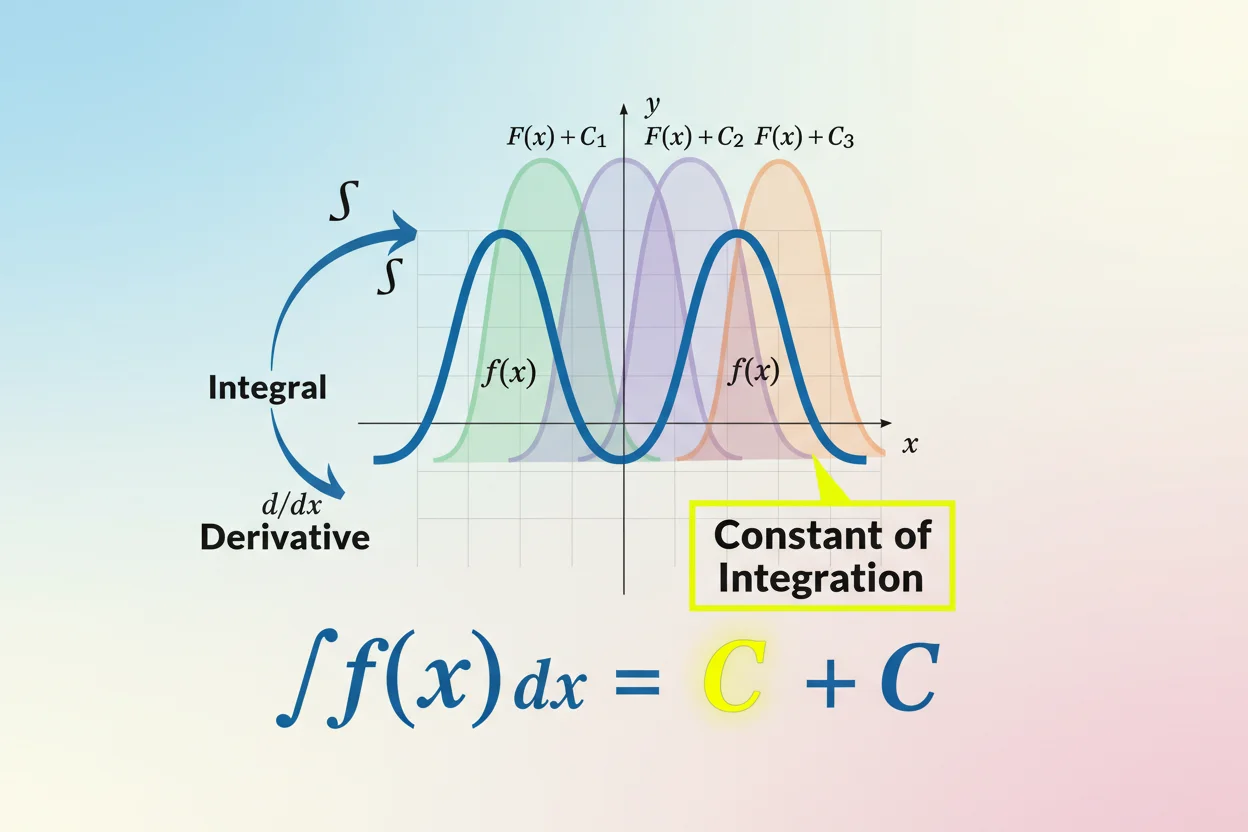

An indefinite integral represents the complete family of functions whose derivative equals a given function. If F′(x) = f(x), then the indefinite integral of f(x) is written ∫f(x) dx = F(x) + C, where C is the constant of integration. The constant is necessary because infinitely many functions that differ only by a constant have the same derivative. Unlike a definite integral, an indefinite integral has no fixed upper and lower bounds and therefore does not produce one accumulated numerical value. Its main purpose is to recover antiderivatives and express all functions satisfying a specified derivative relationship. Standard power, constant, sum, exponential, logarithmic, and trigonometric integration rules handle many basic examples directly. More complicated expressions may require specialized methods such as substitution or integration by parts. Correct indefinite integration therefore depends on recognizing the structure of the integrand and checking the result by differentiation.
What Is an Indefinite Integral?
An indefinite integral is an antiderivative family.
Suppose:
F′(x) = f(x)
Then:
∫ f(x) dx = F(x) + C
The function F(x) is an antiderivative of f(x), while C represents an arbitrary real constant.
For example:
d/dx[x²] = 2x
so:
∫ 2x dx = x² + C
But x² is not the only function whose derivative is 2x.
We also have:
d/dx[x² + 5] = 2x
and:
d/dx[x² − 12] = 2x
Because every constant disappears during differentiation, the complete answer must include:
- C
Indefinite Integral Formula
The basic relationship is:
∫ f(x) dx = F(x) + C
when:
F′(x) = f(x)
The integral symbol:
∫
indicates integration.
The expression:
f(x)
is the integrand.
The symbol:
dx
indicates that integration is being performed with respect to x.
The constant:
C
accounts for all antiderivatives differing by a constant.
Why Is +C Necessary?
Suppose:
∫ 6x² dx
Using the power rule:
∫ 6x² dx = 2x³ + C
Differentiate:
d/dx[2x³ + C] = 6x²
regardless of the value of C.
For example:
2x³
2x³ + 4
2x³ − 100
all have derivative:
6x²
An indefinite integral therefore represents an entire family of curves rather than one unique function.
Geometrically, those curves are vertical translations of each other.
How to Check an Indefinite Integral
The most reliable check is differentiation.
If you claim:
∫ f(x) dx = F(x) + C
differentiate the proposed result.
You should obtain:
F′(x) = f(x)
For example, suppose:
∫ (3x² − 4x + 5) dx
is calculated as:
x³ − 2x² + 5x + C
Differentiate:
d/dx[x³ − 2x² + 5x + C]
= 3x² − 4x + 5
The original integrand is recovered, so the result is correct.
This derivative check is valuable because integration errors often come from coefficients or exponents.
Constant Rule
For a constant k:
∫ k dx = kx + C
For example:
∫ 7 dx = 7x + C
because:
d/dx[7x + C] = 7
Similarly:
∫ −3 dx = −3x + C
Power Rule for Indefinite Integrals
For:
n ≠ −1
the power rule is:
∫ xⁿ dx = xⁿ⁺¹/(n + 1) + C
The procedure is:
increase the exponent by 1, then divide by the new exponent.
For example:
∫ x⁴ dx = x⁵/5 + C
Check:
d/dx[x⁵/5] = x⁴
For:
∫ x⁷ dx
the answer is:
x⁸/8 + C
Example: Integrating a Polynomial
Evaluate:
∫ (4x³ − 6x² + 5x − 8) dx
Integrate term by term.
For the first term:
∫ 4x³ dx = x⁴
For the second:
∫ −6x² dx = −2x³
For the third:
∫ 5x dx = (5/2)x²
For the constant:
∫ −8 dx = −8x
Therefore:
∫ (4x³ − 6x² + 5x − 8) dx
= x⁴ − 2x³ + (5/2)x² − 8x + C
Differentiate the result to recover the original polynomial.
The Special Case n = −1
The power formula does not work for:
n = −1
because the denominator would become:
n + 1 = 0
Instead:
∫ 1/x dx = ln|x| + C
for:
x ≠ 0
The absolute value is important because 1/x has antiderivatives on intervals where x is positive and on intervals where x is negative.
Check:
d/dx[ln|x|] = 1/x
for x ≠ 0.
Constant Multiple Rule
A constant can be factored outside an indefinite integral:
∫ kf(x) dx = k∫ f(x) dx
For example:
∫ 5x⁴ dx
= 5∫ x⁴ dx
= 5(x⁵/5) + C
= x⁵ + C
This rule simplifies expressions with numerical coefficients.
Sum and Difference Rules
Integration distributes across addition and subtraction:
∫ [f(x) + g(x)] dx = ∫ f(x) dx + ∫ g(x) dx
and:
∫ [f(x) − g(x)] dx = ∫ f(x) dx − ∫ g(x) dx
For example:
∫ (x² + 2x − 3) dx
can be handled term by term:
x³/3 + x² − 3x + C
These linearity rules make polynomial integration straightforward.
Integrating Negative Powers
The power rule also applies to negative exponents except −1.
For example:
∫ x⁻³ dx
increase the exponent:
−3 + 1 = −2
Then divide by −2:
∫ x⁻³ dx = x⁻²/(−2) + C
So:
∫ x⁻³ dx = −1/(2x²) + C
Check:
d/dx[−(1/2)x⁻²] = x⁻³
Integrating Fractional Powers
Radicals can often be rewritten using fractional exponents.
For example:
∫ √x dx
Rewrite:
√x = x¹ᐟ²
Apply the power rule:
∫ x¹ᐟ² dx = x³ᐟ²/(3/2) + C
Therefore:
∫ √x dx = (2/3)x³ᐟ² + C
Similarly:
∫ 1/√x dx
becomes:
∫ x⁻¹ᐟ² dx
which gives:
2√x + C
on intervals where the expression is defined.
Exponential Indefinite Integrals
A fundamental exponential rule is:
∫ eˣ dx = eˣ + C
because eˣ is its own derivative.
For a positive constant a with a ≠ 1:
∫ aˣ dx = aˣ/ln(a) + C
For example:
∫ 2ˣ dx = 2ˣ/ln 2 + C
Differentiating:
d/dx[2ˣ/ln 2] = 2ˣ
Basic Trigonometric Integrals
Several standard trigonometric antiderivatives are:
∫ sin x dx = −cos x + C
∫ cos x dx = sin x + C
∫ sec²x dx = tan x + C
∫ csc²x dx = −cot x + C
∫ sec x tan x dx = sec x + C
∫ csc x cot x dx = −csc x + C
These formulas reverse familiar derivative identities.
For example:
d/dx[sin x] = cos x
so:
∫ cos x dx = sin x + C
Example With Trigonometric Terms
Evaluate:
∫ (3cos x − 2sin x) dx
Integrate each term:
∫ 3cos x dx = 3sin x
and:
∫ −2sin x dx = 2cos x
Therefore:
∫ (3cos x − 2sin x) dx
= 3sin x + 2cos x + C
Differentiate:
3cos x − 2sin x
which confirms the result.
Indefinite Integral and the Chain Rule
Some integrals contain a composite function together with the derivative of its inner expression.
For example:
∫ 2x(x² + 1)⁵ dx
The inner function is:
x² + 1
whose derivative is:
2x
This pattern suggests reversing the chain rule.
Let:
u = x² + 1
Then:
du = 2x dx
The integral becomes:
∫ u⁵ du
which equals:
u⁶/6 + C
Substitute back:
(x² + 1)⁶/6 + C
The dedicated integration by substitution method develops this reverse-chain-rule procedure in detail.
Example: Composite Linear Expression
Evaluate:
∫ (3x + 4)⁵ dx
Let:
u = 3x + 4
Then:
du = 3 dx
So:
dx = du/3
Therefore:
∫ (3x + 4)⁵ dx
= (1/3)∫ u⁵ du
= u⁶/18 + C
Substitute:
∫ (3x + 4)⁵ dx = (3x + 4)⁶/18 + C
Check by differentiating:
d/dx[(3x + 4)⁶/18]
= 6(3x + 4)⁵(3)/18
= (3x + 4)⁵
Integrating Products
A product does not generally integrate by simply integrating each factor independently.
In general:
∫ f(x)g(x) dx
is not equal to:
[∫f(x) dx][∫g(x) dx]
For products arising from a derivative product rule, integration by parts may be appropriate.
Its core formula is:
∫ u dv = uv − ∫ v du
For example, an integral such as:
∫ xeˣ dx
does not simplify through the ordinary power rule alone.
Integration by parts handles the product structure while keeping the indefinite-integral goal focused on finding an antiderivative.
Example: ∫ xeˣ dx
Choose:
u = x
and:
dv = eˣ dx
Then:
du = dx
and:
v = eˣ
Apply the formula:
∫ xeˣ dx = xeˣ − ∫ eˣ dx
Therefore:
∫ xeˣ dx = xeˣ − eˣ + C
Factor if desired:
eˣ(x − 1) + C
Differentiate to confirm:
d/dx[eˣ(x − 1)]
= eˣ(x − 1) + eˣ
= xeˣ
Indefinite Integral Versus Definite Integral
An indefinite integral has no fixed limits:
∫ f(x) dx = F(x) + C
Its result is a family of functions.
A definite integral has limits:
∫ₐᵇ f(x) dx
and evaluates to a scalar accumulated value under appropriate conditions:
F(b) − F(a)
The Fundamental Theorem Of Calculus explains why an antiderivative can be used to evaluate a definite integral.
The two forms are related but should not be treated as interchangeable.
Why +C Is Used for Indefinite but Not Definite Integrals
Suppose:
∫ f(x) dx = F(x) + C
For a definite integral:
[F(b) + C] − [F(a) + C]
the constants cancel:
F(b) − F(a)
That is why:
- C
is essential for the indefinite integral but unnecessary in a final definite-integral value.
Indefinite Integral Versus Improper Integral
An improper integral is a definite integral involving an infinite interval or an unbounded integrand.
For example:
∫₁∞ 1/x² dx
requires a limiting definition.
An indefinite integral:
∫ 1/x² dx = −1/x + C
only finds an antiderivative.
Knowing the antiderivative is useful when evaluating the improper integral, but it does not by itself establish convergence.
The limiting behavior must still be checked separately.
Indefinite Integral Versus General Integrals
The broader topic of integrals includes indefinite, definite, improper, multiple, and path-based forms.
The indefinite integral has a narrow role within that family: it finds all antiderivatives of an integrand.
It does not by itself represent accumulated area between numerical endpoints, multidimensional accumulation, or convergence over infinite intervals.
Keeping this boundary clear helps determine which integration procedure a problem actually requires.
Indefinite Integrals and Differential Equations
Indefinite integration often appears when solving differential equations.
Consider:
dy/dx = 6x²
Write:
dy = 6x² dx
Integrate:
∫ dy = ∫ 6x² dx
Therefore:
y = 2x³ + C
The arbitrary constant is essential because the differential equation has infinitely many solutions until an initial condition is supplied.
More complex equations may require specialist methods such as a first-order linear differential equation integrating factor.
Example With an Initial Condition
Suppose:
y′ = 4x³
and:
y(1) = 7
Integrate:
y = x⁴ + C
Apply the condition:
7 = 1⁴ + C
Therefore:
C = 6
So the particular solution is:
y = x⁴ + 6
The indefinite integral provides the general family; the initial condition selects one member.
Indefinite Integral and Implicit Differentiation
Implicit differentiation begins with a relation between variables and finds a derivative.
Indefinite integration reverses derivative information to recover a function family.
For example, if implicit differentiation produces a separable relationship that can later be integrated, an indefinite integral may appear in the subsequent algebra.
However, the two procedures answer different core questions: implicit differentiation finds a rate, while indefinite integration finds antiderivatives.
Indefinite Integral and the Gradient
A gradient collects partial derivatives of a multivariable scalar function:
∇f = (fₓ, fᵧ, …)
An indefinite integral in elementary calculus typically reverses a one-variable derivative.
Recovering a multivariable scalar function from derivative information requires additional consistency conditions and is not simply the same operation as writing:
∫ f(x) dx
The concepts meet in advanced calculus, but an ordinary indefinite integral should remain scoped to its one-variable antiderivative meaning.
Indefinite Integral and Area
An indefinite integral does not directly give a numerical area under a curve.
It produces:
F(x) + C
To calculate signed area between fixed endpoints, use the corresponding definite integral:
∫ₐᵇ f(x) dx
and evaluate:
F(b) − F(a)
If geometric area is required and f changes sign, further interval analysis may be necessary.
Integrating Reciprocal Linear Functions
Consider:
∫ 1/(2x + 3) dx
Let:
u = 2x + 3
Then:
du = 2 dx
Therefore:
dx = du/2
So:
∫ 1/(2x + 3) dx
= (1/2)∫ 1/u du
= (1/2)ln|u| + C
Substitute back:
∫ 1/(2x + 3) dx
= (1/2)ln|2x + 3| + C
Example With an Exponential Composite
Evaluate:
∫ 4e^(4x) dx
Because:
d/dx[4x] = 4
the reverse chain-rule pattern gives:
∫ 4e^(4x) dx = e^(4x) + C
If the coefficient 4 were absent:
∫ e^(4x) dx = e^(4x)/4 + C
Checking by differentiation confirms the factor.
Integrating Functions With Parameters
Suppose a is constant and:
a ≠ −1
Then:
∫ xᵃ dx = xᵃ⁺¹/(a + 1) + C
The integration variable is x, so a is treated as fixed.
If another symbol also varies with x, it cannot automatically be treated as constant.
Always identify the integration variable from the differential:
dx
dy
dt
or another corresponding symbol.
Variable of Integration
The differential tells you which variable is being integrated.
For example:
∫ 3t² dt = t³ + C
while:
∫ 3t² dx
would treat t as constant with respect to x if t is independent of x, giving:
3t²x + C
Context therefore matters.
Most elementary indefinite integrals are written with matching integrand and integration variables, but the notation should still be read carefully.
Domains of Antiderivatives
An indefinite integral formula may be valid only on intervals where the original integrand is defined.
For example:
∫ 1/x dx = ln|x| + C
is valid on intervals not containing zero.
The real line is split into:
x < 0
and:
x > 0
Constants of integration can effectively differ between disconnected intervals.
Similarly, radicals, logarithms, and rational functions may impose domain restrictions that should be retained in the antiderivative interpretation.
Indefinite Integrals and Continuity
A continuous function on an interval has an antiderivative there under the standard calculus framework.
This makes continuity an important sufficient condition for ordinary antiderivative existence.
Functions with discontinuities may still possess antiderivatives on appropriate subintervals, but the domain must be considered carefully rather than treating one formula as valid across singular points.
Constant of Integration After Substitution
Suppose substitution produces:
u²/2 + C
After replacing u with the original expression, there is still only one arbitrary constant:
(g(x))²/2 + C
Do not add a different +C after every intermediate integration step in one calculation.
Constants can be combined into a single arbitrary constant at the end.
Can Different Antiderivative Forms Both Be Correct?
Yes.
Two expressions can look different and still differ only by a constant or an algebraic identity.
For example, trigonometric identities or logarithm properties can make equivalent antiderivatives appear different.
A derivative check is the simplest way to determine whether both forms correctly return the original integrand.
If their derivatives are identical on the relevant interval, they can differ only by a constant on a connected interval.
Common Mistakes With Indefinite Integrals
A common mistake is forgetting:
- C
This turns a complete family of antiderivatives into only one representative.
Another frequent error is applying the power rule to:
1/x
The correct result is:
ln|x| + C
not a division by zero from the ordinary power formula.
Students may also reduce the exponent rather than increase it. Differentiation reduces powers; integration reverses that process:
xⁿ → xⁿ⁺¹/(n + 1)
for n ≠ −1.
Products should not be integrated by simply integrating each factor.
Composite expressions should be checked for a reverse-chain-rule pattern before applying substitution.
Finally, every answer should be differentiated when practical. Integration can involve several plausible-looking forms, and differentiation immediately reveals missing coefficients, wrong signs, and incorrect exponents.
Frequently Asked Questions
What is an indefinite integral?
An indefinite integral is the family of all antiderivatives of a function:
∫ f(x) dx = F(x) + C
where:
F′(x) = f(x)
Why does an indefinite integral need +C?
Because derivatives of constants are zero. Every function F(x) + C has the same derivative F′(x).
What is the power rule for indefinite integrals?
For n ≠ −1:
∫ xⁿ dx = xⁿ⁺¹/(n + 1) + C
What is the integral of 1/x?
∫ 1/x dx = ln|x| + C
for x ≠ 0.
What is the difference between an antiderivative and an indefinite integral?
An antiderivative is one function F satisfying F′ = f. The indefinite integral represents the full family F + C.
What is the difference between indefinite and definite integrals?
An indefinite integral produces a function family and includes +C. A definite integral has endpoints and produces an accumulated numerical value under suitable conditions.
How do you check an indefinite integral?
Differentiate the proposed answer. The result should equal the original integrand.
Does every indefinite integral use the power rule?
No. Logarithmic, exponential, trigonometric, composite, rational, and product forms may require other formulas or techniques.
When should substitution be used?
Substitution is useful when the integrand contains a composite function together with, or nearly together with, the derivative of its inner expression.
When should integration by parts be used?
It is often useful for products where one factor simplifies when differentiated and another is easy to integrate.
Can an indefinite integral have more than one correct-looking answer?
Yes. Equivalent antiderivatives may differ algebraically or by a constant. Differentiating each form verifies whether it is correct.
Does an indefinite integral represent area?
Not directly. It represents antiderivatives. A definite integral with fixed bounds is used for signed accumulation and can represent area under suitable conditions.