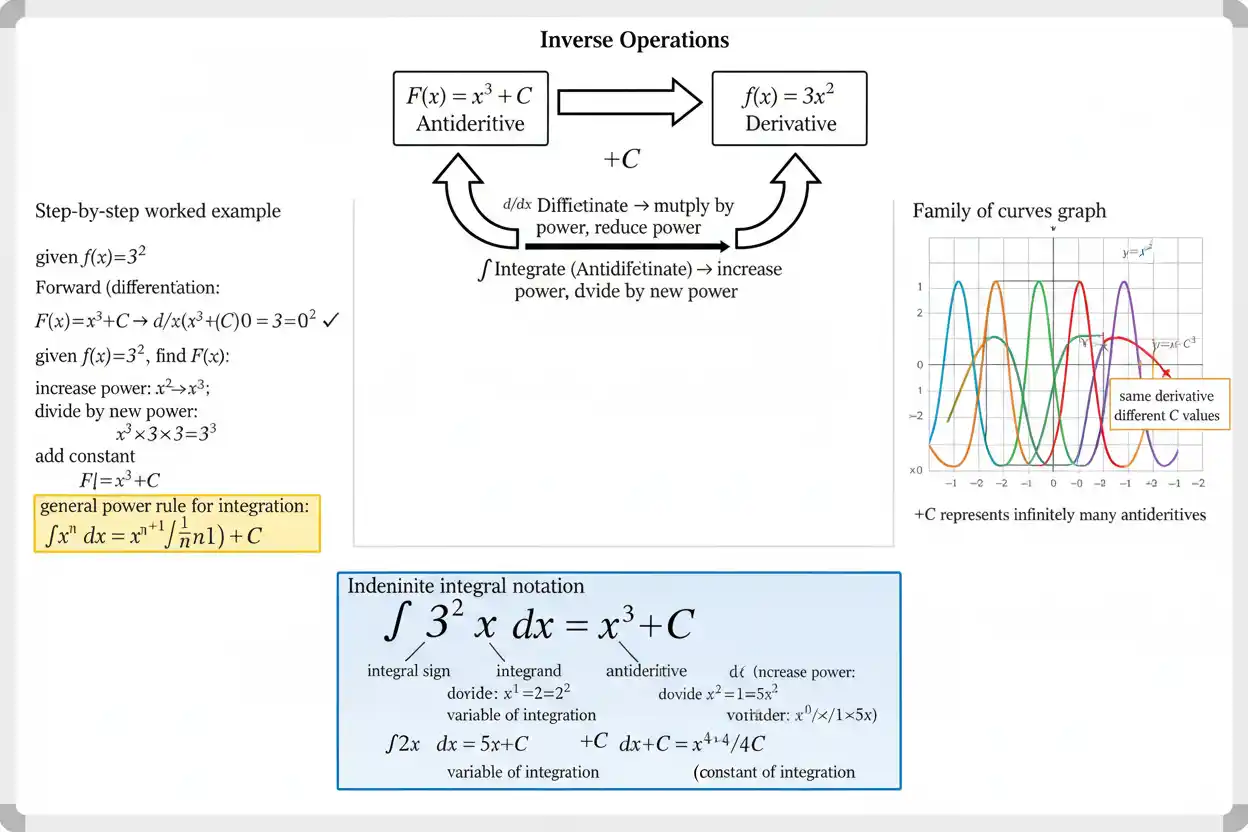

An antiderivative of a function is another function whose derivative equals the original function.
If:
F′(x) = f(x)
then:
F(x) is an antiderivative of f(x)
For example:
f(x) = 2x
An antiderivative is:
F(x) = x²
because:
F′(x) = 2x
But:
x² + 5
is also an antiderivative because:
d/dx(x²+5) = 2x
In fact, every function:
F(x) = x² + C
where C is a constant, has derivative 2x.
This is why indefinite integration is written:
∫f(x) dx = F(x) + C
Antiderivatives reverse differentiation and form the computational foundation for indefinite and definite integration.
What Is an Antiderivative?
Suppose a function is:
f(x)
We seek a function:
F(x)
such that:
F′(x)=f(x)
That function F is an antiderivative.
For:
f(x)=6x²
we know:
d/dx(2x³)=6x²
Therefore:
2x³ is an antiderivative of 6x²
More completely:
∫6x² dx = 2x³+C
because every constant value produces another function with the same derivative.
The forward operation is covered by the derivative; the antiderivative reverses that operation.
Antiderivative Formula
The defining relationship is:
F′(x)=f(x)
or equivalently:
∫f(x) dx = F(x)+C
where:
f(x) = integrandF(x) = an antiderivativeC = arbitrary constant of integration
For example:
∫4x³ dx
An antiderivative of:
4x³
is:
x⁴
Therefore:
∫4x³ dx = x⁴+C
Check:
d/dx(x⁴+C)=4x³
Why Do Antiderivatives Include +C?
Consider:
F(x)=x²
and:
G(x)=x²+100
Differentiate both:
F′(x)=2x
G′(x)=2x
The constant disappears because:
d/dx(C)=0
Therefore differentiation cannot recover which vertical constant was originally present.
All functions:
x²+C
have the same derivative:
2x
So the complete indefinite integral is:
∫2x dx = x²+C
not merely:
x²
Antiderivatives Form a Family of Curves
Changing C shifts the graph vertically.
For:
F(x)=x²+C
choices such as:
C=-3
C=0
C=5
produce different parabolas.
However, they all have identical slopes at corresponding x values because their derivatives are identical:
F′(x)=2x
Thus an indefinite integral represents a family of antiderivatives rather than one unique function.
Power Rule for Antiderivatives
For:
n ≠ -1
the basic power rule is:
∫xⁿ dx = x^(n+1)/(n+1) + C
The process is:
Increase the exponent by 1.
Then divide by the new exponent.
For example:
∫x⁵ dx
Increase:
5→6
Divide by 6:
∫x⁵ dx = x⁶/6+C
Check:
d/dx(x⁶/6)=6x⁵/6=x⁵
Example: ∫x² dx
Apply the power rule:
∫x² dx = x³/3+C
Check:
d/dx(x³/3)
= 3x²/3
= x²
Therefore:
∫x² dx = x³/3+C
Example: Negative Powers
Evaluate:
∫x^-3 dx
Increase exponent:
-3+1=-2
Divide by:
-2
Therefore:
∫x^-3 dx = -1/(2x²)+C
Check:
d/dx[-(1/2)x^-2]
= -(1/2)(-2)x^-3
= x^-3
Exception: n = -1
The power rule cannot be used when:
n=-1
because the denominator:
n+1
would become zero.
Instead:
∫1/x dx = ln|x|+C
for intervals where:
x ≠ 0
Check:
d/dx ln|x| = 1/x
on its domain.
Constant Rule
For a constant k:
∫k dx = kx+C
For example:
∫7 dx
= 7x+C
because:
d/dx(7x+C)=7
Constant Multiple Rule
A constant factor can be moved outside an antiderivative:
∫k f(x) dx = k∫f(x) dx
For example:
∫5x⁴ dx
= 5∫x⁴ dx
= 5(x⁵/5)+C
= x⁵+C
Therefore:
∫5x⁴ dx = x⁵+C
Sum Rule
Antiderivatives distribute across addition:
∫[f(x)+g(x)] dx = ∫f(x) dx + ∫g(x) dx
For example:
∫(3x²+4x) dx
integrate each term:
∫3x² dx + ∫4x dx
= x³+2x²+C
Therefore:
∫(3x²+4x) dx = x³+2x²+C
Difference Rule
Similarly:
∫[f(x)-g(x)] dx = ∫f(x) dx – ∫g(x) dx
For example:
∫(6x²−4) dx
= 2x³−4x+C
Check:
d/dx(2x³−4x+C)
= 6x²−4
Polynomial Antiderivatives
Polynomials can usually be integrated term by term.
Evaluate:
∫(4x³−6x²+2x−9) dx
Integrate:
∫4x³ dx = x⁴
∫−6x² dx = -2x³
∫2x dx = x²
∫−9 dx = -9x
Therefore:
∫(4x³−6x²+2x−9) dx = x⁴−2x³+x²−9x+C
Differentiate the result to verify it.
Fractional Powers
The power rule works for many fractional exponents.
For example:
∫√x dx
Rewrite:
√x = x^(1/2)
Apply:
∫x^(1/2) dx
= x^(3/2)/(3/2)+C
Dividing by 3/2 means multiplying by 2/3:
∫√x dx = (2/3)x^(3/2)+C
Reciprocal Square Root
Evaluate:
∫1/√x dx
Rewrite:
x^-1/2
Apply the power rule:
exponent → 1/2
Therefore:
x^(1/2)/(1/2)+C
= 2√x+C
So:
∫1/√x dx = 2√x+C
for:
x>0
Exponential Antiderivatives
One of the simplest exponential formulas is:
∫eˣ dx = eˣ+C
because:
d/dx(eˣ)=eˣ
More generally:
∫e^(kx) dx = e^(kx)/k+C
for:
k ≠ 0
For example:
∫e^(3x) dx
= e^(3x)/3+C
The factor 1/3 compensates for the inner derivative.
Antiderivative of aˣ
For:
a>0
and:
a≠1
we have:
∫aˣ dx = aˣ/ln(a)+C
because:
d/dx(aˣ)=aˣln(a)
For example:
∫2ˣ dx
= 2ˣ/ln2+C
Basic Trigonometric Antiderivatives
Common formulas include:
∫cos x dx = sin x+C
because:
d/dx(sin x)=cos x
and:
∫sin x dx = -cos x+C
because:
d/dx(-cos x)=sin x
Also:
∫sec²x dx = tan x+C
and:
∫1/(1+x²) dx = arctan x+C
These inverse relationships are useful to recognize directly.
Antiderivative as Reverse Differentiation
Many antiderivative rules can be remembered by reversing familiar derivatives.
If you know:
d/dx(sin x)=cos x
then:
∫cos x dx=sin x+C
If:
d/dx(ln|x|)=1/x
then:
∫1/x dx=ln|x|+C
Recognition becomes increasingly important as integrands become more complex.
Antiderivative and the Chain Rule
The chain rule says:
d/dx F(g(x)) = F′(g(x))g′(x)
Reversing this pattern explains many substitution-style antiderivatives.
Suppose:
∫2x cos(x²) dx
Recognize:
derivative of x² = 2x
and:
antiderivative of cos(u)=sin(u)
Therefore:
∫2x cos(x²) dx = sin(x²)+C
Check:
d/dx sin(x²)
= cos(x²)×2x
The original integrand is recovered.
Reverse Chain Rule Example
Evaluate:
∫6x(3x²+4)⁵ dx
Let:
u=3x²+4
Then:
du=6x dx
The integral becomes:
∫u⁵ du
Apply the power rule:
u⁶/6+C
Substitute back:
(3x²+4)⁶/6+C
This is an antiderivative built by recognizing the reverse chain-rule structure.
Antiderivative With an Initial Condition
An initial condition determines the otherwise arbitrary constant.
Suppose:
F′(x)=6x
and:
F(2)=17
First integrate:
F(x)=3x²+C
Apply:
F(2)=17
So:
3(4)+C=17
12+C=17
C=5
Therefore:
F(x)=3x²+5
The initial condition selects one member from the entire antiderivative family.
Another Initial-Value Example
Suppose:
F′(x)=4x³−2
and:
F(1)=8
Integrate:
F(x)=x⁴−2x+C
Substitute:
8=1−2+C
8=-1+C
C=9
Therefore:
F(x)=x⁴−2x+9
Check:
F′(x)=4x³−2
and:
F(1)=8
Antiderivatives and Definite Integrals
An antiderivative can evaluate a definite integral.
If:
F′(x)=f(x)
then:
∫ₐᵇ f(x) dx = F(b)−F(a)
For example:
∫₀³ 2x dx
An antiderivative is:
x²
Evaluate:
3²−0²
= 9
Therefore:
∫₀³2x dx = 9
The arbitrary constant disappears because:
[F(b)+C]−[F(a)+C]
= F(b)−F(a)
Why +C Is Not Written in a Definite Integral Result
Suppose:
F(x)=x²+C
Then:
F(3)−F(0)
= (9+C)−(0+C)
= 9
The same constant appears at both endpoints and cancels.
Therefore the final definite-integral value is a number, not a family:
9
Antiderivatives and Area Under a Curve
When a function is nonnegative on:
[a,b]
the area under a curve is calculated using:
A = ∫ₐᵇ f(x) dx
An antiderivative converts that accumulation into endpoint evaluation.
For:
f(x)=x
on:
[0,4]
an antiderivative is:
x²/2
Then:
A = 4²/2−0
= 8
Therefore:
Area = 8 square units
The geometric interpretation belongs to the area problem; the antiderivative supplies the computational engine.
Antiderivatives and Area Between Curves
For functions:
f(x) ≥ g(x)
the area between curves is typically:
A = ∫ₐᵇ[f(x)−g(x)]dx
After the correct integrand and bounds are established, antiderivatives evaluate the integral.
For example, between:
y=x
and:
y=x²
on:
[0,1]
the integrand is:
x−x²
An antiderivative is:
x²/2−x³/3
Evaluate:
1/2−1/3
= 1/6
Therefore:
Area = 1/6
Antiderivatives and Arc Length
The arc length calculus formula for:
y=f(x)
is:
L = ∫ₐᵇ √[1+(f′(x))²] dx
Once the arc-length integrand has been constructed from the derivative, finding an antiderivative—when one exists in elementary form—allows exact evaluation.
For example, if:
f′(x)=√x
then the integrand becomes:
√(1+x)
whose antiderivative is:
(2/3)(1+x)^(3/2)
Thus arc-length problems often combine differentiation and antiderivative techniques in one calculation.
Not Every Function Has an Elementary Antiderivative
A continuous function can have an antiderivative even when that antiderivative cannot be expressed with a finite combination of familiar elementary functions.
A standard example is:
e^(-x²)
The integral:
∫e^(-x²)dx
does not have an elementary closed form.
This does not mean the antiderivative fails to exist. It means additional special-function or numerical notation is required.
This distinction becomes important in more advanced calculus.
Continuity and Existence
A standard calculus result states that a continuous function on an interval has an antiderivative locally through an integral construction.
Thus continuity provides a strong condition ensuring that accumulation can define a differentiable function whose derivative recovers the original integrand.
For computational exercises, the main task remains recognizing or constructing a usable antiderivative formula.
Antiderivatives Are Unique Up to a Constant
Suppose:
F′(x)=f(x)
and:
G′(x)=f(x)
on the same interval.
Then:
(F−G)′=0
A function with derivative zero throughout an interval is constant there.
Therefore:
F(x)−G(x)=C
or:
F(x)=G(x)+C
This proves why all antiderivatives of the same function differ only by constants on an interval.
Domain Can Matter
Consider:
f(x)=1/x
Its domain excludes:
x=0
An antiderivative is:
ln|x|+C
The intervals:
x<0
and:
x>0
are disconnected.
When treating antiderivatives separately on disconnected intervals, different constants can be chosen on different components.
So the familiar statement “antiderivatives differ by a constant” should be understood interval by interval.
Antiderivatives in Function Spaces
Functions themselves can be treated as vectors in suitable mathematical settings. The concepts of basis and dimension become relevant when studying finite-dimensional spaces of functions such as polynomials up to a fixed degree.
For example, the polynomial space:
P₂
can use basis:
1, x, x²
Differentiation maps that space into a lower-degree polynomial space.
Antidifferentiation reverses that process only up to the missing constant term.
This provides a linear-algebra perspective on why differentiation loses one degree of freedom and why antiderivatives contain:
+C
Antiderivative of a Polynomial From Its Derivative
Suppose:
F′(x)=12x³−6x+4
Integrate term by term:
∫12x³dx = 3x⁴
∫−6xdx = -3x²
∫4dx = 4x
Therefore:
F(x)=3x⁴−3x²+4x+C
Differentiate:
12x³−6x+4
which confirms the result.
Antiderivative of 1/(3x+2)
Evaluate:
∫1/(3x+2) dx
Because:
d/dx(3x+2)=3
the appropriate logarithmic antiderivative is:
(1/3)ln|3x+2|+C
Check:
d/dx[(1/3)ln|3x+2|]
= (1/3)×3/(3x+2)
= 1/(3x+2)
Antiderivative of cos(4x)
Evaluate:
∫cos(4x) dx
The inner derivative is:
4
Therefore compensate with:
1/4
giving:
∫cos(4x) dx = (1/4)sin(4x)+C
Check:
d/dx[(1/4)sin(4x)]
= (1/4)(4cos4x)
= cos4x
Antiderivative of 1/(1+x²)
A standard inverse-trigonometric relationship is:
d/dx(arctan x)=1/(1+x²)
Therefore:
∫1/(1+x²) dx = arctan x+C
This is an example where recognizing a derivative formula is faster than trying to manipulate the integrand algebraically.
Choosing an Antiderivative Method
For a simple polynomial or power:
use the power rule.
For:
1/x
recognize the logarithm.
For exponentials or common trigonometric functions:
use known derivative pairs.
When a composite function appears with its inner derivative:
look for reverse chain-rule structure.
For more complicated integrals, additional methods may be required.
The central question remains:
What function differentiates to the integrand?
Common Mistake: Forgetting +C
Incorrect:
∫2x dx = x²
Complete:
∫2x dx = x²+C
The constant is essential for an indefinite integral because infinitely many functions share the same derivative.
Common Mistake: Using the Power Rule on 1/x
Incorrect reasoning would produce division by:
0
because:
n=-1
The correct formula is:
∫1/x dx = ln|x|+C
Common Mistake: Dividing by the Old Exponent
For:
∫x⁴ dx
the exponent first becomes:
5
and you divide by:
5
Therefore:
x⁵/5+C
not:
x⁵/4+C
Common Mistake: Ignoring an Inner Derivative
Consider:
∫cos(5x)dx
Writing:
sin(5x)+C
is incorrect because differentiating gives:
5cos(5x)
Correct:
(1/5)sin(5x)+C
The factor 1/5 compensates for the chain rule.
Common Mistake: Adding +C to Every Term
For:
∫(x²+2x+3)dx
you do not need:
x³/3+C₁+x²+C₂+3x+C₃
All constants combine into one arbitrary constant:
x³/3+x²+3x+C
Common Mistake: Treating an Antiderivative as Unique
Without an initial or boundary condition:
∫f(x)dx
does not determine one unique function.
The entire family:
F(x)+C
is required.
How to Check an Antiderivative
Differentiate your answer.
Suppose:
∫(8x³−3)dx = 2x⁴−3x+C
Differentiate:
d/dx(2x⁴−3x+C)
= 8x³−3
This exactly matches the original integrand.
Therefore the antiderivative is correct.
Frequently Asked Questions
What is an antiderivative?
An antiderivative of f(x) is a function F(x) satisfying:
F′(x)=f(x)
What is the antiderivative formula?
∫f(x)dx = F(x)+C
where:
F′(x)=f(x)
Why do antiderivatives need +C?
Because every constant has derivative zero, so functions that differ only by constants have the same derivative.
What is the antiderivative of xⁿ?
For:
n≠-1
∫xⁿdx = x^(n+1)/(n+1)+C
What is the antiderivative of 1/x?
ln|x|+C
What is the antiderivative of eˣ?
eˣ+C
What is the antiderivative of cos x?
sin x+C
What is the antiderivative of sin x?
-cos x+C
What is the difference between an antiderivative and a definite integral?
An antiderivative is a function family. A definite integral produces a numerical accumulated value over stated bounds.
How do I verify an antiderivative?
Differentiate it and confirm that the original integrand is recovered.
Can an initial condition determine C?
Yes. Substitute the known function value into F(x)+C and solve for the constant.
Does every continuous function have an antiderivative?
On an interval, continuity is sufficient for the existence of an antiderivative.
Does every antiderivative have an elementary formula?
No. Some antiderivatives require special functions or numerical representation.
Final Example
Find the function F if:
F′(x)=3x²−4x+5
and:
F(2)=10
First find the general antiderivative:
F(x)=∫(3x²−4x+5)dx
Integrate term by term:
∫3x²dx = x³
∫−4xdx = -2x²
∫5dx = 5x
Therefore:
F(x)=x³−2x²+5x+C
Now use:
F(2)=10
Substitute:
10 = 2³−2(2²)+5(2)+C
10 = 8−8+10+C
10=10+C
Therefore:
C=0
So:
F(x)=x³−2x²+5x
Check:
F′(x)=3x²−4x+5
and:
F(2)=8−8+10=10
Both conditions are satisfied.
The core antiderivative relationship is:
F′(x)=f(x) ⇔ ∫f(x)dx=F(x)+C
Find a function whose derivative matches the integrand, include the constant family for indefinite integrals, and verify the result by differentiating.