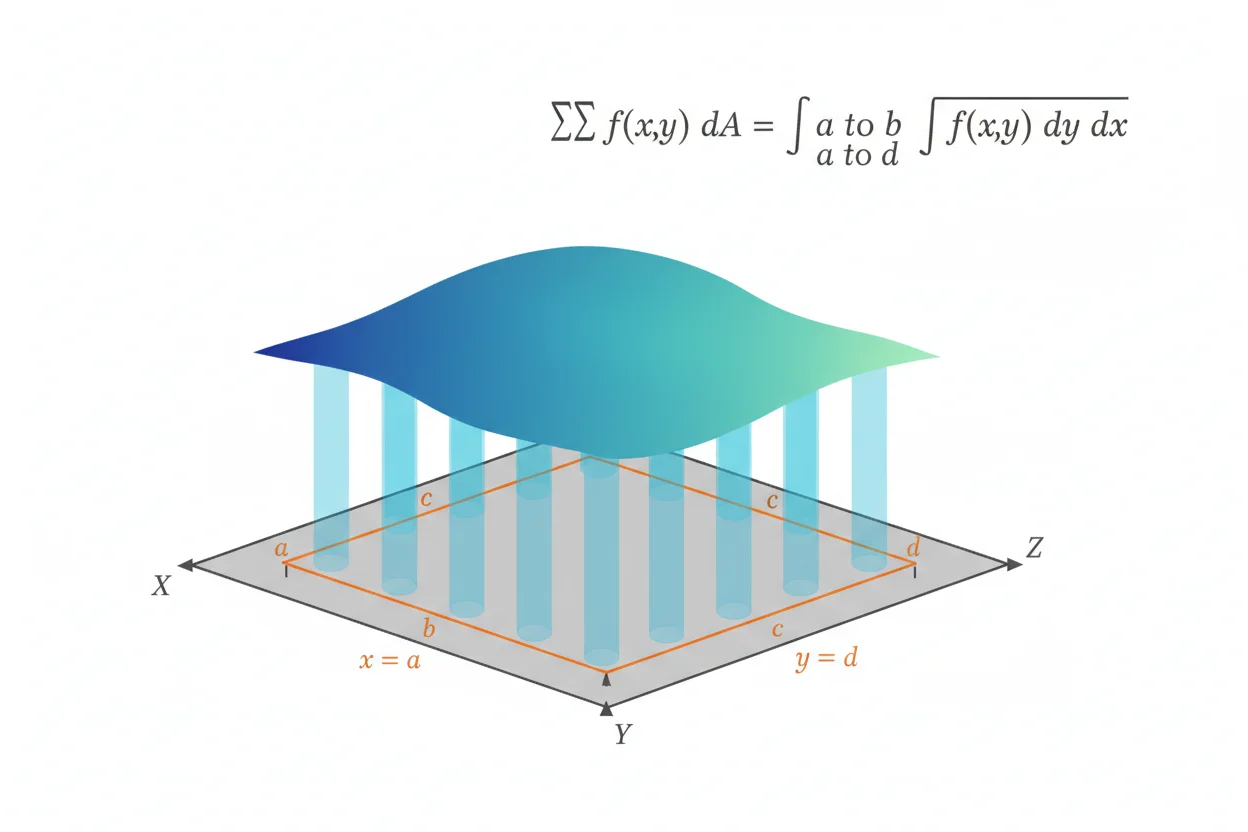

A double integral accumulates a function over a two-dimensional region rather than along a single interval. It is commonly written as ∬ᴿ f(x, y) dA, where R is a region in the xy-plane and f(x, y) supplies the quantity being accumulated. If f is nonnegative, the double integral can represent the volume beneath the surface z = f(x, y) and above R. When f takes both positive and negative values, the result represents signed accumulation rather than ordinary geometric volume. Double integrals can also calculate area, mass, average value, probability, moments, and other quantities distributed over a region. In practice, many double integrals are evaluated as two successive one-variable integrals, provided the function and region satisfy suitable conditions. The bounds may be constant for rectangular regions or depend on another variable for curved and triangular regions. Understanding the region before integrating is therefore just as important as finding the antiderivatives.
What Is a Double Integral?
For a function:
f(x, y)
defined over a two-dimensional region R, the double integral is written:
∬ᴿ f(x, y) dA
The symbol dA represents a small element of area.
In Cartesian coordinates:
dA = dx dy
or:
dA = dy dx
depending on the chosen order of integration.
A double integral extends the accumulation idea behind a definite integral from one dimension to two.
Double Integral Formula
For a rectangular region:
a ≤ x ≤ b
and:
c ≤ y ≤ d
the double integral can be written as an iterated integral:
∬ᴿ f(x, y) dA = ∫ₐᵇ ∫𝚌ᵈ f(x, y) dy dx
Under suitable conditions, the order can also be reversed:
∬ᴿ f(x, y) dA = ∫𝚌ᵈ ∫ₐᵇ f(x, y) dx dy
For nonrectangular regions, one or both bounds may depend on the other variable.
What Does a Double Integral Measure?
The meaning depends on the integrand.
If:
f(x, y) = 1
then:
∬ᴿ 1 dA
equals the area of R.
If f(x, y) represents height and remains nonnegative:
∬ᴿ f(x, y) dA
represents volume beneath the surface and above R.
If f represents surface density:
ρ(x, y)
then:
∬ᴿ ρ(x, y) dA
can represent total mass.
This flexibility is why double integrals are fundamental in multivariable calculus.
Double Integral as a Limit of Sums
A double integral can be defined by dividing the region into many small pieces.
If a small piece has area:
ΔAᵢ
and a sample point within it is:
(xᵢ*, yᵢ*)
then an approximate total is:
Σ f(xᵢ*, yᵢ*)ΔAᵢ
As the pieces become increasingly small, the sum approaches the double integral under suitable conditions:
∬ᴿ f(x, y) dA = lim Σ f(xᵢ*, yᵢ*)ΔAᵢ
This is the two-dimensional counterpart of the Riemann-sum interpretation of a single integral.
How to Evaluate a Double Integral
For an iterated integral such as:
∫ₐᵇ ∫𝚌ᵈ f(x, y) dy dx
evaluate the inner integral first.
While integrating with respect to y, treat x as a constant.
The result will usually be a function of x.
Then integrate that result with respect to x using the outer limits.
For the reverse order:
∫𝚌ᵈ ∫ₐᵇ f(x, y) dx dy
integrate with respect to x first and then y.
Example: Double Integral Over a Rectangle
Evaluate:
∫₀² ∫₀¹ (x + 2y) dy dx
Start with the inner integral:
∫₀¹ (x + 2y) dy
Treat x as constant:
= [xy + y²]₀¹
= x + 1
Now integrate with respect to x:
∫₀² (x + 1) dx
= [x²/2 + x]₀²
= 2 + 2
= 4
Therefore:
∫₀² ∫₀¹ (x + 2y) dy dx = 4
Checking the Example by Reversing the Order
Because the region is the rectangle:
0 ≤ x ≤ 2
0 ≤ y ≤ 1
we can reverse the integration order:
∫₀¹ ∫₀² (x + 2y) dx dy
Integrate with respect to x:
∫₀² (x + 2y) dx
= [x²/2 + 2yx]₀²
= 2 + 4y
Now integrate:
∫₀¹ (2 + 4y) dy
= [2y + 2y²]₀¹
= 2 + 2
= 4
Both orders produce the same result.
Double Integral of a Constant
Suppose:
f(x, y) = c
over a rectangle:
a ≤ x ≤ b
d ≤ y ≤ e
Then:
∬ᴿ c dA = c × area(R)
Since:
area(R) = (b − a)(e − d)
we obtain:
∬ᴿ c dA = c(b − a)(e − d)
For example:
∫₀³ ∫₀² 5 dy dx
equals:
5(3)(2)
= 30
Finding Area With a Double Integral
Set the integrand equal to 1:
A = ∬ᴿ 1 dA
Suppose R is the rectangle:
1 ≤ x ≤ 4
0 ≤ y ≤ 2
Then:
A = ∫₁⁴ ∫₀² 1 dy dx
Evaluate the inner integral:
∫₀² 1 dy = 2
Then:
∫₁⁴ 2 dx
= 2(4 − 1)
= 6
So the region has area:
6
This extends the same accumulation principle underlying area under a curve to two-dimensional domains.
Finding Volume With a Double Integral
Suppose:
z = f(x, y)
is nonnegative over R.
Then the volume under the surface is:
V = ∬ᴿ f(x, y) dA
Consider:
f(x, y) = x + y
over:
0 ≤ x ≤ 1
0 ≤ y ≤ 2
Then:
V = ∫₀¹ ∫₀² (x + y) dy dx
Integrate with respect to y:
[xy + y²/2]₀²
= 2x + 2
Now integrate:
∫₀¹ (2x + 2) dx
= [x² + 2x]₀¹
= 3
Therefore:
V = 3
Signed Volume
A double integral is not automatically an ordinary positive volume.
If f(x, y) is negative over part of R, those regions contribute negatively.
Thus:
∬ᴿ f(x, y) dA
represents signed accumulation.
This is analogous to the distinction between geometric area and signed accumulation in one-variable integration.
If actual geometric volume between a surface and the xy-plane is required, regions where the function changes sign may need to be treated separately.
Nonrectangular Regions
A double integral does not require a rectangular domain.
Suppose R is described by:
0 ≤ x ≤ 1
and:
x ≤ y ≤ 1
Then:
∬ᴿ f(x, y) dA = ∫₀¹ ∫ₓ¹ f(x, y) dy dx
The inner y-bounds now depend on x.
Before calculating such an integral, it is often helpful to understand or sketch the region.
Example Over a Triangular Region
Find the area of:
0 ≤ x ≤ 1
x ≤ y ≤ 1
Use:
A = ∫₀¹ ∫ₓ¹ 1 dy dx
Integrate with respect to y:
[y]ₓ¹
= 1 − x
Now integrate with respect to x:
∫₀¹ (1 − x) dx
= [x − x²/2]₀¹
= 1 − 1/2
= 1/2
Therefore:
A = 1/2
This agrees with the geometric area of a right triangle with base 1 and height 1.
Reversing the Order on a Nonrectangular Region
The same triangular region can be described as:
0 ≤ y ≤ 1
0 ≤ x ≤ y
Therefore:
∫₀¹ ∫ₓ¹ f(x, y) dy dx
can be rewritten as:
∫₀¹ ∫₀ʸ f(x, y) dx dy
when the region is the same.
Reversing the order is not simply a matter of swapping dx and dy. The bounds must also be rewritten to describe the same set of points.
Why Change the Order of Integration?
One order may be considerably easier than the other.
An inner integral can sometimes be difficult or impossible to express using elementary antiderivatives, while reversing the order produces a manageable calculation.
Changing the order can also simplify variable-dependent bounds.
The important requirement is that the new limits describe exactly the same region.
Fubini’s Principle
Under suitable regularity conditions, a double integral over a rectangular region can be evaluated by repeated one-variable integration:
∬ᴿ f(x, y) dA = ∫ ∫ f(x, y) dy dx
and the order can be reversed.
Continuous functions on closed rectangles satisfy the standard conditions used in elementary calculus.
This is one reason continuity is useful when establishing that common integral procedures behave properly.
Double Integral and the Fundamental Theorem
Each stage of an iterated double integral is an ordinary one-variable integration problem.
The Fundamental Theorem of Calculus therefore underlies the evaluation of each nested integral when appropriate antiderivatives exist.
For:
∫ₐᵇ ∫𝚌ᵈ f(x, y) dy dx
the inner integral applies one-variable integration with x treated as fixed. The resulting function of x is then integrated again.
Double Integral With a Product Function
Suppose:
f(x, y) = xy
over:
0 ≤ x ≤ 2
0 ≤ y ≤ 3
Then:
∫₀² ∫₀³ xy dy dx
Integrate with respect to y:
x[y²/2]₀³
= 9x/2
Now integrate:
∫₀² 9x/2 dx
= (9/2)[x²/2]₀²
= (9/2)(2)
= 9
Therefore:
∬ᴿ xy dA = 9
Separating Products
On a rectangular domain, if:
f(x, y) = g(x)h(y)
then the double integral can often separate:
∫ₐᵇ ∫𝚌ᵈ g(x)h(y) dy dx
= [∫ₐᵇ g(x) dx][∫𝚌ᵈ h(y) dy]
For example:
∫₀² ∫₀³ xy dy dx
can be written:
[∫₀² x dx][∫₀³ y dy]
= 2 × 9/2
= 9
This simplification relies on both the product structure and the rectangular bounds.
Double Integral in Polar Coordinates
Circular and radial regions can be awkward in Cartesian coordinates.
Using polar coordinates:
x = r cos θ
y = r sin θ
the area element becomes:
dA = r dr dθ
Therefore a double integral may take the form:
∬ᴿ f(x, y) dA = ∫ ∫ f(r cos θ, r sin θ) r dr dθ
The extra factor r is essential.
For a disk of radius R:
0 ≤ r ≤ R
0 ≤ θ ≤ 2π
This coordinate system can simplify integrals involving circles, disks, and radial symmetry.
Example: Area of a Disk
To find the area of a disk of radius R:
A = ∬ᴿ 1 dA
In polar coordinates:
A = ∫₀²π ∫₀ᴿ r dr dθ
Integrate with respect to r:
∫₀ᴿ r dr = R²/2
Then:
A = ∫₀²π R²/2 dθ
= (R²/2)(2π)
= πR²
The familiar circle-area formula follows directly.
Average Value Over a Region
If R has area A(R), the average value of f over the region is:
f_avg = [1/A(R)] ∬ᴿ f(x, y) dA
For example, suppose:
f(x, y) = x + y
on the unit square:
0 ≤ x ≤ 1
0 ≤ y ≤ 1
The area is 1.
Calculate:
∬ᴿ (x + y) dA
= ∫₀¹ ∫₀¹ (x + y) dy dx
The inner integral is:
x + 1/2
Then:
∫₀¹ (x + 1/2) dx
= 1/2 + 1/2
= 1
Therefore:
f_avg = 1
Mass From Surface Density
Suppose a thin plate occupies region R and has surface density:
ρ(x, y)
Then its mass is:
M = ∬ᴿ ρ(x, y) dA
If density is constant:
ρ(x, y) = ρ₀
then:
M = ρ₀A(R)
If density varies with position, the double integral weights each small area element according to its local density.
Double Integrals and Probability
For a joint continuous probability density:
f(x, y)
probability over a region R can be represented by:
P((X, Y) ∈ R) = ∬ᴿ f(x, y) dA
The total probability over the full support must equal:
1
This is another example of a double integral accumulating a distributed quantity over an area.
Partial Derivatives Versus Double Integrals
A partial derivative measures local change with respect to one variable.
A double integral accumulates values across a two-dimensional region.
For:
f(x, y)
the partial derivative asks questions such as:
How fast does f change as x changes here?
The double integral asks:
What is the accumulated value of f throughout this region?
Both involve multivariable functions, but one is local and differential while the other is regional and accumulative.
Directional Derivative Versus Double Integral
A directional derivative measures the instantaneous rate of change at a point along a specified direction:
Dᵤf = ∇f · u
A double integral accumulates over an entire region.
The distinction is important: a directional derivative gives local slope information, whereas a double integral combines contributions from many points.
Double Integrals and Differentials
The area element:
dA
is built from differentials.
In Cartesian coordinates:
dA = dx dy
The broader idea of differentials explains how infinitesimal-style notation represents local changes and linearized quantities.
In multiple integration, these differential elements identify both the variables of integration and the small geometric elements being accumulated.
Double Integrals and Gradients
The gradient describes the local direction and magnitude of steepest increase of a scalar field.
A double integral instead accumulates the field across a domain.
For example, a temperature field T(x, y) may have a gradient that describes how temperature changes locally, while:
∬ᴿ T(x, y) dA
can contribute to an average-temperature calculation over R.
The same function can therefore support both local derivative analysis and regional integration.
Double Integral Versus Line Integral
A line integral accumulates along a curve, while a double integral accumulates across a two-dimensional region.
Conceptually:
line integral → one-dimensional path in a larger space
double integral → two-dimensional region
Choosing between them depends on the geometry of the domain being accumulated over.
Double Integral Versus Triple Integral
A triple integral extends the same idea into a three-dimensional domain.
A double integral has an area element:
dA
while a triple integral has a volume element:
dV
For example, mass of a thin lamina with surface density may use a double integral, whereas mass of a three-dimensional solid with volume density may require a triple integral.
Double Integrals and Integration Techniques
Some inner or outer integrals require ordinary one-variable techniques.
An expression containing a convenient composite structure may use integration by substitution.
A product may sometimes call for integration by parts.
These techniques solve the nested one-variable integrations; they do not change the basic meaning of the double integral itself.
Improper Double Integrals
If a region is unbounded or the integrand becomes unbounded, ordinary finite-bound evaluation may no longer be sufficient.
The calculation can then require limiting procedures analogous to an improper integral.
Such cases need convergence analysis rather than treating infinity as an ordinary endpoint.
The ordinary double integral framework should therefore be distinguished from improper multidimensional accumulation.
Double Integrals and the Dot Product
The dot product and double integral can appear in the same advanced calculation, but they represent different operations.
A dot product combines vectors and produces a scalar at a particular point.
A double integral accumulates scalar values across a two-dimensional region.
For instance, vector or derivative information may first be converted to a scalar expression, which can then be integrated over a region when the application calls for total accumulation.
Double Integrals Within Calculus and Linear Algebra
Double integrals belong to the multivariable side of the broader Calculus & Linear Algebra framework.
Nearby linear algebra concepts such as an eigenvalue or collections of eigenvalues answer different questions about how linear transformations scale special directions.
Double integration, by contrast, is fundamentally concerned with accumulation across two-dimensional domains. Keeping those roles distinct prevents unrelated linear-algebra procedures from being mixed into integration problems.
Common Mistakes
One common mistake is evaluating the outer integral first. In an iterated expression, the inner integral must be handled first.
Another error is forgetting which variable is being held constant. When integrating with respect to y, x behaves as a constant during that stage.
Variable bounds also require care. If an inner limit contains x, it cannot be treated as a constant when the outer integration later proceeds with respect to x.
When reversing the order of integration, simply exchanging dx and dy is not enough. The region must be described again using valid new bounds.
Polar-coordinate calculations often fail because the factor r in:
dA = r dr dθ
is omitted.
Finally, a nonnegative geometric volume should not be confused with a signed double integral when the integrand changes sign.
Frequently Asked Questions
What is a double integral?
A double integral accumulates a function over a two-dimensional region:
∬ᴿ f(x, y) dA
What is the formula for a double integral over a rectangle?
For:
a ≤ x ≤ b
and:
c ≤ y ≤ d
a common form is:
∫ₐᵇ ∫𝚌ᵈ f(x, y) dy dx
What does a double integral calculate?
Depending on the integrand, it can calculate signed volume, area, mass, average value, probability, moments, and other quantities distributed over a two-dimensional region.
How do you evaluate an iterated double integral?
Evaluate the inner integral first while treating the other variable as constant. Then evaluate the resulting outer integral.
Can you reverse the order of integration?
Yes, under appropriate conditions, but the bounds must be rewritten so the new integral represents exactly the same region.
How do you find area using a double integral?
Set the integrand equal to 1:
A = ∬ᴿ 1 dA
How do you find volume using a double integral?
If f(x, y) is nonnegative over R:
V = ∬ᴿ f(x, y) dA
gives the volume beneath z = f(x, y) and above the region R.
What is dA?
dA represents an element of area. In Cartesian coordinates it is commonly written as dx dy or dy dx.
Why is dA = r dr dθ in polar coordinates?
Changing from Cartesian to polar coordinates changes the area scaling. The factor r accounts for the fact that sectors become wider as the radial distance from the origin increases.
What is the difference between a definite integral and a double integral?
A definite integral accumulates over a one-dimensional interval. A double integral accumulates over a two-dimensional region.
What is the difference between a double and triple integral?
A double integral accumulates over area, while a triple integral accumulates over a three-dimensional volume.
Can a double integral be negative?
Yes. If negative contributions outweigh positive ones, the resulting signed accumulation can be negative.
Does the order of integration always matter?
For sufficiently well-behaved functions over suitable regions, different valid orders produce the same final value. However, the difficulty of the calculation can depend greatly on the chosen order.