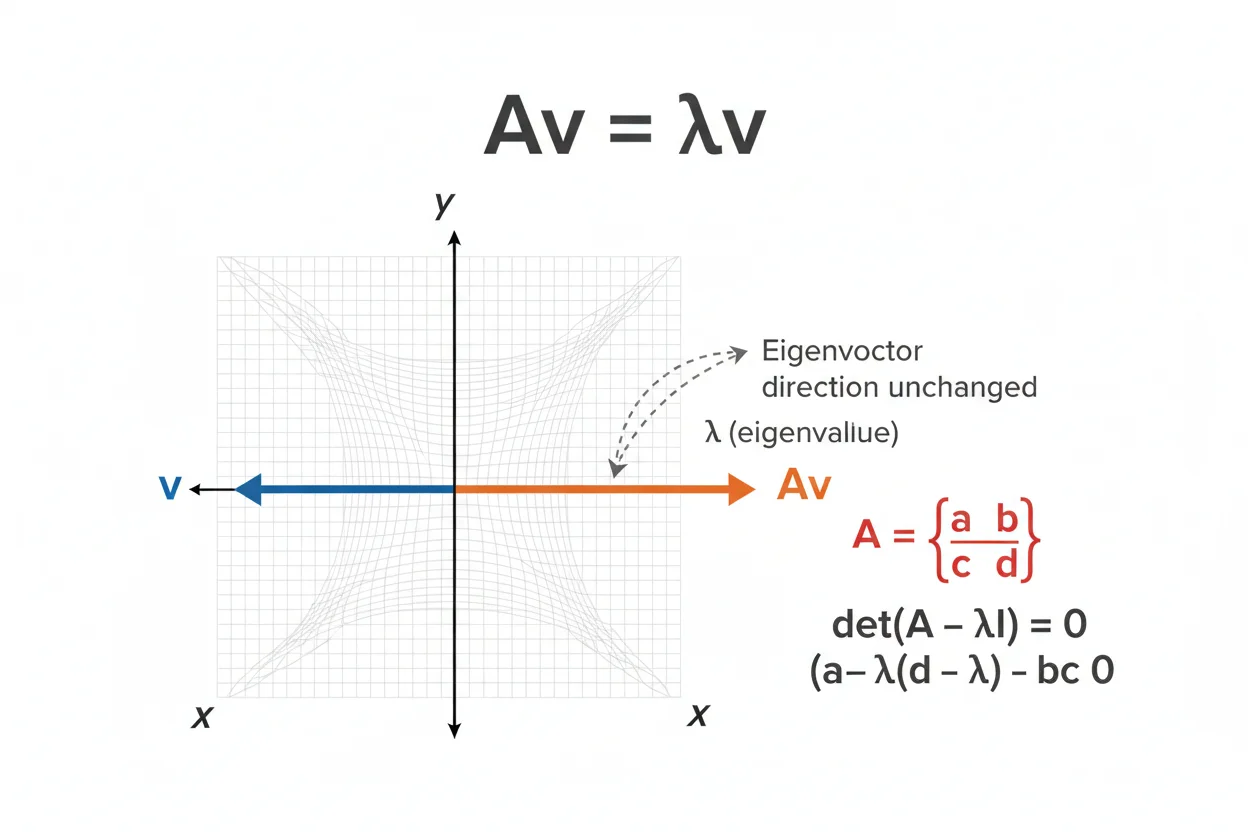

An eigenvalue is a scalar that describes how a matrix or linear transformation scales a special direction without changing that direction, apart from a possible reversal. If A is a square matrix and v is a nonzero vector, λ is an eigenvalue when Av = λv. The corresponding vector v is an eigenvector. To find an eigenvalue from a matrix, the standard method is to solve det(A − λI) = 0, where I is the identity matrix. The resulting equation is called the characteristic equation. A matrix can have one eigenvalue, several distinct eigenvalues, repeated eigenvalues, or—in a real-number setting—no real eigenvalue at all. Eigenvalues reveal important information about transformations, systems of equations, matrix powers, stability, and many other linear-algebra problems. For a 2×2 matrix, the calculation usually reduces to a quadratic equation and can often be completed directly.
What Is an Eigenvalue?
Let A be a square matrix and v a nonzero vector.
If:
Av = λv
then λ is an eigenvalue of A and v is a corresponding eigenvector.
The equation says that applying A to v does not send the vector into a completely different direction. Instead, the transformation simply scales v by λ.
If:
λ = 3
then:
Av = 3v
so the vector becomes three times as long while keeping the same direction.
If:
λ = −2
then:
Av = −2v
so the vector is scaled by 2 and reversed.
If:
λ = 0
then:
Av = 0
meaning the transformation collapses that eigenvector direction to the zero vector.
Eigenvalue Formula
The defining equation is:
Av = λv
Move everything to one side:
Av − λv = 0
Factor v using the identity matrix I:
(A − λI)v = 0
For a nonzero solution v to exist, the matrix A − λI must be singular.
Therefore:
det(A − λI) = 0
This is the standard eigenvalue equation.
The required determinant can be calculated using the same underlying ideas covered by a matrix determinant.
Why Does det(A − λI) Equal Zero?
The equation:
(A − λI)v = 0
is a homogeneous system of linear equations.
If A − λI were invertible, multiplying both sides by its inverse would force:
v = 0
But an eigenvector must be nonzero.
Therefore A − λI cannot be invertible, which requires:
det(A − λI) = 0
This also connects eigenvalue calculations with the structure of a system of linear equations and the conditions under which a matrix has nontrivial null-space solutions.
How to Find an Eigenvalue of a 2×2 Matrix
Let:
A = [ 2 1 ]
[ 1 2 ]
We want to find the eigenvalue or eigenvalues of A.
Step 1: Form A − λI
The 2×2 identity matrix is:
I = [ 1 0 ]
[ 0 1 ]
So:
A − λI = [ 2 − λ 1 ]
[ 1 2 − λ ]
Step 2: Set the Determinant Equal to Zero
For a 2×2 matrix:
det [ a b ] = ad − bc
[ c d ]
Therefore:
det(A − λI) = (2 − λ)(2 − λ) − 1
Set this equal to zero:
(2 − λ)² − 1 = 0
Expand:
4 − 4λ + λ² − 1 = 0
λ² − 4λ + 3 = 0
Step 3: Solve the Characteristic Equation
Factor:
(λ − 1)(λ − 3) = 0
Therefore:
λ = 1
or:
λ = 3
The matrix has two eigenvalues:
1 and 3
The broader eigenvalues topic examines sets of eigenvalues, repeated roots, multiplicity, and matrix-wide interpretation in more detail.
Example: Find One Eigenvalue From an Eigenvector
Suppose:
A = [ 4 1 ]
[ 2 3 ]
and:
v = (1, 1)
Calculate Av using matrix multiplication:
Av = (4·1 + 1·1, 2·1 + 3·1)
= (5, 5)
Since:
(5, 5) = 5(1, 1)
we have:
Av = 5v
Therefore:
λ = 5
is an eigenvalue corresponding to v = (1, 1).
This approach is useful when a candidate eigenvector is already known.
Checking Whether a Number Is an Eigenvalue
Suppose:
A = [ 3 1 ]
[ 0 2 ]
Is:
λ = 2
an eigenvalue?
Compute:
A − 2I = [ 1 1 ]
[ 0 0 ]
Its determinant is:
1·0 − 1·0 = 0
Therefore:
det(A − 2I) = 0
so:
λ = 2
is an eigenvalue.
You do not always need to solve the entire characteristic equation when the problem asks only whether one specific value is an eigenvalue.
General 2×2 Eigenvalue Formula
Let:
A = [ a b ]
[ c d ]
Then:
A − λI = [ a − λ b ]
[ c d − λ ]
The characteristic equation is:
(a − λ)(d − λ) − bc = 0
Expand:
λ² − (a + d)λ + (ad − bc) = 0
So the eigenvalues are roots of:
λ² − (a + d)λ + det(A) = 0
Because:
a + d
is the trace of A, the equation can also be written:
λ² − trace(A)λ + det(A) = 0
For a 2×2 matrix, this gives a useful relationship between its diagonal entries, determinant, and eigenvalues.
Example Using the General 2×2 Formula
Consider:
A = [ 5 2 ]
[ 2 2 ]
The trace is:
5 + 2 = 7
The determinant is:
5(2) − 2(2)
= 10 − 4
= 6
Therefore the characteristic equation is:
λ² − 7λ + 6 = 0
Factor:
(λ − 1)(λ − 6) = 0
So:
λ = 1
or:
λ = 6
Eigenvalue of a Diagonal Matrix
For a diagonal matrix:
A = [ a 0 ]
[ 0 d ]
the eigenvalues are immediately visible:
λ = a
and:
λ = d
For example:
A = [ 4 0 ]
[ 0 −2 ]
has eigenvalues:
4 and −2
No quadratic expansion is necessary.
This pattern extends to larger diagonal matrices: their diagonal entries are their eigenvalues.
Eigenvalue of a Triangular Matrix
The eigenvalues of an upper- or lower-triangular matrix are also its diagonal entries.
For example:
A = [ 3 4 1 ]
[ 0 5 2 ]
[ 0 0 −1 ]
has eigenvalues:
3, 5, −1
This happens because the determinant of A − λI is the product of its diagonal terms:
(3 − λ)(5 − λ)(−1 − λ)
Setting this product equal to zero gives the diagonal entries directly.
What Does a Positive Eigenvalue Mean?
Suppose:
Av = λv
with:
λ > 0
Then A scales v without reversing its direction.
If:
λ > 1
the vector grows in magnitude.
If:
0 < λ < 1
the vector shrinks.
For example:
λ = 0.25
means that repeated application along that eigenvector direction reduces its magnitude to one quarter each time.
What Does a Negative Eigenvalue Mean?
If:
λ < 0
the transformation reverses the eigenvector’s direction while also changing its magnitude.
For:
λ = −3
we have:
Av = −3v
The resulting vector has three times the magnitude and points in the opposite direction.
The negative sign therefore carries directional information, not merely numerical magnitude.
What Does Eigenvalue Zero Mean?
If:
λ = 0
then:
Av = 0
for some nonzero v.
That implies A has a nontrivial null space and is singular.
Therefore:
det(A) = 0
A matrix with eigenvalue zero cannot have a matrix inverse.
Conversely, for a square matrix, if det(A) = 0, then zero is an eigenvalue.
Eigenvalue and the Determinant
For an n×n matrix, the determinant equals the product of its eigenvalues when multiplicities are counted over a field containing all eigenvalues:
det(A) = λ₁λ₂…λₙ
For a 2×2 matrix:
det(A) = λ₁λ₂
Consider the earlier matrix whose eigenvalues were:
1 and 6
Their product is:
1 × 6 = 6
which matches the determinant.
This provides a useful consistency check.
Eigenvalue and the Trace
For an n×n matrix, the trace equals the sum of the eigenvalues, counting algebraic multiplicity:
trace(A) = λ₁ + λ₂ + … + λₙ
For a 2×2 matrix with eigenvalues:
1 and 6
the sum is:
7
which equals the sum of the diagonal entries.
The determinant and trace therefore provide quick checks on an eigenvalue calculation.
Eigenvalues and Matrix Rank
If zero is an eigenvalue, a square matrix is singular and its rank is less than full.
The matrix rank measures how many linearly independent directions survive under the transformation.
A zero eigenvalue identifies at least one nonzero direction that is mapped to zero.
However, the exact multiplicity of zero and the matrix rank require care; simply counting distinct zero eigenvalues is not enough in every case.
Eigenvalue and Linear Transformation
A matrix represents a linear transformation once a basis has been chosen.
Most vectors can change both direction and magnitude when transformed.
Eigenvectors are exceptional because their directions remain on the same line:
Av = λv
The eigenvalue tells how the transformation acts along that special direction.
This geometric interpretation is often more useful than viewing λ as merely a root of a polynomial.
Eigenvalue and Basis
The coordinates used to express a matrix depend on a chosen basis, a concept developed through basis and dimension.
Although a matrix representation changes under an appropriate change of basis, the eigenvalues of the underlying linear operator remain unchanged under similarity transformations.
This invariance is one reason eigenvalues are so valuable: they reveal properties of the transformation itself rather than merely one particular coordinate representation.
Eigenvalues Under Matrix Powers
If:
Av = λv
then:
A²v = A(Av)
= A(λv)
= λAv
= λ²v
More generally:
Aⁿv = λⁿv
So if λ is an eigenvalue of A, then:
λⁿ
is the corresponding eigenvalue of Aⁿ for the same eigenvector.
This makes eigenvalues useful when analyzing repeated matrix operations.
Eigenvalue of an Inverse Matrix
Suppose A is invertible and:
Av = λv
where λ ≠ 0.
Multiply by A⁻¹:
v = λA⁻¹v
Therefore:
A⁻¹v = (1/λ)v
So the corresponding eigenvalue of A⁻¹ is:
1/λ
A zero eigenvalue would prevent this rule because a matrix with eigenvalue zero is not invertible.
Eigenvalues Under Scalar Multiplication
If:
Av = λv
and c is a scalar, then:
(cA)v = c(Av)
= cλv
Therefore the corresponding eigenvalue of cA is:
cλ
Scaling the entire matrix scales each eigenvalue by the same factor.
Eigenvalue of the Identity Matrix
For the identity matrix I:
Iv = v
for every vector v.
Therefore:
Iv = 1v
and the eigenvalue is:
λ = 1
Every nonzero vector is an eigenvector of the identity matrix.
For the zero matrix:
0v = 0
so its only eigenvalue is:
λ = 0
Repeated Eigenvalues
A characteristic equation may contain a repeated root.
For example:
(λ − 4)² = 0
has the eigenvalue:
λ = 4
with algebraic multiplicity 2.
This does not automatically mean there are two independent eigenvectors associated with λ = 4.
The distinction between algebraic multiplicity and the number of independent eigenvectors becomes important when studying eigenvectors and whether a matrix can be represented by a complete eigenvector basis.
Complex Eigenvalues
A real matrix can have complex eigenvalues.
Consider:
A = [ 0 −1 ]
[ 1 0 ]
Then:
det(A − λI) = λ² + 1
So:
λ² = −1
and:
λ = i or −i
There are no real eigenvalues, but there are two complex eigenvalues.
This matrix represents a 90-degree rotation in the plane, which has no nonzero real direction left on its original line.
Eigenvalue Versus Eigenvector
An eigenvalue is a scalar.
An eigenvector is a nonzero vector satisfying:
Av = λv
For example, if:
A(1, 1) = 5(1, 1)
then:
λ = 5
is the eigenvalue, while:
(1, 1)
is an eigenvector.
The scalar describes the scaling; the vector identifies the special direction.
Eigenvalue Versus Dot Product
A dot product combines two vectors and returns a scalar measuring alignment:
a · b = |a||b| cos θ
An eigenvalue is also a scalar, but it arises from a completely different relationship:
Av = λv
The dot product compares two vectors directly. An eigenvalue describes how a matrix transformation acts on an eigenvector.
The two concepts can interact in more advanced linear algebra, but one does not substitute for the other.
Eigenvalue Versus Directional Derivative
A directional derivative measures the local rate of change of a multivariable function along a selected direction:
Dᵤf = ∇f · u
An eigenvalue instead measures the scaling associated with an invariant vector direction under a linear transformation.
Both involve directions and scalar quantities, but they answer fundamentally different questions.
Eigenvalue Versus Double Integral
A double integral accumulates a quantity across a two-dimensional region:
∬ᴿ f(x, y) dA
An eigenvalue is obtained from a square matrix or linear transformation.
They belong to neighboring parts of the broader Calculus & Linear Algebra framework, but a double integral concerns accumulation whereas an eigenvalue concerns invariant scaling under a linear map.
Example: Find the Eigenvalues and Verify One
Consider:
A = [ 7 2 ]
[ 2 4 ]
Form:
A − λI = [ 7 − λ 2 ]
[ 2 4 − λ ]
Set the determinant to zero:
(7 − λ)(4 − λ) − 4 = 0
Expand:
28 − 11λ + λ² − 4 = 0
λ² − 11λ + 24 = 0
Factor:
(λ − 3)(λ − 8) = 0
Therefore:
λ = 3 or 8
Now verify λ = 3.
Calculate:
A − 3I = [ 4 2 ]
[ 2 1 ]
The determinant is:
4(1) − 2(2) = 0
So A − 3I is singular, confirming that:
λ = 3
is an eigenvalue.
Common Eigenvalue Mistakes
A common error is calculating:
det(A) − λ = 0
instead of:
det(A − λI) = 0
The scalar λ must be subtracted from the diagonal entries through λI.
Another mistake is using an eigenvector equal to the zero vector. The definition explicitly requires:
v ≠ 0
Sign errors when expanding a determinant can also change the characteristic equation and produce incorrect roots.
Students sometimes assume every n×n real matrix has n distinct real eigenvalues. It may have repeated eigenvalues or complex eigenvalues instead.
It is also incorrect to assume that every repeated eigenvalue automatically supplies enough independent eigenvectors to form a full basis.
Finally, when checking an eigenvalue through Av = λv, every component must scale by the same λ. Matching only one component is not sufficient.
Frequently Asked Questions
What is an eigenvalue?
An eigenvalue is a scalar λ for which a square matrix A has a nonzero vector v satisfying:
Av = λv
What is the formula for finding an eigenvalue?
Solve:
det(A − λI) = 0
The roots are the eigenvalues.
Does an eigenvalue have to be positive?
No. An eigenvalue can be positive, negative, zero, or complex.
What does a negative eigenvalue mean?
It means the corresponding eigenvector is scaled and reversed in direction.
What does eigenvalue zero mean?
It means at least one nonzero vector is mapped to zero. The matrix is singular and has no inverse.
Can a matrix have only one eigenvalue?
Yes. A matrix may have one repeated eigenvalue even when its size is larger than 1×1.
Are diagonal entries always eigenvalues?
They are for diagonal and triangular matrices. For a general matrix, the diagonal entries need not individually be eigenvalues.
How can I check an eigenvalue?
Substitute λ into:
det(A − λI)
If the determinant equals zero, λ is an eigenvalue.
If a corresponding vector is known, you can also verify:
Av = λv
What is the difference between an eigenvalue and an eigenvector?
An eigenvalue is the scalar scaling factor. An eigenvector is the nonzero direction that is preserved, up to reversal, by the matrix transformation.
How are eigenvalues related to the determinant?
The determinant equals the product of the eigenvalues when algebraic multiplicities are counted appropriately.
How are eigenvalues related to the trace?
The trace equals the sum of the eigenvalues when algebraic multiplicities are counted.
Why are eigenvalues important?
They reveal invariant scaling behavior of linear transformations and help analyze matrix powers, invertibility, stability, systems of equations, and the structure of linear operators.