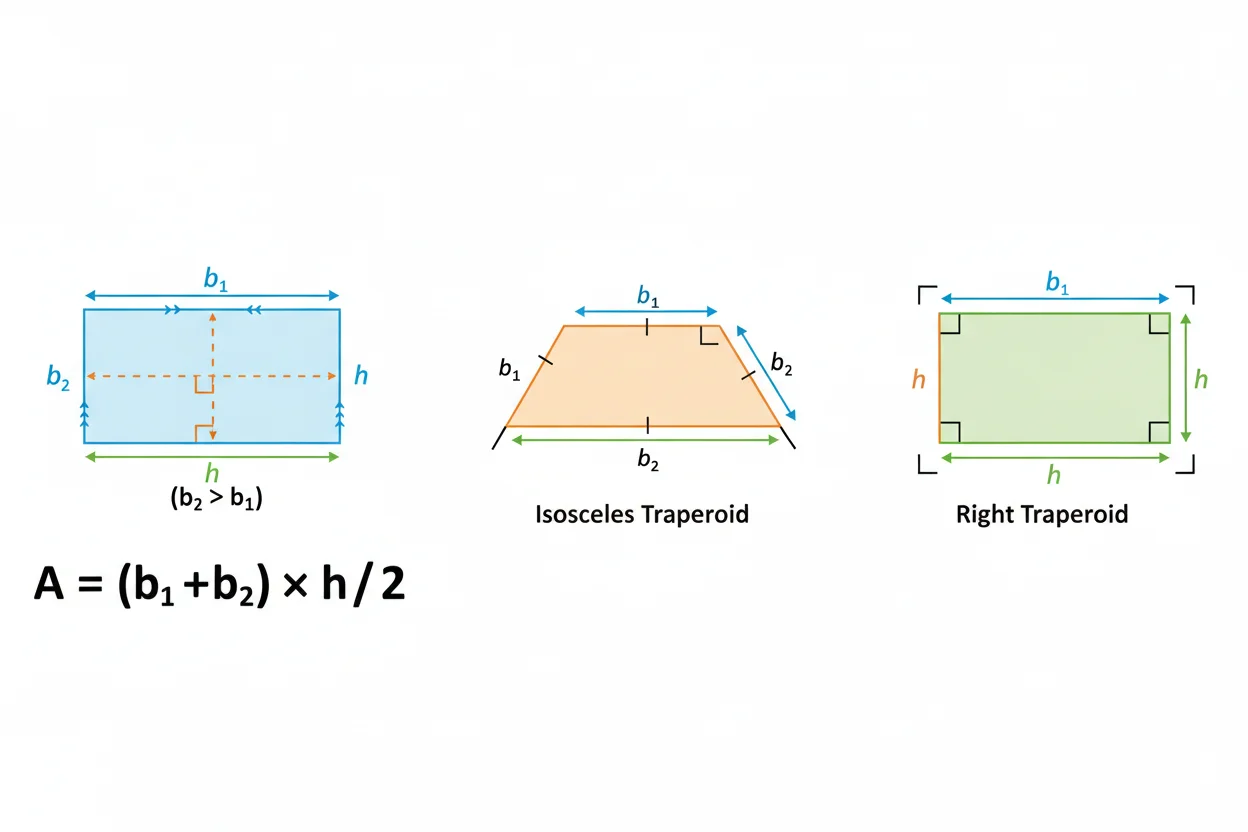

Trapezoid area measures the two-dimensional region enclosed by a quadrilateral with one pair of parallel sides. If the parallel bases have lengths b₁ and b₂ and the perpendicular distance between them is h, the formula is A = (b₁ + b₂)h/2. In other words, average the two parallel sides and multiply by the height. The height must be perpendicular to the bases; a slanted leg cannot normally be substituted directly. The same formula works for right, isosceles, scalene, and other trapezoids as long as the correct parallel bases and perpendicular height are used. If a height is missing, right-triangle geometry, coordinates, slope, trigonometry, or diagonal information may first be needed to determine it. Trapezoid area is measured in square units.
Trapezoid Area Formula
For parallel bases:
b₁
and:
b₂
with perpendicular height:
h
the trapezoid area is:
A = (b₁ + b₂)h/2
Equivalently:
A = [(b₁ + b₂)/2]h
The quantity:
(b₁ + b₂)/2
is the average length of the two parallel bases.
Basic Trapezoid Area Example
Suppose:
b₁ = 8 cm
b₂ = 14 cm
h = 5 cm
Then:
A = (8 + 14)(5)/2
= 22(5)/2
Therefore:
A = 55 cm²
Why the Formula Works
A trapezoid can be duplicated, rotated, and joined to the original to form a parallelogram.
The resulting parallelogram has:
base = b₁ + b₂
and:
height = h
Its area is:
(b₁ + b₂)h
Since that parallelogram consists of two congruent trapezoids:
A_trapezoid = (b₁ + b₂)h/2
This connects trapezoid area directly with Parallelogram Area.
Another Derivation Using Triangles
A trapezoid can also be divided into triangles.
For example, draw one diagonal.
The two resulting triangles have bases:
b₁
and:
b₂
relative to the same perpendicular height h.
Their combined Triangle Area is:
b₁h/2 + b₂h/2
Factor:
A = (b₁ + b₂)h/2
This gives the same formula.
Which Sides Are the Bases?
The bases are the parallel sides.
They do not need to be the longest or shortest sides.
If:
AB ∥ CD
then AB and CD are the bases.
The other two sides are called the:
legs
The area formula uses the lengths of the parallel sides, not an arbitrary pair of opposite sides.
What Is the Height?
The trapezoid height is the shortest distance between the two parallel base lines.
Therefore it is measured:
perpendicular to both bases
In a right trapezoid, one leg may itself be the height.
In a slanted trapezoid, neither leg may equal the height.
Slanted Leg Versus Height
Suppose a trapezoid has:
b₁ = 10
b₂ = 16
slanted leg = 5
The area cannot be found from these three values alone unless the leg’s geometry provides the perpendicular height.
You need:
h
not simply the slanted edge length.
This is similar to the distinction between side and altitude in Triangle Altitudes.
Right Trapezoid Area
A right trapezoid has two right angles.
One leg is perpendicular to both bases and therefore equals the height.
Suppose:
b₁ = 7
b₂ = 13
perpendicular leg = 8
Then:
h = 8
and:
A = (7 + 13)(8)/2
Therefore:
A = 80
square units.
Isosceles Trapezoid
An isosceles trapezoid has congruent legs.
If the bases are centered relative to one another, the difference in their lengths is split equally on both ends.
Let:
longer base = B
shorter base = b
Then each horizontal offset is:
x = (B − b)/2
If leg length is ℓ:
ℓ² = h² + x²
so:
h = √(ℓ² − x²)
The Pythagorean Theorem can therefore provide the missing height.
Isosceles Trapezoid Example
Suppose:
B = 16
b = 10
leg = 5
Horizontal offset:
x = (16 − 10)/2
= 3
Height:
h = √(5² − 3²)
= √16
Therefore:
h = 4
Area:
A = (16 + 10)(4)/2
Therefore:
A = 52
square units.
Find Area From Bases and Leg in an Isosceles Trapezoid
Combining the relationships gives:
h = √[ℓ² − ((B − b)/2)²]
Therefore:
A = (B + b)/2 × √[ℓ² − ((B − b)/2)²]
This formula is specifically useful when the trapezoid is known to be isosceles.
It should not be applied automatically to an arbitrary trapezoid.
Find Height From Area
Start with:
A = (b₁ + b₂)h/2
Multiply by 2:
2A = (b₁ + b₂)h
Therefore:
h = 2A/(b₁ + b₂)
Height Example
Suppose:
A = 96
b₁ = 10
b₂ = 14
Then:
h = 2(96)/(10 + 14)
= 192/24
Therefore:
h = 8
Find One Missing Base
Starting with:
2A = (b₁ + b₂)h
divide by h:
2A/h = b₁ + b₂
Therefore:
b₂ = 2A/h − b₁
Likewise:
b₁ = 2A/h − b₂
Missing Base Example
Suppose:
A = 120
h = 8
b₁ = 11
Then:
b₂ = 240/8 − 11
= 30 − 11
Therefore:
b₂ = 19
Average Base Length
Define the average base length:
m = (b₁ + b₂)/2
Then:
A = mh
This m is also the length of the trapezoid’s midsegment, sometimes called the median.
Thus:
trapezoid area = midsegment × height
Trapezoid Midsegment
The segment joining the midpoints of the two legs is parallel to the bases.
Its length is:
m = (b₁ + b₂)/2
Therefore:
A = mh
For:
b₁ = 8
b₂ = 20
we have:
m = 14
If:
h = 6
then:
A = 84
Find Midsegment From Area
From:
A = mh
solve:
m = A/h
Suppose:
A = 150
h = 10
Then:
m = 15
Therefore the two bases satisfy:
(b₁ + b₂)/2 = 15
or:
b₁ + b₂ = 30
Perimeter Versus Trapezoid Area
The Perimeter is:
P = b₁ + b₂ + ℓ₁ + ℓ₂
Area is:
A = (b₁ + b₂)h/2
Perimeter uses all four side lengths.
Area uses the two parallel bases and perpendicular height.
A trapezoid’s perimeter alone generally does not determine its area.
Area and Perimeter Example
Suppose a right trapezoid has:
bases = 6 and 12
height = 8
The slanted leg is:
√(6² + 8²)
= 10
Perimeter:
P = 6 + 12 + 8 + 10
= 36
Area:
A = (6 + 12)(8)/2
= 72
The two values measure different geometric quantities.
Find a Slanted Leg in a Right Trapezoid
Suppose a right trapezoid has bases:
B > b
and height h.
The difference:
B − b
and height h form the legs of a right triangle whose hypotenuse is the slanted leg ℓ.
Therefore:
ℓ = √[(B − b)² + h²]
Right Trapezoid Example
Suppose:
B = 15
b = 9
h = 8
Then:
ℓ = √(6² + 8²)
= 10
Area:
A = (15 + 9)(8)/2
Therefore:
A = 96
Trapezoid Height From a Base Angle
Suppose a leg of length ℓ makes acute angle θ with a base.
Then its perpendicular component is:
h = ℓ sinθ
If instead the horizontal offset x is known:
tanθ = h/x
so:
h = x tanθ
The Tangent function is especially useful when a base offset and angle are given.
Tangent Example
Suppose:
b₁ = 10
b₂ = 18
and the horizontal offset along one side is:
x = 4
with base angle:
θ = 45°
Then:
h = 4tan45°
= 4
Therefore:
A = (10 + 18)(4)/2
= 56
square units.
Using Sine With a Leg
Suppose:
leg ℓ = 10
and its angle with the base is:
30°
Then:
h = 10sin30°
= 5
If the bases are:
12 and 20
then:
A = (12 + 20)(5)/2
Therefore:
A = 80
Trapezoid Area From Coordinates
When the vertices are known in coordinate form, first identify the parallel sides.
If the bases are horizontal, their lengths come from x-coordinate differences and the height comes from the difference in y-coordinates.
This can make the area calculation especially simple.
Coordinate Example With Horizontal Bases
Suppose:
A = (1,2)
B = (9,2)
C = (7,8)
D = (3,8)
Then:
AB = 8
CD = 4
The vertical distance between the base lines is:
h = 8 − 2
= 6
Therefore:
A = (8 + 4)(6)/2
= 36
square units.
Verify Parallel Sides With Slope
The Slope of horizontal AB is:
0
The slope of horizontal CD is also:
0
Therefore:
AB ∥ CD
If the bases are slanted, equal slopes can similarly verify parallelism.
Slanted Coordinate Bases
Suppose two base segments are parallel but not horizontal.
The perpendicular distance between their supporting lines must be found rather than simply subtracting y-coordinates.
One approach is to:
determine a line equation for each base
and calculate their perpendicular separation.
The Line From Two Points relationship can establish the base-line equations.
Distance Between Parallel Lines
If parallel lines are written:
Ax + By + C₁ = 0
and:
Ax + By + C₂ = 0
their perpendicular distance is:
h = |C₂ − C₁|/√(A² + B²)
Once h and the finite base lengths are known:
A = (b₁ + b₂)h/2
This is useful for coordinate trapezoids whose bases are oblique.
Trapezoid Area Using Coordinates Directly
The coordinate polygon or shoelace method can also find a trapezoid’s area without separately calculating height.
For vertices listed around the boundary:
(x₁,y₁), …, (x₄,y₄)
the polygon area is:
A = 1/2 |Σxᵢyᵢ₊₁ − Σyᵢxᵢ₊₁|
This works for trapezoids and many other simple polygons.
The base-height formula is usually more transparent when the trapezoid dimensions are already available.
Diagonal Splitting
A diagonal divides a trapezoid into two triangles.
If the parallel bases are:
b₁
and:
b₂
the two triangles can use the same height h relative to their corresponding base lines.
Their areas are:
A₁ = b₁h/2
A₂ = b₂h/2
Therefore:
A₁/A₂ = b₁/b₂
Diagonal Area Ratio Example
Suppose:
b₁ = 8
b₂ = 12
Then the two triangle areas formed by a suitable diagonal have ratio:
8/12
Therefore:
A₁/A₂ = 2/3
If total trapezoid area is:
50
the triangle areas are:
20
and:
30
Trapezoid Area and Similar Triangles
In many trapezoid constructions, extending the nonparallel legs produces a larger triangle containing a smaller similar triangle.
The Similar Triangles relationship can determine missing base lengths or heights.
The trapezoid area can then be found either directly or as:
large triangle area − small triangle area
Similar-Triangle Example
Suppose the shorter base is half the longer base in a trapezoid formed by cutting a triangle parallel to its base.
If the large triangle has height:
H
the smaller similar triangle has scale factor:
1/2
and height:
H/2
The trapezoid height is therefore:
H − H/2 = H/2
This similarity structure can provide h before applying the trapezoid formula.
Trapezoid as a Composite Figure
Trapezoids often appear inside composite-area problems.
A trapezoid can itself be divided into:
a rectangle and one triangle
or:
a rectangle and two triangles
depending on its geometry.
The general Area Formulas approach is to calculate nonoverlapping components and add them.
Isosceles Trapezoid Decomposition
For longer base B, shorter base b, and height h:
central rectangle area = bh
Two side triangles together have total base:
B − b
Therefore combined triangular area is:
(B − b)h/2
Add:
A = bh + (B − b)h/2
Simplify:
A = (B + b)h/2
Trapezoid Area as Difference of Rectangles
Some composite figures can produce trapezoidal regions after a rectangle or triangle is removed.
Do not force the trapezoid formula if a simpler decomposition is available.
As long as the same physical region is measured correctly, equivalent methods should agree.
Trapezoidal Prism Surface Area
A trapezoid can form the base of a prism.
Its base area is:
B = (b₁ + b₂)h/2
The general Surface Area of a right prism is:
SA = 2B + Ph
where P is the trapezoid’s perimeter and the second h represents the prism length or height.
Using distinct symbols helps prevent confusion between the trapezoid height and prism dimension.
Trapezoidal Prism Volume
A trapezoidal base also gives:
V = BH
where H is the perpendicular prism height.
Thus:
V = [(b₁ + b₂)h/2]H
The area of the trapezoid is calculated first; the three-dimensional volume calculation follows afterward.
Trapezoid Versus Parallelogram
If the two bases become equal:
b₁ = b₂ = b
then:
A = (b + b)h/2
Therefore:
A = bh
The trapezoid formula reduces naturally to the parallelogram area formula under a definition that allows parallelograms as trapezoids with at least one pair of parallel sides.
Trapezoid Versus Rectangle
If:
b₁ = b₂ = l
and the legs are perpendicular to the bases:
A = (l + l)h/2
Therefore:
A = lh
This is exactly Rectangle Area.
The trapezoid formula therefore agrees with familiar special cases.
Scaling Trapezoid Area
If every length in a trapezoid is multiplied by scale factor k:
b₁ → kb₁
b₂ → kb₂
h → kh
Then:
A_new = k(b₁+b₂)/2
Therefore:
A_new = k²A
Area scales with the square of the linear scale factor.
Scaling Example
Suppose a trapezoid has area:
40
and every dimension triples.
Then:
A_new = 3²(40)
Therefore:
A_new = 360
square units.
Similar Trapezoids
For geometrically similar trapezoids with linear scale factor k:
corresponding sides scale by k
heights scale by k
perimeters scale by k
areas scale by k²
If area ratio is:
25/9
the linear scale factor is:
5/3
Same Height, Different Bases
For trapezoids sharing the same height h:
A ∝ b₁ + b₂
If one trapezoid’s base sum is twice another’s:
its area is twice as large
provided the height remains equal.
This follows directly from:
A = (b₁ + b₂)h/2
Same Bases, Different Heights
For fixed b₁ and b₂:
A ∝ h
Doubling height doubles area.
Tripling height triples area.
This is a linear relationship in h.
Maximum or Minimum Area With Fixed Bases?
If the two base lengths are fixed but height can vary freely, area can also vary freely with h.
Therefore the base lengths alone do not determine a unique trapezoid area.
An additional constraint on height, legs, angle, perimeter, or geometry is necessary.
Units of Trapezoid Area
If:
b₁, b₂, h
are measured in meters, the result uses:
m²
For:
b₁ = 5 m
b₂ = 9 m
h = 4 m
we obtain:
A = 28 m²
The units are squared because the formula multiplies two lengths.
Mixed Units
Convert all dimensions into compatible units first.
Suppose:
b₁ = 1.2 m
b₂ = 80 cm
h = 50 cm
Convert:
1.2 m = 120 cm
Then:
A = (120 + 80)(50)/2
= 5000 cm²
Therefore:
A = 0.5 m²
Exact and Approximate Area
If a trigonometric or Pythagorean calculation gives:
h = 4√3
and:
b₁ + b₂ = 20
then:
A = 20(4√3)/2
Therefore:
A = 40√3
This exact form can be retained.
Approximately:
A ≈ 69.28
Common Trapezoid Area Mistakes
A common mistake is multiplying the bases rather than adding them.
The correct formula is:
A = (b₁ + b₂)h/2
Another error is forgetting the factor:
1/2
Do not assume a slanted leg is the perpendicular height.
The bases must be the parallel sides.
If an isosceles trapezoid is used to find height, split the base difference equally between the two sides.
In coordinate problems, verify which sides are parallel before selecting the bases.
Perimeter alone generally cannot determine area.
When the height comes from tangent, sine, or the Pythagorean theorem, calculate it before applying the trapezoid formula.
Finally, report square units.
Frequently Asked Questions
What is the trapezoid area formula?
A = (b₁ + b₂)h/2
What are b₁ and b₂?
They are the lengths of the two parallel sides.
What is h?
The perpendicular distance between the parallel bases.
Is a slanted leg the height?
Not unless it is perpendicular to the bases.
How do you find trapezoid height from area?
h = 2A/(b₁ + b₂)
How do you find a missing base?
b₂ = 2A/h − b₁
What is the trapezoid midsegment?
m = (b₁ + b₂)/2
How is area related to the midsegment?
A = mh
What is the area of a right trapezoid?
Use the same formula, with the perpendicular leg serving as h.
How do you find the height of an isosceles trapezoid?
If B is the longer base, b the shorter base, and ℓ the leg:
h = √[ℓ² − ((B − b)/2)²]
Can coordinates be used to find trapezoid area?
Yes. Determine the parallel base lengths and perpendicular distance, or use a polygon coordinate-area formula.
Does perimeter determine trapezoid area?
Not by itself.
How does trapezoid area scale?
If every length is multiplied by k:
area is multiplied by k²
What units does trapezoid area use?
Square units such as cm², m², or ft².
How can I check a trapezoid area calculation?
Verify that the selected sides are parallel, confirm h is perpendicular to them, calculate the average base length, multiply it by h, and compare with a triangle or rectangle decomposition when convenient.