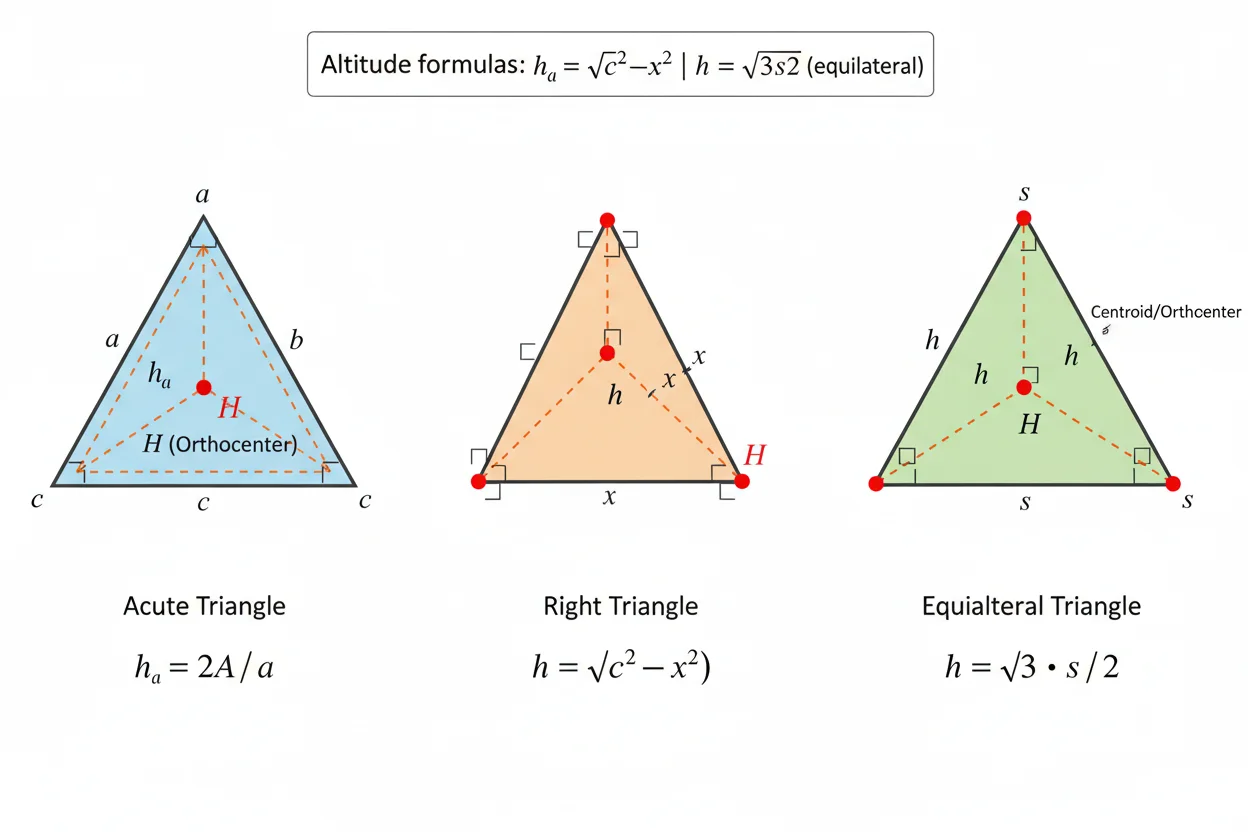

Triangle altitudes are perpendicular segments drawn from a vertex to the line containing the opposite side. Every nondegenerate triangle has three altitudes, one corresponding to each vertex and opposite side. If a triangle has area A and a side of length a, the altitude to that side is hₐ = 2A/a because A = ahₐ/2. In an acute triangle all three altitudes lie inside the triangle, in a right triangle two altitudes are the legs themselves, and in an obtuse triangle two altitudes meet extensions of the opposite sides outside the triangle. The three altitude lines always meet at one point called the orthocenter. Missing altitudes can be found from area, side lengths, coordinates, right-triangle geometry, trigonometry, Heron’s formula, or other triangle relationships.
What Is a Triangle Altitude?
An altitude is a perpendicular segment from a triangle vertex to the line containing the opposite side.
For triangle:
ABC
the altitude from A meets line BC at a right angle.
If the foot of that altitude is D:
AD ⟂ BC
The length:
AD
is the altitude corresponding to side:
BC
Three Altitudes in a Triangle
Every triangle has three vertices, so it has three altitudes.
Using standard notation:
side a is opposite vertex A
side b is opposite vertex B
side c is opposite vertex C
The corresponding altitude lengths are:
hₐ
h_b
h_c
Each pair can be used in the Triangle Area formula:
A = ahₐ/2
A = bh_b/2
A = ch_c/2
Altitude Formula From Triangle Area
From:
A = ahₐ/2
solve:
hₐ = 2A/a
Similarly:
h_b = 2A/b
h_c = 2A/c
These are the most general altitude formulas when the triangle’s area is already known.
Basic Altitude Example
Suppose:
A = 60 cm²
and:
a = 12 cm
Then:
hₐ = 2(60)/12
Therefore:
hₐ = 10 cm
Find Area From an Altitude
If a side and its corresponding altitude are known:
A = ahₐ/2
Suppose:
a = 14
hₐ = 8
Then:
A = 14(8)/2
Therefore:
A = 56
square units.
Why the Altitude Must Be Perpendicular
The triangle area formula uses:
base × perpendicular height / 2
A slanted segment from the opposite vertex to the base generally does not measure the correct height.
The altitude is specifically the shortest perpendicular distance from the vertex to the opposite side’s line.
This perpendicularity is what allows the area formula to work.
Acute Triangle Altitudes
An acute triangle has all three angles smaller than:
90°
Every altitude falls inside the triangle.
Therefore the orthocenter also lies:
inside the triangle
This makes acute-triangle altitude diagrams relatively straightforward.
Right Triangle Altitudes
In a Right Triangle, the two legs are already perpendicular.
Therefore each leg is an altitude relative to the other leg.
Suppose legs are:
a
and:
b
Then two altitude lengths are simply:
a
and:
b
The third altitude runs from the right-angle vertex to the hypotenuse.
Right Triangle Example
Suppose the legs are:
6
and:
8
and the hypotenuse is:
10
The altitude corresponding to the 6-unit leg is:
8
The altitude corresponding to the 8-unit leg is:
6
The altitude to the hypotenuse is:
h_c = ab/c
Therefore:
h_c = 6(8)/10
= 4.8
Deriving the Altitude to a Hypotenuse
The right triangle’s area can be written using its legs:
A = ab/2
It can also be written using hypotenuse c as the base:
A = ch_c/2
Set equal:
ab/2 = ch_c/2
Therefore:
ab = ch_c
So:
h_c = ab/c
3-4-5 Triangle Altitude
For:
a = 3
b = 4
c = 5
the altitude to the hypotenuse is:
h_c = 3(4)/5
Therefore:
h_c = 12/5
or:
2.4
The area check is:
3(4)/2 = 6
and:
5(2.4)/2 = 6
Obtuse Triangle Altitudes
An obtuse triangle contains one angle greater than:
90°
The altitude from the obtuse-angle vertex falls inside the triangle.
The altitudes from the two acute vertices meet extensions of the opposite sides outside the triangle.
Therefore the orthocenter lies:
outside the triangle
An altitude is defined relative to the line containing the opposite side, not only the finite side segment.
Why Side Extensions Matter
Consider an obtuse triangle where altitude from A to line BC falls beyond point B.
The perpendicular foot may not lie between B and C.
The segment from A to that foot is still a valid altitude because it is perpendicular to:
line BC
This distinction is essential in obtuse-triangle diagrams.
Equilateral Triangle Altitude
In an equilateral triangle, all sides have length:
s
An altitude also acts as:
median
angle bisector
perpendicular bisector
It divides the triangle into two 30-60-90 triangles.
Half of the base is:
s/2
Hypotenuse is:
s
Using the Pythagorean Theorem:
h² + (s/2)² = s²
Therefore:
h = s√3/2
Equilateral Example
Suppose:
s = 10
Then:
h = 10√3/2
Therefore:
h = 5√3
The area becomes:
A = 10(5√3)/2
Therefore:
A = 25√3
Equilateral Area From Altitude
Because:
h = s√3/2
solve for s:
s = 2h/√3
Then area can also be written in terms of h:
A = sh/2
Substitute:
A = h²/√3
or:
A = √3h²/3
Isosceles Triangle Altitude
In an isosceles triangle, the altitude from the apex to the base also:
bisects the base
bisects the apex angle
Suppose equal sides have length:
ℓ
and base:
b
Then each half-base is:
b/2
The altitude is:
h = √[ℓ² − (b/2)²]
Isosceles Example
Suppose:
ℓ = 13
b = 10
Then:
b/2 = 5
So:
h = √(13² − 5²)
= √144
Therefore:
h = 12
Area:
A = 10(12)/2
Therefore:
A = 60
Isosceles Altitude From Apex Angle
Suppose equal sides are:
ℓ
and apex angle is:
A
The altitude bisects A.
Therefore:
h = ℓ cos(A/2)
and:
b/2 = ℓ sin(A/2)
so:
b = 2ℓ sin(A/2)
This combines symmetry with trigonometry.
Example Using Apex Angle
Suppose:
ℓ = 10
A = 60°
Then:
h = 10cos30°
= 5√3
and:
b = 20sin30°
= 10
The triangle is equilateral in this special case.
Altitude From a Side and Angle
Suppose side c forms angle B with base a.
The perpendicular component of c is:
hₐ = c sinB
Similarly, if side b makes angle C with base a:
hₐ = b sinC
This follows from Sine in the right triangle created by the altitude.
Trigonometric Altitude Example
Suppose:
c = 12
B = 40°
Then:
hₐ = 12sin40°
Approximately:
hₐ ≈ 7.71
If:
a = 15
then:
A = 15(7.71)/2
Approximately:
A ≈ 57.83
Altitude From Horizontal Offset and Tangent
If dropping an altitude creates a right triangle with horizontal segment x and angle θ:
tanθ = h/x
Therefore:
h = x tanθ
The Tangent function is useful when a base subdivision rather than a slanted side is known.
Tangent Example
Suppose:
x = 6
θ = 35°
Then:
h = 6tan35°
Approximately:
h ≈ 4.20
This altitude can then be inserted into:
A = bh/2
Altitude From Area and Heron’s Formula
If all three side lengths are known but area is not, first use Heron Formula.
For sides:
a, b, c
semiperimeter:
s = (a + b + c)/2
Area:
A = √[s(s−a)(s−b)(s−c)]
Then:
hₐ = 2A/a
Heron Altitude Formula
Combining gives:
hₐ = 2√[s(s−a)(s−b)(s−c)]/a
This finds the altitude to side a directly from the three side lengths.
Heron Example
Suppose triangle sides are:
5, 5, 6
Semiperimeter:
s = 8
Area:
A = √[8(3)(3)(2)]
= 12
Altitude to side:
6
is:
h = 2(12)/6
Therefore:
h = 4
Altitude From Law of Cosines Data
Suppose three sides are known.
The Law of Cosines can determine an angle first:
cosB = (a² + c² − b²)/(2ac)
Then:
hₐ = c sinB
This is an alternative to Heron’s formula.
Law of Sines Connection
The Law of Sines states:
a/sinA = b/sinB = c/sinC
If side c and angle B are available:
hₐ = c sinB
The law can sometimes supply B or c from other known triangle data before the altitude is calculated.
Altitudes and Triangle Area Formulas
Because:
hₐ = c sinB
the area formula:
A = ahₐ/2
becomes:
A = ac sinB/2
Similarly:
A = ab sinC/2
This shows that the familiar side-angle triangle area formulas are altitude formulas with the perpendicular component substituted.
Coordinate Triangle Altitudes
If triangle vertices are given in coordinates, an altitude can be constructed by:
- finding the slope of the opposite side;
- finding the perpendicular slope;
- writing the line through the chosen vertex.
This combines Slope with Point-Slope Form.
Coordinate Altitude Example
Suppose:
A = (2,5)
B = (0,0)
C = (6,0)
Side BC is horizontal:
y = 0
Therefore its perpendicular direction is vertical.
The altitude from A is:
x = 2
Its length to BC is:
5
Slanted Coordinate Example
Suppose:
A = (1,5)
B = (0,0)
C = (4,2)
Slope BC:
m_BC = (2 − 0)/(4 − 0)
= 1/2
Therefore the altitude from A has perpendicular slope:
m = −2
Using point-slope form:
y − 5 = −2(x − 1)
This equation describes the altitude line from A.
Find the Altitude Foot
To find the actual altitude length in coordinates, determine the intersection between:
the altitude line
and:
the opposite-side line
The Line Intersection gives the foot of the altitude.
Then the Distance Formula gives the length between the vertex and that foot.
Distance From a Point to a Line
If the opposite side lies on:
Ax + By + C = 0
and the vertex is:
(x₀,y₀)
the perpendicular distance is:
h = |Ax₀ + By₀ + C|/√(A² + B²)
This distance is exactly the altitude to that side.
Point-to-Line Example
Suppose base line is:
3x + 4y − 20 = 0
and the opposite vertex is:
(0,0)
Then:
h = |−20|/√(9 + 16)
= 20/5
Therefore:
h = 4
If the base segment length is known, the triangle area follows immediately.
Coordinate Area to Altitude
Another efficient method is:
- calculate triangle area from coordinates;
- calculate the selected base length;
- use h = 2A/base.
If coordinate area is:
A = 30
and base length is:
12
then:
h = 60/12
Therefore:
h = 5
The Orthocenter
The three altitude lines of every nondegenerate triangle are concurrent.
Their common intersection is called the:
orthocenter
Its location depends on triangle type:
acute triangle → inside
right triangle → at the right-angle vertex
obtuse triangle → outside
This distinguishes the orthocenter from other triangle centers.
Orthocenter of a Right Triangle
Consider a right triangle with right angle at C.
Side AC is perpendicular to BC.
Therefore:
AC is the altitude from A
and:
BC is the altitude from B
These two altitude lines already intersect at:
C
So the orthocenter is:
the right-angle vertex
Orthocenter of an Acute Triangle
For an acute triangle, each perpendicular from a vertex reaches the opposite side within the side segment.
All three altitude segments therefore lie inside the triangle and meet at an interior orthocenter.
Orthocenter of an Obtuse Triangle
In an obtuse triangle, two altitudes must reach extensions of opposite sides.
Their lines meet outside the triangle.
The orthocenter therefore lies outside the boundary.
This does not make the altitude construction invalid.
Orthocenter From Coordinates
Given three vertices, find equations for two altitudes.
Their intersection determines the orthocenter.
A third altitude can then be used as a verification.
Only two altitude lines are required to locate the concurrency point.
Example Orthocenter
Take:
A = (0,0)
B = (6,0)
C = (2,4)
Side AB is horizontal, so altitude from C is:
x = 2
Slope BC:
(4 − 0)/(2 − 6)
= −1
Therefore altitude from A has slope:
1
and equation:
y = x
Intersect with:
x = 2
to get:
y = 2
Therefore the orthocenter is:
(2,2)
Altitude Versus Median
A median joins a vertex to the midpoint of the opposite side.
An altitude meets the opposite side line at:
90°
These are different conditions.
A segment can be both a median and an altitude in symmetric triangles, such as an isosceles triangle from its apex, but not in a general triangle.
The Triangle Medians meet at the centroid rather than the orthocenter.
Altitude Versus Angle Bisector
An angle bisector divides an interior angle into two equal angles.
An altitude is defined by perpendicularity to the opposite side.
The two coincide in special symmetric cases but are generally different lines.
Altitude Versus Perpendicular Bisector
A perpendicular bisector:
is perpendicular to a side
and:
passes through that side’s midpoint
An altitude:
is perpendicular to an opposite-side line
and:
passes through a triangle vertex
The perpendicular bisectors meet at the Triangle Circumcenter, not generally at the orthocenter.
Altitudes and the Centroid
The Triangle Centroid is the intersection of the medians.
It is generally not the intersection of the altitudes.
In an equilateral triangle, however, the:
centroid
orthocenter
circumcenter
incenter
all coincide because of the triangle’s complete symmetry.
Altitudes and the Incenter
The Triangle Incenter is the intersection of the internal angle bisectors.
It is always inside the triangle.
By contrast, the orthocenter can be:
inside
on a vertex
or:
outside
depending on triangle type.
Altitude and Trapezoid Geometry
A trapezoid’s height is also a perpendicular distance between parallel lines.
The mapped Trapezoid Area formula:
A = (b₁ + b₂)h/2
therefore uses the same fundamental idea as a triangle altitude:
area depends on perpendicular height rather than slanted side length.
Triangle Altitudes in Surface Area Problems
Three-dimensional Surface Area problems often contain triangular faces.
To calculate a triangular face area:
A_face = bh/2
the face altitude may have to be found first.
This frequently occurs in:
pyramids
triangular prisms
composite polyhedra
Pyramid Face Example
Suppose a triangular lateral face has equal edges:
13
and base:
10
Its face altitude is:
√(13² − 5²)
= 12
Therefore face area:
10(12)/2
= 60
If four congruent triangular faces exist:
lateral area = 240
Altitudes and Similar Triangles
Dropping an altitude can divide a triangle into smaller Similar Triangles.
In a right triangle, the altitude to the hypotenuse creates two triangles similar to the original.
This produces important geometric-mean relationships.
Right-Triangle Geometric Mean Relations
If altitude h to hypotenuse c divides it into:
p
and:
q
then:
h² = pq
and:
a² = cp
b² = cq
These results come from similarity.
Geometric Mean Example
Suppose:
p = 4
q = 9
Then:
h = √(4·9)
Therefore:
h = 6
The full hypotenuse is:
c = 13
The leg lengths are:
√52
and:
√117
which simplify to:
2√13
and:
3√13
Find Hypotenuse Segments From Altitude
If:
h² = pq
and:
p + q = c
additional information can determine p and q.
For example, if:
h = 6
c = 13
then:
pq = 36
and:
p + q = 13
The numbers:
4 and 9
satisfy both conditions.
Altitude and Circumradius Formula
Triangle area also satisfies:
A = abc/(4R)
where R is the circumradius.
Since:
A = ahₐ/2
we get:
ahₐ/2 = abc/(4R)
Cancel a:
hₐ = bc/(2R)
This provides an altitude formula involving two sides and the circumradius.
Altitude and Inradius
Triangle area also satisfies:
A = rs
where:
r = inradius
s = semiperimeter
Therefore:
hₐ = 2rs/a
This connects altitude length with the inradius and side lengths.
Altitude Ratios
Because:
A = ahₐ/2 = bh_b/2 = ch_c/2
we have:
ahₐ = bh_b = ch_c = 2A
Therefore altitudes are inversely proportional to their corresponding sides:
hₐ : h_b : h_c = 1/a : 1/b : 1/c
The longest side has the shortest corresponding altitude.
Altitude Ratio Example
Suppose side lengths are proportional to:
3 : 4 : 6
Then corresponding altitude lengths are proportional to:
1/3 : 1/4 : 1/6
Multiplying by 12:
4 : 3 : 2
So the altitude to the longest side is the shortest.
Scaling Triangle Altitudes
If every triangle length is multiplied by scale factor k:
sides scale by k
altitudes scale by k
perimeter scales by k
area scales by k²
Altitude is a linear dimension.
Scaling Example
Suppose a triangle has altitude:
7
A similar triangle is enlarged by factor:
3
Then the corresponding altitude is:
21
If the original area is:
20
the new area is:
180
because:
3² = 9
Altitudes Under Reflection and Rotation
Rotating or reflecting a triangle does not change its side lengths or altitude lengths.
Only its orientation changes.
Therefore altitude is an intrinsic geometric measurement rather than something dependent on whether the base appears horizontal on a page.
The Base Does Not Need to Be Horizontal
Any triangle side can serve as the base.
Its corresponding altitude is the perpendicular distance from the opposite vertex to that side’s line.
Turning the diagram changes neither:
base length
nor:
altitude length
nor:
triangle area
Same Area, Different Base-Altitude Pairs
One triangle has three equivalent area expressions:
A = ahₐ/2
A = bh_b/2
A = ch_c/2
A longer chosen base produces a shorter corresponding altitude.
All three products:
ahₐ
bh_b
ch_c
are equal.
Example With Multiple Altitudes
Suppose triangle area is:
60
and sides are:
a = 10
b = 12
c = 15
Then:
hₐ = 120/10 = 12
h_b = 120/12 = 10
h_c = 120/15 = 8
Each gives:
base × altitude / 2 = 60
Can an Altitude Lie on a Triangle Side?
Yes.
In a right triangle, the legs serve as two altitudes.
For example, if:
AC ⟂ BC
then:
AC
is an altitude from A to BC, while:
BC
is an altitude from B to AC.
Thus an altitude does not always appear as an extra interior segment.
Can an Altitude Be Outside the Triangle?
Yes.
In an obtuse triangle, altitudes from the acute vertices extend outside the triangle before meeting the lines containing the opposite sides.
The altitude segment used for its length runs from the vertex to the perpendicular foot on that extended line.
Degenerate Case
If three vertices become collinear, the figure no longer forms a nondegenerate triangle.
Its area becomes:
0
and the usual three-altitude geometry collapses.
Standard triangle-altitude formulas assume a genuine triangle with positive area.
Exact Versus Approximate Altitudes
Suppose:
h = 5√3
This is an exact value.
Approximately:
h ≈ 8.66
Keep exact radicals during further calculations when practical.
Decimals are appropriate when the problem requires approximate physical measurements.
Units of Triangle Altitudes
An altitude is a length, so it uses linear units:
cm
m
ft
in
When inserted into the area formula:
base × altitude
produces square units.
Do not report an altitude itself in square units.
Common Triangle Altitude Mistakes
A common mistake is assuming any segment from a vertex to the opposite side is an altitude.
It must meet the opposite side’s line at:
90°
Another error is assuming the altitude always lies inside the triangle. That is false for obtuse triangles.
Do not confuse altitudes with medians or angle bisectors.
In an isosceles triangle, the apex altitude bisects the base, but this is a special symmetry property.
For a right triangle, remember that two legs are already altitudes.
When using:
h = 2A/a
make sure a is the side corresponding to that altitude.
For coordinate geometry, use a perpendicular slope rather than the same slope as the opposite side.
Finally, remember that the orthocenter is the intersection of altitude lines, including extensions where necessary.
Frequently Asked Questions
What is a triangle altitude?
A perpendicular segment from a vertex to the line containing the opposite side.
How many altitudes does a triangle have?
3
What is the altitude formula from area?
hₐ = 2A/a
What is triangle area using an altitude?
A = ahₐ/2
Where are the altitudes in an acute triangle?
All three lie inside the triangle.
Where is the orthocenter of an acute triangle?
Inside the triangle.
What happens in a right triangle?
Two legs are altitudes, and the orthocenter is the right-angle vertex.
Where is the orthocenter of an obtuse triangle?
Outside the triangle.
Can an altitude meet an extension of a side?
Yes. This occurs in obtuse triangles.
What is the altitude of an equilateral triangle?
h = s√3/2
What is the apex altitude of an isosceles triangle?
If equal side length is ℓ and base is b:
h = √[ℓ² − (b/2)²]
What is the altitude to a right triangle’s hypotenuse?
h = ab/c
where a and b are the legs and c is the hypotenuse.
What geometric-mean formula uses the hypotenuse altitude?
If the hypotenuse is split into p and q:
h² = pq
Are altitude and median the same?
Not generally. A median goes to the opposite side’s midpoint; an altitude meets the opposite-side line perpendicularly.
Are altitude and angle bisector the same?
Not generally.
How do you find an altitude from coordinates?
Find the opposite side’s line, construct a perpendicular line through the vertex, and calculate the vertex-to-line distance or use:
h = |Ax₀ + By₀ + C|/√(A² + B²)
How do altitudes scale in similar triangles?
They scale by the same linear factor k as corresponding sides.
How can I check a triangle altitude calculation?
Verify perpendicularity, confirm the correct opposite side, calculate A = base × altitude / 2, and check that all three base-altitude products equal 2A when enough measurements are available.