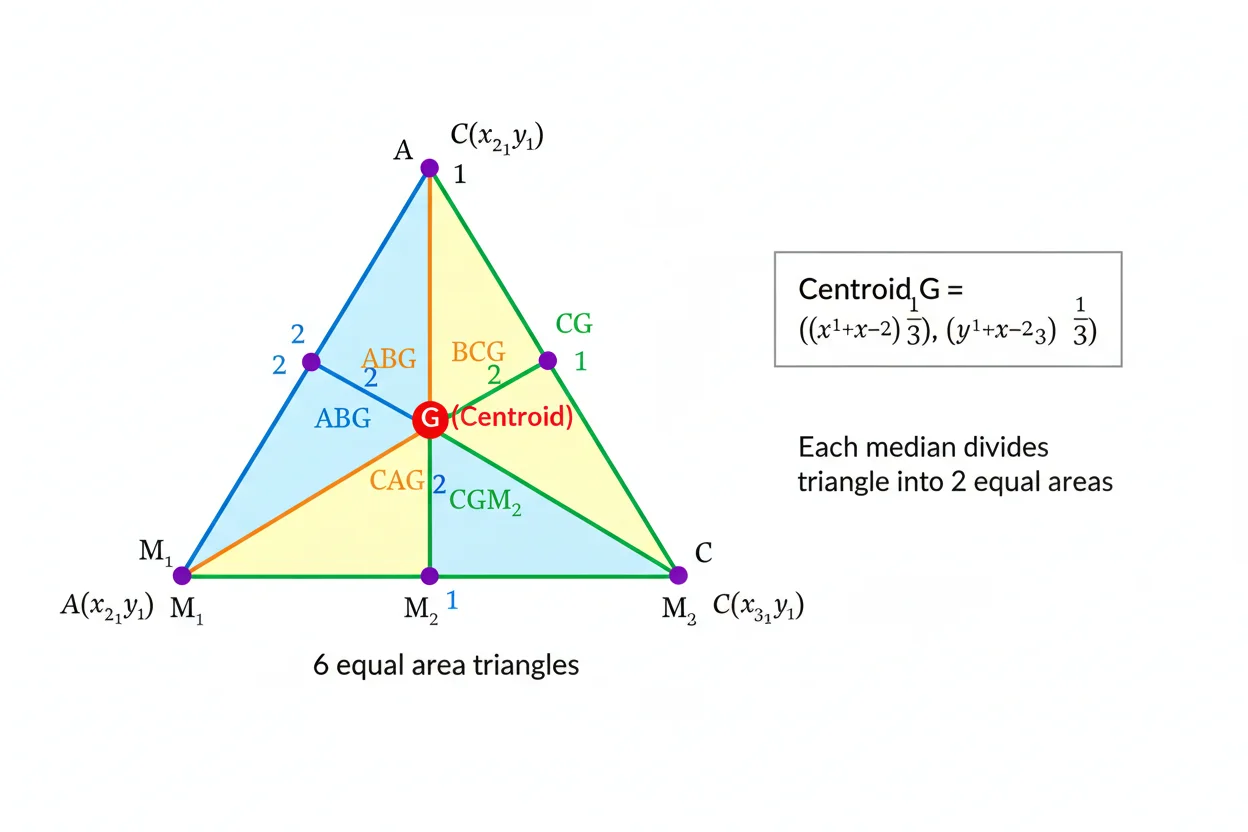

The triangle centroid is the point where all three medians of a triangle intersect. A median connects a vertex to the midpoint of the opposite side, and every triangle has three of them. The centroid always lies inside a nondegenerate triangle and divides each median in a 2:1 ratio, with the longer section between the vertex and the centroid. In coordinate geometry, if the triangle vertices are (x₁,y₁), (x₂,y₂), and (x₃,y₃), the centroid is G = ((x₁+x₂+x₃)/3, (y₁+y₂+y₃)/3). It can therefore be found simply by averaging the three x-coordinates and averaging the three y-coordinates. The centroid is also the geometric balance point of a uniform triangular lamina and divides the triangle into three equal-area triangles when connected to the vertices.
What Is the Triangle Centroid?
The triangle centroid is the common intersection point of the triangle’s three medians.
For triangle:
ABC
let:
Mₐ = midpoint of BC
M_b = midpoint of AC
M_c = midpoint of AB
Then the three medians are:
AMₐ
BM_b
CM_c
All three meet at one point:
G
This point G is the:
centroid
What Is a Median?
A median connects a triangle vertex to the midpoint of the opposite side.
For example, if M is the midpoint of BC:
BM = MC
Then:
AM
is a median from vertex A.
The dedicated Triangle Medians page develops median lengths and constructions more fully; the defining role here is that their common intersection is the centroid.
Triangle Centroid Coordinate Formula
For vertices:
A = (x₁,y₁)
B = (x₂,y₂)
C = (x₃,y₃)
the centroid is:
G = ((x₁ + x₂ + x₃)/3, (y₁ + y₂ + y₃)/3)
So:
x_G = (x₁ + x₂ + x₃)/3
y_G = (y₁ + y₂ + y₃)/3
The centroid is the arithmetic mean of the vertex coordinates.
Basic Coordinate Example
Suppose:
A = (0,0)
B = (6,0)
C = (3,9)
Then:
x_G = (0 + 6 + 3)/3
= 3
and:
y_G = (0 + 0 + 9)/3
= 3
Therefore:
G = (3,3)
Example With Negative Coordinates
Let:
A = (−4,2)
B = (5,8)
C = (2,−1)
Then:
x_G = (−4 + 5 + 2)/3
= 1
and:
y_G = (2 + 8 − 1)/3
= 3
Therefore:
G = (1,3)
Why the Coordinate Formula Works
Consider median from A to midpoint M of BC.
The Midpoint Formula gives:
M = ((x₂+x₃)/2, (y₂+y₃)/2)
The centroid lies:
2/3
of the way from A to M.
So:
G = A + (2/3)(M − A)
Substituting M simplifies to:
x_G = (x₁+x₂+x₃)/3
y_G = (y₁+y₂+y₃)/3
The averaging formula therefore follows directly from the 2:1 median division.
Centroid 2:1 Rule
The centroid divides every median in the ratio:
2 : 1
measured from the vertex toward the midpoint of the opposite side.
If A is a vertex, M is the midpoint of BC, and G is the centroid:
AG : GM = 2 : 1
Therefore:
AG = 2AM/3
and:
GM = AM/3
Median Ratio Example
Suppose a median has total length:
AM = 15
Then:
AG = 2(15)/3
= 10
and:
GM = 15/3
Therefore:
GM = 5
Check:
10 + 5 = 15
Find the Median From Vertex-to-Centroid Distance
If:
AG = 12
then:
AG = 2AM/3
Therefore:
AM = 3AG/2
= 18
The centroid-to-midpoint segment is:
GM = AM/3
Therefore:
GM = 6
Find Vertex-to-Centroid Distance
If a median is:
21
then:
AG = 2(21)/3
Therefore:
AG = 14
The remaining section is:
7
Why the Longer Part Is Near the Vertex
The 2:1 rule means the centroid is closer to the midpoint of the opposite side than to the corresponding vertex.
Along median AM:
vertex A —— 2 parts —— G —— 1 part —— M
Therefore the centroid is not the midpoint of a median.
A common error is assuming:
AG = GM
which is false except in a degenerate interpretation.
Every Triangle Has One Centroid
All three medians are concurrent.
Therefore every nondegenerate triangle has exactly one centroid.
The centroid is defined regardless of whether the triangle is:
acute
right
obtuse
scalene
isosceles
or:
equilateral
The Centroid Is Always Inside the Triangle
Unlike the Triangle Circumcenter or orthocenter, which may lie outside an obtuse triangle, the centroid always lies inside a nondegenerate triangle.
This follows geometrically because each median lies within the triangle from its vertex to the opposite-side midpoint, and the three medians intersect internally.
Centroid of a Right Triangle
Suppose a right triangle has vertices:
A = (0,0)
B = (6,0)
C = (0,9)
Then:
G = ((0+6+0)/3, (0+0+9)/3)
Therefore:
G = (2,3)
The centroid is not the right-angle vertex.
The Right Triangle special geometry affects the circumcenter and orthocenter differently, but the centroid still follows the coordinate average.
Centroid of an Isosceles Triangle
Suppose an isosceles triangle is symmetric about:
x = 0
with vertices:
(−a,0)
(a,0)
(0,h)
Then:
x_G = 0
and:
y_G = h/3
Therefore:
G = (0,h/3)
measured from the base.
Equivalently, it lies:
2h/3
down the median from the apex.
Isosceles Example
Let:
A = (−5,0)
B = (5,0)
C = (0,12)
Then:
G = (0,4)
The median from C has length:
12
and:
CG = 8
while:
G to base midpoint = 4
The ratio is:
2 : 1
Centroid of an Equilateral Triangle
In an equilateral triangle, the medians are also:
altitudes
angle bisectors
perpendicular bisectors
Therefore the:
centroid
orthocenter
circumcenter
incenter
all coincide.
This is a special consequence of complete triangle symmetry.
Equilateral Coordinate Example
Take:
A = (0,0)
B = (6,0)
C = (3,3√3)
Then:
x_G = 3
and:
y_G = √3
Therefore:
G = (3,√3)
The altitude is:
3√3
and the centroid lies one-third of that altitude above the base.
Finding a Centroid From Midpoints
A triangle centroid can also be found geometrically:
- find the midpoint of two sides;
- draw a median from each opposite vertex;
- find the intersection of the two median lines.
The third median must pass through the same point.
Only two medians are necessary to locate G.
Example of Median Construction
Suppose:
A = (0,6)
B = (−4,0)
C = (8,0)
Midpoint of BC:
Mₐ = (2,0)
Midpoint of AC:
M_b = (4,3)
Median from A passes through:
(0,6) and (2,0)
Median from B passes through:
(−4,0) and (4,3)
Their intersection is the centroid.
The averaging formula gives:
G = ((0−4+8)/3,(6+0+0)/3)
Therefore:
G = (4/3,2)
Median Equations
Once a vertex and opposite-side midpoint are known, the Line From Two Points method can produce the median equation.
Alternatively, calculate its slope and use Point-Slope Form:
y − y₁ = m(x − x₁)
The intersection of two median equations gives the centroid.
Slope of a Median
Suppose:
A = (1,6)
and midpoint of BC is:
M = (7,2)
Median slope:
m = (2 − 6)/(7 − 1)
= −4/6
Therefore:
m = −2/3
Its equation is:
y − 6 = −(2/3)(x − 1)
The Slope describes the median’s direction but does not by itself locate the centroid.
Centroid as a Vector Average
If position vectors of the vertices are:
a
b
c
then centroid vector is:
g = (a + b + c)/3
This is the vector form of the coordinate average.
It works in two dimensions, three dimensions, and higher-dimensional coordinate settings.
Vector Example
Suppose:
a = (1,2)
b = (7,5)
c = (4,−1)
Then:
g = [(1,2)+(7,5)+(4,−1)]/3
= (12,6)/3
Therefore:
g = (4,2)
Centroid in Three-Dimensional Coordinates
For a triangular face in 3D with vertices:
(x₁,y₁,z₁)
(x₂,y₂,z₂)
(x₃,y₃,z₃)
the centroid is:
G = ((x₁+x₂+x₃)/3, (y₁+y₂+y₃)/3, (z₁+z₂+z₃)/3)
The same coordinate averaging principle applies.
3D Example
Vertices:
A = (0,0,0)
B = (6,0,3)
C = (0,9,6)
Then:
G = (2,3,3)
This point lies in the plane of the triangular face.
Centroid and Triangle Area
Connecting the centroid G to all three vertices creates three triangles:
△ABG
△BCG
△CAG
Each has exactly one-third of the original Triangle Area:
A_ABG = A_BCG = A_CAG = A_total/3
Equal-Area Example
Suppose the original triangle has area:
90
Then each centroid-created triangle has area:
90/3
Therefore:
30
square units.
Why the Three Areas Are Equal
A median divides the original triangle into two equal-area triangles because the two pieces have:
equal bases
and:
the same altitude
The three medians together create six small triangles of equal area.
Each triangle formed by the centroid and one whole side contains two of those six pieces.
Therefore each has:
2/6 = 1/3
of the total area.
Six Equal-Area Triangles
The three medians divide the triangle into:
6
small triangles of equal area.
If the total area is:
72
then each small triangle has:
72/6
Therefore:
12
square units.
This is useful in area-ratio problems involving centroid diagrams.
Area Ratio Along a Median
Suppose median AM is divided by centroid G.
Triangles:
ABG
and:
ACG
have equal areas because G lies on the median from A and B and C occupy equal base segments relative to that median structure.
More broadly, centroid partitions create fixed area ratios independent of the triangle’s specific shape.
Centroid as Balance Point
For a flat triangular lamina with uniform density and thickness, the centroid is its balance point.
If the entire triangular sheet had uniform mass distribution, its center of mass would lie at G.
This is why the term centroid is also used in mechanics and engineering.
The geometric centroid does not depend on the triangle’s orientation.
Why Rotation Does Not Change the Centroid
Rotating or translating the entire triangle moves the centroid by the same transformation.
The centroid’s relative position within the triangle remains unchanged.
If every vertex is translated by vector:
t
then:
G_new = G_old + t
If the triangle is uniformly scaled, the centroid scales from the same transformation center.
Centroid Under Dilation
Suppose a dilation centered at the origin multiplies all coordinates by k.
Vertices become:
(kx₁,ky₁)
(kx₂,ky₂)
(kx₃,ky₃)
The new centroid is:
(k(x₁+x₂+x₃)/3, k(y₁+y₂+y₃)/3)
Therefore:
G_new = kG_old
This agrees with the geometry of Similar Triangles.
Recover a Missing Vertex From the Centroid
The centroid formula can be rearranged.
If:
G = (x_G,y_G)
and vertices A and B are known, then:
x₃ = 3x_G − x₁ − x₂
y₃ = 3y_G − y₁ − y₂
This allows the third vertex to be recovered.
Missing Vertex Example
Suppose:
G = (4,3)
A = (1,2)
B = (5,7)
Then:
x_C = 12 − 1 − 5
= 6
and:
y_C = 9 − 2 − 7
= 0
Therefore:
C = (6,0)
Recover a Vertex From Vector Form
From:
3g = a + b + c
solve:
c = 3g − a − b
This is the same missing-coordinate calculation expressed compactly with vectors.
Find a Midpoint From Centroid and Vertex
Because:
AG : GM = 2 : 1
we have:
G = A + (2/3)(M − A)
Solve for M:
M = A + (3/2)(G − A)
Equivalently:
M = (3G − A)/2
This can recover the midpoint of the opposite side when the vertex and centroid are known.
Midpoint Example
Suppose:
A = (0,6)
G = (2,2)
Then:
M = A + (3/2)[(2,2) − (0,6)]
= (0,6) + (3/2)(2,−4)
= (0,6) + (3,−6)
Therefore:
M = (3,0)
Find a Vertex From Centroid and Opposite Midpoint
From the same median relationship:
AG = 2GM
In vector form:
G = (A + 2M)/3
Solve:
A = 3G − 2M
This can reconstruct a vertex from centroid and opposite-side midpoint.
Centroid and Distance Formula
Once centroid coordinates are known, the Distance Formula can calculate distances such as:
AG
BG
CG
These distances are generally unequal unless the triangle has special symmetry.
The centroid is not defined as a point equidistant from the vertices.
Centroid Is Not Usually Equidistant From Vertices
The point equidistant from all three vertices is the circumcenter.
The centroid instead averages the vertices and intersects the medians.
For a scalene triangle:
AG
BG
CG
will usually have three different lengths.
This distinction helps separate the centroid’s intent from the circumcenter’s.
Centroid Versus Circumcenter
The Triangle Circumcenter is the intersection of perpendicular bisectors.
It is equidistant from the:
three vertices
The centroid is the intersection of:
three medians
It follows the:
2:1 median ratio
and always lies inside the triangle.
These points coincide only in special symmetric cases such as an equilateral triangle.
Centroid Versus Incenter
The Triangle Incenter is the intersection of the internal angle bisectors.
It is equidistant from:
all three sides
and is the center of the incircle.
The centroid is not generally equidistant from either the sides or the vertices.
Its defining property is median concurrency.
Centroid Versus Orthocenter
The orthocenter is the intersection of the Triangle Altitudes.
Its position can be:
inside
at a vertex
or:
outside
depending on triangle type.
The centroid always remains inside.
The two points are different except in special cases.
Centroid and the Euler Line
In a non-equilateral triangle, the:
orthocenter
centroid
and:
circumcenter
lie on one line called the Euler line.
The centroid divides the segment joining circumcenter O and orthocenter H in the ratio:
OG : GH = 1 : 2
Equivalently:
HG = 2GO
This is a different 2:1 relationship from the centroid’s division of each median, so the two should not be confused.
Euler-Line Vector Relationship
With circumcenter O as the reference:
G = H/3
under a suitable origin placement at O.
More generally, the centroid lies one-third of the way from O toward H:
G = O + (1/3)(H − O)
Therefore:
OG = OH/3
and:
GH = 2OH/3
Centroid of an Equilateral Triangle and Euler Line
In an equilateral triangle:
centroid = circumcenter = orthocenter = incenter
So the Euler line is not uniquely determined by distinct centers because the relevant points coincide.
The complete symmetry collapses the usual separation between triangle centers.
Centroid and Trapezoid Area Problems
The mapped Trapezoid Area does not use the triangle centroid directly.
However, centroid partitions can create smaller triangles and quadrilateral regions whose areas are found by subtraction.
For example, if a triangle of area A is divided by joining G to its vertices, each component has:
A/3
Two adjacent components together therefore have:
2A/3
Such regions can become useful parts of composite-area diagrams.
Centroid and Base-Height Area
Suppose G is the centroid of triangle ABC.
Triangle GBC has area:
A/3
Using BC as its base:
A/3 = BC·h_G/2
where h_G is the perpendicular distance from G to BC.
The full triangle has:
A = BC·h_A/2
Divide the equations:
h_G/h_A = 1/3
Therefore the centroid lies one-third of the full altitude above the base, measured in the direction perpendicular to that base.
Distance From Centroid to a Base
For the altitude from A to BC with full altitude hₐ:
perpendicular distance from G to BC = hₐ/3
The perpendicular distance from A to the line through G parallel to BC is:
2hₐ/3
This follows from both similarity and the 2:1 median position.
Isosceles Height Example
Suppose an isosceles triangle has altitude:
15
The centroid lies along that altitude.
Distance from the base to the centroid:
15/3 = 5
Distance from the apex to the centroid:
10
Again:
10 : 5 = 2 : 1
Centroid and Parallel Cross Sections
A line through the centroid parallel to one side can create a smaller triangle similar to the original.
Suppose the line through G is parallel to base BC.
Because G lies one-third of the altitude above BC, the small triangle near vertex A has altitude:
2/3
of the full altitude.
Its linear scale factor is therefore:
2/3
and its area is:
(2/3)² = 4/9
of the full triangle.
Area Below a Centroid-Parallel Line
Using the previous configuration, the remaining trapezoidal region below the parallel line has area:
1 − 4/9
Therefore:
5/9
of the total triangle area.
This is one natural connection between centroid geometry, similarity, and trapezoidal regions.
Centroid and Medial Triangle
Joining the midpoints of the three sides creates the medial triangle.
Its side lengths are:
1/2
of the corresponding original sides.
Therefore its area is:
1/4
of the original triangle area.
The centroid of the medial triangle is the same point as the centroid of the original triangle.
Why the Centroids Coincide
Let the original vertex vectors be:
a, b, c
The three midpoint vectors are:
(a+b)/2
(b+c)/2
(c+a)/2
Average them:
[2a + 2b + 2c]/6
Therefore:
(a+b+c)/3
which is the original centroid.
Centroid and Translation of Coordinates
If the coordinate origin is moved, the numerical coordinates of every vertex and the centroid change together.
But the centroid’s relative position in the triangle remains unchanged.
This makes the centroid an affine geometric property rather than something dependent on one particular coordinate system.
Centroid and Affine Transformations
Transformations that preserve straight lines and ratios along lines preserve centroid structure.
Examples include:
translations
rotations
uniform scaling
and more generally many affine transformations.
The medians remain medians because midpoints and straight-line incidence are preserved.
Weighted Average Versus Triangle Centroid
The ordinary triangle centroid uses equal weight for all three vertices:
(a + b + c)/3
If different point masses were placed at the vertices, their center of mass would instead be a weighted average.
That is a different problem from the geometric centroid of a uniform triangular region.
For an ordinary triangle centroid, the three coordinate weights are equal.
Centroid of a Uniform Triangular Region
For a uniformly filled triangular lamina, the area centroid is at the same point as the median intersection.
This is not merely the average of three isolated point masses by coincidence; integration over the entire triangular region produces the same location.
The median geometry therefore agrees with the physical balance-point interpretation.
Centroid Coordinates From Intersections
Although averaging coordinates is the fastest method when all three vertices are known, median intersection provides a useful verification.
If two calculated median equations intersect at:
G
the third median should also pass through G.
Failure of the third check indicates an earlier midpoint, slope, or algebra error.
Verification Example
Suppose vertices are:
A = (0,0)
B = (6,0)
C = (0,9)
Coordinate average gives:
G = (2,3)
Midpoint of BC:
(3,4.5)
The line from A to that midpoint contains G because:
G = 2/3(3,4.5)
= (2,3)
The median ratio is confirmed.
Can the Centroid Lie on a Side?
For a nondegenerate triangle:
no
The centroid lies strictly inside.
If three vertices become collinear, the figure degenerates and ordinary triangle-center geometry no longer applies.
Can the Centroid Equal a Vertex?
Not for a nondegenerate triangle.
The centroid is an interior weighted average of all three distinct vertices.
It can coincide with a vertex only in a degenerate configuration where the triangle collapses.
Does the Centroid Depend on Side Lengths Directly?
The coordinate formula does not require side lengths:
G = average of vertex coordinates
However, side lengths affect where the vertices lie and therefore indirectly determine the centroid’s position.
If only side lengths are given without a coordinate placement or construction, the absolute coordinate location of the centroid cannot be determined.
Scaling Centroid Distances
For similar triangles with scale factor k, all median lengths scale by k.
Since:
vertex-to-centroid distance = 2/3 median
those distances also scale by:
k
The centroid retains exactly the same relative location in every pair of similar triangles.
Units
Centroid coordinates use the same linear units as the vertex coordinates.
If coordinates are measured in centimeters:
x_G and y_G are in centimeters
The centroid itself is a point, so it does not have square or cubic units.
Area relationships involving the centroid still use square units.
Common Triangle Centroid Mistakes
A common mistake is averaging only two vertex coordinates.
The centroid requires all three:
x_G = (x₁+x₂+x₃)/3
y_G = (y₁+y₂+y₃)/3
Another error is confusing the centroid with the midpoint of a side or median.
The centroid divides each median:
2:1
not:
1:1
The longer part lies between the vertex and centroid.
Do not confuse medians with altitudes, angle bisectors, or perpendicular bisectors.
The centroid is always inside a nondegenerate triangle, unlike the circumcenter or orthocenter in some triangle types.
When reconstructing a missing vertex, multiply the centroid coordinates by 3 before subtracting the other two vertices.
Finally, remember that the centroid is not generally equidistant from the vertices or sides.
Frequently Asked Questions
What is the triangle centroid?
The centroid is the intersection point of the three medians.
What is a triangle median?
A segment from a vertex to the midpoint of the opposite side.
What is the centroid coordinate formula?
G = ((x₁+x₂+x₃)/3, (y₁+y₂+y₃)/3)
How do you calculate the centroid?
Average the three x-coordinates and separately average the three y-coordinates.
Where is the centroid located?
Always inside a nondegenerate triangle.
How does the centroid divide a median?
vertex-to-centroid : centroid-to-midpoint = 2 : 1
What fraction of a median lies between the vertex and centroid?
2/3
What fraction lies between the centroid and side midpoint?
1/3
How do you find a median from vertex-to-centroid distance?
median = 3(vertex-to-centroid distance)/2
Does the centroid divide triangle area?
Yes. Joining it to all three vertices creates three equal-area triangles.
How much area does each centroid triangle contain?
1/3
of the original triangle area.
What do all three medians create?
They divide the triangle into six equal-area smaller triangles.
Is the centroid the balance point?
Yes, for a uniform triangular lamina.
Is the centroid the same as the circumcenter?
Not generally. The circumcenter is the intersection of perpendicular bisectors.
Is the centroid the same as the incenter?
Not generally. The incenter is the intersection of internal angle bisectors.
Is the centroid the same as the orthocenter?
Not generally. The orthocenter is the intersection of altitudes.
When do the main triangle centers coincide?
In an equilateral triangle.
How do you find a missing vertex from the centroid?
x₃ = 3x_G − x₁ − x₂
y₃ = 3y_G − y₁ − y₂
How can I check a centroid calculation?
Verify the coordinate average, construct two medians, confirm their intersection matches the calculated centroid, and check that the centroid divides each median in the 2:1 ratio.