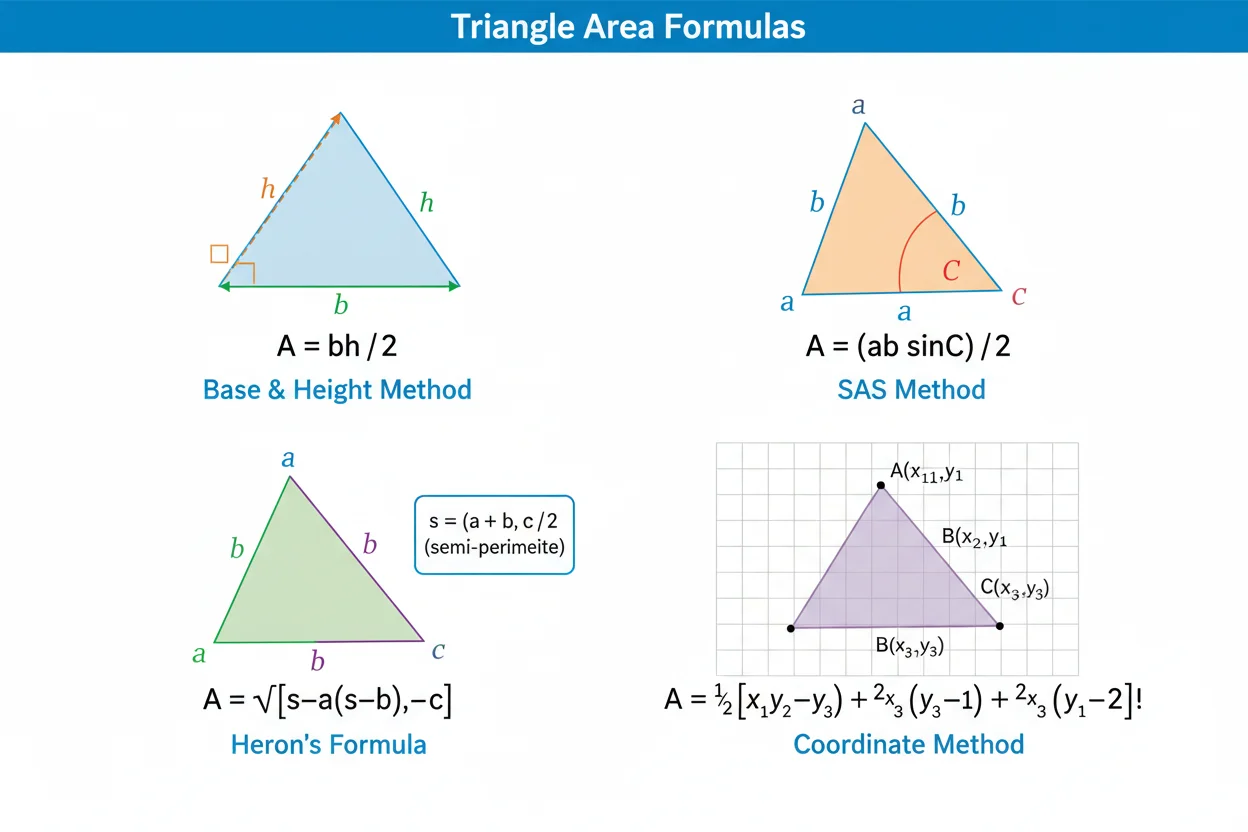

Triangle area measures the two-dimensional region enclosed by three sides. The standard formula is A = bh/2, where b is any chosen side used as the base and h is the perpendicular height from the opposite vertex to the line containing that base. A right triangle can use its two perpendicular legs directly, giving A = ab/2. If two sides and their included angle are known, the formula becomes A = ab sinC/2. When all three side lengths are known, Heron’s formula finds the area without first calculating an altitude. Coordinate triangles can be solved from base and height, determinants, or the shoelace formula. Every valid method gives the same triangle area when the measurements describe the same triangle.
Triangle Area Formula
The basic formula is:
A = bh/2
where:
A = triangle area
b = base length
h = perpendicular height to that base
Any of the triangle’s three sides can be selected as b.
The corresponding h must always be perpendicular to that side or to the line containing it.
Basic Triangle Area Example
Suppose:
b = 12 cm
h = 7 cm
Then:
A = 12(7)/2
= 84/2
Therefore:
A = 42 cm²
Because area is two-dimensional, the answer uses square units.
Why Triangle Area Is Half of bh
A triangle can be paired with a congruent copy to form a parallelogram with the same base b and perpendicular height h.
The Parallelogram Area is:
bh
Since the parallelogram consists of two congruent triangles:
A_triangle = bh/2
This geometric relationship explains the factor:
1/2
The Height Must Be Perpendicular
The height used in:
A = bh/2
is not simply another triangle side.
It is the perpendicular distance from the opposite vertex to the line containing the selected base.
The geometry of Triangle Altitudes determines this height.
In acute triangles, the relevant altitude may lie inside the triangle.
In obtuse triangles, the altitude can meet an extension of the base outside the triangle.
Find Height From Triangle Area
Starting with:
A = bh/2
multiply by 2:
2A = bh
Therefore:
h = 2A/b
Suppose:
A = 54
b = 12
Then:
h = 108/12
Therefore:
h = 9
Find the Base From Area
Similarly:
b = 2A/h
If:
A = 80
h = 10
then:
b = 160/10
Therefore:
b = 16
Right Triangle Area
A Right Triangle has two perpendicular legs.
If their lengths are:
a
and:
b
then one can be used as the base and the other as the height.
Therefore:
A = ab/2
Right Triangle Example
Suppose the legs are:
6
and:
8
Then:
A = 6(8)/2
Therefore:
A = 24
square units.
Its hypotenuse is:
√(6² + 8²) = 10
but the hypotenuse is not required for this area calculation.
Area From a Leg and Hypotenuse
Suppose one leg a and hypotenuse c are known.
Use the Pythagorean Theorem to find the other leg:
b = √(c² − a²)
Then:
A = a√(c² − a²)/2
For:
a = 5
c = 13
we obtain:
b = 12
and:
A = 5(12)/2
Therefore:
A = 30
Area Using Two Sides and the Included Angle
If sides a and b enclose angle C:
A = ab sinC/2
The Sine function supplies the perpendicular component of one side relative to the other.
Since:
h = b sinC
the standard formula becomes:
A = a(b sinC)/2
Therefore:
A = ab sinC/2
Side-Angle-Side Example
Suppose:
a = 10
b = 8
C = 30°
Then:
A = 10(8)sin30°/2
= 80(1/2)/2
Therefore:
A = 20
square units.
Obtuse Included Angle
The same formula works when C is obtuse.
Suppose:
a = 9
b = 12
C = 120°
Then:
A = 9(12)sin120°/2
Since:
sin120° = √3/2
we get:
A = 27√3
Approximately:
A ≈ 46.77
The sine remains positive for an interior triangle angle between 0° and 180°.
Find an Included Angle From Area
From:
A = ab sinC/2
solve:
sinC = 2A/(ab)
Then:
C = sin⁻¹[2A/(ab)]
However, because supplementary angles have the same sine, additional triangle information may be necessary to distinguish an acute from an obtuse included angle.
The Inverse Trigonometric Functions framework handles those angle interpretations.
Heron’s Formula
When all three side lengths are known, Heron Formula gives:
A = √[s(s − a)(s − b)(s − c)]
where:
s = (a + b + c)/2
is the semiperimeter.
This avoids calculating an altitude first.
Heron Example
Suppose the sides are:
5, 5, 6
Semiperimeter:
s = (5 + 5 + 6)/2
= 8
Then:
A = √[8(3)(3)(2)]
= √144
Therefore:
A = 12
square units.
13-14-15 Triangle Example
For sides:
13, 14, 15
semiperimeter:
s = 21
Then:
A = √[21(8)(7)(6)]
= √7056
Therefore:
A = 84
square units.
This is a classic example where Heron’s formula gives an integer area.
Triangle Inequality Check
Before using three side lengths, verify they can form a triangle.
For positive sides:
a + b > c
a + c > b
b + c > a
For:
2, 3, 6
we have:
2 + 3 < 6
so no ordinary triangle exists and there is no positive triangle area.
Equilateral Triangle Area
For an equilateral triangle with side s:
A = √3s²/4
This follows by splitting the triangle into two 30-60-90 triangles.
Its altitude is:
h = s√3/2
Then:
A = s(s√3/2)/2
Therefore:
A = √3s²/4
Equilateral Example
Suppose:
s = 8
Then:
A = √3(64)/4
Therefore:
A = 16√3
Approximately:
A ≈ 27.71
square units.
Isosceles Triangle Area
Suppose an isosceles triangle has equal sides ℓ and base b.
The altitude from the apex bisects the base, producing half-base:
b/2
Using the Pythagorean theorem:
h = √[ℓ² − (b/2)²]
Therefore:
A = b/2 × √[ℓ² − (b/2)²]
Isosceles Example
Suppose:
ℓ = 13
b = 10
Then:
h = √(169 − 25)
= 12
Area:
A = 10(12)/2
Therefore:
A = 60
square units.
Triangle Area From Three Altitudes?
Altitude lengths alone do not immediately fit:
A = bh/2
because a corresponding side is also needed.
However, if enough additional triangle information determines the sides, any side-altitude pair can then calculate the same area.
For every triangle:
ahₐ = bh_b = ch_c = 2A
This provides a useful consistency check.
Triangle Area From Coordinates
Suppose vertices are:
A = (x₁,y₁)
B = (x₂,y₂)
C = (x₃,y₃)
A direct coordinate formula is:
A = 1/2 |x₁(y₂ − y₃) + x₂(y₃ − y₁) + x₃(y₁ − y₂)|
This is equivalent to the three-vertex form of the shoelace formula.
Coordinate Example
Let:
A = (0,0)
B = (6,0)
C = (2,4)
Then:
A = 1/2 |0(0−4) + 6(4−0) + 2(0−0)|
= 1/2 |24|
Therefore:
A = 12
square units.
The same result comes from:
base = 6
height = 4
so:
A = 6(4)/2 = 12
Axis-Aligned Coordinate Triangle
If a triangle has one horizontal side, the calculation can be especially simple.
Suppose:
A = (1,3)
B = (9,3)
C = (5,10)
Then:
AB = 8
and the perpendicular height is:
10 − 3 = 7
Therefore:
A = 8(7)/2
= 28
square units.
Area Using the Distance Formula
Coordinate problems may require side lengths before applying Heron’s formula or another method.
For endpoints:
(x₁,y₁)
and:
(x₂,y₂)
the Distance Formula is:
d = √[(x₂ − x₁)² + (y₂ − y₁)²]
Once all three side lengths are known, Heron’s formula can determine area.
Area From a Base Line and Opposite Point
If a base lies on:
Ax + By + C = 0
and the opposite vertex is:
(x₀,y₀)
the perpendicular height is:
h = |Ax₀ + By₀ + C|/√(A² + B²)
Then:
A = bh/2
where b is the finite length of the base segment.
This is useful when the selected base is not horizontal or vertical.
Vector Formula for Triangle Area
If two side vectors from the same vertex are:
u = (u₁,u₂)
v = (v₁,v₂)
then:
A = |u₁v₂ − u₂v₁|/2
The determinant magnitude gives the area of the corresponding parallelogram.
A triangle occupies half of it.
Vector Example
Suppose:
u = (4,1)
v = (2,5)
Then:
A = |4(5) − 1(2)|/2
= 18/2
Therefore:
A = 9
square units.
Collinear Points Have Zero Area
If three coordinate points lie on one line, the determinant formula gives:
A = 0
For example:
(0,0)
(2,2)
(5,5)
are collinear.
The points do not enclose a nondegenerate triangle.
This provides an area-based test for collinearity.
Triangle Area and Slope
The Slope of sides can help identify:
horizontal bases
perpendicular sides
parallel relationships
or:
altitude directions
If one side has slope m, an altitude to that side has perpendicular slope:
−1/m
for ordinary nonhorizontal, nonvertical cases.
Slope helps construct the geometry; area still requires a base length and perpendicular height or an equivalent formula.
Tangent and Triangle Height
The mapped Tangent function can find a missing altitude.
If an altitude creates a right triangle with horizontal run x and angle θ:
tanθ = h/x
Therefore:
h = x tanθ
Then:
A = bh/2
Tangent Example
Suppose:
base = 18
A base subdivision adjacent to angle θ is:
x = 5
and:
θ = 40°
Then:
h = 5tan40°
Approximately:
h ≈ 4.20
Therefore:
A ≈ 18(4.20)/2
≈ 37.76
square units.
Law of Sines and Triangle Area
The Law of Sines can determine a missing side or angle before area is calculated.
Once two sides and their included angle are known:
A = ab sinC/2
For example, if the law of sines produces:
b = 12
and the other relevant side and angle are:
a = 9
C = 45°
then:
A = 54√2/2
= 27√2
Law of Cosines and Triangle Area
The Law of Cosines can also provide missing sides or angles.
For three sides:
c² = a² + b² − 2ab cosC
Once C is found, area follows from:
A = ab sinC/2
Alternatively, use Heron’s formula directly when all three side lengths are already known.
Triangle Area From Circumradius
If a, b, and c are side lengths and R is the Triangle Circumcenter circle radius, then:
A = abc/(4R)
This follows from the extended law of sines.
Therefore:
R = abc/(4A)
This connects triangle area with its circumcircle.
Circumradius Example
Suppose a triangle has sides:
3, 4, 5
and area:
6
Then:
R = 3(4)(5)/(4·6)
= 60/24
Therefore:
R = 5/2
For a right triangle, this equals half the hypotenuse as expected.
Triangle Area From Inradius
If r is the inradius and s is the semiperimeter:
A = rs
The Triangle Incenter is equally distant from all three sides, and that common perpendicular distance is r.
The triangle can be divided into three smaller triangles, each with height r.
Adding their areas produces:
A = r(a+b+c)/2
Therefore:
A = rs
Inradius Example
Suppose:
r = 4
s = 15
Then:
A = 4(15)
Therefore:
A = 60
square units.
Triangle Centroid and Area
The three medians meet at the Triangle Centroid.
Connecting the centroid to all three vertices divides the triangle into:
3 triangles of equal area
Therefore each has:
A/3
The centroid is therefore useful in area-partition problems even though it does not determine the triangle’s total size by itself.
Median Area Division
A median joins a vertex to the midpoint of the opposite side.
Because the two smaller triangles formed by a median have:
equal base lengths
and:
the same altitude
they have equal area.
Therefore every median divides the triangle into:
two equal-area triangles
This connects area directly with Triangle Medians.
Three Medians and Six Equal Areas
The three medians divide a triangle into six smaller triangles.
All six have equal area.
If the original triangle area is:
72
then each small median-created triangle has:
72/6
Therefore:
12
square units.
Midpoint and Area
The Midpoint Formula can identify a median endpoint in coordinate geometry.
If M is the midpoint of BC, then:
BM = MC
Triangles ABM and ACM share the same altitude from A to line BC.
Therefore:
Area(ABM) = Area(ACM)
Trapezoid and Triangle Area
A Trapezoid Area can be understood by splitting the trapezoid into triangles.
Its formula is:
A = (b₁ + b₂)h/2
The factor 1/2 and perpendicular-height principle are the same ones used for triangle area.
Conversely, many composite figures can be decomposed into triangles and trapezoids.
Polygon Area From Triangles
A convex polygon can often be partitioned into triangles.
From one vertex of an n-sided convex polygon, drawing noncrossing diagonals forms:
n − 2
triangles.
The Polygon Diagonals count from one vertex is:
n − 3
Those diagonals create the triangulation used to sum polygon areas.
Regular Polygon Area as Triangle Sum
A regular polygon can be divided from its center into congruent triangles.
The Regular Polygon Area formula:
A = aP/2
comes from summing:
n
triangles, each with base equal to one polygon side and height equal to the apothem.
Triangle area is therefore the foundation of that polygon formula.
Rhombus Area From Triangles
A Rhombus Area can be divided by its diagonals into four right triangles.
Summing them produces:
A = d₁d₂/2
Again, a familiar quadrilateral formula can be derived from triangle areas.
Scaling Triangle Area
If every linear dimension of a triangle is multiplied by scale factor k:
base → kb
height → kh
Then:
A_new = (kb)(kh)/2
Therefore:
A_new = k²A
Triangle area scales with the square of the linear scale factor.
Scaling Example
Suppose a triangle has area:
20
A similar triangle has every corresponding side twice as long.
Then:
A_new = 2²(20)
Therefore:
A_new = 80
Area Ratio of Similar Triangles
For similar triangles:
A₂/A₁ = k²
where k is the corresponding side ratio.
If side ratio is:
3/5
then area ratio is:
9/25
This is one of the most useful consequences of triangle similarity.
Find Linear Scale From Area Ratio
If:
A₂/A₁ = 49/16
then:
k = √(49/16)
Therefore:
k = 7/4
All corresponding lengths have ratio:
7/4
Same Base, Different Heights
For two triangles sharing the same base b:
A ∝ h
If one altitude is twice the other, its area is twice as large.
This is useful in diagrams where several vertices lie at different perpendicular distances from the same base line.
Same Height, Different Bases
If two triangles have equal perpendicular heights:
A ∝ b
A triangle with twice the base length has twice the area.
This explains why a median splits a triangle into two equal-area parts: the two bases are equal.
Same Base and Same Parallel Line
If two triangles share the same base and their opposite vertices lie on a line parallel to that base, they have equal heights.
Therefore they have equal areas.
This geometric result is useful even when the triangle shapes look quite different.
Maximum Area With Two Fixed Sides
If sides a and b are fixed:
A = ab sinC/2
The largest possible sine value is:
1
Therefore maximum area occurs when:
C = 90°
and:
A_max = ab/2
So two fixed sides enclose the largest triangle area when they are perpendicular.
Maximum-Area Example
Suppose:
a = 8
b = 12
Then:
A ≤ 8(12)/2
Therefore:
A ≤ 48
The maximum occurs when the included angle is:
90°
Units of Triangle Area
If base and height are in centimeters:
cm × cm = cm²
Therefore the result is in:
cm²
If measurements use meters:
m²
If they use feet:
ft²
Always convert incompatible length units before multiplication.
Mixed-Unit Example
Suppose:
b = 2 m
h = 75 cm
Convert:
2 m = 200 cm
Then:
A = 200(75)/2
Therefore:
A = 7500 cm²
which equals:
0.75 m²
Exact Versus Approximate Area
Expressions involving radicals or π-like trigonometric values are often best retained exactly.
For example:
A = 27√2
is exact.
Approximately:
A ≈ 38.18
Keeping the exact form avoids rounding error in subsequent calculations.
Common Triangle Area Mistakes
A common mistake is forgetting the factor:
1/2
The basic formula is:
A = bh/2
Another error is using a slanted side instead of the perpendicular height.
When using:
A = ab sinC/2
C must be the included angle between a and b.
For Heron’s formula, calculate the semiperimeter rather than the full perimeter.
In coordinate problems, take the absolute value of the determinant result because area is nonnegative.
Do not confuse linear, square, and cubic units.
When solving backward for an angle through sine, remember that supplementary angles can share the same sine.
Finally, check that three proposed side lengths satisfy the triangle inequality before treating them as a valid triangle.
Frequently Asked Questions
What is the basic triangle area formula?
A = bh/2
What does h represent?
The perpendicular height from the opposite vertex to the line containing the selected base.
Can any side be the base?
Yes, provided its corresponding perpendicular altitude is used.
What is the area of a right triangle?
A = ab/2
where a and b are the perpendicular legs.
What is the area formula using two sides and an angle?
A = ab sinC/2
What is Heron’s formula?
A = √[s(s−a)(s−b)(s−c)]
where:
s = (a+b+c)/2
What is the area of an equilateral triangle?
A = √3s²/4
How do you find height from area?
h = 2A/b
How do you find base from area?
b = 2A/h
Can coordinates determine triangle area?
Yes:
A = 1/2 |x₁(y₂−y₃)+x₂(y₃−y₁)+x₃(y₁−y₂)|
What happens if the coordinate area is zero?
The three points are collinear rather than forming a nondegenerate triangle.
How is area related to circumradius?
A = abc/(4R)
How is area related to inradius?
A = rs
where r is the inradius and s is the semiperimeter.
How does a median divide triangle area?
Each median divides a triangle into two equal-area triangles.
How does the centroid divide the area?
Joining the centroid to the vertices creates three equal-area triangles.
How do areas of similar triangles compare?
If side scale factor is k:
area scale factor = k²
How can I check a triangle area answer?
Use a second formula when enough information is available, verify the height is perpendicular to the selected base, confirm the result is nonnegative, and make sure the final units are squared.