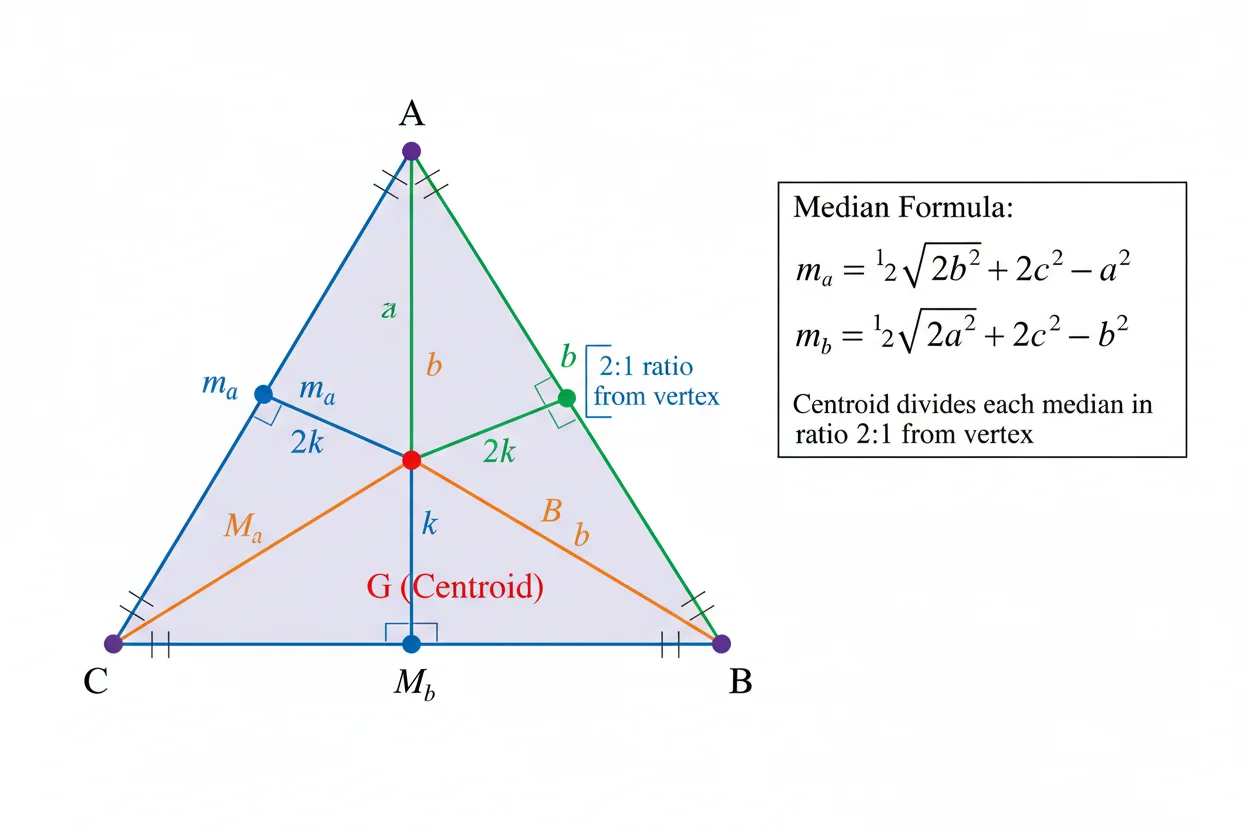

Triangle medians are segments that connect each vertex of a triangle to the midpoint of the opposite side. Every nondegenerate triangle has exactly three medians, and all three intersect at one point called the centroid. The centroid divides every median in a 2:1 ratio, with the longer section running from the vertex to the centroid. If side a is opposite vertex A, the length of the median from A is mₐ = ½√(2b² + 2c² − a²). Each median also divides the triangle into two regions of equal area, regardless of the triangle’s shape. In coordinate geometry, a median can be constructed by finding an opposite-side midpoint and joining it to the corresponding vertex. Triangle medians are useful for finding centroids, solving side-length problems, proving area relationships, and analyzing special triangles.
What Is a Triangle Median?
In triangle ABC, let M be the midpoint of side BC.
Then:
BM = MC
The segment:
AM
is the median from vertex A.
Similarly, the other two vertices each have a median to the midpoint of their opposite side.
The three median lengths are commonly written:
mₐ
m_b
m_c
where mₐ corresponds to side a, m_b to side b, and m_c to side c.
Every Triangle Has Three Medians
A triangle has:
3 vertices
and:
3 opposite sides
Each opposite side has one unique midpoint.
Therefore every nondegenerate triangle has:
3 medians
All three lie inside the triangle and intersect at one common point.
That intersection is the Triangle Centroid.
Median Length Formula
For triangle sides:
a, b, c
the median to side a is:
mₐ = ½√(2b² + 2c² − a²)
Similarly:
m_b = ½√(2a² + 2c² − b²)
m_c = ½√(2a² + 2b² − c²)
These formulas are consequences of Apollonius’ theorem.
Basic Median Example
Suppose:
a = 10
b = 13
c = 13
Find the median to side a:
mₐ = ½√[2(13²) + 2(13²) − 10²]
= ½√(338 + 338 − 100)
= ½√576
Therefore:
mₐ = 12
Because the triangle is isosceles with base 10, this median is also the altitude to the base.
Apollonius’ Theorem
The median formula can be written without the square root as:
4mₐ² = 2b² + 2c² − a²
or:
a² + 4mₐ² = 2b² + 2c²
This relationship is known as Apollonius’ theorem.
It connects:
one side
the median to that side
the other two triangle sides
and can be rearranged to solve for any missing quantity.
Deriving the Median Formula
Let M be the midpoint of BC.
Then:
BM = CM = a/2
Suppose:
AM = mₐ
Applying the Law of Cosines to triangles ABM and ACM and combining the resulting equations eliminates the unknown angle.
The result is:
2b² + 2c² = a² + 4mₐ²
Therefore:
mₐ² = (2b² + 2c² − a²)/4
and:
mₐ = ½√(2b² + 2c² − a²)
Find a Side From a Median
Starting with:
a² + 4mₐ² = 2b² + 2c²
solve for a:
a² = 2b² + 2c² − 4mₐ²
Therefore:
a = √(2b² + 2c² − 4mₐ²)
for a positive side length.
Missing-Side Example
Suppose:
b = 10
c = 13
mₐ = 9
Then:
a² = 2(100) + 2(169) − 4(81)
= 200 + 338 − 324
= 214
Therefore:
a = √214
Approximately:
a ≈ 14.63
Find Another Side
Apollonius’ relationship can also be rearranged for b:
2b² = a² + 4mₐ² − 2c²
so:
b = √[(a² + 4mₐ² − 2c²)/2]
A corresponding expression can be used for c.
The supplied measurements must still describe a valid triangle.
Coordinate Construction of a Median
Suppose:
A = (x₁,y₁)
B = (x₂,y₂)
C = (x₃,y₃)
First find the midpoint M of BC with the Midpoint Formula:
M = ((x₂+x₃)/2, (y₂+y₃)/2)
The median from A is the segment joining:
A
to:
M
Coordinate Example
Let:
A = (2,8)
B = (0,0)
C = (10,0)
Midpoint of BC:
M = ((0+10)/2,(0+0)/2)
Therefore:
M = (5,0)
The median from A connects:
(2,8)
to:
(5,0)
Median Length From Coordinates
Using the Distance Formula:
AM = √[(5−2)² + (0−8)²]
= √(9 + 64)
Therefore:
AM = √73
This is the coordinate median length.
Equation of a Median
Once a vertex and opposite-side midpoint are known, the median’s slope can be found.
For:
A = (2,8)
M = (5,0)
the Slope is:
m = (0−8)/(5−2)
= −8/3
Using Point-Slope Form:
y − 8 = −8/3(x − 2)
This equation represents the entire median line.
Medians Meet at the Centroid
All three medians are concurrent.
Their intersection is:
G
the centroid.
If the vertices are:
(x₁,y₁)
(x₂,y₂)
(x₃,y₃)
then:
G = ((x₁+x₂+x₃)/3, (y₁+y₂+y₃)/3)
The coordinate average provides the centroid directly without calculating all three median equations.
The 2:1 Median Rule
The centroid divides each median in the ratio:
2 : 1
measured from the vertex.
If median AM passes through centroid G:
AG : GM = 2 : 1
Therefore:
AG = 2mₐ/3
and:
GM = mₐ/3
2:1 Example
Suppose:
mₐ = 18
Then:
AG = 2(18)/3
Therefore:
AG = 12
and:
GM = 18/3
Therefore:
GM = 6
Check:
12 + 6 = 18
Find Median From Vertex-to-Centroid Length
If:
AG = d
and:
AG = 2mₐ/3
then:
mₐ = 3d/2
Suppose:
AG = 10
Then:
mₐ = 15
The centroid-to-midpoint portion is:
GM = 5
Find Median From Centroid-to-Midpoint Length
Because:
GM = mₐ/3
we have:
mₐ = 3GM
If:
GM = 7
then:
mₐ = 21
and:
AG = 14
Medians Divide Triangle Area in Half
Every median divides a triangle into two equal-area triangles.
Suppose AM is a median to BC.
Because:
BM = MC
triangles ABM and ACM have equal bases.
They also have the same perpendicular altitude from A to line BC.
Therefore:
Area(ABM) = Area(ACM)
Each has:
1/2
of the original Triangle Area.
Equal-Area Example
Suppose triangle ABC has area:
80
A median from A to BC creates two triangles.
Each has area:
40
This remains true even if the median is not perpendicular to BC.
All Three Medians Create Six Equal Areas
When all three medians are drawn, they divide a triangle into:
6
small triangles of equal area.
If the original area is:
A
each small region has:
A/6
If:
A = 120
each small triangle has:
20
square units.
Centroid-to-Vertices Area Partition
Connecting centroid G to all three vertices creates three larger triangles:
△ABG
△BCG
△CAG
Each contains two of the six equal median-created pieces.
Therefore each has:
A/3
of the total triangle area.
Median Versus Altitude
A median goes from:
vertex → opposite-side midpoint
An altitude goes from:
vertex → opposite-side line at 90°
The Triangle Altitudes therefore use a different defining condition.
A median does not need to be perpendicular to its opposite side.
Median Versus Angle Bisector
An angle bisector divides:
a vertex angle into two equal angles
A median divides:
the opposite side into two equal lengths
They are generally different segments.
The Triangle Incenter comes from angle bisectors, while the centroid comes from medians.
Median Versus Perpendicular Bisector
A perpendicular bisector:
passes through a side midpoint
and:
is perpendicular to that side
A median:
passes through a side midpoint
and:
also passes through the opposite vertex
The perpendicular bisectors meet at the Triangle Circumcenter.
Medians meet at the centroid.
Median Versus Orthocenter Construction
The Triangle Orthocenter is the intersection of altitudes.
Therefore:
medians → centroid
altitudes → orthocenter
These constructions coincide only in special symmetric triangles such as an equilateral triangle.
Median in an Isosceles Triangle
Suppose:
AB = AC
and BC is the base.
The median from A to BC is also:
an altitude
an angle bisector
a perpendicular bisector
This happens because the triangle is symmetric around that median.
Isosceles Median Formula
If equal sides are:
ℓ
and base is:
b
the apex median is:
m = √[ℓ² − (b/2)²]
This is the same formula as the altitude because the apex median is perpendicular to the base.
Isosceles Example
Suppose:
ℓ = 17
b = 16
Then:
b/2 = 8
So:
m = √(17² − 8²)
= √225
Therefore:
m = 15
Median in an Equilateral Triangle
In an equilateral triangle, every median is also:
an altitude
an angle bisector
a perpendicular bisector
If side length is s:
m = s√3/2
All three medians have equal length.
Equilateral Example
Suppose:
s = 12
Then:
m = 12√3/2
Therefore:
m = 6√3
The centroid lies:
2/3
of the way from each vertex to the opposite midpoint.
Thus vertex-to-centroid distance is:
4√3
Median in a Right Triangle
A remarkable property applies to the median drawn to the hypotenuse of a Right Triangle.
If c is the hypotenuse:
m_c = c/2
The midpoint of the hypotenuse is therefore equally distant from all three vertices.
It is also the right triangle’s circumcenter.
Right Triangle Example
Suppose a right triangle has sides:
6, 8, 10
The median to the hypotenuse is:
m_c = 10/2
Therefore:
m_c = 5
This is also the circumradius.
Verify With the General Median Formula
For:
a = 6
b = 8
c = 10
the median to c is:
m_c = ½√[2(6²) + 2(8²) − 10²]
= ½√(72 + 128 − 100)
= ½√100
Therefore:
m_c = 5
The specialized right-triangle rule agrees with Apollonius’ formula.
Converse of the Hypotenuse-Median Rule
Suppose a median to side c satisfies:
m_c = c/2
Then the triangle is right with c as the hypotenuse.
To see why, use:
4m_c² = 2a² + 2b² − c²
Substitute:
4(c²/4) = 2a² + 2b² − c²
Then:
c² = 2a² + 2b² − c²
so:
a² + b² = c²
The converse of the Pythagorean theorem confirms a right triangle.
Sum of the Squares of the Medians
The three medians satisfy:
mₐ² + m_b² + m_c² = 3/4(a² + b² + c²)
This gives a useful global relationship between side lengths and median lengths.
Sum-of-Squares Example
For a:
3-4-5
triangle:
a² + b² + c² = 9 + 16 + 25
= 50
Therefore:
mₐ² + m_b² + m_c² = 3(50)/4
So:
= 75/2
Recover Sides From Median Lengths
The median formulas can be inverted.
For example:
a = 2/3√(2m_b² + 2m_c² − mₐ²)
Similarly:
b = 2/3√(2mₐ² + 2m_c² − m_b²)
c = 2/3√(2mₐ² + 2m_b² − m_c²)
Thus the three median lengths uniquely determine the triangle’s three side lengths.
Median-Length Example
Suppose:
mₐ = 5
m_b = 4
m_c = 3
Then:
a = 2/3√[2(4²)+2(3²)−5²]
= 2/3√25
Therefore:
a = 10/3
Other sides can be recovered the same way.
The resulting side lengths must satisfy triangle inequalities.
The Triangle Formed by the Medians
The three median lengths of any triangle can themselves form the sides of another triangle.
That triangle is sometimes called the median triangle.
Its area is:
3/4
of the area of the original triangle.
This gives another geometric connection between medians and area.
Coordinate Centroid From a Median
Suppose vertex A and opposite midpoint M are known.
The centroid is two-thirds of the way from A to M:
G = A + 2/3(M − A)
In coordinate form:
x_G = x_A + 2/3(x_M − x_A)
y_G = y_A + 2/3(y_M − y_A)
This gives G from one complete median.
Coordinate Example
Suppose:
A = (0,9)
M = (6,0)
Then:
G = (0,9) + 2/3(6,−9)
= (0,9) + (4,−6)
Therefore:
G = (4,3)
Recover the Opposite Midpoint
If A and G are known:
G = A + 2/3(M−A)
Solve:
M = A + 3/2(G−A)
Suppose:
A = (0,9)
G = (4,3)
Then:
M = (0,9) + 3/2(4,−6)
= (6,0)
Vector Formula for a Median
Let the position vectors of vertices be:
a, b, c
The midpoint of BC is:
(b + c)/2
Therefore the median from A has direction vector:
(b + c)/2 − a
The centroid is:
g = (a + b + c)/3
This vector representation makes the concurrency of the three medians particularly transparent.
Proving Median Concurrency With Vectors
Along the median from A:
g − a
equals:
(b + c − 2a)/3
The vector from A to the midpoint of BC is:
(b + c − 2a)/2
Therefore:
g − a = 2/3(A-to-midpoint vector)
So G lies on the median from A.
The same reasoning works for B and C.
Therefore all three medians pass through G.
Medians and Triangle Solving
In Triangle Solving, a known median may provide an additional equation when ordinary side-angle data are incomplete.
For example, if:
a
b
m_c
are known, Apollonius’ formula can determine c or constrain the remaining side.
Median information should be combined with the specific triangle data rather than treated as a replacement for all other triangle relationships.
Median and Law of Cosines
The median formula resembles the Law of Cosines because its derivation effectively applies that law to the two smaller triangles created by the median.
This provides a useful way to remember that:
a median is generally not perpendicular
so ordinary Pythagorean reasoning cannot be applied unless additional symmetry or right-angle information exists.
Scaling Triangle Medians
If similar triangles have linear scale factor k:
sides scale by k
Therefore the median formulas show:
medians also scale by k
The Similar Triangles area ratio still scales by:
k²
Scaling Example
Suppose an original median is:
8
A similar triangle has scale factor:
3
Then the corresponding median is:
24
If original triangle area is:
20
the new area is:
180
Median Ratios in Similar Triangles
For similar triangles:
mₐ₂/mₐ₁ = a₂/a₁ = k
The same applies to corresponding:
sides
altitudes
angle bisectors
circumradii
inradii
because all are linear measurements under similarity.
Medians and Area Without Length Changes
Moving a vertex parallel to its opposite side can preserve the altitude and base, hence preserve area, while changing some side and median lengths.
Therefore a triangle’s area does not uniquely determine its medians.
Additional shape information is needed.
Median Is Always Inside a Nondegenerate Triangle
Unlike certain altitudes or perpendicular bisectors, a median segment always lies within the triangle.
Its endpoint is a point on the opposite side, and the straight segment from the vertex to that midpoint stays inside a convex triangle.
This is one reason the centroid is always an interior point.
Units
A median is a length.
Therefore it uses linear units such as:
cm
m
ft
in
Median-created triangle areas use square units.
The 2:1 centroid ratio itself is dimensionless.
Exact Versus Approximate Median Length
Suppose:
mₐ = √73
This is exact.
Approximately:
mₐ ≈ 8.54
Keep the radical form when further symbolic work follows.
Common Triangle Median Mistakes
A common mistake is confusing a median with an altitude.
A median must meet the opposite side at its midpoint; it does not generally meet it at 90°.
Another error is applying the centroid ratio backward. The centroid divides a median:
2:1
with the larger part between the vertex and centroid.
Do not assume every median is an angle bisector or perpendicular bisector. Those coincidences require symmetry.
When using:
mₐ = ½√(2b² + 2c² − a²)
make sure a is the side that the median meets.
For coordinate problems, calculate the opposite-side midpoint before finding the median equation.
For a right triangle, only the median to the hypotenuse automatically equals half that side.
Finally, remember that a median always divides triangle area in half even when it is not perpendicular.
Frequently Asked Questions
What is a triangle median?
A segment joining a triangle vertex to the midpoint of the opposite side.
How many medians does a triangle have?
3
Where do the three medians meet?
At the centroid.
What is the median formula?
mₐ = ½√(2b² + 2c² − a²)
What is Apollonius’ theorem?
a² + 4mₐ² = 2b² + 2c²
How does the centroid divide a median?
2:1
from the vertex toward the opposite-side midpoint.
What fraction of a median lies between the vertex and centroid?
2/3
What fraction lies between the centroid and midpoint?
1/3
Does a median divide triangle area equally?
Yes. Each median creates two equal-area triangles.
What happens when all three medians are drawn?
They create six equal-area small triangles.
Is a median always an altitude?
No.
Is a median always an angle bisector?
No.
What is special about an isosceles triangle’s apex median?
It is also an altitude, angle bisector, and perpendicular bisector of the base.
What is the median length in an equilateral triangle?
m = s√3/2
What is the median to the hypotenuse of a right triangle?
m = c/2
Can the three median lengths determine the sides?
Yes:
a = 2/3√(2m_b² + 2m_c² − mₐ²)
with analogous formulas for b and c.
What is the sum-of-squares identity for the medians?
mₐ² + m_b² + m_c² = 3/4(a²+b²+c²)
How can I check a median calculation?
Verify that the endpoint is the opposite side’s midpoint, check the median length with Apollonius’ formula, and confirm that the centroid divides the median in a 2:1 ratio when centroid information is available.