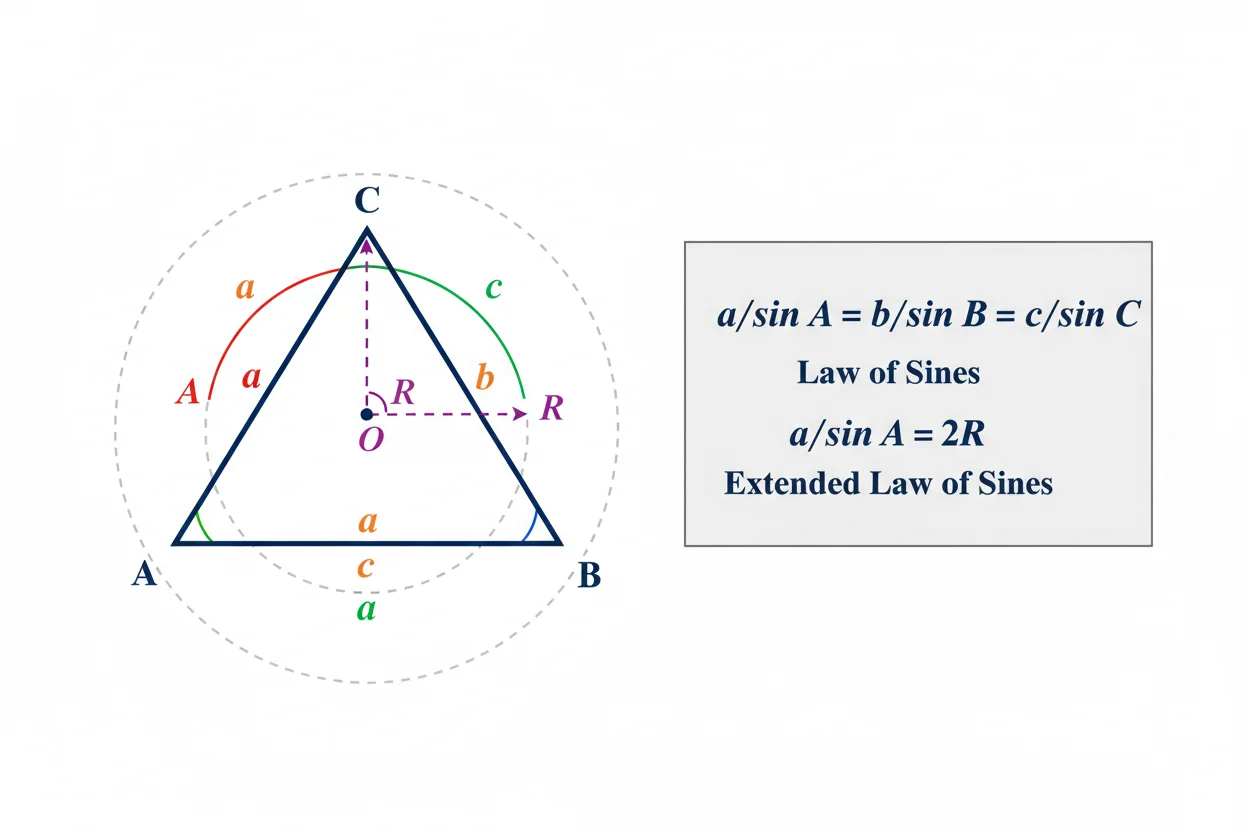

The Law of Sines relates each side of a triangle to the sine of its opposite angle. For a triangle with sides a, b, and c opposite angles A, B, and C, the formula is a/sin A = b/sin B = c/sin C. It is particularly useful when one complete side-angle opposite pair is known. This commonly occurs in ASA and AAS triangle problems and in some SSA problems. The formula can find missing sides or angles in acute, right, and obtuse triangles; it is not limited to right triangles. SSA requires special care because the same sine value can correspond to two supplementary angles, creating the ambiguous case. The Law of Sines also connects every triangle to its circumcircle through a/sin A = b/sin B = c/sin C = 2R, where R is the circumradius.
What Is the Law of Sines?
For any nondegenerate triangle:
a/sin A = b/sin B = c/sin C
where:
a is opposite A
b is opposite B
c is opposite C
The same relationship may be written reciprocally:
sin A/a = sin B/b = sin C/c
Both forms are equivalent.
Correctly matching each side with its opposite angle is the most important setup rule.
The Law of Sines complements the Law of Cosines, which is generally more direct for SAS and SSS data.
Side-Angle Correspondence
In triangle ABC:
side a ↔ angle A
side b ↔ angle B
side c ↔ angle C
A side and its opposite angle do not touch each other.
For example, side a lies across the triangle from vertex A.
If:
A = 40°
and:
a = 8
then:
8/sin40°
is a complete opposite side-angle pair.
That known pair can be compared with another pair to solve the triangle.
When to Use the Law of Sines
The Law of Sines is usually useful when the given data contain a known opposite side-angle pair.
Common configurations include:
ASA — Angle-Side-Angle
AAS — Angle-Angle-Side
SSA — Side-Side-Angle
ASA and AAS determine a unique triangle.
SSA may produce:
no triangle
one triangle
or:
two triangles
The Congruent Triangles criteria help explain why ASA and AAS uniquely determine size and shape while general SSA does not.
Basic Law of Sines Example
Suppose:
A = 30°
a = 5
B = 45°
Find side b.
Use:
a/sin A = b/sin B
Substitute:
5/sin30° = b/sin45°
Solve:
b = 5sin45°/sin30°
Using:
sin30° = 1/2
sin45° = √2/2
we obtain:
b = 5(√2/2)/(1/2)
Therefore:
b = 5√2
Approximately:
b ≈ 7.07
Find a Missing Side
The general relationship:
a/sin A = b/sin B
can be rearranged:
b = a sin B/sin A
Similarly:
c = a sin C/sin A
The known pair acts as the reference ratio.
Suppose:
A = 50°
a = 12
B = 70°
Then:
b = 12sin70°/sin50°
Approximately:
b ≈ 14.72
Finding the Third Angle First
In ASA or AAS problems, it is often useful to find the third angle before solving any missing sides.
Triangle Interior Angles satisfy:
A + B + C = 180°
Therefore:
C = 180° − A − B
For:
A = 40°
B = 65°
we get:
C = 75°
Now all three angle measures are known.
AAS Example
Suppose:
A = 40°
B = 65°
a = 10
First:
C = 180° − 40° − 65°
= 75°
Find b:
b = 10sin65°/sin40°
Approximately:
b ≈ 14.10
Find c:
c = 10sin75°/sin40°
Approximately:
c ≈ 15.03
The triangle is now completely solved.
ASA Example
Suppose:
A = 35°
C = 80°
b = 12
Find B:
B = 180° − 35° − 80°
= 65°
Now use:
b/sin B = a/sin A
So:
a = 12sin35°/sin65°
Approximately:
a ≈ 7.59
Similarly:
c = 12sin80°/sin65°
Approximately:
c ≈ 13.04
Finding a Missing Angle
If two sides and one opposite angle are known:
a/sin A = b/sin B
Rearrange:
sin B = b sin A/a
Then:
B = sin⁻¹(b sin A/a)
This is where the principal-value behavior of Inverse Trigonometric Functions becomes important.
Inverse sine alone gives one principal angle, but a second supplementary angle may also have the same sine.
Simple Missing-Angle Example
Suppose:
a = 10
A = 30°
b = 8
Then:
sin B = 8sin30°/10
= 8(1/2)/10
= 0.4
Principal solution:
B₁ = sin⁻¹(0.4)
Approximately:
B₁ ≈ 23.58°
A possible second angle is:
B₂ = 180° − 23.58°
≈ 156.42°
But this second angle must be tested against A.
Since:
30° + 156.42° > 180°
the second possibility is impossible.
Therefore only:
B ≈ 23.58°
works.
The SSA Ambiguous Case
SSA occurs when the known angle is not between the two known sides.
For example:
A
a
b
may be known.
Use:
sin B = b sin A/a
A sine value between 0 and 1 can correspond to:
B₁ = sin⁻¹(value)
and:
B₂ = 180° − B₁
Both can potentially fit the triangle.
This is called the ambiguous case.
Why Sine Creates Two Possible Angles
For angles between 0° and 180°:
sin θ = sin(180° − θ)
For example:
sin40° = sin140°
Therefore knowing only:
sin B = 0.6428
does not distinguish automatically between:
B = 40°
and:
B = 140°
The triangle’s remaining angle constraints determine whether one or both possibilities are valid.
SSA With Two Triangles
Suppose:
A = 30°
a = 10
b = 14
Then:
sin B = 14sin30°/10
= 0.7
First possibility:
B₁ = sin⁻¹(0.7)
≈ 44.43°
Second possibility:
B₂ = 180° − 44.43°
≈ 135.57°
Test each.
For B₁:
C₁ = 180° − 30° − 44.43°
≈ 105.57°
This is valid.
For B₂:
C₂ = 180° − 30° − 135.57°
≈ 14.43°
This is also positive.
Therefore two distinct triangles exist.
Completing the First SSA Triangle
Using:
C₁ ≈ 105.57°
and:
a = 10
find c₁:
c₁/sin105.57° = 10/sin30°
So:
c₁ = 10sin105.57°/sin30°
Approximately:
c₁ ≈ 19.27
The first triangle is approximately:
A = 30°
B = 44.43°
C = 105.57°
a = 10
b = 14
c = 19.27
Completing the Second SSA Triangle
For the second possibility:
C₂ ≈ 14.43°
Then:
c₂ = 10sin14.43°/sin30°
Approximately:
c₂ ≈ 4.99
The second triangle is approximately:
A = 30°
B = 135.57°
C = 14.43°
a = 10
b = 14
c = 4.99
The same original SSA data therefore produce two different triangles.
SSA With No Triangle
Suppose:
A = 30°
a = 5
b = 12
Then:
sin B = 12sin30°/5
= 6/5
= 1.2
But real sine values satisfy:
−1 ≤ sin B ≤ 1
Therefore no real angle B exists.
So the supplied measurements cannot form a triangle.
SSA With Exactly One Right Triangle
Suppose:
A = 30°
a = 5
b = 10
Then:
sin B = 10sin30°/5
= 1
Therefore:
B = 90°
There is only one possible value.
The remaining angle is:
C = 60°
So exactly one triangle exists.
Geometric SSA Height Test
For acute A with sides a opposite A and b adjacent to A, define altitude:
h = b sin A
Then several quick cases can occur.
If:
a < h
there is no triangle.
If:
a = h
there is one right triangle.
If:
h < a < b
there are two triangles.
If:
a ≥ b
there is typically one triangle.
This geometric test is a useful way to understand the ambiguous case before doing full calculations.
SSA Height Example
Suppose:
A = 30°
b = 14
Then:
h = 14sin30°
= 7
If:
a = 6
then:
a < h
so no triangle exists.
If:
a = 7
there is one right triangle.
If:
7 < a < 14
two triangles may exist.
This matches the behavior of inverse sine.
Why ASA and AAS Are Not Ambiguous
If two angles are known, the third is fixed because:
A + B + C = 180°
Once one corresponding side length is also known, the overall scale is fixed.
Therefore ASA and AAS determine a unique triangle.
There is no supplementary-angle ambiguity because all angle measures are already constrained.
Law of Sines Versus Law of Cosines
The Law of Cosines is generally preferred for:
SAS
SSS
The Law of Sines is generally preferred for:
ASA
AAS
and:
SSA
when a known opposite pair exists.
A problem may use both laws sequentially.
For example, Law of Cosines can first find a missing side, after which Law of Sines can efficiently find a remaining angle.
Combined Example
Suppose:
a = 7
b = 10
C = 60°
This is SAS, so Law of Cosines first gives:
c² = 7² + 10² − 2(7)(10)cos60°
= 79
Therefore:
c = √79
Now use Law of Sines:
sin A/a = sin C/c
So:
sin A = 7sin60°/√79
Then:
A = sin⁻¹[7sin60°/√79]
Once A is known:
B = 180° − A − 60°
Each formula is used where it is strongest.
Law of Sines and Right Triangles
The Law of Sines also works for Right Triangles.
Suppose:
C = 90°
Then:
sin C = 1
So:
c/sin90° = c
If c is the hypotenuse:
a/sin A = c
Therefore:
sin A = a/c
This is exactly the ordinary right-triangle sine definition:
sin A = opposite/hypotenuse
The Law of Sines therefore extends familiar right-triangle trigonometry to all triangles.
Right Triangle Example
Suppose:
c = 13
C = 90°
A = 22.62°
Then:
a/sin22.62° = 13/1
Therefore:
a = 13sin22.62°
Approximately:
a ≈ 5
The familiar 5-12-13 triangle is recovered.
Law of Sines and Sine
The Sine function controls how a side compares with the triangle’s common circumdiameter.
In:
a/sin A = b/sin B = c/sin C
larger angles correspond to larger opposite sides.
Within a triangle:
A > B
implies:
a > b
This ordering relationship provides a useful reasonableness check.
Largest Angle and Largest Side
Suppose:
A = 80°
B = 60°
C = 40°
Then:
a > b > c
because the sides follow the same ordering as their opposite angles.
If a calculation produces the smallest side opposite the largest angle, a side-angle correspondence or arithmetic error has likely occurred.
Extended Law of Sines
The Law of Sines has an important extended form:
a/sin A = b/sin B = c/sin C = 2R
where:
R = circumradius
The circumradius is the radius of the circle passing through all three triangle vertices.
Thus:
a = 2R sin A
b = 2R sin B
c = 2R sin C
This connects triangle trigonometry directly with circle geometry.
Find Circumradius From One Side-Angle Pair
From:
a/sin A = 2R
solve:
R = a/(2sin A)
Suppose:
a = 10
A = 30°
Then:
R = 10/[2(1/2)]
Therefore:
R = 10
The triangle’s circumcircle has radius 10.
Find a Side From Circumradius
Suppose:
R = 8
A = 45°
Then:
a = 2R sin A
= 16sin45°
= 16(√2/2)
Therefore:
a = 8√2
This is the chord subtended by central geometry associated with the triangle’s circumcircle.
Law of Sines and Circle Chords
Every side of an inscribed triangle is a chord of its circumcircle.
For chord a opposite inscribed angle A:
a = 2R sin A
This is consistent with the Chord Length formula because the corresponding central angle is:
2A
The chord formula gives:
a = 2R sin[(2A)/2]
Therefore:
a = 2R sin A
This is exactly the extended Law of Sines.
Circumcircle Example
Suppose an inscribed triangle has:
A = 60°
and circumradius:
R = 5
Then:
a = 2(5)sin60°
= 10(√3/2)
Therefore:
a = 5√3
The side opposite the 60° angle is a chord of the circumcircle.
Triangle Area and the Law of Sines
The triangle area formula:
K = ab sin C/2
can be combined with the Law of Sines.
Since:
sin C = c/(2R)
we obtain:
K = ab[c/(2R)]/2
Therefore:
K = abc/(4R)
This useful identity relates:
area K
three side lengths
circumradius R
Find Circumradius From Area
From:
K = abc/(4R)
solve:
R = abc/(4K)
Suppose a 3-4-5 triangle has:
K = 6
Then:
R = 3·4·5/(4·6)
= 60/24
Therefore:
R = 2.5
For a right triangle, this equals half the hypotenuse:
5/2 = 2.5
Law of Sines and Heron’s Formula
If all three sides are known, Heron Formula gives area:
K = √[s(s − a)(s − b)(s − c)]
The area can then be combined with:
R = abc/(4K)
to obtain the circumradius.
This is useful when no angle is initially given.
The Law of Sines and Heron’s formula therefore complement each other without serving the same primary purpose.
Law of Sines and Kite Geometry
A diagonal can divide a Kite Area problem into triangles.
If one resulting triangle provides an opposite side-angle pair, the Law of Sines can determine another side or angle.
Those dimensions may then help calculate:
A = d₁d₂/2
or:
A = ab sinθ
depending on the data.
The Law of Sines solves the triangle component rather than replacing the kite-area formula.
Law of Sines and Line Geometry
Coordinates can create triangles from points and lines.
A Line From Two Points determines the line through two vertices, while the Distance Formula determines side lengths.
Once one angle and its opposite side are known, the Law of Sines can solve remaining triangle measurements.
This is useful when coordinate geometry and classical triangle geometry appear in the same problem.
Line Intersection and Triangle Construction
A Line Intersection can provide the third vertex of a triangle formed by two known lines.
After finding that point, side lengths can be calculated from coordinates.
Angles can then be found with inverse trigonometry, Law of Cosines, or Law of Sines depending on the available measurements.
The intersection operation identifies the vertex; the triangle formulas analyze the resulting geometry.
Law of Sines With Exterior Angles
A triangle Exterior Angles problem may give an exterior angle instead of an interior angle.
If exterior angle E is adjacent to interior angle C:
C = 180° − E
Once the actual interior angle is found, it can be used in the Law of Sines.
For example:
E = 120°
gives:
C = 60°
Then:
c/sin60°
can form an opposite pair.
Exterior-Angle Example
Suppose:
exterior angle at C = 120°
c = 12
A = 40°
Then:
C = 60°
Find B:
B = 180° − 40° − 60°
= 80°
Now:
b/sin80° = 12/sin60°
Therefore:
b = 12sin80°/sin60°
Approximately:
b ≈ 13.65
Degrees and Radians
The Law of Sines works with angles in degrees or radians.
For example:
30° = π/6
so:
sin30° = sin(π/6) = 1/2
The conversion rules in Degrees and Radians must match the calculator’s angle setting.
The formula itself does not change.
Radian Example
Suppose:
A = π/6
a = 4
B = π/3
Then:
b = 4sin(π/3)/sin(π/6)
= 4(√3/2)/(1/2)
Therefore:
b = 4√3
The result is exactly the same as using:
A = 30°
B = 60°
Law of Sines and Similar Triangles
Similar Triangles have equal corresponding angles and proportional corresponding sides.
If two triangles share the same angles, their sine values are the same.
The quantities:
a/sin A
scale with the overall triangle size.
Within any one triangle, however, all three side-to-sine ratios are equal.
This distinguishes internal Law-of-Sines proportionality from proportionality between separate similar triangles.
Numerical Accuracy
When finding a side:
b = a sin B/sin A
retain enough calculator precision until the final result.
When finding an angle:
B = sin⁻¹(b sin A/a)
avoid rounding the intermediate sine value aggressively.
In the ambiguous case, a small rounding error can affect whether:
A + B < 180°
appears to hold near a boundary.
Keep full precision until the triangle possibilities have been tested.
Common Law of Sines Mistakes
A common mistake is pairing a side with the wrong angle.
Remember:
a ↔ A
b ↔ B
c ↔ C
Another error is using the Law of Sines when no opposite side-angle pair is known. For SAS or SSS, the Law of Cosines is normally the correct starting point.
SSA must be checked for the ambiguous case.
A calculator’s inverse sine returns only a principal value, not automatically every possible triangle angle.
All triangle angles must remain positive and total:
180°
Real sine inputs must lie between:
−1 and 1
Finally, verify degree or radian mode before evaluating trigonometric expressions.
Frequently Asked Questions
What is the Law of Sines?
a/sin A = b/sin B = c/sin C
Which side goes with angle A?
Side a, which lies opposite angle A.
When should I use the Law of Sines?
It is especially useful for ASA, AAS, and certain SSA triangle problems.
Can the Law of Sines be used for right triangles?
Yes. It reduces naturally to ordinary right-triangle sine relationships.
Can it be used for obtuse triangles?
Yes.
What is the ambiguous case?
SSA data can sometimes produce two valid triangles because:
sin θ = sin(180° − θ)
Can SSA produce no triangle?
Yes, if the calculated sine of an angle exceeds 1 or if the geometric dimensions cannot form a triangle.
How do you find a missing side?
For example:
b = a sin B/sin A
How do you find a missing angle?
B = sin⁻¹(b sin A/a)
followed by checking whether a supplementary angle is also valid.
What is the extended Law of Sines?
a/sin A = b/sin B = c/sin C = 2R
where R is the circumradius.
How do you find circumradius?
R = a/(2sin A)
using any known opposite side-angle pair.
How is the Law of Sines related to chord length?
Every triangle side is a chord of its circumcircle, giving:
a = 2R sin A
What is the difference between Law of Sines and Law of Cosines?
Law of Sines is generally most direct when a known opposite side-angle pair exists. Law of Cosines is generally most direct for SAS and SSS.
How can I check a Law of Sines answer?
Verify side-angle correspondence, confirm the largest angle is opposite the largest side, make sure all angles are positive and total 180°, and test the supplementary angle whenever SSA creates a possible ambiguous case.