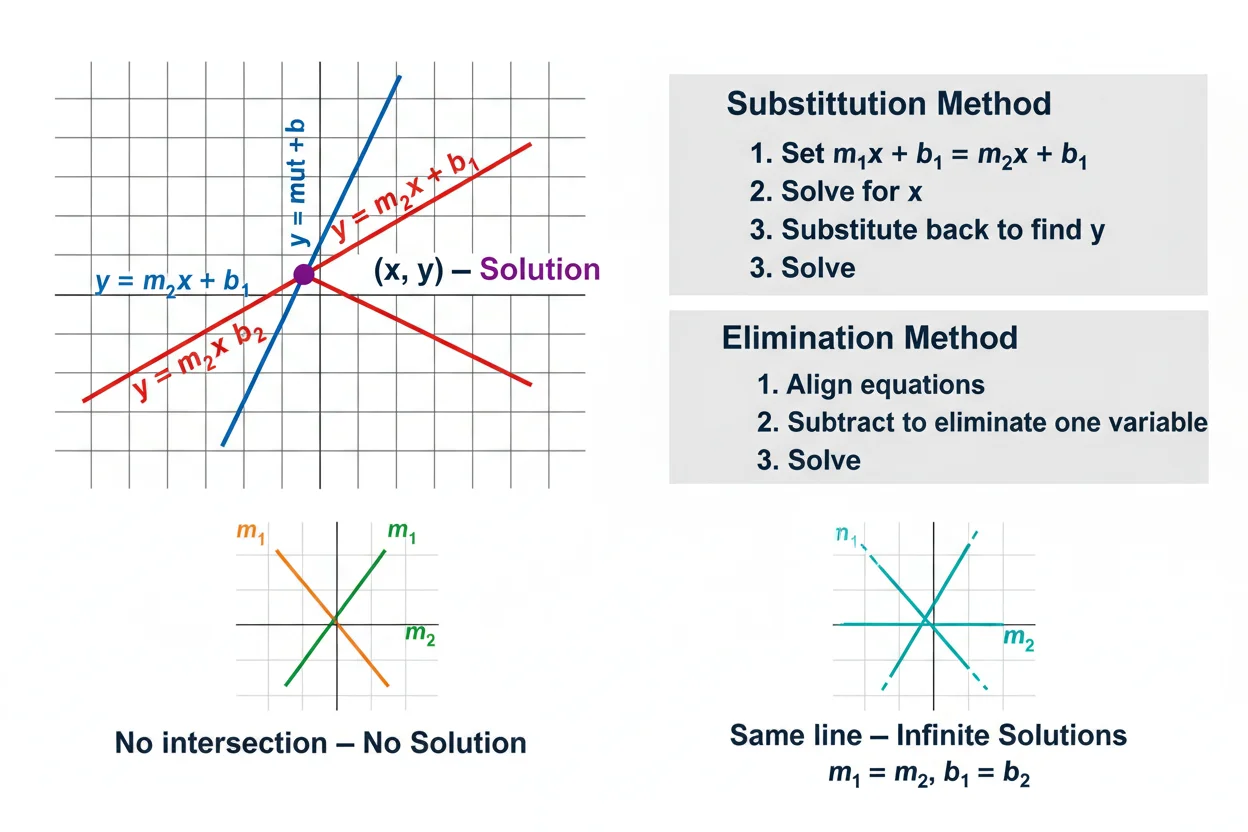

A line intersection is a point that satisfies the equations of two lines at the same time. For two nonparallel lines in a plane, there is exactly one intersection point. If the lines are written as y = m₁x + b₁ and y = m₂x + b₂, their intersection can be found by setting the two expressions for y equal: m₁x + b₁ = m₂x + b₂. Solving for x and substituting back gives the corresponding y-coordinate. Lines with equal slopes and different intercepts are parallel and have no intersection, while equations describing the same line have infinitely many common points. Standard-form equations can be solved by substitution, elimination, or a direct determinant formula. Line intersection is fundamental in coordinate geometry because it identifies where paths, boundaries, diagonals, graphs, and linear relationships meet.
What Is a Line Intersection?
Suppose two lines are:
L₁
and:
L₂
A point:
P = (x, y)
is their intersection if P satisfies both equations.
For example:
y = 2x + 1
and:
y = −x + 7
intersect where both expressions produce the same y-value.
Set them equal:
2x + 1 = −x + 7
Then:
3x = 6
so:
x = 2
Substitute:
y = 2(2) + 1
= 5
Therefore the line intersection is:
(2, 5)
Basic Line Intersection Formula
For two lines:
y = m₁x + b₁
y = m₂x + b₂
set:
m₁x + b₁ = m₂x + b₂
Rearrange:
(m₁ − m₂)x = b₂ − b₁
If:
m₁ ≠ m₂
then:
x = (b₂ − b₁)/(m₁ − m₂)
Then substitute x into either original equation:
y = m₁x + b₁
or:
y = m₂x + b₂
This gives the unique intersection point.
Example Using the Direct Formula
Consider:
y = 3x − 4
and:
y = −2x + 11
Here:
m₁ = 3
b₁ = −4
m₂ = −2
b₂ = 11
Then:
x = [11 − (−4)]/[3 − (−2)]
= 15/5
= 3
Substitute:
y = 3(3) − 4
= 5
Therefore:
intersection = (3, 5)
Check the Intersection
A correct intersection must satisfy both equations.
First line:
5 = 3(3) − 4
5 = 5
Second line:
5 = −2(3) + 11
5 = 5
Because both equations are satisfied, the intersection is verified.
Substitution Method
Substitution works especially well when one equation is already solved for one variable.
Suppose:
y = 4x − 3
and:
2x + y = 12
Substitute:
y = 4x − 3
into the second equation:
2x + 4x − 3 = 12
Then:
6x = 15
so:
x = 5/2
Now:
y = 4(5/2) − 3
= 10 − 3
Therefore:
y = 7
The intersection is:
(5/2, 7)
Elimination Method
Elimination is often convenient when both equations are in standard form.
Suppose:
2x + 3y = 13
4x − 3y = 5
Add the equations:
6x = 18
Therefore:
x = 3
Substitute into:
2x + 3y = 13
Then:
6 + 3y = 13
3y = 7
So:
y = 7/3
Therefore:
intersection = (3, 7/3)
Standard Form
A line can be written:
Ax + By = C
Suppose two lines are:
A₁x + B₁y = C₁
A₂x + B₂y = C₂
These equations form a two-variable linear system.
The intersection is exactly the solution of that system.
This connects coordinate geometry with the broader algebra of simultaneous equations.
Direct Standard-Form Formula
Define:
D = A₁B₂ − A₂B₁
If:
D ≠ 0
the lines have one intersection.
The coordinates are:
x = (C₁B₂ − C₂B₁)/D
and:
y = (A₁C₂ − A₂C₁)/D
These formulas are equivalent to solving the system by elimination.
Standard-Form Example
Consider:
2x + y = 8
x − y = 1
Here:
A₁ = 2, B₁ = 1, C₁ = 8
A₂ = 1, B₂ = −1, C₂ = 1
Compute:
D = 2(−1) − 1(1)
= −3
Then:
x = [8(−1) − 1(1)]/(−3)
= −9/−3
= 3
For y:
y = [2(1) − 1(8)]/(−3)
= −6/−3
= 2
Therefore:
intersection = (3, 2)
Why Two Nonparallel Lines Intersect Once
Two distinct nonparallel lines have different directions.
In slope-intercept form:
y = m₁x + b₁
y = m₂x + b₂
with:
m₁ ≠ m₂
their vertical difference is:
(m₁ − m₂)x + (b₁ − b₂)
Because the coefficient of x is nonzero, this difference equals zero for exactly one x-value.
That x-value produces the unique line intersection.
Parallel Lines
Two different nonvertical lines are parallel when:
m₁ = m₂
but:
b₁ ≠ b₂
For example:
y = 3x + 2
y = 3x − 5
Set them equal:
3x + 2 = 3x − 5
Subtract 3x:
2 = −5
This contradiction means there is:
no intersection
The lines remain the same distance apart.
Coincident Lines
Sometimes two equations describe the same line.
For example:
2x + 4y = 8
and:
x + 2y = 4
Multiplying the second equation by 2 gives the first.
Therefore every point on one line lies on the other.
The system has:
infinitely many solutions
There is no single unique line intersection.
One Solution, No Solution, or Infinitely Many
Two lines in the same plane can have three possible relationships.
If their directions differ:
one intersection
If they are distinct and parallel:
no intersection
If they represent the same line:
infinitely many common points
These cases correspond directly to the possible outcomes of a two-equation linear system.
Determinant Test
For:
A₁x + B₁y = C₁
A₂x + B₂y = C₂
calculate:
D = A₁B₂ − A₂B₁
If:
D ≠ 0
there is one unique intersection.
If:
D = 0
the lines are either parallel or coincident.
Additional comparison of the coefficients and constants determines which case applies.
Vertical and Nonvertical Line Intersection
A vertical line has equation:
x = a
Suppose:
x = 4
and:
y = 2x − 3
Substitute:
x = 4
Then:
y = 2(4) − 3
= 5
Therefore:
intersection = (4, 5)
No slope for the vertical line is required.
Horizontal and Vertical Lines
Suppose:
x = −2
and:
y = 7
These lines intersect immediately at:
(−2, 7)
A vertical and horizontal line are perpendicular.
Their coordinate equations make the intersection visible without algebra.
Two Vertical Lines
Consider:
x = 3
and:
x = 8
These are distinct parallel vertical lines.
Therefore:
no intersection
If both equations were:
x = 3
they would represent the same line and have infinitely many common points.
Two Horizontal Lines
Consider:
y = 4
and:
y = −1
They have equal zero slopes and different intercepts.
Therefore they are parallel and have:
no intersection
If both equations simplify to:
y = 4
they coincide.
Finding the Lines First
Sometimes a problem gives two pairs of points rather than two line equations.
First construct each Line From Two Points.
For nonvertical points:
m = (y₂ − y₁)/(x₂ − x₁)
Then write:
y − y₁ = m(x − x₁)
After both line equations are established, solve them simultaneously to find their intersection.
Intersection of Two Point-Defined Lines
Line 1 passes through:
A = (0, 1)
B = (4, 9)
Its slope is:
m₁ = (9 − 1)/(4 − 0)
= 2
So:
y = 2x + 1
Line 2 passes through:
C = (0, 7)
D = (6, 1)
Its slope is:
m₂ = (1 − 7)/(6 − 0)
= −1
So:
y = −x + 7
Set equal:
2x + 1 = −x + 7
Then:
3x = 6
so:
x = 2
and:
y = 5
Therefore:
intersection = (2, 5)
Point-Slope Form and Intersection
Two lines may be supplied in Point-Slope Form.
For example:
y − 2 = 3(x − 1)
and:
y + 1 = −2(x − 4)
Simplify the first:
y = 3x − 1
Simplify the second:
y = −2x + 7
Set them equal:
3x − 1 = −2x + 7
Then:
5x = 8
so:
x = 8/5
Substitute:
y = 3(8/5) − 1
= 19/5
Therefore:
intersection = (8/5, 19/5)
Graphical Interpretation
On a coordinate graph, the line intersection is the point where the two line graphs cross.
Graphing can provide a useful visual estimate.
For example, the lines:
y = 2x + 1
and:
y = −x + 7
visually cross at:
(2, 5)
For exact answers, algebraic methods are generally preferable to reading coordinates from a graph.
Intersection as a Shared Solution
Suppose:
P = (3, 4)
lies on two lines.
Then substituting P into both equations must produce true statements.
This provides a general verification rule:
intersection point ⇒ solution of equation 1 and equation 2
Conversely, any ordered pair satisfying both line equations is an intersection point.
Line Intersection and Midpoints
A Midpoint Formula becomes especially important when diagonals intersect.
In a parallelogram, the diagonals bisect each other.
Therefore their intersection is the midpoint of both diagonals.
This can provide a faster geometric solution than solving both diagonal equations explicitly.
Parallelogram Diagonal Intersection
Suppose parallelogram vertices include opposite points:
A = (1, 2)
C = (9, 8)
The midpoint of diagonal AC is:
M = ((1 + 9)/2, (2 + 8)/2)
= (5, 5)
Because parallelogram diagonals bisect one another, the other diagonal must also pass through:
(5, 5)
Thus their line intersection is known immediately.
Verifying a Parallelogram With Diagonals
If quadrilateral diagonals have the same midpoint, the quadrilateral is a parallelogram under the usual nondegenerate vertex arrangement.
Suppose:
midpoint AC = (4, 3)
and:
midpoint BD = (4, 3)
Then the diagonals bisect each other.
Their intersection is:
(4, 3)
The geometric property can therefore replace a longer simultaneous-equation calculation.
Line Intersection and Parallelogram Area
A Parallelogram Area problem may be defined by intersecting lines or coordinate vertices.
Finding intersections can identify the parallelogram’s vertices.
Once the vertices are known, base-height, determinant, or coordinate methods can determine area.
Line intersection finds the boundary points; it does not itself provide the area.
Intersection of Triangle Sides
The lines containing two sides of a triangle intersect at a vertex.
If two side lines are given algebraically, solving their intersection identifies that vertex.
Once all three triangle vertices are known, side lengths can be calculated with the Distance Formula.
The triangle can then be analyzed using the Law of Cosines or Law of Sines when appropriate.
Example: Create a Triangle From Three Lines
Suppose:
L₁: y = x
L₂: y = −x + 4
L₃: y = 0
Intersect L₁ and L₃:
x = 0
giving:
(0, 0)
Intersect L₂ and L₃:
−x + 4 = 0
so:
x = 4
giving:
(4, 0)
Intersect L₁ and L₂:
x = −x + 4
2x = 4
x = 2
Then:
y = 2
giving:
(2, 2)
These three intersections form the triangle’s vertices.
Line Intersection and Perpendicular Lines
Two nonvertical perpendicular lines satisfy:
m₁m₂ = −1
If:
m₁ = 2
then:
m₂ = −1/2
Such lines are guaranteed to intersect unless one is an impossible duplicate representation.
For example:
y = 2x + 1
and:
y = −x/2 + 6
have one unique intersection.
Perpendicular Intersection Example
Set:
2x + 1 = −x/2 + 6
Multiply by 2:
4x + 2 = −x + 12
Then:
5x = 10
so:
x = 2
Therefore:
y = 5
The lines meet at:
(2, 5)
Because their slopes multiply to −1, the angle at the intersection is 90°.
Intersection and Angles Between Lines
For slopes m₁ and m₂, the acute angle θ between nonvertical lines can satisfy:
tanθ = |(m₂ − m₁)/(1 + m₁m₂)|
when:
1 + m₁m₂ ≠ 0
If:
m₁m₂ = −1
the lines are perpendicular and:
θ = 90°
The intersection coordinate tells where the lines meet; their slopes tell how they meet.
These are separate pieces of geometric information.
Intersection With the x-Axis
The x-axis is:
y = 0
To find where:
y = mx + b
intersects it, set:
0 = mx + b
Therefore:
x = −b/m
when:
m ≠ 0
The intersection point is:
(−b/m, 0)
This is the x-intercept.
Intersection With the y-Axis
The y-axis is:
x = 0
Substitute into:
y = mx + b
Then:
y = b
Therefore the line intersects the y-axis at:
(0, b)
This is the y-intercept.
Segment Intersection Versus Line Intersection
An infinite line extends forever in both directions.
A line segment includes only points between two endpoints.
Two infinite lines may intersect even when their finite segments do not.
For example, the supporting lines of two short segments might meet far outside both segment ranges.
If the problem concerns segments, first find the line intersection and then verify that the point lies within both segments.
Checking Whether an Intersection Lies on a Segment
Suppose segment AB has endpoints:
A = (x₁,y₁)
B = (x₂,y₂)
A candidate point P must lie on line AB and have coordinates within the endpoint bounds:
min(x₁,x₂) ≤ x_P ≤ max(x₁,x₂)
and:
min(y₁,y₂) ≤ y_P ≤ max(y₁,y₂)
with appropriate care for vertical or horizontal segments.
This converts an infinite-line solution into a segment-intersection test.
Intersection and Linear Systems
Every pair of line equations in two variables can be interpreted geometrically.
One algebraic solution:
one line intersection
No algebraic solution:
distinct parallel lines
Infinitely many solutions:
coincident lines
This geometric interpretation makes simultaneous linear equations easier to visualize.
Exact Fractions Versus Decimals
Suppose a line intersection is:
(7/3, 11/5)
These fractions are exact.
Decimal versions:
(2.333…, 2.2)
may be easier to visualize but can lose precision.
Unless a decimal is required, retaining exact fractions often makes subsequent geometric calculations more accurate.
Common Line Intersection Mistakes
A common mistake is equating slopes instead of equating the full line expressions.
For:
y = m₁x + b₁
and:
y = m₂x + b₂
the intersection satisfies:
m₁x + b₁ = m₂x + b₂
Another error is declaring every equal-slope pair coincident. Equal slopes with different intercepts mean parallel lines.
Vertical lines require special handling because their slopes are undefined.
When using elimination, apply multiplication to every term in an equation.
When using substitution, verify the final point in both original equations.
If working with finite segments, an intersection of the infinite supporting lines may lie outside the actual segments.
Finally, distinguish the coordinates of the intersection from related quantities such as slope, midpoint, distance, or angle.
Frequently Asked Questions
What is a line intersection?
It is a point that lies on two lines and satisfies both line equations.
How do you find the intersection of y = m₁x + b₁ and y = m₂x + b₂?
Set:
m₁x + b₁ = m₂x + b₂
Then solve for x and substitute to find y.
What is the direct x formula?
If:
m₁ ≠ m₂
then:
x = (b₂ − b₁)/(m₁ − m₂)
What if the slopes are equal?
If the intercepts differ, the lines are parallel and do not intersect. If the equations describe the same line, they have infinitely many common points.
Can substitution find a line intersection?
Yes.
Can elimination find a line intersection?
Yes, especially when the equations are in standard form.
How do you intersect a vertical line with another line?
Substitute the vertical line’s fixed x-value into the other equation.
What is the intersection of x = a and y = b?
(a, b)
How can I check an intersection?
Substitute the coordinates into both original equations. Both must be true.
How is line intersection related to a linear system?
The intersection point is the simultaneous solution of the two equations.
Do the diagonals of a parallelogram intersect at their midpoints?
Yes. Parallelogram diagonals bisect each other.
Can two line segments fail to intersect even if their lines intersect?
Yes. The infinite lines may meet outside the endpoint ranges of one or both segments.
How can I tell whether two standard-form lines have one intersection?
For:
A₁x + B₁y = C₁
A₂x + B₂y = C₂
calculate:
D = A₁B₂ − A₂B₁
If:
D ≠ 0
there is one unique intersection.
How can I check the overall calculation?
Verify the final point in both equations, compare slopes to confirm the expected geometric relationship, and keep exact fractions until the final step when possible.