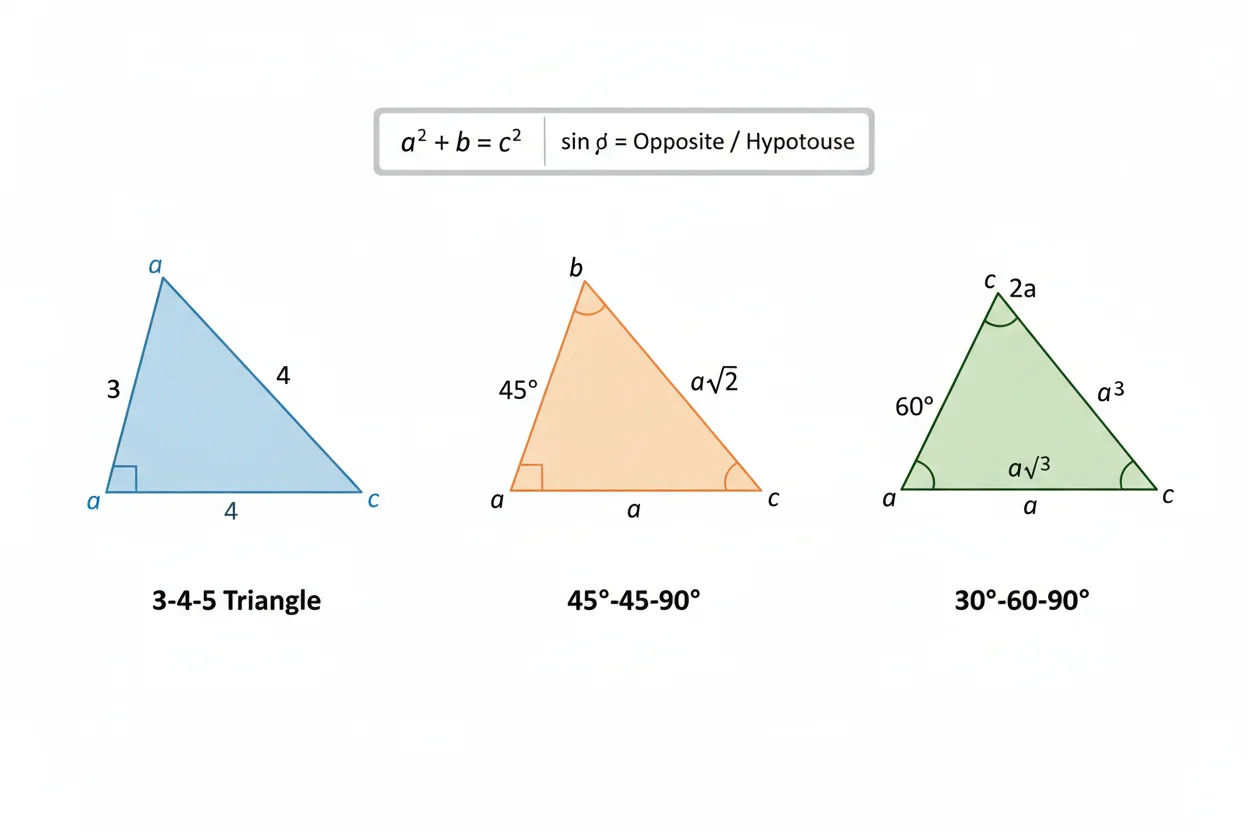

Right triangles are triangles with one interior angle equal to 90°. The two sides that form the right angle are called legs, while the side opposite the right angle is the hypotenuse. Their defining side relationship is a² + b² = c², where a and b are the legs and c is the hypotenuse. Right triangles also form the foundation of elementary trigonometry because sine, cosine, and tangent connect their acute angles to ratios of side lengths. Their area is A = ab/2, their perimeter is P = a + b + c, and their two acute angles are complementary. Important families include 45-45-90 and 30-60-90 triangles, while integer-sided examples such as 3-4-5 and 5-12-13 are known as Pythagorean triples. Right triangles appear throughout coordinate geometry, distance calculations, slopes, circles, polygons, construction, surveying, and three-dimensional geometry.
What Are Right Triangles?
A right triangle contains exactly one:
90° angle
The two sides meeting at that angle are:
legs
The opposite side is the:
hypotenuse
If the side lengths are labeled:
a, b, c
with c opposite the right angle, then:
c is the hypotenuse
and:
a and b are the legs
The dedicated Right Triangle calculation page focuses on solving one triangle from particular measurements, while this broader right triangles overview explains the shared structure and relationships across the entire class.
Angle Structure of Right Triangles
Every triangle has interior-angle sum:
180°
A right triangle already contains:
90°
Therefore its other two angles satisfy:
A + B = 90°
The acute angles are complementary.
For example, if:
A = 32°
then:
B = 90° − 32°
Therefore:
B = 58°
This follows directly from the general Interior Angles relationship.
Can a Right Triangle Have Two Right Angles?
No.
Two 90° angles would already total:
180°
leaving no positive angle for the third vertex.
Therefore every nondegenerate Euclidean right triangle has:
exactly one right angle
and:
exactly two acute angles
Pythagorean Relationship
The defining side relationship is the Pythagorean Theorem:
a² + b² = c²
This lets you find any missing side when the other two are known.
If both legs are known:
c = √(a² + b²)
If the hypotenuse and leg b are known:
a = √(c² − b²)
Basic 3-4-5 Right Triangle
Suppose:
a = 3
b = 4
Then:
c = √(3² + 4²)
= √25
Therefore:
c = 5
The triangle has side lengths:
3, 4, 5
and satisfies:
3² + 4² = 5²
5-12-13 Example
For:
a = 5
b = 12
we obtain:
c = √(25 + 144)
= √169
Therefore:
c = 13
This is another common integer-sided right triangle.
Converse of the Pythagorean Theorem
The relationship can also test whether a triangle is right.
Let c be the longest side.
If:
a² + b² = c²
then the triangle is right.
For:
7, 24, 25
we have:
49 + 576 = 625
and:
25² = 625
Therefore the triangle is right.
Classifying a Triangle From Its Sides
With c as the longest side:
c² < a² + b² → acute
c² = a² + b² → right
c² > a² + b² → obtuse
This classification comes from the Law of Cosines.
For sides:
4, 5, 7
we have:
49 > 16 + 25
so the triangle is obtuse rather than right.
Area of Right Triangles
The two legs are perpendicular.
Therefore one leg can serve as the base and the other as the corresponding height.
The area formula is:
A = ab/2
For:
a = 8
b = 15
we get:
A = 8(15)/2
Therefore:
A = 60
square units.
This is a special case of the general Triangle Area formula.
Perimeter of Right Triangles
The perimeter is:
P = a + b + c
For a:
3-4-5
triangle:
P = 3 + 4 + 5
Therefore:
P = 12
The broader Perimeter principle is simply to add all outer side lengths.
Area When One Leg Is Missing
Suppose:
c = 13
a = 5
First find:
b = √(13² − 5²)
= 12
Then:
A = 5(12)/2
Therefore:
A = 30
This pattern combines the Pythagorean theorem with the area formula.
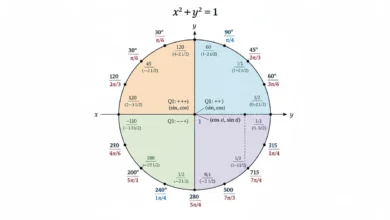
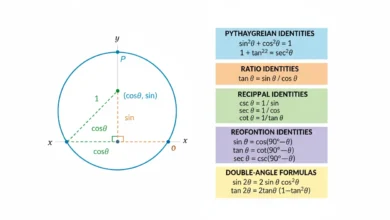
Right-Triangle Trigonometry
For an acute angle θ:
sinθ = opposite/hypotenuse
cosθ = adjacent/hypotenuse
tanθ = opposite/adjacent
These relationships allow angles and sides to be calculated from partial information.
The words “opposite” and “adjacent” depend on which acute angle is chosen.
The hypotenuse does not change.
Sine Example
Suppose:
opposite = 5
hypotenuse = 13
Then:
sinθ = 5/13
Therefore:
θ = sin⁻¹(5/13)
Approximately:
θ ≈ 22.62°
The Sine ratio connects the selected angle with the opposite leg.
Cosine Example
In the same 5-12-13 triangle:
adjacent = 12
hypotenuse = 13
Therefore:
cosθ = 12/13
and:
θ = cos⁻¹(12/13)
≈ 22.62°
The Cosine calculation confirms the same angle.
Tangent Example
Using the legs:
tanθ = 5/12
Therefore:
θ = tan⁻¹(5/12)
≈ 22.62°
The Tangent ratio is especially useful when the hypotenuse is unknown or unnecessary.
Inverse Trigonometry
When a side ratio is known and an angle is required:
θ = sin⁻¹(opposite/hypotenuse)
θ = cos⁻¹(adjacent/hypotenuse)
θ = tan⁻¹(opposite/adjacent)
The Inverse Trigonometric Functions recover an angle from a known ratio.
Because a right triangle’s non-right angles are acute, the principal inverse values normally give the required angle directly.
Find Sides From an Angle and Hypotenuse
Suppose:
c = 20
θ = 30°
Opposite leg:
a = 20sin30°
= 10
Adjacent leg:
b = 20cos30°
= 10√3
Therefore the side lengths are:
10, 10√3, 20
This is a 30-60-90 triangle.
Find a Side Using Tangent
Suppose:
θ = 40°
adjacent = 12
Then:
tan40° = opposite/12
So:
opposite = 12tan40°
Approximately:
opposite ≈ 10.07
The hypotenuse can then be found by the Pythagorean theorem if required.
Reciprocal Trigonometric Ratios
Right triangles also define:
secθ = hypotenuse/adjacent
cscθ = hypotenuse/opposite
cotθ = adjacent/opposite
The Secant function is the reciprocal of cosine:
secθ = 1/cosθ
These reciprocal functions contain the same side information in different forms.
Secant Example
In a 5-12-13 right triangle, let θ be adjacent to the side of length 12.
Then:
cosθ = 12/13
so:
secθ = 13/12
Both ratios describe the same angle-side relationship.
45-45-90 Right Triangles
A 45-45-90 triangle has angles:
45°, 45°, 90°
The two legs are equal.
If each leg equals x:
c = x√2
Therefore the side ratio is:
1 : 1 : √2
These triangles appear naturally in squares and diagonal problems.
45-45-90 Example
Suppose the legs are:
7 and 7
Then:
c = 7√2
Area:
A = 49/2
Perimeter:
P = 14 + 7√2
No decimal approximation is necessary unless requested.
Square Diagonal Connection
A square diagonal divides the square into two congruent 45-45-90 triangles.
For square side s:
d = s√2
If:
s = 10
then:
d = 10√2
The Rectangle Area of this square is:
100
while the diagonal relationship comes from right-triangle geometry.
30-60-90 Right Triangles
A 30-60-90 triangle has side ratio:
1 : √3 : 2
where:
shortest leg is opposite 30°
longer leg is opposite 60°
hypotenuse is opposite 90°
If the shortest leg is x:
longer leg = x√3
hypotenuse = 2x
30-60-90 Example
Suppose:
hypotenuse = 18
Then:
2x = 18
so:
x = 9
Longer leg:
9√3
Therefore the sides are:
9, 9√3, 18
Equilateral Triangle Connection
Drawing an altitude in an equilateral triangle divides it into two 30-60-90 right triangles.
For equilateral side s:
half-base = s/2
hypotenuse = s
Therefore altitude:
h = s√3/2
This relationship contributes to the general Regular Polygon Area framework.
Pythagorean Triples
A Pythagorean triple consists of positive integers satisfying:
a² + b² = c²
Common examples include:
3-4-5
5-12-13
7-24-25
8-15-17
9-40-41
Multiplying all three numbers by the same positive factor creates another right triangle.
Similar Right Triangles
Two right triangles are similar if they share one corresponding acute angle.
They already both contain:
90°
so one additional equal angle forces the third angles to be equal.
The triangles then satisfy the general Similar Triangles principle:
corresponding sides are proportional
Similarity Example
Suppose one right triangle is:
3-4-5
A similar triangle has hypotenuse:
25
Scale factor:
25/5 = 5
Therefore its legs are:
15
and:
20
The new triangle remains right because similarity preserves angles.
Altitude to the Hypotenuse
Drop a perpendicular altitude from the right-angle vertex to the hypotenuse.
This creates two smaller right triangles that are similar to the original and to each other.
If the altitude divides the hypotenuse into segments:
p
and:
q
then:
p + q = c
Important relationships are:
h² = pq
a² = cp
b² = cq
Geometric Mean Example
Suppose:
p = 4
q = 9
Then:
c = 13
Altitude:
h = √(4·9)
= 6
One leg:
a = √(13·4)
= 2√13
Other leg:
b = √(13·9)
= 3√13
Area Using Hypotenuse and Its Altitude
The ordinary leg formula gives:
A = ab/2
The hypotenuse can also serve as a base:
A = ch/2
where h is the perpendicular altitude to c.
Therefore:
ab = ch
and:
h = ab/c
For a 3-4-5 triangle:
h = 12/5
Circumcircle of a Right Triangle
A right triangle inscribed in a circle has its hypotenuse as a diameter.
Therefore its circumradius is:
R = c/2
For:
c = 10
we get:
R = 5
The midpoint of the hypotenuse is equidistant from all three triangle vertices.
Midpoint of the Hypotenuse
Suppose hypotenuse endpoints are:
A = (0,0)
B = (6,8)
The Midpoint Formula gives:
M = (3,4)
Hypotenuse length:
10
So:
MA = MB = 5
If C is the right-angle vertex:
MC = 5
as well.
Coordinate Right Triangles
Coordinate axes naturally create right angles.
Suppose points are:
A = (1,2)
B = (7,2)
C = (7,10)
Then:
AB = 6
BC = 8
The segments are horizontal and vertical, so they are perpendicular.
Using the Distance Formula:
AC = √(6² + 8²)
= 10
Therefore ABC is a right triangle.
Testing Perpendicular Slopes
Two nonvertical lines are perpendicular when:
m₁m₂ = −1
Suppose one side has slope:
2
and another:
−1/2
Their product is:
−1
so the sides meet at 90°.
This connects right triangles to Slope and coordinate-line geometry.
Constructing a Right Triangle From Lines
A Line From Two Points can determine each side’s equation.
If two side lines intersect and their slopes are negative reciprocals, their intersection forms a right angle.
A third segment joining points on those lines completes a right triangle.
Point-Slope Form Connection
Suppose a line through:
(2,3)
has slope:
3/4
A perpendicular line through the same point has slope:
−4/3
Using Point-Slope Form:
y − 3 = (3/4)(x − 2)
and:
y − 3 = −(4/3)(x − 2)
These two lines form the legs of right-angle geometry at:
(2,3)
Right Triangles and Polar Coordinates
In Polar and Rectangular Form, a point:
(r,θ)
has components:
x = r cosθ
y = r sinθ
The radial line r acts as the hypotenuse of a coordinate right triangle.
Therefore:
x² + y² = r²
This is another direct Pythagorean application.
Vector Magnitudes
For a vector:
v = (x,y)
the Vector Magnitude is:
|v| = √(x² + y²)
The x- and y-components act like perpendicular legs of a right triangle.
In three dimensions:
|v| = √(x² + y² + z²)
through repeated Pythagorean reasoning.
Rhombus Diagonals
The diagonals of a Rhombus Area problem intersect at right angles.
Their half-lengths and a rhombus side form right triangles:
s² = (d₁/2)² + (d₂/2)²
This makes right-triangle geometry especially useful for finding rhombus sides, diagonals, and angles.
Rhombus Example
Suppose half-diagonals are:
5
and:
12
Then:
s = √(25 + 144)
= 13
Full diagonals are:
10 and 24
Rhombus area:
A = 10(24)/2
= 120
Sector and Right-Triangle Geometry
A Sector Area is a circular region rather than a triangle.
However, radii and chords within a sector can create right triangles.
For example, a perpendicular from a circle center to a chord bisects the chord.
Radius, half-chord, and center-to-chord distance then satisfy:
r² = d² + (c/2)²
Chord Example
Suppose:
r = 13
center-to-chord distance = 5
Then:
c/2 = √(169 − 25)
= 12
Therefore:
c = 24
The right triangle lies inside the circle.
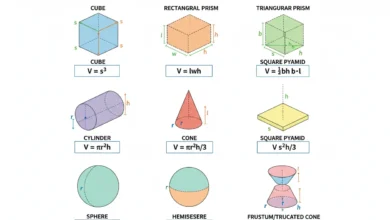
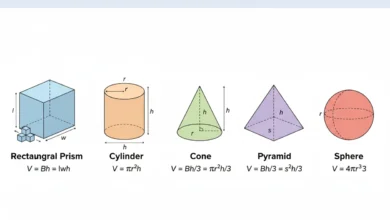
Prism Geometry
Right triangles often appear inside a Prism Volume problem.
For a rectangular prism:
d_space² = l² + w² + h²
This relationship can find a missing dimension before:
V = lwh
is calculated.
Pyramid Geometry
In a Pyramid Volume problem, slant height and perpendicular height are often connected by a right triangle.
For a square pyramid:
ℓ² = h² + (s/2)²
Therefore:
h = √[ℓ² − (s/2)²]
This h then enters:
V = s²h/3
Right Triangles and the Law of Cosines
The Law of Cosines is:
c² = a² + b² − 2ab cosC
For a right angle:
C = 90°
and:
cos90° = 0
Therefore:
c² = a² + b²
The Pythagorean theorem is thus the right-angle specialization of the Law of Cosines.
Right Triangles and the Law of Sines
The Law of Sines states:
a/sinA = b/sinB = c/sinC
If:
C = 90°
then:
sinC = 1
So:
a/sinA = c
which gives:
sinA = a/c
This is exactly ordinary right-triangle sine.
Right Triangles and Heron’s Formula
Heron Formula can calculate any triangle’s area from three side lengths.
For a 3-4-5 triangle:
s = 6
Then:
A = √[6·3·2·1]
= 6
This matches:
A = 3(4)/2
The right-triangle area formula is usually simpler when the legs are identifiable.
Scaling Right Triangles
If every side is multiplied by k:
a → ka
b → kb
c → kc
then:
perimeter scales by k
and:
area scales by k²
The angles remain unchanged.
Therefore the new triangle is similar to the original.
Scaling Example
A:
5-12-13
triangle has area:
30
Double every side:
10-24-26
The new area is:
2²(30)
Therefore:
120
Units in Right-Triangle Problems
Side lengths and perimeter use linear units:
cm, m, ft, in
Area uses square units:
cm², m², ft², in²
Angles use:
degrees
or:
radians
The underlying formulas remain the same as long as measurements use compatible units.
Common Right Triangle Mistakes
A common mistake is using the Pythagorean theorem on a triangle that has not been shown to contain a right angle.
Another is choosing the wrong hypotenuse. The hypotenuse is always opposite the 90° angle and is always the longest side.
For area, multiply the two perpendicular legs and divide by 2.
When applying trigonometric ratios, label sides relative to the selected acute angle before choosing sine, cosine, or tangent.
If an angle is found with an inverse trigonometric function, confirm the calculator’s degree or radian mode.
Do not assume every integer-sided triangle is right.
Finally, remember that right triangles can be scaled to many sizes while preserving exactly the same angles and side ratios.
Frequently Asked Questions
What are right triangles?
Right triangles are triangles containing one 90° angle.
What are the sides called?
The two sides forming the right angle are legs. The opposite side is the hypotenuse.
What is the main right-triangle formula?
a² + b² = c²
How do you find the hypotenuse?
c = √(a² + b²)
How do you find a missing leg?
a = √(c² − b²)
or:
b = √(c² − a²)
What is the area formula?
A = ab/2
What is the perimeter formula?
P = a + b + c
What do the two acute angles add to?
90°
What is sine in a right triangle?
sinθ = opposite/hypotenuse
What is cosine?
cosθ = adjacent/hypotenuse
What is tangent?
tanθ = opposite/adjacent
What is secant?
secθ = hypotenuse/adjacent = 1/cosθ
What is a 45-45-90 triangle?
A right triangle with side ratio:
1 : 1 : √2
What is a 30-60-90 triangle?
A right triangle with side ratio:
1 : √3 : 2
What are Pythagorean triples?
Integer side lengths satisfying:
a² + b² = c²
such as:
3-4-5
and:
5-12-13
How can you test whether a triangle is right?
Put the longest side as c and check:
a² + b² = c²
How can I check a solved right triangle?
Confirm the Pythagorean relationship, verify the two acute angles total 90°, make sure the hypotenuse is longest, and use a second trigonometric ratio when possible.