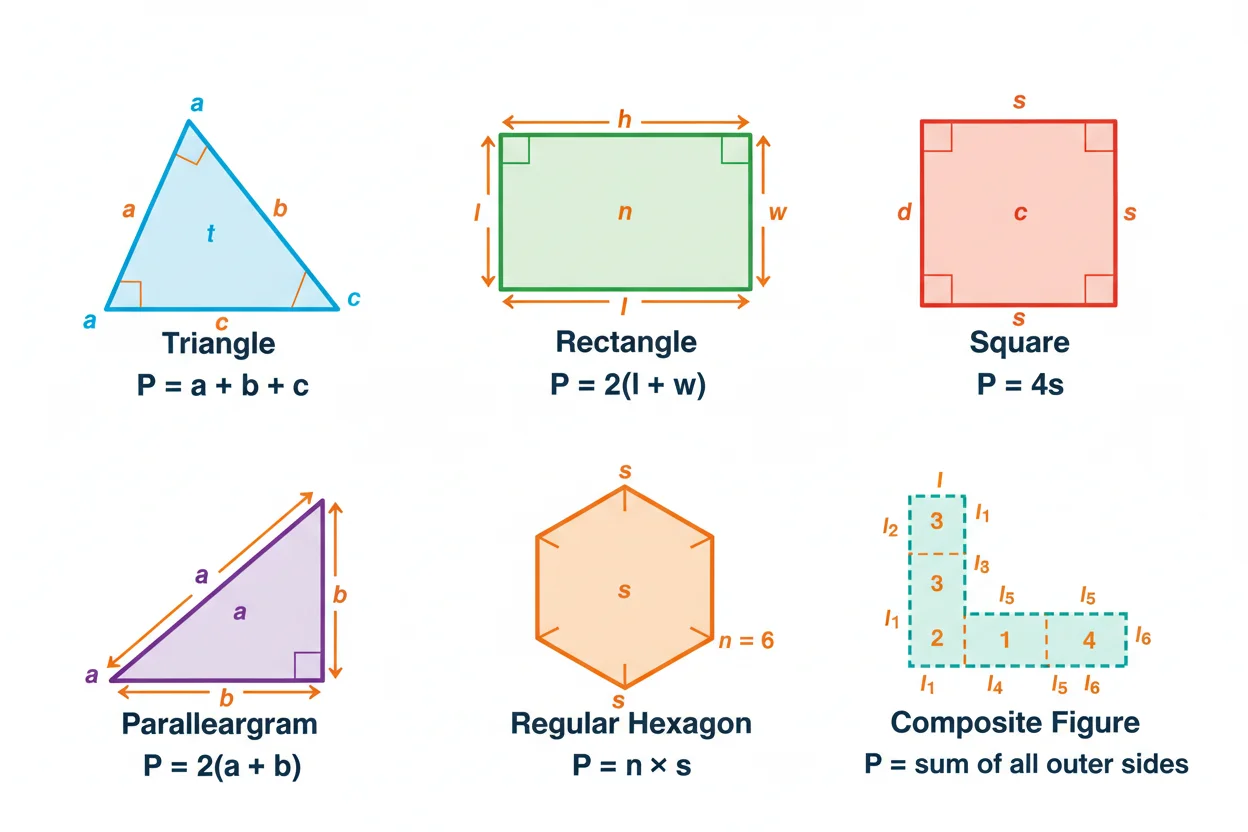

Perimeter is the total distance around the boundary of a two-dimensional figure. To find perimeter, add the lengths of all sides that make up the outer edge. For a rectangle, P = 2(l + w); for a square, P = 4s; for a triangle, P = a + b + c; and for a regular polygon with n equal sides of length s, P = ns. Perimeter uses linear units such as centimeters, meters, feet, or inches rather than square units. Curved boundaries are handled using their corresponding arc-length or circumference formulas, which is why the perimeter of a circle is normally called its circumference. Composite figures require special care because only exposed outer edges count; shared internal edges are not part of the perimeter. Coordinate geometry can also be used by calculating the distance between consecutive vertices and adding those lengths.
What Is Perimeter?
Perimeter measures the length of a closed figure’s boundary.
If a polygon has side lengths:
s₁, s₂, s₃, …, sₙ
then:
P = s₁ + s₂ + s₃ + … + sₙ
or compactly:
P = Σsᵢ
Perimeter is therefore a one-dimensional measurement even though the figure itself encloses a two-dimensional region.
Basic Perimeter Example
Suppose a quadrilateral has sides:
4 cm, 7 cm, 6 cm, 9 cm
Then:
P = 4 + 7 + 6 + 9
Therefore:
P = 26 cm
No area calculation is required.
Triangle Perimeter
For a triangle with side lengths:
a, b, c
the perimeter is:
P = a + b + c
For:
a = 5
b = 7
c = 9
we get:
P = 21
units.
This formula works for acute, right, obtuse, scalene, isosceles, and equilateral triangles.
Equilateral Triangle Perimeter
An equilateral triangle has three equal sides.
If each side has length s:
P = 3s
For:
s = 8
we obtain:
P = 24
Isosceles Triangle Perimeter
If the equal sides have length a and the base has length b:
P = 2a + b
Suppose:
a = 10
b = 6
Then:
P = 20 + 6
Therefore:
P = 26
Rectangle Perimeter
For a rectangle:
P = 2l + 2w
Factor:
P = 2(l + w)
where:
l = length
w = width
For:
l = 12
w = 5
we get:
P = 2(12 + 5)
Therefore:
P = 34
Find Rectangle Length From Perimeter
Starting with:
P = 2(l + w)
divide by 2:
P/2 = l + w
Therefore:
l = P/2 − w
Suppose:
P = 50
w = 9
Then:
l = 25 − 9
Therefore:
l = 16
Find Rectangle Width From Perimeter
Similarly:
w = P/2 − l
If:
P = 64
l = 20
then:
w = 32 − 20
Therefore:
w = 12
Square Perimeter
A square has four equal sides.
Therefore:
P = 4s
If:
s = 7
then:
P = 28
To solve for side length:
s = P/4
So a square with perimeter:
36
has side:
9
Parallelogram Perimeter
A parallelogram has two pairs of equal opposite sides.
If adjacent side lengths are:
a
and:
b
then:
P = 2a + 2b
or:
P = 2(a + b)
For:
a = 8
b = 13
we obtain:
P = 42
Its Parallelogram Area requires additional information such as perpendicular height or included angle; perimeter alone does not determine area.
Rhombus Perimeter
A rhombus has four equal sides.
Therefore:
P = 4s
This is the same perimeter formula as a square.
The difference is that a general rhombus does not require 90° interior angles.
Its area therefore may need a height, diagonals, or an included angle.
Kite Perimeter
A kite has two pairs of adjacent equal sides.
If the two distinct side lengths are:
a
and:
b
then:
P = 2a + 2b
or:
P = 2(a + b)
The Kite Area usually requires diagonals or side-angle information rather than perimeter alone.
Trapezoid Perimeter
For a trapezoid with side lengths:
a, b, c, d
the perimeter is simply:
P = a + b + c + d
The fact that one pair of sides is parallel does not change the perimeter rule.
For:
6, 10, 5, 7
we get:
P = 28
Regular Polygon Perimeter
A regular polygon has n equal sides of length s.
Therefore:
P = ns
For a regular pentagon:
n = 5
If:
s = 9
then:
P = 45
For a regular decagon with:
s = 4
we have:
P = 40
Find Side Length of a Regular Polygon
From:
P = ns
solve:
s = P/n
Suppose a regular octagon has:
P = 96
Then:
s = 96/8
Therefore:
s = 12
Find Number of Sides
If a regular polygon has perimeter P and side length s:
n = P/s
Suppose:
P = 84
s = 7
Then:
n = 12
The polygon has 12 sides.
The result must be a whole number for a regular polygon with a finite number of sides.
Perimeter and Exterior Angles
For a regular polygon, the Exterior Angles give:
E = 360°/n
so:
n = 360°/E
Once n is known and side length s is given:
P = ns
Therefore:
P = (360°/E)s
when E is in degrees.
Exterior-Angle Example
Suppose each exterior angle is:
45°
Then:
n = 360/45
= 8
If each side is:
6
the perimeter is:
P = 8(6)
Therefore:
P = 48
Perimeter and Interior Angles
For a regular polygon:
I = 180° − 360°/n
If I is known, first find:
n = 360°/(180° − I)
Then use:
P = ns
For:
I = 150°
we get:
n = 12
If:
s = 5
then:
P = 60
Circle Perimeter Is Circumference
A circle has no straight sides, so the distance around it is usually called its circumference rather than perimeter.
The Circle Circumference formulas are:
C = 2πr
and:
C = πd
where:
r = radius
d = diameter
Circumference is the circular version of boundary length.
Circle Example
Suppose:
r = 6
Then:
C = 2π(6)
Therefore:
C = 12π
Approximately:
C ≈ 37.70
linear units.
Semicircle Perimeter
A semicircle’s boundary contains:
one half of the circle circumference
plus:
the diameter
The curved portion is:
πr
The diameter is:
2r
Therefore:
P = πr + 2r
Do not use only:
πr
unless the problem asks specifically for the arc length.
Semicircle Example
Suppose:
r = 5
Then:
P = 5π + 10
Approximately:
P ≈ 25.71
The straight diameter is part of the boundary and must be included.
Quarter-Circle Perimeter
A quarter-circle region has:
one quarter of the circumference
plus:
two radii
The arc length is:
(1/4)(2πr)
= πr/2
Therefore:
P = πr/2 + 2r
For:
r = 8
we get:
P = 4π + 16
Sector Perimeter
A circular sector has:
one arc
and:
two radii
If the arc length is s:
P = s + 2r
For central angle θ in radians:
s = rθ
so:
P = rθ + 2r
For θ in degrees:
s = (θ/360°)2πr
The Sector Area measures the enclosed region, while sector perimeter measures its complete boundary.
Sector Example
Suppose:
r = 10
θ = 60°
Arc:
s = (60/360)2π(10)
= 10π/3
Therefore:
P = 20 + 10π/3
Arc Length in Perimeter Problems
Curved composite shapes often use Arc Length for part of their boundary.
For θ radians:
s = rθ
For θ degrees:
s = (θ/360°)2πr
After calculating each curved portion, add it to the relevant straight boundary segments.
Only edges actually exposed on the outside should be counted.
Composite Figure Perimeter
For a composite figure, trace the outer boundary once.
Add every exposed boundary segment.
Do not include lines that lie inside the figure where two component shapes meet.
This differs from some area calculations, where internal divisions may be useful for splitting the region into simpler pieces.
Composite Rectangle Example
Suppose two identical rectangles:
6 × 4
are joined along one side of length:
4
Each separate rectangle has perimeter:
20
Adding:
20 + 20 = 40
double-counts the shared edge twice.
Subtract both copies:
P = 40 − 2(4)
Therefore:
P = 32
This equals the perimeter of the resulting:
12 × 4
rectangle:
2(12 + 4) = 32
Shared-Edge Formula
If two shapes with perimeters:
P₁
and:
P₂
are joined along a shared edge of length L, and that edge becomes completely internal:
P_combined = P₁ + P₂ − 2L
The shared edge was counted once in each original perimeter, so it must be removed twice.
This shortcut applies when there is one complete shared boundary segment and no other geometric complication.
Missing Side From Total Perimeter
Suppose a pentagon has side lengths:
6, 8, 7, 5, x
and perimeter:
35
Then:
6 + 8 + 7 + 5 + x = 35
The known sides total:
26
Therefore:
x = 9
Perimeter equations are often simple linear equations in a missing side length.
Algebraic Perimeter Example
Suppose a triangle has sides:
x + 2
2x − 1
x + 5
and perimeter:
34
Then:
(x + 2) + (2x − 1) + (x + 5) = 34
Combine:
4x + 6 = 34
Therefore:
4x = 28
so:
x = 7
The side lengths are:
9, 13, 12
and:
9 + 13 + 12 = 34
Check Triangle Validity
If perimeter algebra produces triangle sides, the lengths must also satisfy the triangle inequality.
For sides:
a, b, c
require:
a + b > c
a + c > b
b + c > a
A positive perimeter alone does not guarantee that three calculated lengths form a valid triangle.
Coordinate Perimeter
When polygon vertices are given as coordinates, calculate the distance between each pair of consecutive vertices using the Distance Formula:
d = √[(x₂ − x₁)² + (y₂ − y₁)²]
Then add those side lengths.
Remember to include the final side connecting the last vertex back to the first.
Coordinate Triangle Example
Suppose:
A = (0,0)
B = (4,0)
C = (4,3)
Then:
AB = 4
BC = 3
CA = √(4² + 3²)
= 5
Therefore:
P = 4 + 3 + 5
= 12
Coordinate Rectangle Example
Suppose rectangle vertices are:
(1,2)
(7,2)
(7,6)
(1,6)
Horizontal side length:
6
Vertical side length:
4
Therefore:
P = 2(6 + 4)
= 20
The same answer results from applying the distance formula to all four consecutive edges.
Midpoints and Perimeter
A Midpoint Formula divides a side into two equal parts but does not change its total boundary length.
If side AB has:
AB = 14
and M is the midpoint:
AM = MB = 7
Then:
AM + MB = 14
Replacing a side with two collinear subsegments therefore leaves the perimeter unchanged.
Point-Slope Form in Coordinate Boundaries
A polygon edge may be described by a line equation rather than directly by endpoints.
Point-Slope Form is:
y − y₁ = m(x − x₁)
If the endpoints of the finite edge are identified from line intersections, their distance can then be calculated.
The line equation determines the boundary’s direction, while the endpoint coordinates determine the actual segment length contributing to perimeter.
Line Intersections as Vertices
A polygon can be defined by several boundary lines.
The Line Intersection of consecutive boundary lines gives each vertex.
Once all vertices are known:
- order them around the boundary;
- calculate each consecutive side length;
- add the side lengths.
The intersections establish corners; the distances establish perimeter.
Boundary Lines Example
Suppose four lines are:
x = 0
x = 6
y = 0
y = 4
Their intersections form:
(0,0)
(6,0)
(6,4)
(0,4)
The resulting rectangle has:
P = 2(6 + 4)
Therefore:
P = 20
Polar Coordinates and Perimeter
Points may also be given in Polar and Rectangular Form.
A polar point:
(r, θ)
converts to:
x = r cosθ
y = r sinθ
If polygon vertices are initially polar, they can be converted to rectangular coordinates and then connected with the distance formula.
For curved polar boundaries, perimeter can require arc-length methods rather than simple straight-segment addition.
Polar Coordinate Example
Suppose two points on a circle of radius 5 are:
(5, 0)
and:
(5, π/2)
Their rectangular coordinates are:
(5,0)
and:
(0,5)
The straight chord between them has length:
√[(0 − 5)² + (5 − 0)²]
= 5√2
The circular arc between them has length:
5(π/2)
These are different possible boundary paths.
Perimeter calculations must use whichever path actually belongs to the figure.
Perimeter Versus Area
Perimeter measures:
boundary length
Area measures:
enclosed surface
For a rectangle:
P = 2(l + w)
while:
A = lw
A rectangle with:
l = 8
w = 5
has:
P = 26
and:
A = 40
The numerical values use different units and describe different geometric properties.
Same Perimeter, Different Area
Consider a rectangle:
1 × 9
Its perimeter is:
20
and area is:
9
Now consider:
5 × 5
Its perimeter is also:
20
but area is:
25
Therefore equal perimeter does not imply equal area.
Same Area, Different Perimeter
A rectangle:
2 × 8
has area:
16
and perimeter:
20
A square:
4 × 4
also has area:
16
but perimeter:
16
Therefore equal area does not imply equal perimeter.
Maximum Rectangle Area for Fixed Perimeter
Suppose rectangle perimeter is fixed:
P = 2(l + w)
Then:
l + w = P/2
Among all rectangles with the same perimeter, the maximum area occurs when:
l = w
so the rectangle is a square.
For:
P = 40
the square has side:
10
and area:
100
This illustrates how boundary and enclosed area are related but not interchangeable.
Scaling Perimeter
If every linear dimension of a figure is multiplied by factor k:
P_new = kP_old
Perimeter scales linearly.
For example, doubling every side length doubles the perimeter.
Tripling every side length triples the perimeter.
This differs from area, which scales by:
k²
Scaling Example
Suppose a polygon has:
P = 36
Every linear dimension doubles.
Then:
P_new = 72
If its original area were A, the new area would be:
4A
The different scaling behavior reflects perimeter’s one-dimensional nature.
Similar Figures and Perimeter
For similar figures with linear scale factor k:
P₂/P₁ = k
If one similar polygon has:
P₁ = 30
and the second has side lengths:
1.5
times as large, then:
P₂ = 45
The same scale factor applies to every corresponding boundary length.
Perimeter Ratio and Area Ratio
For similar figures:
perimeter ratio = k
while:
area ratio = k²
Therefore if:
P₂/P₁ = 3
then:
A₂/A₁ = 9
This relationship can solve similarity problems without calculating every individual side.
Units of Perimeter
Perimeter uses linear units:
mm
cm
m
km
in
ft
yd
It does not use square units.
If side lengths are in centimeters, the perimeter is in centimeters.
Converting Perimeter Units
Linear conversions use the ordinary one-dimensional conversion factor.
Since:
1 m = 100 cm
then:
3.5 m = 350 cm
Unlike area:
1 m² = 10,000 cm²
Perimeter does not square the conversion factor.
Mixed Units
All side lengths must be converted to the same unit before they are added.
Suppose a rectangle has:
l = 2 m
w = 50 cm
Convert:
2 m = 200 cm
Then:
P = 2(200 + 50)
= 500 cm
or:
5 m
Using mixed units directly would be invalid.
Irregular Polygon Perimeter
For an irregular polygon, there may be no useful shortcut.
Simply add the side lengths:
P = s₁ + s₂ + … + sₙ
Suppose a six-sided polygon has:
4, 7, 3, 9, 5, 8
Then:
P = 36
The fact that the sides are unequal changes only the arithmetic, not the underlying definition.
Concave Polygon Perimeter
A concave polygon uses the same rule:
add every outer boundary side
An inward indentation is still part of the boundary.
Therefore its sides must be included.
Concavity affects the figure’s shape but not the basic definition of perimeter.
Missing Boundary in Composite Shapes
Sometimes the perimeter of a composite figure includes a side length that is not labeled directly.
Use other known dimensions to infer it.
For example, in an L-shaped figure formed from rectangles, an unlabeled horizontal section may equal the difference between two larger horizontal lengths.
Solve missing boundary segments before adding the outer edges.
L-Shaped Example
Suppose an outer rectangle is:
10 × 8
and a:
4 × 3
corner is removed.
The resulting L-shaped boundary contains additional inner edges, but the total perimeter can remain equal to the original rectangle’s perimeter if the removed corner simply replaces lengths with equal parallel lengths.
Original perimeter:
2(10 + 8)
= 36
Tracing the new boundary confirms the same:
36
This is a useful reminder that removing a corner does not always decrease perimeter.
Perimeter of a Shape With a Circular Cutout
If part of a straight boundary is replaced by a semicircular arc, subtract the removed straight segment and add the new curved arc.
For a semicircle of radius r replacing a diameter-length segment:
removed length = 2r
added arc = πr
Therefore the perimeter change is:
πr − 2r
This boundary-replacement approach is useful in composite curved figures.
Perimeter and Polygon Diagonals
Polygon Diagonals lie inside a polygon and normally do not contribute to its perimeter.
A regular hexagon may contain many diagonals, but its perimeter still uses only its six outer sides:
P = 6s
Do not add internal diagonals unless the problem explicitly defines a path that follows them.
Perimeter and Chords
A Chord Length can contribute to perimeter when it forms part of a region’s outer boundary.
For example, a circular segment is bounded by:
an arc
and:
a chord
Its perimeter is:
P = arc length + chord length
The chord is straight while the arc is curved, so the two parts require different length formulas.
Circular Segment Example
Suppose:
r = 10
central angle = 60°
Arc:
s = 10π/3
Chord:
c = 2(10)sin30°
= 10
Therefore the circular segment perimeter is:
P = 10 + 10π/3
Exact Versus Approximate Perimeter
For straight-sided polygons, exact values are often integers, fractions, or radicals.
For curved figures, π may appear.
For example:
P = 12 + 5π
is exact.
Using:
π ≈ 3.14159
gives:
P ≈ 27.71
Retaining exact expressions until the final step preserves precision.
Common Perimeter Mistakes
A common mistake is confusing perimeter with area.
Perimeter uses linear units; area uses square units.
For composite figures, do not count shared internal edges.
For semicircles and sectors, include straight boundary segments as well as curved arcs when the full perimeter is requested.
When a circle is involved, use circumference rather than πr².
In coordinate problems, connect the final vertex back to the first.
Convert mixed measurement units before adding.
For regular polygons:
P = ns
but do not use that shortcut for irregular polygons with unequal sides.
Finally, trace the boundary visually or conceptually once around the figure to make sure each exposed segment is counted exactly once.
Frequently Asked Questions
What is perimeter?
Perimeter is the total distance around the boundary of a two-dimensional figure.
What is the general perimeter formula?
For side lengths s₁ through sₙ:
P = s₁ + s₂ + … + sₙ
What is the rectangle perimeter formula?
P = 2(l + w)
What is the square perimeter formula?
P = 4s
What is the triangle perimeter formula?
P = a + b + c
What is the parallelogram perimeter formula?
P = 2(a + b)
What is the perimeter of a regular polygon?
P = ns
How do you find one regular-polygon side?
s = P/n
What is the perimeter of a circle called?
Circumference:
C = 2πr = πd
What is a semicircle’s full perimeter?
P = πr + 2r
What is a sector’s perimeter?
P = arc length + 2r
Does perimeter include internal lines?
Normally no. Only the outer boundary is counted.
How do you find perimeter from coordinates?
Calculate the distance between each pair of consecutive vertices, include the final side back to the starting vertex, and add the distances.
Does equal perimeter mean equal area?
No.
How does perimeter scale?
If every length is multiplied by k:
perimeter is multiplied by k
What units does perimeter use?
Linear units such as cm, m, ft, or in.
How can I check a perimeter calculation?
Trace the boundary once, verify every exposed segment is included exactly once, exclude internal shared edges, and confirm that the final units are linear.