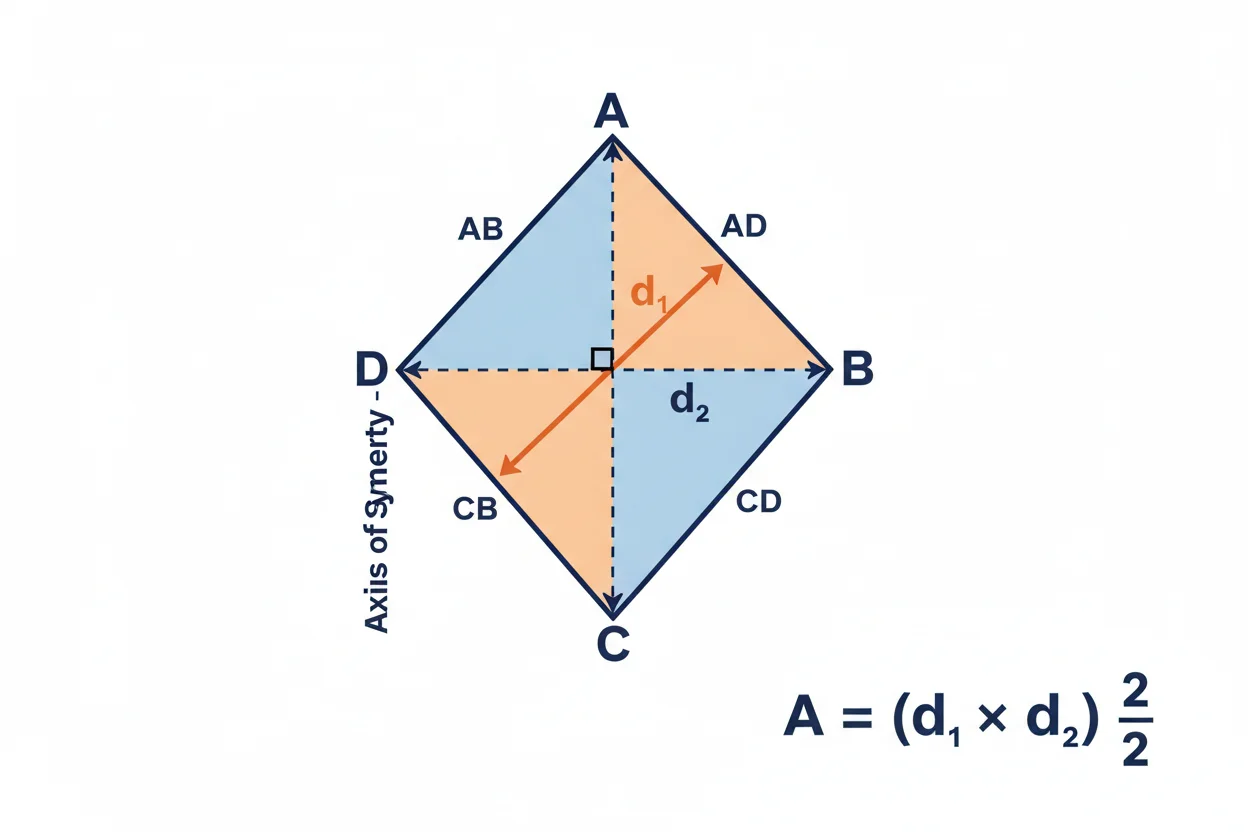

Kite area measures the two-dimensional region enclosed by a kite, a quadrilateral with two pairs of adjacent equal sides. The most useful kite area formula is A = d₁d₂/2, where d₁ and d₂ are the lengths of the diagonals. This formula works because the diagonals of a kite are perpendicular, allowing the figure to be divided into right triangles whose areas combine to one-half the product of the diagonals. If the two different side lengths a and b and the included angle θ between them are known, the area can also be calculated with A = ab sinθ. Kite area is measured in square units, and the formula can be rearranged to find an unknown diagonal when the area and other diagonal are known. Coordinate geometry can also be used to find the diagonals or calculate the area directly from the vertices.
What Is a Kite?
A kite is a quadrilateral with two distinct pairs of adjacent equal sides.
If the vertices are arranged as:
A, B, C, D
a typical kite may satisfy:
AB = AD
and:
BC = CD
The equal sides meet at two opposite vertices.
One diagonal joins those vertices and acts as the kite’s axis of symmetry in the standard symmetric kite.
The other diagonal crosses it at a right angle.
These properties make the diagonal formula one of the simplest Area Formulas for a quadrilateral.
Kite Area Formula Using Diagonals
If the diagonals have lengths:
d₁
and:
d₂
then:
A = d₁d₂/2
where:
A = kite area
This is the standard formula.
For example, if:
d₁ = 12
d₂ = 8
then:
A = 12(8)/2
= 96/2
Therefore:
A = 48
square units.
Why the Kite Area Formula Works
Suppose the diagonals intersect at point O.
In a kite:
d₁ ⟂ d₂
One diagonal also bisects the other.
The diagonals divide the kite into four right triangles.
Let one diagonal have total length:
d₁ = p + q
and let half of the other diagonal be:
d₂/2
The two triangles on one side of the symmetry diagonal have combined area:
p(d₂/2)
The two triangles on the other side have combined area:
q(d₂/2)
So total area is:
A = p(d₂/2) + q(d₂/2)
Factor:
A = (p + q)d₂/2
Since:
p + q = d₁
we obtain:
A = d₁d₂/2
Basic Diagonal Example
Suppose a kite has diagonals:
15 cm
and:
10 cm
Then:
A = 15(10)/2
= 75 cm²
The answer uses square centimeters because area is two-dimensional.
Find a Missing Diagonal
Starting with:
A = d₁d₂/2
multiply by 2:
2A = d₁d₂
Therefore:
d₁ = 2A/d₂
or:
d₂ = 2A/d₁
depending on which diagonal is unknown.
Missing Diagonal Example
Suppose:
A = 84 cm²
d₁ = 14 cm
Then:
d₂ = 2(84)/14
= 168/14
Therefore:
d₂ = 12 cm
Check:
14(12)/2 = 84
Kite Area From Side Lengths and an Angle
Suppose the two distinct side lengths are:
a
and:
b
and θ is the interior angle between one side of length a and one side of length b.
The kite can be divided along its symmetry diagonal into two congruent triangles.
Each triangle has area:
ab sinθ/2
There are two such triangles.
Therefore:
A = ab sinθ
This formula is useful when the diagonals are unknown but two adjacent unequal sides and the angle between them are known.
Side-Angle Example
Suppose:
a = 6
b = 10
θ = 60°
Then:
A = 6(10)sin60°
Since:
sin60° = √3/2
we obtain:
A = 60(√3/2)
Therefore:
A = 30√3
Approximately:
A ≈ 51.96
square units.
The Sine function converts the side-angle information into area.
Why the Side-Angle Formula Works
The symmetry diagonal divides the kite into two Congruent Triangles.
Each triangle contains:
one side a
one side b
included angle θ
The standard triangle-area relationship is:
A_triangle = ab sinθ/2
Because both halves are congruent:
A_kite = 2(ab sinθ/2)
Therefore:
A_kite = ab sinθ
This formula depends on θ being the angle between the two unequal adjacent side lengths.
Find an Angle From Kite Area
Starting with:
A = ab sinθ
we have:
sinθ = A/(ab)
Therefore:
θ = sin⁻¹[A/(ab)]
with the geometric configuration determining which possible angle is appropriate.
Suppose:
A = 48
a = 8
b = 8
Then:
sinθ = 48/64
= 3/4
so the principal angle is:
θ = sin⁻¹(3/4)
Approximately:
θ ≈ 48.59°
When an inverse trigonometric calculation is required, the principal-angle rules in Inverse Trigonometric Functions must be interpreted with the geometry.
Find a Side From Area and Angle
From:
A = ab sinθ
solve for a:
a = A/(b sinθ)
Similarly:
b = A/(a sinθ)
Suppose:
A = 60
b = 10
θ = 30°
Then:
a = 60/[10(1/2)]
= 60/5
Therefore:
a = 12
Kite Area From Perpendicular Diagonals
The formula:
A = d₁d₂/2
also appears for other quadrilaterals with perpendicular diagonals.
However, the defining properties of a kite guarantee the relevant perpendicular structure.
A Rhombus Area can also be calculated with:
A = d₁d₂/2
because a rhombus has perpendicular diagonals.
The shapes have different defining properties even though this particular area formula is shared.
Kite Versus Rhombus
A kite has:
two pairs of adjacent equal sides
A rhombus has:
all four sides equal
Every rhombus satisfies the adjacent-pair equality condition in a broad sense, but geometry courses often distinguish an ordinary kite as having two distinct pairs of adjacent equal sides.
Both can use:
A = d₁d₂/2
when their diagonals are known.
The formula alone therefore does not identify which quadrilateral is present.
Kite Versus Parallelogram
A Parallelogram Area is commonly:
A = bh
A kite generally does not have opposite sides parallel, so a single parallelogram base-height formula is not its natural area relationship.
Instead, the perpendicular diagonals make:
A = d₁d₂/2
particularly efficient.
Kite Versus Trapezoid
A Trapezoid Area uses:
A = (b₁ + b₂)h/2
because its geometry is organized around parallel bases.
A kite is organized around:
adjacent equal sides
and:
perpendicular diagonals
Therefore different quadrilateral structures lead to different convenient formulas.
Kite Perimeter
If the equal side pairs have lengths a and b:
P = 2a + 2b
Factor:
P = 2(a + b)
The perimeter does not directly determine kite area because many kites can have the same side lengths but different angles.
However, if one side length and the perimeter are known, the other side length can be found.
Find a Side From Perimeter
Suppose:
P = 40
and:
a = 7
Use:
40 = 2(7 + b)
Divide by 2:
20 = 7 + b
Therefore:
b = 13
If the included angle θ is also known, area follows from:
A = ab sinθ
Perimeter and Area Example
Suppose:
P = 40
a = 7
θ = 30°
We found:
b = 13
Therefore:
A = 7(13)sin30°
= 91(1/2)
Thus:
A = 45.5
square units.
This shows why perimeter alone is insufficient but can become useful with additional angular information.
Kite Diagonal Properties
For the usual kite ABCD with:
AB = AD
and:
BC = CD
the diagonal joining the vertices where the equal side pairs meet is an axis of symmetry.
It:
bisects the other diagonal
and:
is perpendicular to the other diagonal
It also bisects the two vertex angles through which it passes.
These properties create the right triangles used in many kite calculations.
One Diagonal Does Not Usually Bisect the Other Both Ways
A common misconception is that both kite diagonals bisect one another.
That property belongs to parallelograms such as rhombi.
In a general kite, the symmetry diagonal bisects the other diagonal, but the other diagonal does not normally bisect the symmetry diagonal.
The area formula does not require both diagonals to bisect one another.
It only needs their perpendicular geometry.
Find a Diagonal From Right Triangles
Suppose the symmetry diagonal is divided into segments:
p
and:
q
while half of the other diagonal is:
x
The two side lengths can satisfy:
a² = p² + x²
and:
b² = q² + x²
through the Pythagorean Theorem.
Once p, q, and x are known:
d₁ = p + q
d₂ = 2x
Then:
A = d₁d₂/2
Right-Triangle Example
Suppose the half-width of a kite is:
x = 4
and the symmetry diagonal is divided into:
p = 3
q = 6
Then:
d₁ = 3 + 6 = 9
d₂ = 8
Therefore:
A = 9(8)/2
= 36
The corresponding side lengths are:
√(3² + 4²) = 5
and:
√(6² + 4²) = √52 = 2√13
Kite Area From Four Right Triangles
The same example can be checked by summing the four triangle areas.
Two upper triangles each have:
A = 3(4)/2 = 6
Their combined area is:
12
Two lower triangles each have:
A = 6(4)/2 = 12
Combined:
24
Total:
12 + 24 = 36
which matches:
d₁d₂/2 = 36
Using the Law of Cosines in a Kite
The Law of Cosines can find a diagonal when two kite sides and the included angle are known.
Suppose a triangle formed by two kite sides has:
sides a and b
and included angle θ.
The connecting diagonal c satisfies:
c² = a² + b² − 2ab cosθ
After c is found, other kite dimensions may be derived from symmetry, right triangles, or another triangle.
This can eventually provide the diagonals required by:
A = d₁d₂/2
Law of Cosines Example
Suppose:
a = 5
b = 8
θ = 60°
Then the diagonal opposite θ satisfies:
c² = 5² + 8² − 2(5)(8)cos60°
= 25 + 64 − 40
= 49
Therefore:
c = 7
The same side-angle data also allows the kite’s total area directly:
A = 5(8)sin60°
= 20√3
If only area is required, the sine formula is shorter.
Using the Law of Sines
The Law of Sines can help determine missing sides or angles in one of the triangles formed by a kite diagonal:
a/sinA = b/sinB = c/sinC
Once enough lengths are known, the kite’s diagonals can be calculated.
However, if both diagonals are already known, the direct area formula remains much more efficient.
Interior Angles of a Kite
A kite is a quadrilateral, so its Interior Angles sum to:
360°
In a symmetric kite, one pair of opposite angles is equal.
Suppose those equal angles are:
B = D
Then:
A + C + 2B = 360°
This relationship can help solve missing angles before applying a side-angle area formula.
Interior-Angle Example
Suppose:
A = 80°
C = 120°
and:
B = D
Then:
80° + 120° + 2B = 360°
So:
2B = 160°
Therefore:
B = D = 80°
If sides a and b surrounding one of these 80° angles are known, area can be found with:
A_kite = ab sin80°
Kite Area With Heron’s Formula
The symmetry diagonal divides a kite into two congruent triangles.
If the three side lengths of one half are known, Heron Formula can calculate one triangle’s area:
A_triangle = √[s(s − a)(s − b)(s − c)]
Then:
A_kite = 2A_triangle
This method is useful when diagonal and side information is known but no convenient altitude or included angle is given.
Heron Example
Suppose each half of a kite is a triangle with sides:
5, 5, 6
Semiperimeter:
s = 8
Triangle area:
A_triangle = √[8·3·3·2]
= 12
Two congruent halves give:
A_kite = 24
square units.
Kite Area From Coordinates
If the four vertices are given as coordinates, several methods are available.
If the diagonal endpoints are identifiable, calculate their lengths with the Distance Formula:
d = √[(x₂ − x₁)² + (y₂ − y₁)²]
Then use:
A = d₁d₂/2
provided the points form the expected kite.
A general coordinate polygon-area formula can also calculate the area directly.
Coordinate Kite Example
Suppose a kite has vertices:
A = (0, 6)
B = (4, 0)
C = (0, −2)
D = (−4, 0)
The vertical diagonal AC has length:
d₁ = 8
The horizontal diagonal BD has length:
d₂ = 8
Therefore:
A = 8(8)/2
= 32
square units.
Check the Coordinate Sides
For the same points:
AB = √[(4 − 0)² + (0 − 6)²]
= √52
and:
AD = √52
Likewise:
BC = √[(0 − 4)² + (−2 − 0)²]
= √20
and:
CD = √20
So the points satisfy the kite side-pair condition.
The coordinate geometry confirms the classification as well as the area.
Kite Area With the Shoelace Formula
For coordinates:
(x₁,y₁), (x₂,y₂), (x₃,y₃), (x₄,y₄)
listed around the boundary, polygon area can be found with the shoelace method:
A = 1/2 |Σxᵢyᵢ₊₁ − Σyᵢxᵢ₊₁|
This works even if the diagonals are inconvenient to calculate.
For a correctly ordered kite, it gives the same area as:
d₁d₂/2
Kite Scaling
If every linear dimension of a kite is multiplied by scale factor k:
d₁ → kd₁
d₂ → kd₂
Then:
A_new = (kd₁)(kd₂)/2
Therefore:
A_new = k²A_old
So doubling every length multiplies area by:
4
Tripling every length multiplies area by:
9
This is the standard two-dimensional scaling rule.
Scaling Example
Suppose a kite has:
A = 30
Every length is doubled.
Then:
A_new = 2²(30)
= 120
The perimeter doubles, but the area quadruples.
Kite Area and Units
If the diagonals are measured in centimeters:
d₁d₂
has units:
cm²
Dividing by 2 does not change the unit.
Therefore kite area is in:
cm²
Likewise, meter inputs produce:
m²
Area should never be reported in ordinary linear units.
Converting Kite Area Units
Since:
1 m = 100 cm
then:
1 m² = 10,000 cm²
If:
A = 2.4 m²
then:
A = 24,000 cm²
Area conversion factors must be squared.
Exact and Approximate Kite Area
If trigonometry produces an exact radical, retaining it preserves precision.
For example:
A = 30√3
is exact.
Approximately:
A ≈ 51.96
If the problem does not require a decimal, the exact form is generally cleaner.
Common Kite Area Mistakes
A common mistake is forgetting the factor:
1/2
in:
A = d₁d₂/2
Another is assuming both diagonals bisect each other. In a general kite, only one diagonal bisects the other.
Do not confuse diagonal length with side length.
When using:
A = ab sinθ
θ must be the included angle between the two different adjacent side lengths a and b.
If a coordinate problem gives vertices out of order, arrange them around the boundary before using a polygon-area method.
Area requires square units.
Finally, do not assume that knowing only the four side lengths always determines the most convenient kite-area calculation without considering the kite’s angular or diagonal geometry.
Frequently Asked Questions
What is the kite area formula?
Using diagonals:
A = d₁d₂/2
Why is there a 1/2 in the formula?
The perpendicular diagonals divide the kite into triangles whose combined area is one-half the product of the diagonals.
Are kite diagonals perpendicular?
Yes, the diagonals of a kite are perpendicular.
Do both kite diagonals bisect each other?
Not generally. One diagonal bisects the other.
How do you find a missing diagonal?
d₁ = 2A/d₂
or:
d₂ = 2A/d₁
Can kite area be found from sides and an angle?
Yes. If a and b are the two distinct adjacent side lengths and θ is their included angle:
A = ab sinθ
How do you find the angle from area?
θ = sin⁻¹[A/(ab)]
with the kite’s geometry used to select the correct angle.
What is the perimeter of a kite?
For side pairs a and b:
P = 2a + 2b
Is kite area the same formula as rhombus area?
Both can use:
A = d₁d₂/2
because their diagonals are perpendicular, although the shapes have different defining properties.
Can Heron’s formula find kite area?
Yes. Split the kite into two congruent triangles, calculate one triangle’s area, and double it.
Can coordinates be used?
Yes. Find the diagonal lengths with the distance formula or use a general coordinate polygon-area method.
How does kite area scale?
If every length is multiplied by k:
area is multiplied by k²
What units does kite area use?
Square units such as cm², m², ft², or in².
How can I check a kite-area answer?
Verify the diagonals or side-angle data, confirm the factor 1/2 when using diagonals, check square units, and calculate the area another way—such as summing the component triangles—when possible.