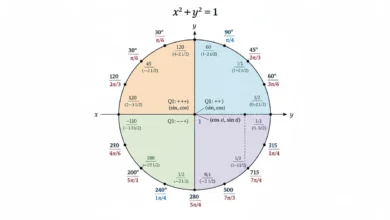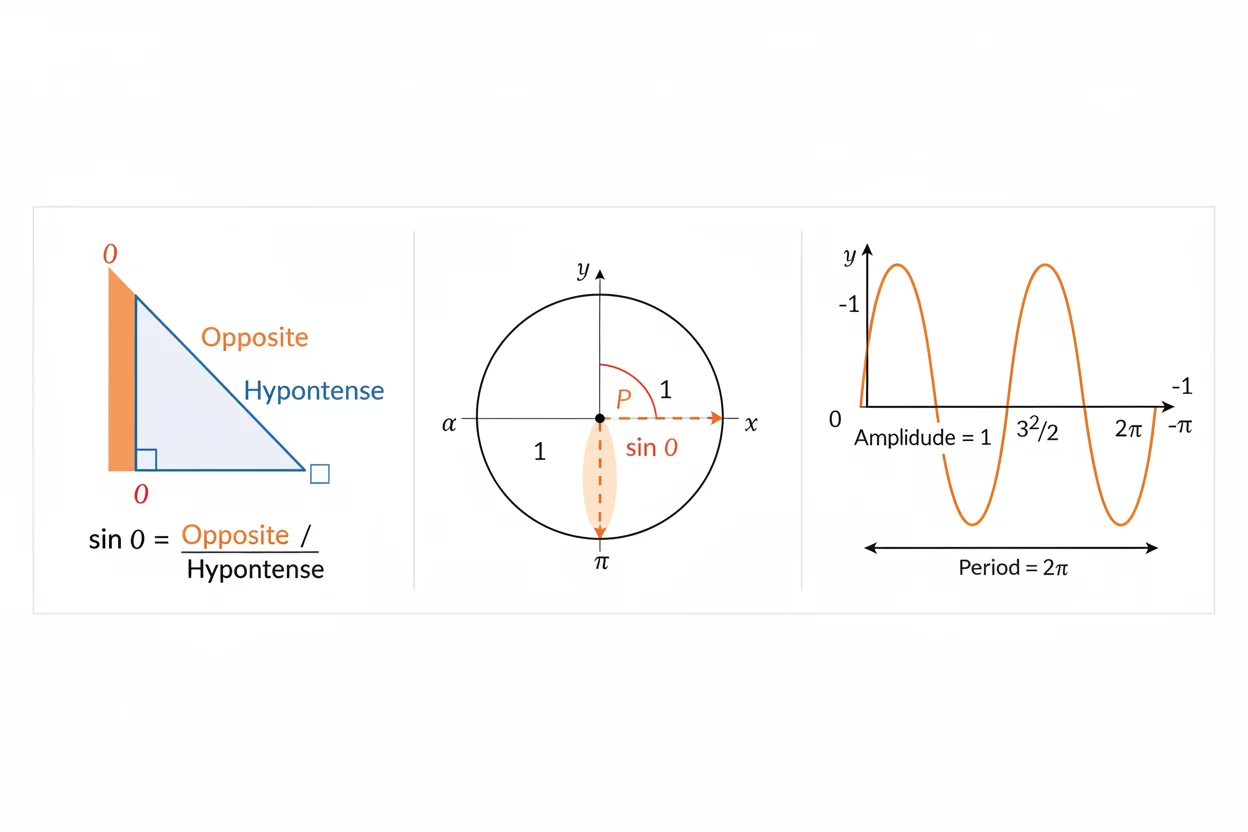

Sine is a trigonometric function that connects an angle to a ratio of lengths or coordinates. In a right triangle, sinθ = opposite/hypotenuse. On the unit circle, sinθ is the y-coordinate of the point reached by rotating through angle θ from the positive x-axis. These definitions agree for acute angles and the unit-circle definition extends sine to all real angles. Sine values always lie between −1 and 1, repeat every 2π radians or 360°, and change sign according to the angle’s quadrant. Common exact values include sin0° = 0, sin30° = 1/2, sin45° = √2/2, sin60° = √3/2, and sin90° = 1. Sine appears throughout triangle solving, circular motion, waves, vectors, geometry, and calculus.
Sine Formula in a Right Triangle
For an acute angle θ in a Right Triangle:
sinθ = opposite/hypotenuse
The opposite side lies directly across from θ.
The hypotenuse lies opposite the 90° angle and is the triangle’s longest side.
Basic Sine Example
Suppose:
opposite = 3
hypotenuse = 5
Then:
sinθ = 3/5
Therefore:
sinθ = 0.6
The adjacent leg is not needed when the opposite side and hypotenuse are already known.
5-12-13 Triangle Example
In a:
5-12-13
right triangle, let θ be the acute angle opposite the side of length 5.
Then:
sinθ = 5/13
For the other acute angle φ:
sinφ = 12/13
The ratio changes because the side considered “opposite” changes with the reference angle.
Find the Opposite Side Using Sine
From:
sinθ = opposite/hypotenuse
solve:
opposite = hypotenuse × sinθ
Suppose:
hypotenuse = 10
θ = 30°
Then:
opposite = 10sin30°
Since:
sin30° = 1/2
we obtain:
opposite = 5
Find the Hypotenuse Using Sine
Rearrange:
hypotenuse = opposite/sinθ
Suppose:
opposite = 6
θ = 40°
Then:
hypotenuse = 6/sin40°
Approximately:
hypotenuse ≈ 9.33
Find an Angle Using Inverse Sine
If a side ratio is known:
sinθ = x
then:
θ = sin⁻¹x
for the principal value.
Suppose:
sinθ = 3/5
Then:
θ = sin⁻¹(3/5)
Approximately:
θ ≈ 36.87°
The broader rules for principal values and multiple solutions are covered by Inverse Trigonometric Functions.
Why Right-Triangle Sine Is a Function of Angle
All Similar Triangles sharing the same acute angle θ have proportional corresponding sides.
Suppose one triangle is scaled by k.
Then:
opposite → k(opposite)
hypotenuse → k(hypotenuse)
Their ratio becomes:
k(opposite)/k(hypotenuse)
The scale factor cancels.
Therefore:
sinθ
depends on the angle, not on the overall size of the triangle.
Unit Circle Definition of Sine
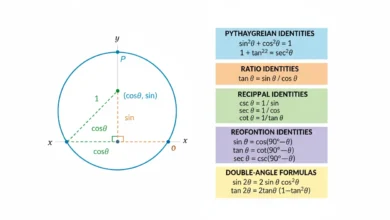
On the Unit Circle, a point at angle θ has coordinates:
(cosθ, sinθ)
Therefore:
sinθ = y-coordinate
Because the unit circle has radius:
1
this definition extends sine beyond acute right-triangle angles.
Why the Unit-Circle Definition Matches the Triangle Ratio
For a unit-circle point:
(x,y)
draw a perpendicular to the x-axis.
The resulting right triangle has:
hypotenuse = 1
opposite side = y
Therefore:
sinθ = y/1
So:
sinθ = y
The unit-circle and right-triangle definitions are consistent.
Sine Range
Every unit-circle y-coordinate satisfies:
−1 ≤ y ≤ 1
Therefore:
−1 ≤ sinθ ≤ 1
The range of sine is:
[−1,1]
A claimed real value such as:
sinθ = 1.4
is impossible.
Exact Sine Values
Important exact values include:
sin0° = 0
sin30° = 1/2
sin45° = √2/2
sin60° = √3/2
sin90° = 1
In radians:
sin0 = 0
sin(π/6) = 1/2
sin(π/4) = √2/2
sin(π/3) = √3/2
sin(π/2) = 1
Sine at 30°
A 30-60-90 triangle has side ratio:
1 : √3 : 2
For the 30° angle:
opposite = 1
hypotenuse = 2
Therefore:
sin30° = 1/2
Sine at 45°
A 45-45-90 triangle has side ratio:
1 : 1 : √2
Therefore:
sin45° = 1/√2
Rationalize:
sin45° = √2/2
Sine at 60°
Using the 30-60-90 ratio, for the 60° angle:
opposite = √3
hypotenuse = 2
Therefore:
sin60° = √3/2
Degrees and Radians
Sine can use angles measured in degrees or radians.
Equivalent examples include:
30° = π/6
45° = π/4
60° = π/3
90° = π/2
The conversion rules in Degrees and Radians ensure the calculator and formula use consistent angle units.
Sine Signs by Quadrant
On the unit circle:
Quadrant I → sine positive
Quadrant II → sine positive
Quadrant III → sine negative
Quadrant IV → sine negative
This happens because sine is the y-coordinate.
Points above the x-axis have positive y-values.
Points below it have negative y-values.
Quadrant II Example
Find:
sin150°
The reference angle is:
30°
Sine is positive in Quadrant II.
Therefore:
sin150° = sin30°
= 1/2
Quadrant III Example
Find:
sin210°
Reference angle:
30°
Sine is negative in Quadrant III.
Therefore:
sin210° = −1/2
Quadrant IV Example
Find:
sin330°
Reference angle:
30°
Sine is negative in Quadrant IV.
Therefore:
sin330° = −1/2
Reference Angles
Reference angles reduce many calculations to familiar acute-angle values.
For example:
120° = 180° − 60°
so its reference angle is:
60°
Because 120° lies in Quadrant II:
sin120° = √3/2
Similarly:
sin240° = −√3/2
Period of Sine
Sine repeats after one complete revolution.
Therefore:
sin(θ + 2π) = sinθ
In degrees:
sin(θ + 360°) = sinθ
The period is:
2π radians
or:
360°
Coterminal Angle Example
Because:
30° + 360° = 390°
we have:
sin390° = sin30°
Therefore:
sin390° = 1/2
Likewise:
sin(π/6 + 2π) = 1/2
Is Sine Odd or Even?
Sine is an odd function:
sin(−θ) = −sinθ
For example:
sin(−30°) = −1/2
This creates origin symmetry in the sine graph.
By comparison, cosine is even.
Sine Graph
The basic graph is:
y = sinx
It oscillates between:
−1
and:
1
Important points over one period include:
x = 0 → y = 0
x = π/2 → y = 1
x = π → y = 0
x = 3π/2 → y = −1
x = 2π → y = 0
The pattern then repeats.
Amplitude
For:
y = A sinx
the amplitude is:
|A|
The amplitude measures the distance from the graph’s midline to a maximum or minimum.
For:
y = 3sinx
amplitude is:
3
and the range is:
[−3,3]
Period of a Transformed Sine Function
For:
y = A sin(Bx)
the period is:
2π/|B|
For:
y = sin(2x)
the period is:
π
For:
y = sin(x/2)
the period is:
4π
Horizontal and Vertical Shifts
A transformed sine function can be written:
y = A sin[B(x − C)] + D
where:
|A| = amplitude
2π/|B| = period
C = horizontal shift
D = vertical shift
The midline is:
y = D
Example of a Transformed Sine Function
Consider:
y = 2sin(3x) + 4
Amplitude:
2
Period:
2π/3
Midline:
y = 4
Range:
[2,6]
The graph completes three cycles over an interval of length:
2π
Sine and Cosine
Sine and Cosine are closely related.
Their fundamental identity is:
sin²θ + cos²θ = 1
Therefore:
sin²θ = 1 − cos²θ
and:
cos²θ = 1 − sin²θ
This identity follows directly from the Pythagorean theorem.
Find Sine From Cosine
Suppose:
cosθ = 3/5
Then:
sin²θ = 1 − 9/25
= 16/25
Therefore:
sinθ = ±4/5
The sign depends on the quadrant.
If θ is acute:
sinθ = 4/5
Pythagorean Identity
The central Trigonometric Identities relationship is:
sin²θ + cos²θ = 1
On the unit circle:
x² + y² = 1
with:
x = cosθ
y = sinθ
Therefore:
cos²θ + sin²θ = 1
The identity is simply the unit-circle equation written trigonometrically.
Sine and Tangent
Because:
tanθ = sinθ/cosθ
the Tangent function can be calculated when sine and cosine are known.
Suppose:
sinθ = 3/5
cosθ = 4/5
Then:
tanθ = (3/5)/(4/5)
Therefore:
tanθ = 3/4
Sine and Cosecant
Cosecant is the reciprocal of sine:
cscθ = 1/sinθ
If:
sinθ = 5/13
then:
cscθ = 13/5
Cosecant is undefined wherever sine equals zero.
Sine and Secant
Secant is the reciprocal of cosine:
secθ = 1/cosθ
Although sine and secant are not reciprocal partners, the Pythagorean identities connect them.
From:
sin²θ + cos²θ = 1
and:
cosθ = 1/secθ
we obtain:
sin²θ + 1/sec²θ = 1
when the expressions are defined.
Complementary-Angle Identity
In a right triangle:
sinθ = cos(90° − θ)
In radians:
sinθ = cos(π/2 − θ)
For example:
sin30° = cos60°
and both equal:
1/2
This reflects the fact that the two acute angles of a right triangle are complementary.
Sine Addition Formula
For any angles A and B:
sin(A + B) = sinA cosB + cosA sinB
Similarly:
sin(A − B) = sinA cosB − cosA sinB
These formulas allow exact values for angles built from familiar angles.
Example: sin75°
Write:
75° = 45° + 30°
Then:
sin75° = sin45°cos30° + cos45°sin30°
Substitute:
= (√2/2)(√3/2) + (√2/2)(1/2)
Therefore:
sin75° = (√6 + √2)/4
Double-Angle Formula
Set:
A = B = θ
in the addition formula:
sin(2θ) = 2sinθ cosθ
This identity appears frequently in geometry, calculus, and equation solving.
For:
θ = 30°
we get:
sin60° = 2(1/2)(√3/2)
Therefore:
sin60° = √3/2
Solving Basic Sine Equations
Suppose:
sinθ = 1/2
On:
0° ≤ θ < 360°
the reference angle is:
30°
Sine is positive in Quadrants I and II.
Therefore:
θ = 30°
or:
θ = 150°
Solving sinθ = −√2/2
The reference angle is:
45°
Sine is negative in Quadrants III and IV.
Therefore on one full revolution:
θ = 225°
or:
θ = 315°
General Solutions
If:
sinθ = sinα
then general solutions can be written:
θ = α + 2πk
or:
θ = π − α + 2πk
where k is any integer.
In degrees:
θ = α + 360°k
or:
θ = 180° − α + 360°k
These forms account for periodicity and the two equal-sine angles in one revolution.
Why Sine Creates the SSA Ambiguous Case
For angles between 0° and 180°:
sinθ = sin(180° − θ)
Therefore a sine value alone may correspond to two supplementary triangle angles.
This creates the ambiguous SSA case in the Law of Sines.
For example:
sin40° = sin140°
Both angles have the same sine.
Law of Sines
For any triangle:
a/sinA = b/sinB = c/sinC
This extends the right-triangle sine ratio to acute, right, and obtuse triangles.
If C = 90°:
sinC = 1
so:
c/sinC = c
and:
a/sinA = c
Therefore:
sinA = a/c
which is exactly the right-triangle definition.
Triangle Area Using Sine
If two sides a and b and included angle C are known:
A = ab sinC/2
This formula extends the ordinary triangle base-height formula.
The perpendicular height relative to side b is:
h = a sinC
So:
A = bh/2
becomes:
A = ab sinC/2
Triangle Area Example
Suppose:
a = 8
b = 10
C = 30°
Then:
A = 8(10)sin30°/2
= 80(1/2)/2
Therefore:
A = 20
square units.
Parallelogram Area Using Sine
For adjacent sides a and b with included angle θ:
A = ab sinθ
This is the Parallelogram Area side-angle formula.
The triangle formula has an additional factor:
1/2
because a diagonal divides a parallelogram into two equal triangles.
Rhombus Area Using Sine
A rhombus has:
a = b = s
Therefore the Rhombus Area formula becomes:
A = s²sinθ
For:
s = 10
θ = 30°
area is:
50
square units.
Sector Geometry and Sine
A Sector Area uses:
A_sector = r²θ/2
for θ in radians.
The chord joining the sector endpoints uses sine:
c = 2r sin(θ/2)
Thus the same central angle controls both the sector’s area and its chord length.
Chord Length Example
Suppose:
r = 10
θ = 60°
Then:
c = 20sin30°
Therefore:
c = 10
The Chord Length is a straight distance, while sector area is two-dimensional.
Arc Length and Sine
The Arc Length of a radius-r circle over θ radians is:
s = rθ
Sine is not needed for the arc itself.
However, the straight chord over the same endpoints is:
c = 2r sin(θ/2)
For positive minor arcs:
c < s
except in the limiting case as θ approaches zero, where the two lengths become increasingly close.
Regular Polygon Geometry
A Regular Polygon Area can be described using circumradius R.
For n sides:
A = nR²sin(2π/n)/2
Each polygonal section is a triangle with two sides R and included central angle:
2π/n
The sine triangle-area formula produces the result.
Regular Polygon Side Length
A regular n-gon’s side is a chord of its circumcircle:
s = 2R sin(π/n)
For a regular hexagon:
n = 6
Therefore:
s = 2R sin30°
= R
This proves the familiar result that a regular hexagon’s side equals its circumradius.
Polar and Rectangular Coordinates
In Polar and Rectangular Form:
x = r cosθ
y = r sinθ
Therefore sine determines the vertical component of a point or vector with magnitude r.
For:
r = 10
θ = 30°
we get:
y = 5
Vector Components
A vector of magnitude r and direction θ can be written:
(r cosθ, r sinθ)
The vertical component is:
r sinθ
The horizontal component is:
r cosθ
This is the same geometry as a right triangle.
Sine and Slope
For a nonvertical line with inclination angle θ:
slope = tanθ
Since:
tanθ = sinθ/cosθ
the Slope can be related to sine when the line’s direction angle is known.
If a direction vector has unit length:
(cosθ, sinθ)
then sine is literally its vertical component.
Slope Example
Suppose:
θ = 30°
Then:
slope = tan30°
= 1/√3
While:
sin30° = 1/2
These are different functions: sine measures vertical component relative to hypotenuse, while slope/tangent compares vertical change with horizontal change.
Sine and Sphere Geometry
Spherical calculations can contain sine when points or cross sections are described by angles.
For example, a horizontal circle cut from a sphere of radius R at polar angle θ can have radius:
r = R sinθ
That cross-sectional radius may then contribute to a local circle area.
The total Sphere Surface Area remains:
4πR²
and is not found merely by inserting a sine ratio into that formula.
Why Sine Appears in Periodic Motion
A point moving uniformly around a circle has vertical coordinate:
y = R sinθ
If angular position changes with time:
θ = ωt + φ
then:
y = R sin(ωt + φ)
This creates sinusoidal motion.
The repeating sine graph therefore models oscillations and waves naturally.
Sine of Small Angles
When θ is measured in radians and is close to zero:
sinθ ≈ θ
For example:
sin0.01 ≈ 0.01
This approximation becomes increasingly accurate as θ approaches zero.
It is important in calculus, physics, and numerical approximations.
Sine Derivative
In calculus, with x measured in radians:
d/dx(sinx) = cosx
This elegant relationship is one reason radians are mathematically natural.
If angles were measured numerically in degrees, an additional conversion factor would appear in the derivative.
Sine Antiderivative
An antiderivative is:
∫ sinx dx = −cosx + C
because:
d/dx(−cosx) = sinx
These calculus relationships extend sine beyond elementary triangle geometry.
Common Sine Mistakes
A common mistake is reversing the right-triangle ratio.
The correct formula is:
sinθ = opposite/hypotenuse
Another error is confusing sine with inverse sine:
sinθ
returns a ratio, while:
sin⁻¹x
returns an angle under a principal-value convention.
For unit-circle problems, use the y-coordinate for sine, not the x-coordinate.
Check the quadrant before assigning the sign.
Sine values must remain between:
−1 and 1
When solving equations, do not keep only the principal inverse-sine solution if the interval contains another valid angle.
Make sure the calculator uses the intended degree or radian mode.
Finally, distinguish sine from tangent when dealing with slope: slope is tanθ, not sinθ.
Frequently Asked Questions
What is the sine formula in a right triangle?
sinθ = opposite/hypotenuse
What is sine on the unit circle?
Sine is the y-coordinate:
point = (cosθ, sinθ)
What is the range of sine?
−1 ≤ sinθ ≤ 1
What is sin0°?
0
What is sin30°?
1/2
What is sin45°?
√2/2
What is sin60°?
√3/2
What is sin90°?
1
What is the period of sine?
360°
or:
2π
Is sine positive in Quadrant II?
Yes.
Is sine negative in Quadrant III?
Yes.
Is sine odd or even?
Sine is odd:
sin(−θ) = −sinθ
How do you find an angle from sine?
Use:
θ = sin⁻¹x
then interpret the result according to the required interval and quadrant.
What is the Pythagorean identity involving sine?
sin²θ + cos²θ = 1
How is sine related to tangent?
tanθ = sinθ/cosθ
when cosine is nonzero.
How is sine used for triangle area?
A = ab sinC/2
How is sine used for chord length?
c = 2r sin(θ/2)
How can I check a sine calculation?
Confirm the value lies between −1 and 1, check its sign from the quadrant, compare with a known reference-angle value, and use the identity sin²θ + cos²θ = 1 when cosine is available.