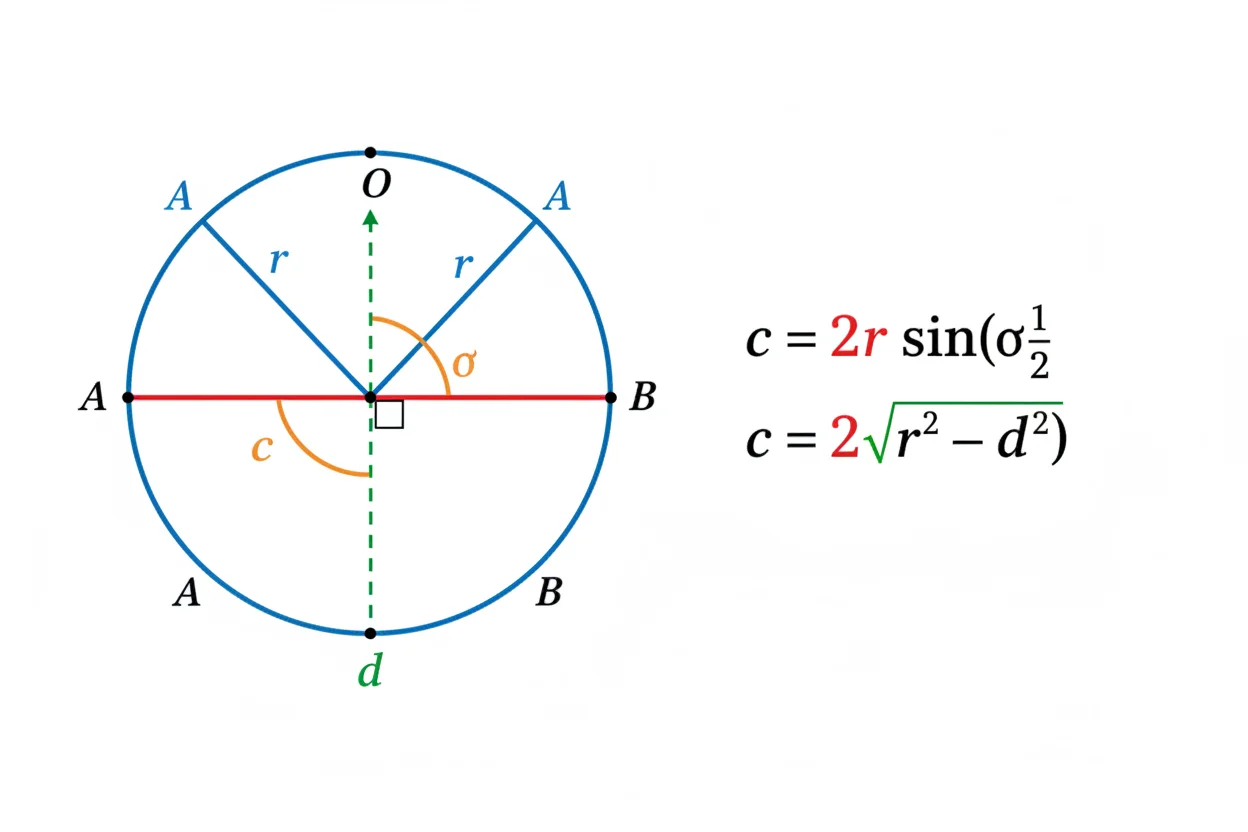

Chord length is the straight-line distance between two points on a circle. If a circle has radius r and the chord subtends central angle θ, the chord length formula is c = 2r sin(θ/2). The angle can be measured in degrees or radians as long as the sine calculation uses the matching angle unit. A chord can also be found when the perpendicular distance from the center to the chord is known: c = 2√(r² − d²). The longest possible chord in any circle is its diameter, with length 2r. As a chord moves farther from the center, its length decreases; as it moves toward the center, its length increases. Chord length is different from arc length because a chord follows a straight path between two points while an arc follows the circle’s curved boundary. These relationships connect circle geometry with right triangles, sine, cosine, central angles, sector geometry, and the Pythagorean theorem.
What Is a Chord?
A chord is a line segment whose two endpoints lie on a circle.
If points A and B lie on the same circle, then:
AB
is a chord.
A diameter is a special chord that passes through the center of the circle.
Every diameter is therefore a chord, but not every chord is a diameter.
The general properties of radii, diameters, and circular boundaries are part of Circles: Radius, Diameter, Area.
Chord Length Formula From Radius and Central Angle
If:
r = circle radius
θ = central angle subtended by the chord
c = chord length
then:
c = 2r sin(θ/2)
This is the standard chord length formula.
For example, if:
r = 10
and:
θ = 60°
then:
c = 2(10)sin30°
Since:
sin30° = 1/2
we obtain:
c = 20(1/2)
= 10
Therefore the chord length is:
10 units
Why the Formula Uses Half the Central Angle
Connect the center O to both endpoints A and B.
Because:
OA = OB = r
triangle OAB is isosceles.
Now draw a perpendicular from O to the midpoint M of chord AB.
This divides the original triangle into two congruent right triangles.
The central angle:
θ
is divided into:
θ/2
and the chord is divided into two equal lengths:
c/2
For either right triangle:
sin(θ/2) = (c/2)/r
Therefore:
c/2 = r sin(θ/2)
Multiply by 2:
c = 2r sin(θ/2)
The formula follows directly from right-triangle Sine.
Chord Length Formula Using Diameter
Since:
diameter = 2r
let:
D = 2r
Then:
c = D sin(θ/2)
This version can be convenient when a problem gives the diameter rather than the radius.
For example, if:
D = 16
θ = 90°
then:
c = 16sin45°
Since:
sin45° = √2/2
we get:
c = 8√2
Approximately:
c ≈ 11.31
Semicircle Chord
If the central angle is:
θ = 180°
then:
c = 2r sin90°
= 2r
The chord is a diameter.
This confirms an important limit:
c ≤ 2r
for every chord in a circle.
No chord can be longer than the diameter.
Chord With a 90° Central Angle
Suppose:
r = 7
θ = 90°
Then:
c = 2(7)sin45°
= 14(√2/2)
Therefore:
c = 7√2
Approximately:
c ≈ 9.90
This chord forms the base of an isosceles right triangle whose equal sides are both radii.
Chord With a 120° Central Angle
Let:
r = 6
θ = 120°
Then:
c = 12sin60°
Since:
sin60° = √3/2
we obtain:
c = 6√3
Approximately:
c ≈ 10.39
The corresponding curved distance between the same endpoints is larger, as shown by the Arc Length formula.
Chord Length Versus Arc Length
A chord and an arc can connect the same two circle points, but they measure different paths.
Chord:
straight-line distance between endpoints
Arc:
curved distance along circumference
For radius r and minor central angle θ in radians:
chord = 2r sin(θ/2)
while:
arc = rθ
For a nonzero minor angle less than π:
chord length < arc length
because the straight segment is the shortest path between its endpoints.
Example Comparing Chord and Arc
Suppose:
r = 10
θ = 60° = π/3
Chord:
c = 20sin30°
= 10
Arc:
s = 10(π/3)
= 10π/3
Approximately:
s ≈ 10.47
Therefore:
chord = 10
arc ≈ 10.47
The arc is slightly longer.
Chord Length From Arc Length
Because:
s = rθ
we can write:
θ = s/r
Substitute into:
c = 2r sin(θ/2)
to obtain:
c = 2r sin[s/(2r)]
This formula finds chord length directly from:
radius r
and:
arc length s
provided s corresponds to the relevant minor arc.
Example From Arc Length
Suppose:
r = 8
and the minor arc length is:
s = 4π
Then:
θ = s/r
= 4π/8
= π/2
So:
c = 16sin(π/4)
= 16(√2/2)
Therefore:
c = 8√2
The same result follows directly from:
c = 2r sin[s/(2r)]
Chord Length From Distance to the Center
Suppose the perpendicular distance from the circle’s center to a chord is d.
Then:
c = 2√(r² − d²)
where:
0 ≤ d ≤ r
This formula is especially useful when no central angle is given.
The perpendicular segment from the center to a chord bisects that chord.
Therefore one-half of the chord, the distance d, and the radius form a right triangle.
Deriving the Distance Formula
Let:
M = midpoint of chord AB
Then:
OM = d
OA = r
AM = c/2
Because OM is perpendicular to AB:
d² + (c/2)² = r²
using the Pythagorean Theorem.
Rearrange:
(c/2)² = r² − d²
Take the nonnegative square root:
c/2 = √(r² − d²)
Therefore:
c = 2√(r² − d²)
Example From Center-to-Chord Distance
Suppose:
r = 13
and:
d = 5
Then:
c = 2√(13² − 5²)
= 2√(169 − 25)
= 2√144
= 24
Therefore the chord length is:
24 units
The corresponding half-chord has length 12, giving the familiar:
5-12-13
right triangle.
Find Distance From Center to Chord
Rearrange:
c = 2√(r² − d²)
Start with:
c/2 = √(r² − d²)
Square:
c²/4 = r² − d²
Then:
d² = r² − c²/4
Therefore:
d = √[r² − (c/2)²]
The positive root is used because d represents geometric distance.
Distance Example
Suppose:
r = 10
and:
c = 16
Then:
d = √[10² − 8²]
= √(100 − 64)
= √36
Therefore:
d = 6
The chord is 6 units from the circle’s center.
How Chord Length Changes With Distance From the Center
Using:
c = 2√(r² − d²)
with fixed r, the chord decreases as d increases.
At:
d = 0
we get:
c = 2r
which is the diameter.
At:
d = r
we get:
c = 0
which is the limiting case where the chord endpoints coincide at a tangent point.
Thus chords closer to the center are longer.
Equal Chords and Equal Distances From the Center
Within the same circle, equal chords are equally distant from the center.
Suppose two chords have the same length c.
From:
d = √[r² − (c/2)²]
the value of d is identical for both.
The converse is also true: chords at equal perpendicular distances from the center have equal lengths.
This is an important circle symmetry property.
Find Central Angle From Chord Length
Starting with:
c = 2r sin(θ/2)
divide by 2r:
c/(2r) = sin(θ/2)
Apply inverse sine:
θ/2 = sin⁻¹[c/(2r)]
Therefore:
θ = 2sin⁻¹[c/(2r)]
This gives the minor central angle when:
0 ≤ c ≤ 2r
and the principal inverse-sine interpretation is used appropriately.
Central Angle Example
Suppose:
r = 10
and:
c = 10
Then:
θ = 2sin⁻¹(10/20)
= 2sin⁻¹(1/2)
= 2(30°)
Therefore:
θ = 60°
This reverses the earlier chord calculation.
Find Radius From Chord and Central Angle
Rearrange:
c = 2r sin(θ/2)
to:
r = c/[2sin(θ/2)]
Suppose:
c = 12
and:
θ = 90°
Then:
r = 12/[2sin45°]
= 12/√2
Rationalize or simplify:
r = 6√2
Approximately:
r ≈ 8.49
Chord Length Using the Law of Cosines
Triangle OAB has two sides of length r and included angle θ.
The Law of Cosines gives:
c² = r² + r² − 2r²cosθ
Therefore:
c² = 2r²(1 − cosθ)
so:
c = r√[2(1 − cosθ)]
This is equivalent to:
c = 2r sin(θ/2)
because:
1 − cosθ = 2sin²(θ/2)
Both formulas describe the same chord.
Example Using Cosine
Suppose:
r = 5
θ = 120°
Then:
c = 5√[2(1 − cos120°)]
Since:
cos120° = −1/2
we get:
c = 5√[2(3/2)]
= 5√3
The sine half-angle formula gives the same answer:
10sin60° = 5√3
Chord Midpoint Property
A line from the center of a circle perpendicular to a chord bisects the chord.
Conversely, a line from the center to the midpoint of a non-diameter chord is perpendicular to that chord.
This creates two congruent Right Triangles.
The property is central to the formulas involving:
radius
half-chord
distance from center
Chord Length and Circle Radius
For a fixed central angle:
c = 2r sin(θ/2)
so chord length is directly proportional to radius.
If radius doubles while θ remains fixed:
chord length doubles
For example, a 60° chord in a circle of radius 5 has length:
5
A 60° chord in radius 10 has length:
10
The geometry scales uniformly.
Chord Length and Circle Circumference
The Circle Circumference is:
C = 2πr
Therefore:
r = C/(2π)
Substitute into the chord formula:
c = 2[C/(2π)]sin(θ/2)
Simplify:
c = (C/π)sin(θ/2)
Thus chord length can be determined from circumference and central angle without separately calculating radius.
Example From Circumference
Suppose a circle has circumference:
C = 20π
Then:
r = 10
For a:
90°
central angle:
c = 20sin45°
= 10√2
The circumference determines the circle’s size, while the central angle determines what fraction of its geometry separates the endpoints.
Chord Length and Circle Area
The Circle Area is:
A = πr²
Therefore:
r = √(A/π)
Substitute into:
c = 2r sin(θ/2)
to obtain:
c = 2√(A/π) sin(θ/2)
This makes it possible to calculate a chord when circle area and central angle are known.
Example From Circle Area
Suppose:
A = 100π
Then:
r = √(100π/π)
= 10
For:
θ = 60°
the chord is:
c = 20sin30°
= 10
The Area determines the radius indirectly before the chord geometry is applied.
Chord Length and Area Formulas
The broader Area Formulas framework can be used when a chord divides a circle into geometric regions.
Two radii and a chord form an isosceles triangle.
Its area is:
A_triangle = r²sinθ/2
The sector with the same central angle has area:
A_sector = r²θ/2
for θ in radians.
Subtracting the triangle area from the sector area produces the corresponding minor circular segment.
Circular Segment Area
For central angle θ in radians, the minor segment area is:
A_segment = r²(θ − sinθ)/2
Its straight boundary is the chord:
c = 2r sin(θ/2)
and its curved boundary is the arc:
s = rθ
These three quantities describe different aspects of the same circular segment.
Equal Chords and Equal Arcs
Within the same circle:
equal chords ↔ equal minor central angles ↔ equal minor arcs
If two chords have equal lengths, then:
2r sin(θ₁/2) = 2r sin(θ₂/2)
for their minor angles.
Within the relevant range, this means:
θ₁ = θ₂
and therefore their corresponding arc lengths are equal.
Same Chord, Minor and Major Arc
A chord divides a circle into two arcs:
one minor arc
one major arc
Both arcs have the same chord endpoints.
Therefore one chord corresponds to two possible arc measures whose angles sum to:
360°
The chord length itself does not distinguish which arc is intended.
A problem requesting arc length must therefore specify or imply the minor or major arc.
Diameter as the Longest Chord
The formula:
c = 2r sin(θ/2)
has its largest value when:
sin(θ/2) = 1
For the minor-angle range, this occurs at:
θ/2 = 90°
so:
θ = 180°
Therefore:
c_max = 2r
The longest chord is the diameter.
This result also follows geometrically because the chord passes through the center when its distance d is zero.
Chord Length in a Semicircle
If a chord is the diameter, it divides the circle into two semicircular arcs.
The chord length is:
2r
while each semicircular arc length is:
πr
This provides a clear example of the difference between straight and curved measurements.
Chord Length From Sagitta
The sagitta h is the perpendicular height from the midpoint of a chord to the corresponding arc, measured toward the circle.
If r is the radius:
d = r − h
where d is the center-to-chord distance.
Substitute into:
c = 2√(r² − d²)
to obtain:
c = 2√[r² − (r − h)²]
Expand:
c = 2√(2rh − h²)
Therefore:
c = 2√[h(2r − h)]
Sagitta Example
Suppose:
r = 10
h = 2
Then:
c = 2√[2(10)(2) − 2²]
= 2√(40 − 4)
= 2√36
Therefore:
c = 12
The center-to-chord distance is:
d = 10 − 2 = 8
and the alternative formula confirms:
c = 2√(100 − 64) = 12
Find Sagitta From Chord Length
Starting with:
d = √[r² − (c/2)²]
and:
h = r − d
we obtain:
h = r − √[r² − (c/2)²]
For:
r = 10
c = 12
we get:
h = 10 − √(100 − 36)
= 10 − 8
= 2
This is the inverse of the previous example.
Chord Length and Circle Equation
A circle centered at:
(h, k)
with radius r has Circle Equation:
(x − h)² + (y − k)² = r²
A horizontal or vertical line intersecting the circle can create a chord.
For example, in:
x² + y² = 25
the horizontal line:
y = 3
produces intersection points satisfying:
x² + 9 = 25
so:
x² = 16
x = ±4
The chord endpoints are:
(−4, 3)
and:
(4, 3)
Therefore the chord length is:
8
This matches:
c = 2√(5² − 3²) = 8
Coordinate Chord Length
If two chord endpoints are known:
A = (x₁, y₁)
B = (x₂, y₂)
their straight-line distance is:
c = √[(x₂ − x₁)² + (y₂ − y₁)²]
This is simply the coordinate distance formula.
The points must lie on the same circle for the segment to be a chord of that circle.
This approach is useful when coordinates are supplied directly rather than radius-angle data.
Scaling Chords
If a circle is scaled by factor k, all lengths scale by:
k
Therefore:
radius → kr
chord → kc
circumference → kC
while Circle Area scales by:
k²
A geometric enlargement preserves central angles but changes all lengths proportionally.
Units of Chord Length
Chord length is a one-dimensional measurement.
If radius is measured in:
cm
then chord length is measured in:
cm
If radius is in meters:
chord is in meters
Do not report square units; those belong to area.
Likewise, central angles are measured in degrees or radians but do not supply the chord’s physical unit.
Common Chord Length Mistakes
A common error is using:
c = 2r sinθ
instead of:
c = 2r sin(θ/2)
The half-angle is essential.
Another mistake is confusing chord length with arc length. A chord is straight; an arc is curved.
When using:
c = 2√(r² − d²)
d must be the perpendicular distance from the center to the chord.
The diameter is the maximum chord length, so any calculated result greater than 2r signals an error.
Make sure the calculator’s angle mode matches whether θ is given in degrees or radians.
When calculating a major arc, remember that the chord remains the same as for the corresponding minor arc.
Finally, if coordinates are given, calculate endpoint distance rather than adding coordinate differences directly.
Frequently Asked Questions
What is chord length?
Chord length is the straight-line distance between two points on a circle.
What is the chord length formula?
For radius r and central angle θ:
c = 2r sin(θ/2)
Can θ be in degrees?
Yes, provided the sine calculation uses degree mode. If using radian mode, convert θ first.
What is the longest chord in a circle?
The diameter:
c_max = 2r
How do you find chord length from distance to the center?
c = 2√(r² − d²)
where d is the perpendicular distance from the center to the chord.
How do you find the distance from the center to a chord?
d = √[r² − (c/2)²]
How do you find the central angle from chord length?
θ = 2sin⁻¹[c/(2r)]
How do you find radius from chord and angle?
r = c/[2sin(θ/2)]
What is the difference between chord length and arc length?
Chord length is the straight distance between endpoints. Arc length follows the circular boundary.
Are equal chords equally distant from the center?
Yes, within the same circle.
Do equal chords have equal arcs?
In the same circle, equal chords subtend equal minor central angles and equal corresponding minor arcs.
Why does a perpendicular from the center bisect a chord?
It creates two congruent right triangles with equal radii as hypotenuses and a shared perpendicular leg.
Can a chord be longer than the diameter?
No. The diameter is the longest possible chord.
How can I check a chord-length answer?
Verify:
0 ≤ c ≤ 2r
and, when possible, check the result using either the right-triangle formula or the central-angle formula.