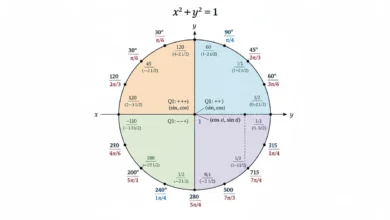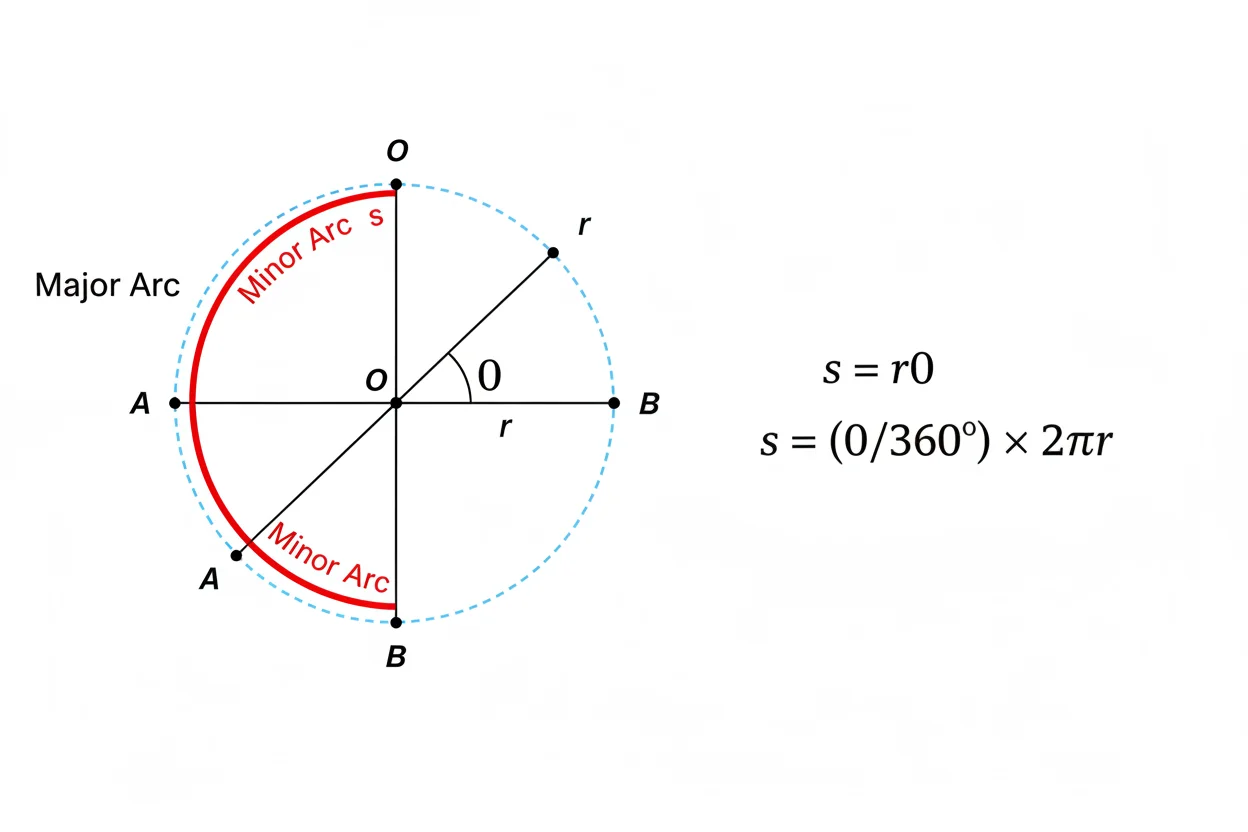

Arc length is the distance measured along part of a circle’s circumference. If a circle has radius r and a central angle θ measured in radians, the arc length formula is s = rθ. If θ is measured in degrees, the equivalent formula is s = (θ/360°)·2πr. Arc length is proportional to both the circle’s radius and the central angle: doubling the radius doubles the arc length, and doubling the angle doubles the arc length when the radius stays fixed. A complete circle has arc length equal to its circumference, 2πr, while a semicircle has length πr and a quarter-circle has length πr/2. The formula can also be rearranged to find an unknown radius or central angle. Correct angle units are essential because the compact equation s = rθ requires θ in radians.
What Is Arc Length?
An arc is a portion of a circle’s boundary.
Its length is the distance traveled along that curved boundary between two points.
If the endpoints are close together, the shorter route is called the minor arc.
The longer route around the circle is the major arc.
A semicircle has endpoints at opposite ends of a diameter and represents exactly half the circumference.
Arc length belongs to the broader geometry of Circles: Radius, Diameter, Area, where radius and central angle determine how much of the circular boundary is included.
Arc Length Formula in Radians
If:
r = radius
θ = central angle in radians
then:
s = rθ
where:
s = arc length
This is the most compact arc length formula.
For example, if:
r = 6
and:
θ = π/3
then:
s = 6(π/3)
= 2π
Therefore the arc length is:
2π units
Arc Length Formula in Degrees
If θ is measured in degrees:
s = (θ/360°)·2πr
This formula works because:
θ/360°
is the fraction of the entire circle represented by the central angle.
Since the full Circle Circumference is:
C = 2πr
the corresponding arc is the same fraction of C.
An equivalent degree formula is:
s = πrθ/180
where θ is the numerical angle in degrees.
Basic Degree Example
Find the arc length for:
r = 10
θ = 72°
Use:
s = (72/360)·2π(10)
Simplify:
72/360 = 1/5
Therefore:
s = (1/5)(20π)
= 4π
So the arc length is:
4π units
or approximately:
12.57 units
Why s = rθ Works Only With Radians
A radian is defined using arc length itself.
One radian is the central angle that subtends an arc whose length equals the radius.
Therefore:
θ = s/r
when θ is measured in radians.
Rearrange:
s = rθ
This direct relationship is why radians are the natural angular unit in many mathematical formulas.
The conversion rules between the two systems are covered by Degrees and Radians.
Convert Degrees Before Using s = rθ
Suppose:
r = 8
θ = 45°
You cannot correctly calculate:
s = 8(45)
because 45 is a degree measure.
First convert:
45° × π/180
= π/4
Then:
s = 8(π/4)
= 2π
The same answer follows from the degree formula:
s = (45/360)2π(8)
= 2π
Full Circle Arc Length
A complete revolution has:
θ = 2π radians
Therefore:
s = r(2π)
= 2πr
This is exactly the circumference formula.
In degrees:
θ = 360°
so:
s = (360/360)2πr
= 2πr
Arc length therefore generalizes circumference from a full circle to any fractional part of one.
Semicircle Arc Length
A semicircle has central angle:
180° = π radians
Thus:
s = rπ
So the curved portion of a semicircle has length:
πr
If a problem asks for the perimeter of the semicircular region rather than only its arc, the diameter must also be included:
perimeter = πr + 2r
Arc length and total perimeter are therefore different quantities.
Quarter-Circle Arc Length
A quarter circle has:
θ = 90° = π/2 radians
Therefore:
s = r(π/2)
So:
s = πr/2
For:
r = 12
the arc length is:
6π
A quarter circle contains one-fourth of the full circumference, which gives the same result:
(1/4)(24π) = 6π
Find Radius From Arc Length
Starting with:
s = rθ
solve for r:
r = s/θ
where θ is in radians.
Suppose:
s = 15
and:
θ = 2.5
Then:
r = 15/2.5
= 6
Therefore the radius is:
6 units
Find Central Angle From Arc Length
Rearrange:
s = rθ
to:
θ = s/r
This gives θ in radians.
Suppose:
s = 9
and:
r = 6
Then:
θ = 9/6
= 3/2 radians
If a degree answer is desired:
degrees = (3/2)(180/π)
≈ 85.94°
Find an Angle in Degrees Directly
From:
s = (θ/360°)2πr
solve for θ:
θ = 180s/(πr)
when θ is expressed in degrees.
For:
s = 5π
and:
r = 10
we get:
θ = 180(5π)/(10π)
= 90°
Therefore the arc is a quarter-circle.
Minor Arc
A minor arc corresponds to a central angle less than:
180°
Its length is:
s_minor = (θ/360°)2πr
where:
0° < θ < 180°
For θ measured in radians:
0 < θ < π
and:
s_minor = rθ
Major Arc
If the minor central angle is θ, the corresponding major angle is:
360° − θ
Therefore the major arc length is:
s_major = [(360° − θ)/360°]2πr
Another efficient method is:
s_major = circumference − s_minor
So:
s_major = 2πr − s_minor
This is often faster than recalculating the major angle from the beginning.
Minor and Major Arc Example
Suppose:
r = 5
and the minor central angle is:
120°
Minor arc:
s_minor = (120/360)2π(5)
= 10π/3
The full circumference is:
10π
Therefore the major arc is:
s_major = 10π − 10π/3
= 20π/3
The two arcs add back to the complete circumference.
Arc Length as a Fraction of Circumference
The central relationship can be written:
arc length/circumference = central angle/full angle
In degrees:
s/(2πr) = θ/360°
In radians:
s/(2πr) = θ/(2π)
Both forms describe the same proportional relationship.
This is often the easiest conceptual way to solve circle-fraction problems.
Example From a Fraction of a Circle
Suppose an arc represents:
3/8
of a circle with radius:
16
The circumference is:
2π(16) = 32π
Therefore:
s = 3/8(32π)
= 12π
The corresponding central angle is:
3/8(360°)
= 135°
No separate trigonometric calculation is required.
Arc Length and Chord Length
Arc length should not be confused with straight-line Chord Length.
For radius r and central angle θ:
arc length = rθ
when θ is in radians.
The corresponding chord length is:
c = 2r sin(θ/2)
The arc follows the circumference.
The chord connects the two endpoints directly through a straight segment.
Except in a limiting sense for very small angles:
chord length < minor arc length
for a nonzero minor arc.
Arc and Chord Example
Let:
r = 10
and:
θ = 60° = π/3
Arc length:
s = 10π/3
Chord length:
c = 2(10)sin30°
= 20(1/2)
= 10
Numerically:
10π/3 ≈ 10.47
so the curved arc is slightly longer than the straight chord.
Arc Length and Sine
The chord relationship:
c = 2r sin(θ/2)
uses the Sine function because dividing the isosceles triangle formed by two radii creates two right triangles.
The arc itself does not require sine when radius and central angle are known.
This distinction helps determine whether a problem asks for:
curved boundary distance
or:
straight endpoint-to-endpoint distance
Arc Length and Cosine
The Cosine relationship can also produce chord length through the Law of Cosines.
For two radii r separated by angle θ:
c² = r² + r² − 2r²cosθ
so:
c² = 2r²(1 − cosθ)
This again concerns the straight chord, while:
s = rθ
gives the curved arc.
Both quantities depend on the same central angle but describe different geometric distances.
Arc Length and Sector Area
A circular sector contains the region between two radii and their connecting arc.
For θ in radians, Sector Area is:
A = r²θ/2
Since:
s = rθ
we can substitute:
θ = s/r
giving:
A = r²(s/r)/2
Therefore:
A = rs/2
This formula directly connects sector area, radius, and arc length.
Sector Area Example From Arc Length
Suppose:
r = 8
and:
s = 6
Then:
A = rs/2
= 8(6)/2
= 24
Therefore the sector has area:
24 square units
The corresponding angle is:
θ = s/r = 6/8 = 3/4 radian
Arc Length and Circle Area
The full Circle Area is:
A_circle = πr²
A sector occupies the same fraction of the circle’s area as its arc occupies of the circumference:
sector area/circle area = arc length/circumference
Thus:
A_sector/(πr²) = s/(2πr)
which simplifies to:
A_sector = rs/2
The relationship illustrates how central angle controls both circular boundary length and enclosed sector area.
Arc Length and General Area Formulas
Arc length itself is a length, not an Area.
However, it often appears inside area calculations involving sectors and composite figures.
The general collection of Area Formulas uses squared units, whereas arc length uses linear units.
This dimensional difference is an effective way to catch formula confusion.
Angle Bisectors and Arcs
If a central angle is divided into two equal angles, the same radius applies to both resulting arcs.
Because:
s = rθ
equal central angles produce equal arc lengths.
An Angle Bisector Theorem problem inside a triangle instead concerns how an angle bisector divides the opposite side proportionally.
The phrase “angle bisector” can therefore appear in both triangle and circle geometry, but the governing relationships are different.
Equal Arcs and Equal Central Angles
Within the same circle, equal central angles subtend equal arcs.
Conversely, equal arcs correspond to equal central angles.
If two arcs have lengths:
s₁ = s₂
and both belong to the same circle of radius r:
rθ₁ = rθ₂
so:
θ₁ = θ₂
This proportionality is one of the most useful properties of circular geometry.
Different Circles Can Have the Same Angle but Different Arc Lengths
Suppose two circles both contain a:
60°
central angle.
Circle 1 has:
r = 3
Circle 2 has:
r = 12
The angle is:
π/3 radians
So:
s₁ = 3π/3 = π
while:
s₂ = 12π/3 = 4π
The same angular rotation produces a longer arc on the larger circle.
Same Arc Length With Different Radii
If:
s = rθ
is fixed, increasing r requires decreasing θ.
For example, an arc of length 6 can occur with:
r = 3, θ = 2 radians
or:
r = 6, θ = 1 radian
The same curved distance can therefore represent different fractions of differently sized circles.
Arc Length in Polar Coordinates
The conversion between Cartesian and Polar and Rectangular Form uses an angle θ and radial coordinate r.
On a circle where r is constant, changing θ by:
Δθ
produces circular arc length:
s = rΔθ
when Δθ is measured in radians.
This geometric relationship is one reason radians and polar coordinates work naturally together.
Arc Length and Perimeter
The Perimeter of a composite figure may include one or more circular arcs.
For example, a semicircular region of radius r has perimeter:
πr + 2r
because the boundary includes:
semicircular arc = πr
and:
diameter = 2r
Always determine whether the question asks only for the arc or for the complete boundary.
Composite Arc-Length Problems
A boundary can contain several arcs.
Suppose a figure has:
one quarter-circle of radius 4
and:
one semicircle of radius 2
Their arc lengths are:
s₁ = π(4)/2 = 2π
and:
s₂ = π(2) = 2π
Total curved length:
s_total = 4π
Straight boundary segments must be added separately if the full perimeter is required.
Units of Arc Length
Arc length is a one-dimensional distance.
If radius is measured in:
cm
then arc length is measured in:
cm
If radius is in meters:
s is in meters
Radians are dimensionless in the mathematical sense, so:
s = rθ
has the same length units as r.
A result in square units would indicate that an area formula has been used instead.
Exact Versus Decimal Arc Length
When π remains in the result, an exact answer is often preferable.
For example:
s = 5π/3
is exact.
Using:
π ≈ 3.14159
gives:
s ≈ 5.236
Both can be useful, but rounding should normally occur only at the end of the calculation.
Premature rounding can introduce unnecessary error.
Arc Length in This Geometry Context Versus Calculus
The circular arc length formula here assumes a fixed radius and central angle.
A general curved function such as:
y = f(x)
does not usually have constant radius from one center.
Its length is handled by Arc Length Calculus, using a derivative-based integral such as:
L = ∫√(1 + [f′(x)]²)dx
Thus:
circle arc → s = rθ
and:
general curve → derivative-based arc-length integral
are related ideas but distinct calculations.
Common Arc Length Mistakes
The most common mistake is using:
s = rθ
with θ measured in degrees.
That compact formula requires radians.
Another error is using diameter instead of radius.
Remember:
r = d/2
A major arc should not be calculated with the minor central angle unless it is subtracted from the full circumference afterward.
Arc length and chord length are different: one follows the circle, while the other is a straight segment.
Do not confuse arc length with sector area; arc length uses linear units, while sector area uses square units.
Finally, a semicircular region’s full perimeter includes its diameter in addition to the curved arc.
Frequently Asked Questions
What is arc length?
Arc length is the distance measured along a portion of a circle’s circumference.
What is the arc length formula in radians?
s = rθ
where θ is measured in radians.
What is the formula in degrees?
s = (θ/360°)2πr
Can I use s = rθ with degrees?
No. Convert the angle to radians first.
How do you find the radius from arc length?
r = s/θ
when θ is in radians.
How do you find the central angle?
θ = s/r
which gives the angle in radians.
What is the arc length of a semicircle?
s = πr
What is the arc length of a quarter circle?
s = πr/2
Is arc length the same as circumference?
Circumference is the arc length of an entire circle. An ordinary arc is only part of that circumference.
What is the difference between arc length and chord length?
Arc length follows the curved circumference. Chord length is the straight distance between the same endpoints.
How is arc length related to sector area?
For radius r and arc length s:
A_sector = rs/2
Does a larger radius always mean a larger arc?
For the same central angle, yes. Because:
s = rθ
arc length is directly proportional to radius.
How can I check an arc length answer?
Compare the central angle with a full revolution. If the angle represents fraction f of the circle, the arc length should equal the same fraction f of:
2πr