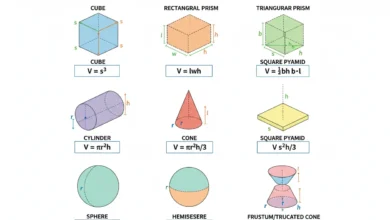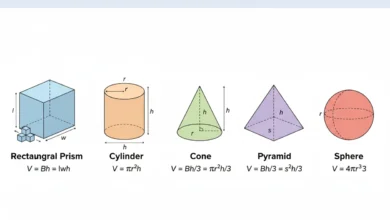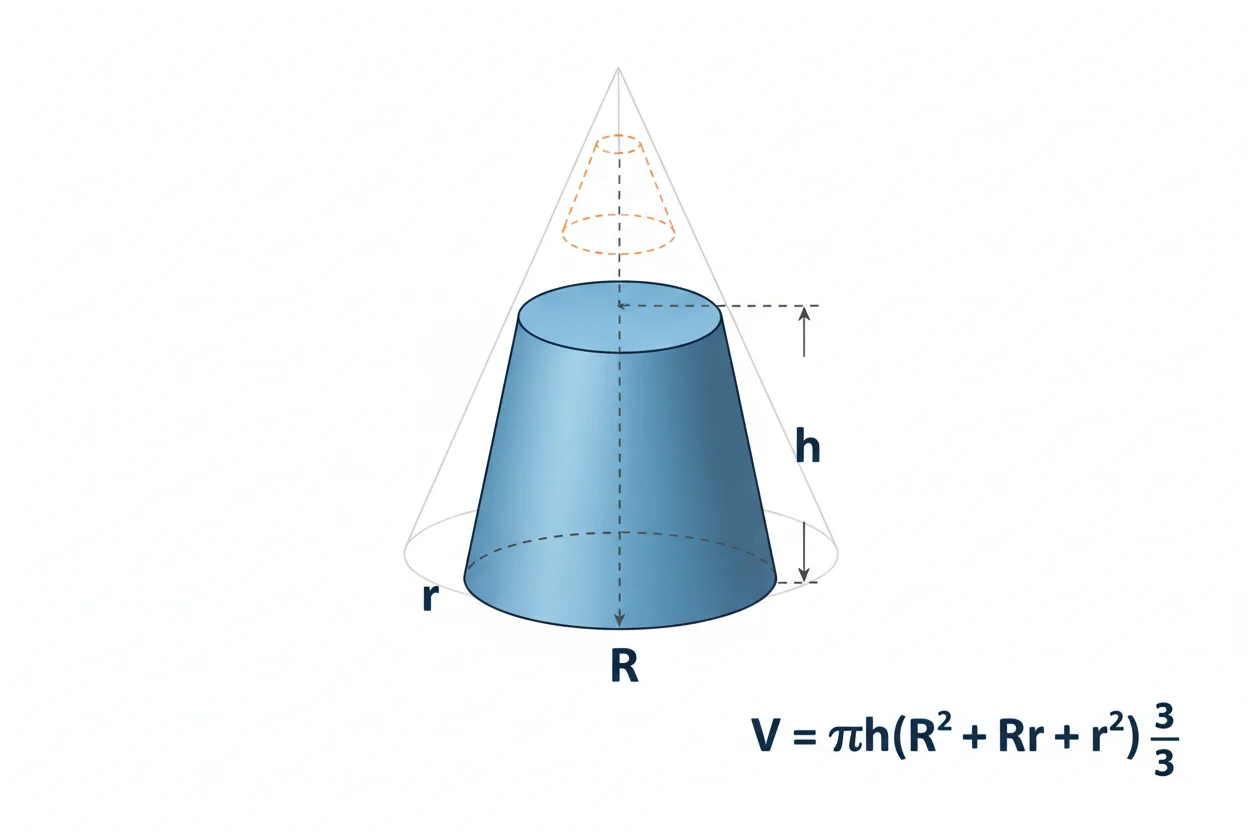

Frustum volume measures the three-dimensional space inside a solid formed when the top of a cone or pyramid is cut off by a plane parallel to its base. For a circular conical frustum with larger radius R, smaller radius r, and perpendicular height h, the formula is V = πh(R² + Rr + r²)/3. A more general formula uses the areas of the two parallel bases: V = h(B₁ + B₂ + √(B₁B₂))/3. The height must be measured perpendicular to the parallel bases; it is not the slant height. A frustum can also be treated as the difference between two similar cones or pyramids, which explains the structure of the formula. Frustum volume is measured in cubic units and is useful for truncated cones, buckets, tapered containers, lampshade-like solids, architectural forms, and polygonal truncated pyramids.
What Is a Frustum?
A frustum is created by cutting a cone or pyramid with a plane parallel to its base and removing the smaller solid containing the original apex.
A conical frustum therefore has:
larger circular base
smaller circular base
perpendicular height between them
A pyramidal frustum has two similar polygonal bases.
The defining condition is that the cutting plane is parallel to the original base.
This makes the removed and original solids similar.
Conical Frustum Volume Formula
For a right circular frustum:
V = πh(R² + Rr + r²)/3
where:
R = larger radius
r = smaller radius
h = perpendicular height
V = volume
The radii correspond to the two parallel circular bases.
The larger radius is conventionally written R and the smaller radius r, although the formula itself is symmetric in the two radii.
Basic Frustum Volume Example
Suppose:
R = 6
r = 3
h = 8
Use:
V = πh(R² + Rr + r²)/3
Substitute:
V = π(8)(6² + 6·3 + 3²)/3
= 8π(36 + 18 + 9)/3
= 8π(63)/3
Therefore:
V = 168π
Approximately:
V ≈ 527.79
cubic units.
Why All Three Radius Terms Appear
The expression:
R² + Rr + r²
contains:
larger-base term R²
mixed term Rr
smaller-base term r²
A frustum is not correctly modeled by simply averaging the two circular areas and multiplying by height.
The cross-sectional radius changes linearly through the height, while cross-sectional area depends on the square of radius.
That squared change produces the mixed:
Rr
term.
General Frustum Volume Formula
For a frustum of a cone or pyramid with parallel similar bases of areas:
B₁
and:
B₂
the volume is:
V = h(B₁ + B₂ + √(B₁B₂))/3
This formula is useful when the base areas are known directly.
For circular bases:
B₁ = πR²
B₂ = πr²
Then:
√(B₁B₂) = πRr
Substituting gives:
V = πh(R² + Rr + r²)/3
Base-Area Example
Suppose a pyramidal frustum has:
B₁ = 100
B₂ = 25
h = 12
Then:
V = 12[100 + 25 + √(100·25)]/3
= 12(100 + 25 + 50)/3
= 12(175)/3
Therefore:
V = 700
cubic units.
Frustum as Large Cone Minus Small Cone
A conical frustum can be reconstructed conceptually by placing the removed small cone back on top.
Then:
frustum volume = large cone volume − small cone volume
The Cone Volume formula is:
V = πr²h/3
Because the cutting plane is parallel to the base, the small and large cones are similar.
Their corresponding radii and heights are proportional.
This similarity allows the subtraction method to simplify into the direct frustum formula.
Similarity Relationship
Let:
H = height of original large cone
x = height of removed small cone
Then the frustum height is:
h = H − x
Similarity gives:
r/R = x/H
Solving these relationships yields:
H = hR/(R − r)
and:
x = hr/(R − r)
provided:
R ≠ r
These formulas are useful when reconstructing the two original cones.
Difference-of-Cones Example
Suppose:
R = 6
r = 3
h = 8
The original cone height is:
H = 8(6)/(6 − 3)
= 16
The removed cone height is:
x = 8(3)/(3)
= 8
Large cone volume:
V_large = π(6²)(16)/3
= 192π
Small cone volume:
V_small = π(3²)(8)/3
= 24π
Subtract:
V_frustum = 192π − 24π
= 168π
This matches the direct formula.
Frustum Height Must Be Perpendicular
The height h in the volume formula is the perpendicular distance between the two parallel bases.
It is not the slant height.
For a right conical frustum, the slant height ℓ lies along the lateral surface.
If ℓ is known instead of h:
ℓ² = h² + (R − r)²
Therefore:
h = √[ℓ² − (R − r)²]
This follows from the Distance Formula or the Pythagorean theorem applied to an axial cross section.
Slant-Height Example
Suppose:
R = 8
r = 3
ℓ = 13
Then:
R − r = 5
So:
h = √(13² − 5²)
= √(169 − 25)
= √144
= 12
Now calculate volume:
V = π(12)(8² + 8·3 + 3²)/3
= 4π(64 + 24 + 9)
= 388π
Find Height From Volume
Starting with:
V = πh(R² + Rr + r²)/3
solve for h:
h = 3V/[π(R² + Rr + r²)]
Suppose:
V = 156π
R = 5
r = 2
Then:
h = 3(156π)/[π(25 + 10 + 4)]
= 468/39
Therefore:
h = 12
Find Volume From Diameters
If larger and smaller diameters are:
D
and:
d
then:
R = D/2
r = d/2
Substituting into the formula gives:
V = πh(D² + Dd + d²)/12
This is equivalent to using the radii.
Diameter Example
Suppose:
D = 12
d = 6
h = 8
Then:
R = 6
r = 3
Therefore:
V = 168π
Using the direct diameter formula:
V = π(8)(144 + 72 + 36)/12
= 8π(252)/12
= 168π
Square Pyramidal Frustum
Suppose the two bases are squares with side lengths:
a
and:
b
Their areas are:
a²
and:
b²
The general frustum formula becomes:
V = h(a² + ab + b²)/3
because:
√(a²b²) = ab
for positive side lengths.
Square Frustum Example
Suppose:
a = 10
b = 4
h = 9
Then:
V = 9(100 + 40 + 16)/3
= 3(156)
Therefore:
V = 468
cubic units.
Regular Polygon Frustums
A pyramidal frustum can have regular polygon bases.
If the base areas are not supplied directly, each can first be calculated from its dimensions.
For a regular polygon:
A = aP/2
where:
a = apothem
P = perimeter
The Regular Polygon Area result can therefore provide B₁ and B₂ before the frustum formula is used.
Exterior Angles and Polygonal Frustums
If the base is a regular polygon and its Exterior Angles are known:
E = 360°/n
so:
n = 360°/E
This can identify the number of base sides.
For example:
E = 45°
gives:
n = 8
so the base is a regular octagon.
Once its side measurements or apothem are known, its area can be calculated and used as a frustum base area.
Interior Angles and Base Identification
For a regular n-gon, each Interior Angle is:
I = 180° − 360°/n
If:
I = 135°
then:
E = 45°
and:
n = 8
Again, the angular information identifies the polygonal base but does not determine volume without a length scale and frustum height.
Degrees and Radians in Frustum Geometry
Ordinary frustum volume needs no angular input when R, r, and h are known.
However, angles can appear in problems where the height or radius must first be determined.
The Degrees and Radians conversion:
radians = degrees × π/180
is important whenever trigonometric functions are used.
For example:
30° = π/6
Both representations describe the same geometric angle.
Frustum Volume From an Angle
Suppose a right conical frustum has:
R = 8
r = 4
and its slant side makes angle θ with the horizontal.
The horizontal change in an axial cross section is:
R − r = 4
If:
tan θ = h/(R − r)
then:
h = (R − r)tan θ
For:
θ = 45°
we get:
h = 4
Then:
V = π(4)(64 + 32 + 16)/3
= 448π/3
The angle calculation is only an intermediate step; the frustum formula still uses perpendicular height.
Frustum Versus Full Cone
If:
r = 0
the smaller base shrinks to a point.
The frustum formula becomes:
V = πh(R² + 0 + 0)/3
Therefore:
V = πR²h/3
which is exactly the full cone-volume formula.
A cone can therefore be viewed as the limiting case of a frustum whose upper radius is zero.
Frustum Versus Cylinder
If:
r = R
the two circular bases have equal radii.
Then the frustum formula becomes:
V = πh(R² + R² + R²)/3
= πR²h
This is exactly the cylinder-volume formula.
So a cylinder can be interpreted as the equal-radii limiting case.
Why the Equal-Radii Case Works
The usual geometric construction of a frustum assumes a tapered original cone, but the algebraic formula has a continuous limit as:
r → R
The taper disappears.
Every horizontal cross section approaches the same circle area:
πR²
Therefore the solid becomes cylindrical and:
V = πR²h
Compare Frustum With a Cylinder
Suppose:
R = 6
r = 3
h = 8
A cylinder using the larger radius would have:
V_cylinder = π(6²)(8)
= 288π
The frustum has:
V_frustum = 168π
The frustum is smaller because its cross sections decrease from radius 6 to radius 3.
A cylinder based only on the larger radius would overestimate the volume.
Average Radius Is Not Enough
A tempting shortcut is to calculate:
average radius = (R + r)/2
and then use a cylinder formula.
This is generally incorrect because area depends on the square of radius.
For:
R = 6
r = 3
average radius is:
4.5
A radius-4.5 cylinder of height 8 would have:
π(4.5²)(8) = 162π
But the correct frustum volume is:
168π
The difference comes from nonlinear area scaling.
Average Base Area Is Also Not Exact
Another tempting approximation is:
V ≈ h(B₁ + B₂)/2
For the same example:
B₁ = 36π
B₂ = 9π
Average-base estimate:
V ≈ 8(45π/2)
= 180π
Again, this differs from:
168π
The exact formula includes:
√(B₁B₂)
as the third term.
Frustum Volume and Similar Solids
The smaller removed cone and the complete original cone are similar.
If their linear scale factor is:
k = r/R
then their volume ratio is:
k³
Therefore:
V_small/V_large = (r/R)³
This cubic scaling provides another way to solve some frustum problems.
Similarity Example
Suppose:
r/R = 1/2
Then the removed cone has:
(1/2)³ = 1/8
of the complete cone’s volume.
Therefore the remaining frustum has:
7/8
of the original cone’s volume.
This works when the cut corresponds to the stated similarity scale factor.
Frustum Capacity
A tapered container can often be modeled as a conical frustum.
Suppose its interior dimensions are:
R = 15 cm
r = 10 cm
h = 30 cm
Then:
V = π(30)(225 + 150 + 100)/3
= 10π(475)
Therefore:
V = 4750π cm³
Approximately:
V ≈ 14,922.57 cm³
Since:
1000 cm³ = 1 L
the ideal geometric capacity is approximately:
14.92 L
when the measurements are internal dimensions.
Outer Versus Inner Dimensions
For real containers, wall thickness matters.
Exterior radii describe the outside solid.
Capacity requires interior dimensions.
If wall thickness is significant, using outer R and r can overestimate usable volume.
The mathematical formula remains the same, but the chosen measurements must correspond to the quantity being modeled.
Frustum Volume and Surface Area
Volume measures the interior space:
cubic units
Surface area measures the exterior boundary:
square units
The volume formula uses:
R, r, h
A conical frustum’s lateral surface area also involves slant height:
ℓ = √[h² + (R − r)²]
Do not substitute slant height into the volume formula.
Heron’s Formula and Frustum Geometry
Heron Formula calculates the area of a triangle from three side lengths.
It can become useful in more complex polygonal or triangulated frustum models where a base or cross-sectional region is decomposed into triangles.
Once the required parallel base areas:
B₁
and:
B₂
are known, the frustum volume itself is still:
V = h(B₁ + B₂ + √(B₁B₂))/3
Heron’s formula provides an area input rather than replacing the volume equation.
Example With Triangulated Base Areas
Suppose a pyramidal frustum has triangular parallel bases whose side lengths allow their areas to be found separately.
If Heron’s formula gives:
B₁ = 64
and:
B₂ = 16
with:
h = 9
then:
V = 9(64 + 16 + √1024)/3
= 3(64 + 16 + 32)
= 336
cubic units.
Scaling Frustum Volume
If every linear dimension is multiplied by scale factor k:
R → kR
r → kr
h → kh
Then:
V_new = π(kh)[(kR)² + (kR)(kr) + (kr)²]/3
Every term contributes a total factor of:
k³
Therefore:
V_new = k³V_old
Scaling Example
Suppose a frustum has volume:
100π
and every linear dimension doubles.
Then:
k = 2
so:
V_new = 2³(100π)
= 800π
The new volume is eight times as large.
Find One Radius From the Other Quantities
If V, h, and R are known, the equation can be treated as a quadratic in r:
V = πh(R² + Rr + r²)/3
Rearrange:
r² + Rr + R² − 3V/(πh) = 0
The quadratic formula can then solve for r.
Only a geometrically meaningful nonnegative solution should be retained.
Example Solving for the Smaller Radius
Suppose:
R = 5
h = 12
V = 156π
Then:
156π = 4π(25 + 5r + r²)
Divide by:
4π
39 = 25 + 5r + r²
Therefore:
r² + 5r − 14 = 0
Factor:
(r + 7)(r − 2) = 0
So:
r = 2
or:
r = −7
Reject the negative radius.
Therefore:
r = 2
Units of Frustum Volume
Frustum volume uses cubic units.
If radii and height are measured in centimeters:
R²h
has units:
cm² × cm = cm³
Therefore:
V → cm³
The same principle gives:
m³
ft³
in³
depending on the input units.
Cubic Unit Conversion
If:
1 m = 100 cm
then:
1 m³ = 100³ cm³
Therefore:
1 m³ = 1,000,000 cm³
Volume conversion factors must be cubed.
This differs from area conversions, which square the linear conversion factor.
Exact and Approximate Answers
When a circular frustum calculation produces π, the exact answer can usually retain π.
For example:
V = 168π
is exact.
Using:
π ≈ 3.14159
gives:
V ≈ 527.79
Avoid rounding intermediate dimensions unless the problem specifically involves approximate measurements.
Common Frustum Volume Mistakes
A common mistake is using:
V = πR²h
which treats the frustum as a cylinder with its larger radius.
Another is averaging the radii and applying a cylinder formula. Because area depends on radius squared, that shortcut is not exact.
The volume formula requires perpendicular height h, not slant height ℓ.
Remember all three terms:
R² + Rr + r²
For a pyramidal frustum, the two bases must be parallel and similar for the standard formula.
Radius and diameter should not be confused.
If using a difference-of-cones approach, similarity ratios must be applied to both radius and height.
Finally, report cubic units rather than square units.
Frequently Asked Questions
What is the conical frustum volume formula?
V = πh(R² + Rr + r²)/3
What do R and r mean?
R is the larger radius and r is the smaller radius.
What does h represent?
h is the perpendicular distance between the parallel bases.
Is h the slant height?
No. For a right conical frustum:
h = √[ℓ² − (R − r)²]
when slant height ℓ is known.
What is the general frustum formula?
V = h(B₁ + B₂ + √(B₁B₂))/3
How do you find frustum height from volume?
h = 3V/[π(R² + Rr + r²)]
for a conical frustum.
Can a frustum be calculated as two cones?
Yes:
V_frustum = V_large cone − V_small cone
What happens if the smaller radius is zero?
The formula becomes the ordinary cone-volume formula.
What happens if the radii are equal?
The formula becomes:
V = πR²h
which is cylinder volume.
What is a square-frustum volume formula?
For square side lengths a and b:
V = h(a² + ab + b²)/3
How does frustum volume scale?
If every length scales by k:
volume scales by k³
What units does frustum volume use?
Cubic units such as cm³, m³, ft³, or in³.
How can I check a frustum volume answer?
Confirm that the result lies between the volumes of cylinders using the smaller and larger base radii with the same height:
πr²h < V < πR²h
for a genuinely tapered frustum with:
0 < r < R.