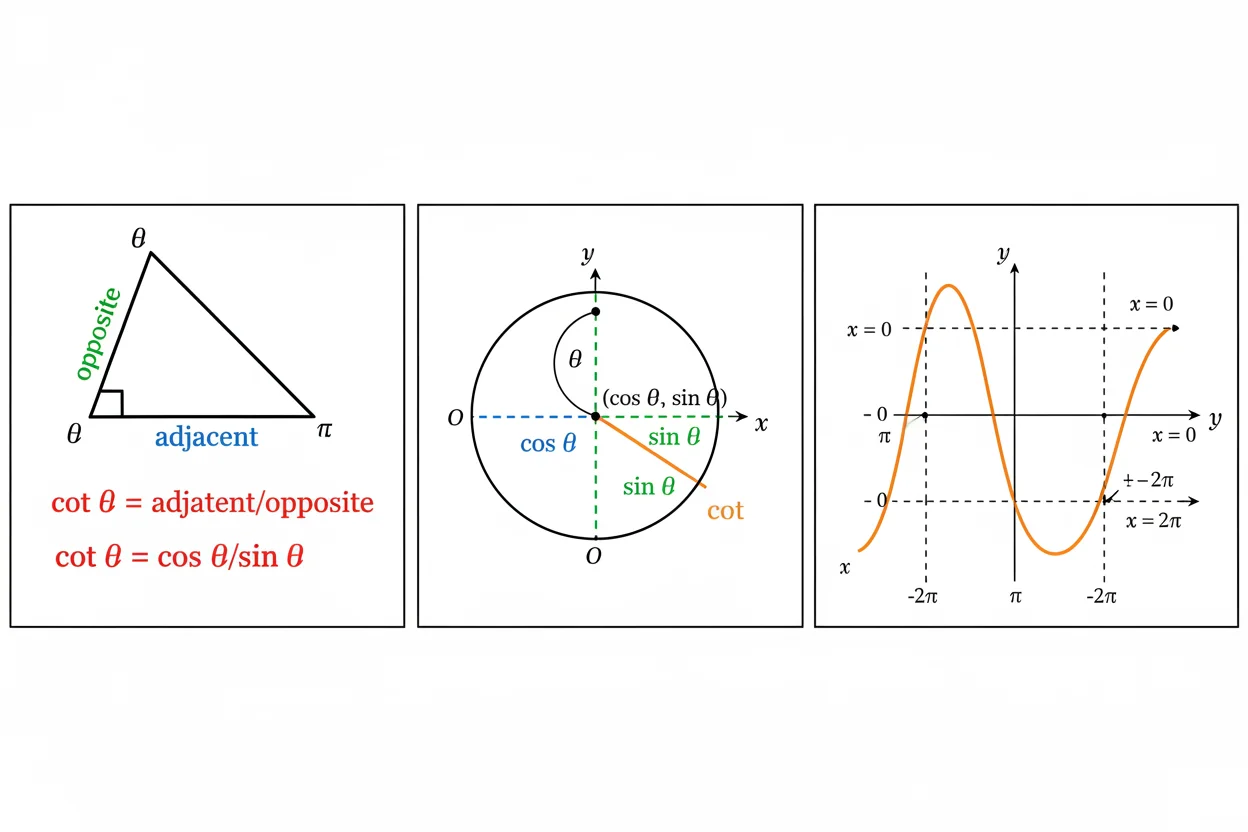

Cotangent is a trigonometric function defined as the reciprocal of tangent. For an angle θ, cot θ = 1/tan θ wherever tangent is nonzero. In a right triangle, cotangent is the ratio of the adjacent side to the opposite side, so cot θ = adjacent/opposite. It can also be written as cos θ/sin θ, which extends the definition beyond acute angles to the unit circle and general trigonometric calculations. Cotangent has period π radians, or 180°, and is undefined wherever sin θ = 0. Unlike sine and cosine, cotangent can take any real value. It is useful for solving right triangles, simplifying identities, finding angles, analyzing slopes and directions, and expressing geometric dimensions when adjacent and opposite lengths are naturally paired.
What Is Cotangent?
Cotangent is one of the six standard trigonometric functions.
It is written:
cot θ
and can be defined in several equivalent ways:
cot θ = 1/tan θ
cot θ = cos θ/sin θ
For an acute right-triangle angle:
cot θ = adjacent/opposite
These formulas describe the same function from different viewpoints.
The right-triangle interpretation is convenient for geometry, while the sine-cosine definition works for angles throughout the coordinate plane.
Cotangent Formula in a Right Triangle
For a right triangle and an acute angle θ:
cot θ = adjacent/opposite
Suppose:
adjacent = 12
opposite = 5
Then:
cot θ = 12/5
Therefore:
cot θ = 2.4
The broader Right Triangles framework explains how side names change according to which acute angle is selected.
Cotangent as the Reciprocal of Tangent
The Tangent function is:
tan θ = opposite/adjacent
Taking the reciprocal gives:
cot θ = adjacent/opposite
Therefore:
cot θ = 1/tan θ
and:
tan θ = 1/cot θ
whenever both expressions are defined.
If:
tan θ = 3/4
then:
cot θ = 4/3
Basic Cotangent Example
Suppose a right triangle has:
opposite = 8
adjacent = 15
Then:
cot θ = 15/8
The hypotenuse is not required to calculate cotangent.
If needed, the Pythagorean Theorem gives:
h = √(8² + 15²)
= 17
but cotangent depends only on the two legs.
Find an Adjacent Side
Suppose:
cot θ = 5/2
and:
opposite = 6
Use:
cot θ = adjacent/opposite
Then:
5/2 = a/6
Cross-multiply:
2a = 30
Therefore:
a = 15
The adjacent side is:
15
Find an Opposite Side
Suppose:
cot θ = 3
and:
adjacent = 18
Then:
3 = 18/o
Therefore:
3o = 18
so:
o = 6
The opposite side is:
6
Cotangent From Sine and Cosine
Cotangent can be written:
cot θ = cos θ/sin θ
Suppose:
cos θ = 4/5
and:
sin θ = 3/5
Then:
cot θ = (4/5)/(3/5)
= 4/3
This definition is particularly useful outside elementary right-triangle problems.
The separate Cosine relationship provides the horizontal component, while sine supplies the vertical component.
Deriving cot θ = cos θ/sin θ
For a right triangle:
cos θ = adjacent/hypotenuse
and:
sin θ = opposite/hypotenuse
Divide cosine by sine:
cos θ/sin θ
= (adjacent/hypotenuse)/(opposite/hypotenuse)
The hypotenuse factors cancel:
cos θ/sin θ = adjacent/opposite
Therefore:
cot θ = cos θ/sin θ
Exact Cotangent Values
Common exact values include:
cot 30° = √3
cot 45° = 1
cot 60° = √3/3
At:
90°
we have:
cos90° = 0
and:
sin90° = 1
so:
cot90° = 0
At:
0°
sine equals zero, so cotangent is undefined.
Cotangent of 30°
Use:
cot30° = cos30°/sin30°
Since:
cos30° = √3/2
and:
sin30° = 1/2
we get:
cot30° = (√3/2)/(1/2)
Therefore:
cot30° = √3
Cotangent of 45°
For:
θ = 45°
the opposite and adjacent legs of a 45-45-90 triangle are equal.
Therefore:
cot45° = adjacent/opposite
= 1
The sine-cosine form gives the same result:
(√2/2)/(√2/2) = 1
Cotangent of 60°
Use the reciprocal of tangent:
tan60° = √3
Therefore:
cot60° = 1/√3
Rationalize:
cot60° = √3/3
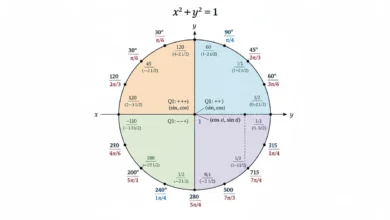
Cotangent on the Unit Circle
On the Unit Circle, the point corresponding to θ is:
(cos θ, sin θ)
Therefore:
cot θ = cos θ/sin θ
can be interpreted as:
cot θ = x/y
provided:
y ≠ 0
This gives cotangent meaning for positive, negative, large, and radian-measured angles.
Where Cotangent Is Undefined
Cotangent is undefined whenever its denominator is zero:
sin θ = 0
On the unit circle, this happens at:
θ = nπ
where n is any integer.
In degrees:
θ = 180°n
Examples include:
0°, 180°, 360°, −180°
At these values:
cos θ/sin θ
would require division by zero.
Where Cotangent Equals Zero
Cotangent equals zero when:
cos θ = 0
while:
sin θ ≠ 0
Therefore:
θ = π/2 + nπ
In degrees:
θ = 90° + 180°n
Examples include:
90°
270°
At these angles, the numerator is zero and the denominator is nonzero.
Domain of Cotangent
The real domain is:
all real θ except θ = nπ
because those are the angles where sine vanishes.
Therefore cotangent is defined on intervals such as:
(0, π)
(π, 2π)
but not at the endpoints that are integer multiples of π.
Range of Cotangent
Cotangent can take any real value.
Therefore its range is:
(−∞, ∞)
This differs from Cosecant, whose real outputs satisfy:
csc θ ≤ −1
or:
csc θ ≥ 1
Cotangent has no comparable gap in its range.
Cotangent Signs by Quadrant
Because:
cot θ = cos θ/sin θ
its sign depends on whether sine and cosine have the same sign.
Quadrant I:
positive/positive → positive
Quadrant II:
negative/positive → negative
Quadrant III:
negative/negative → positive
Quadrant IV:
positive/negative → negative
Thus cotangent is positive in Quadrants I and III and negative in Quadrants II and IV.
Cotangent of 135°
The reference angle is:
45°
Cotangent is negative in Quadrant II.
Therefore:
cot135° = −cot45°
= −1
Cotangent of 225°
Reference angle:
45°
Quadrant III has positive cotangent.
Therefore:
cot225° = 1
This also follows from cotangent’s period of 180°:
225° = 45° + 180°
so:
cot225° = cot45°
Period of Cotangent
Cotangent repeats every:
π radians
or:
180°
Therefore:
cot(θ + π) = cot θ
This period is shorter than the 2π period of sine and cosine.
The reason is that both sine and cosine reverse signs after π:
sin(θ + π) = −sin θ
cos(θ + π) = −cos θ
Their ratio remains unchanged.
Cotangent Graph
The basic graph is:
y = cot x
It has vertical asymptotes at:
x = nπ
and zeros at:
x = π/2 + nπ
Between consecutive asymptotes, the function decreases continuously from positive infinity to negative infinity.
The pattern repeats every:
π
Vertical Asymptotes
Because cotangent is undefined where sine equals zero, vertical asymptotes occur at:
…, −2π, −π, 0, π, 2π, …
As x approaches one of these values, cotangent’s magnitude becomes arbitrarily large.
These discontinuities divide the graph into separate repeating branches.
Cotangent Is an Odd Function
Sine is odd:
sin(−θ) = −sin θ
Cosine is even:
cos(−θ) = cos θ
Therefore:
cot(−θ)
= cos(−θ)/sin(−θ)
= cos θ/(−sin θ)
so:
cot(−θ) = −cot θ
Cotangent is an odd function.
Its graph has rotational symmetry about the origin.
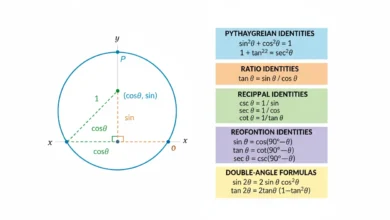
Cosecant-Cotangent Identity
One of the central trigonometric identities is:
csc²θ = 1 + cot²θ
Equivalently:
cot²θ = csc²θ − 1
This relationship connects cotangent directly with Cosecant.
It follows from the fundamental identity:
sin²θ + cos²θ = 1
Deriving the Identity
Start with:
sin²θ + cos²θ = 1
Divide by:
sin²θ
Then:
1 + cos²θ/sin²θ = 1/sin²θ
Recognize:
cos²θ/sin²θ = cot²θ
and:
1/sin²θ = csc²θ
Therefore:
1 + cot²θ = csc²θ
This belongs to the broader system of Trigonometric Identities.
Find Cotangent From Cosecant
Suppose:
csc θ = 13/5
and θ lies in Quadrant I.
Use:
cot²θ = csc²θ − 1
Then:
cot²θ = 169/25 − 1
= 144/25
Therefore:
cot θ = 12/5
The positive root is appropriate in Quadrant I.
Find Cosecant From Cotangent
Suppose:
cot θ = −3
and θ lies in Quadrant II.
Then:
csc²θ = 1 + 9
= 10
So:
csc θ = ±√10
Cosecant is positive in Quadrant II, therefore:
csc θ = √10
The sign cannot be chosen correctly without quadrant information.
Cotangent and Secant
Secant is reciprocal to cosine:
sec θ = 1/cos θ
while:
cot θ = cos θ/sin θ
The two functions are not reciprocals.
However, combinations of cotangent, secant, sine, and cosine can often be simplified by rewriting everything in terms of:
sin θ
and:
cos θ
Cotangent and Tangent
Cotangent and tangent satisfy:
cot θ = 1/tan θ
and:
tan θ = 1/cot θ
where both functions are defined.
Therefore:
tan θ · cot θ = 1
For example:
tan θ = 2/7
implies:
cot θ = 7/2
This reciprocal relationship is often the fastest way to move between the two functions.
Cotangent and Degrees and Radians
Cotangent works with angles measured in either degrees or radians.
For example:
45° = π/4
so:
cot45° = cot(π/4)
= 1
The Degrees and Radians conversion is:
radians = degrees × π/180
A calculator must use the angle mode matching the supplied unit.
Solving cot x = 1
Rewrite:
tan x = 1
On:
0 ≤ x < 2π
this occurs at:
x = π/4
and:
x = 5π/4
Because cotangent has period π, the general solution is:
x = π/4 + nπ
where n is any integer.
Solving cot x = −√3
Rewrite:
tan x = −1/√3
The reference angle is:
π/6
Cotangent is negative in Quadrants II and IV.
On:
0 ≤ x < 2π
the solutions are:
x = 5π/6
and:
x = 11π/6
The general solution can be written:
x = 5π/6 + nπ
Finding an Angle From Cotangent
Suppose:
cot θ = 4/3
Then:
tan θ = 3/4
For an acute angle:
θ = tan⁻¹(3/4)
Therefore:
θ ≈ 36.87°
This approach uses Inverse Trigonometric Functions because calculators commonly provide inverse tangent rather than a dedicated inverse-cotangent key.
Cotangent in Right-Triangle Geometry
Suppose a right triangle has an acute angle:
θ = 30°
and opposite side:
5
Since:
cot30° = √3
the adjacent side is:
adjacent = opposite × cot30°
= 5√3
This can be more direct than introducing tangent and then taking a reciprocal.
Cotangent and Similar Triangles
For Similar Triangles, corresponding side ratios remain constant.
Therefore for a fixed acute angle:
adjacent/opposite
has the same value in every similar right triangle.
That constant ratio is:
cot θ
This explains why cotangent depends on the angle rather than the triangle’s absolute size.
Cotangent and Congruent Triangles
Congruent Triangles have equal corresponding sides and angles.
If two congruent right triangles contain corresponding angle θ, then their adjacent and opposite sides are individually equal, so their cotangent values are identical.
Congruence may first establish the geometric measurements, after which cotangent can express or verify their ratio.
Cotangent and Slope
For an angle θ measured from the positive x-axis, slope is commonly:
m = tan θ
Therefore, when the slope is nonzero:
cot θ = 1/m
For example, a line with slope:
m = 2
has:
cot θ = 1/2
for the corresponding direction angle where the relationships are defined.
Cotangent can therefore be interpreted as horizontal change divided by vertical change.
Cotangent as Run Over Rise
Because:
tan θ = rise/run
we can write:
cot θ = run/rise
This is consistent with the right-triangle formula:
adjacent/opposite
when the adjacent leg represents horizontal change and the opposite leg represents vertical change.
It can be useful when horizontal distance is more natural than vertical slope.
Cotangent in Cylinder Geometry
A vertical axial cross section of a right cylinder is a rectangle.
Suppose a diagonal of that rectangle makes angle θ with its horizontal side.
If the horizontal dimension is the cylinder diameter:
2r
and the vertical dimension is height h, then:
cot θ = adjacent/opposite
can become:
cot θ = 2r/h
depending on how θ is defined.
Therefore:
h = 2r/cot θ
Once h is known, it can be used in Cylinder Surface Area or Cylinder Volume.
Cylinder Example Using Cotangent
Suppose an axial diagonal makes angle:
θ = 45°
with the horizontal diameter of a cylinder.
Let:
r = 4
Then:
diameter = 8
Since:
cot45° = 1
we have:
cot θ = 8/h
Therefore:
1 = 8/h
so:
h = 8
The resulting dimensions can then be used in the relevant cylinder measurement formula.
Cotangent and Cosine in Cylinder Problems
A different cylinder problem may give the diagonal length d and its angle with a side.
Then Cosine can determine one component:
cos θ = adjacent/d
while cotangent relates the two perpendicular components directly:
cot θ = adjacent/opposite
Which function is more efficient depends on which lengths are already known.
Cotangent and Circle Geometry
A central angle and radius can create right triangles when a chord is bisected by a perpendicular radius.
Those triangles may contain cotangent relationships between:
half-chord
and:
center-to-chord distance
For central half-angle α:
cot α = adjacent/opposite
can relate the perpendicular distance from the center to half the chord.
The direct Chord Length formula is often faster, but cotangent provides another geometric route.
Cotangent and Polar Coordinates
In Polar and Rectangular Form:
x = r cos θ
y = r sin θ
Therefore:
x/y = cos θ/sin θ
so:
cot θ = x/y
when:
y ≠ 0
This gives a coordinate interpretation of cotangent as horizontal coordinate divided by vertical coordinate.
Cotangent Derivative
In calculus:
d/dx[cot x] = −csc²x
The negative sign agrees with the cotangent graph, which decreases between consecutive vertical asymptotes.
The derivative also reinforces the close identity relationship between cotangent and cosecant.
Cotangent Antiderivative
A standard antiderivative is:
∫cot x dx = ln|sin x| + C
because:
cot x = cos x/sin x
and the derivative of sin x is cos x.
This provides a direct example of why expressing cotangent as cosine divided by sine is useful.
Common Cotangent Mistakes
A frequent mistake is reversing the right-triangle ratio.
Cotangent is:
adjacent/opposite
not:
opposite/adjacent
The latter is tangent.
Another mistake is confusing cotangent with cosine. Cotangent uses both sine and cosine:
cot θ = cos θ/sin θ
Cotangent is undefined when sine is zero.
Its period is π, not 2π.
When solving equations, remember that inverse tangent can be used after taking the reciprocal, but additional periodic solutions may be required.
Finally, check the chosen angle carefully because the labels “adjacent” and “opposite” change when the reference angle changes.
Frequently Asked Questions
What is cotangent?
Cotangent is the reciprocal of tangent:
cot θ = 1/tan θ
What is the right-triangle formula?
cot θ = adjacent/opposite
How is cotangent related to sine and cosine?
cot θ = cos θ/sin θ
What is cot 45°?
1
What is cot 30°?
√3
What is cot 60°?
√3/3
Where is cotangent undefined?
At:
θ = nπ
because sine equals zero there.
Where does cotangent equal zero?
At:
θ = π/2 + nπ
What is the period of cotangent?
π radians
or:
180°
What is the range of cotangent?
All real numbers.
In which quadrants is cotangent positive?
Quadrants I and III.
What identity relates cotangent and cosecant?
csc²θ = 1 + cot²θ
How do you find cotangent from tangent?
Take the reciprocal:
cot θ = 1/tan θ
Can cotangent be zero?
Yes, when cosine is zero and sine is nonzero.
How can I check a cotangent answer?
Verify that it equals both:
adjacent/opposite
and:
cos θ/sin θ
when those measurements are available, and confirm its sign from the angle’s quadrant.