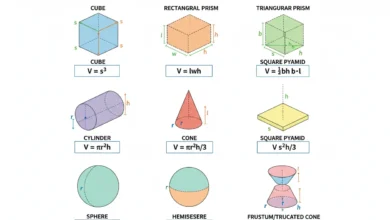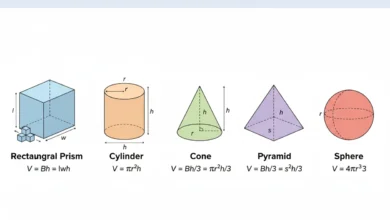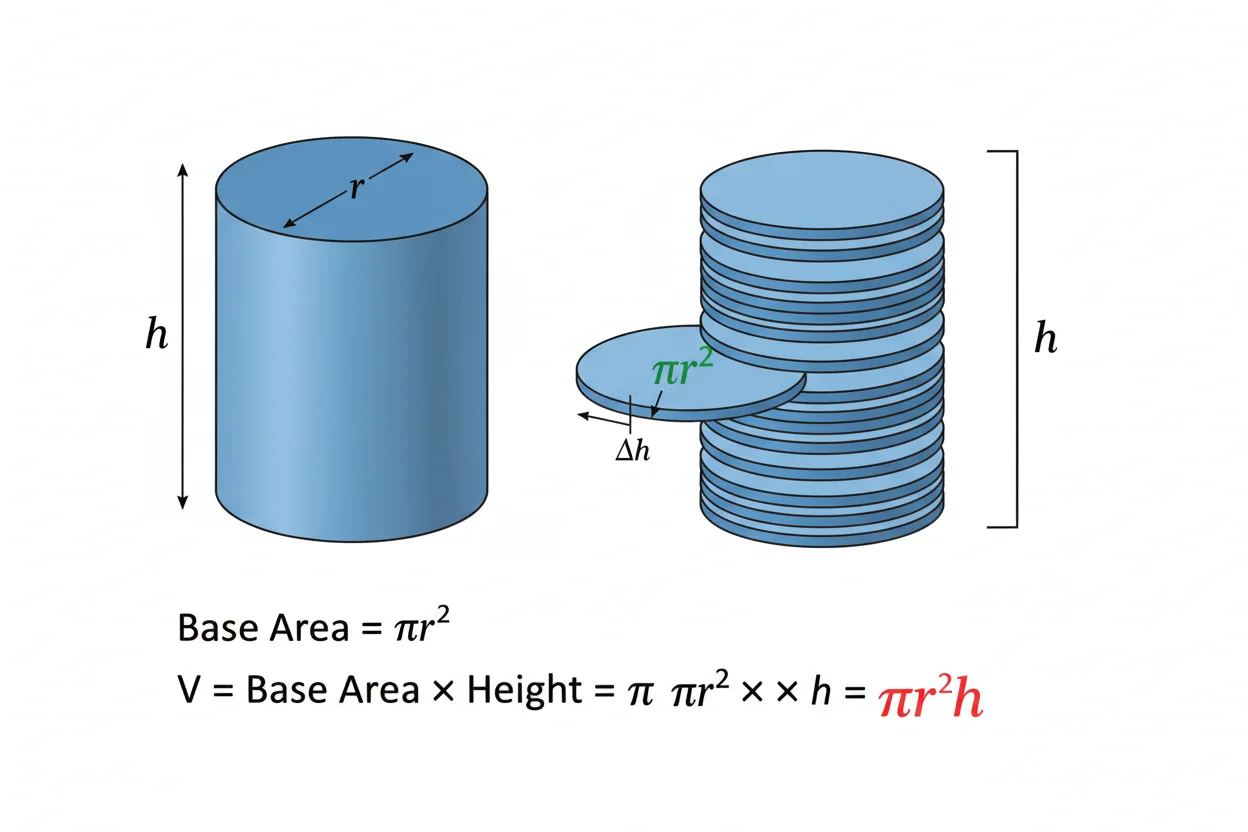

Cylinder volume measures the three-dimensional space inside a cylinder. For a right circular cylinder with radius r and perpendicular height h, the cylinder volume formula is V = πr²h. The term πr² is the area of one circular base, and multiplying that base area by the height gives the total volume. If diameter is given instead of radius, use r = d/2 before calculating, or use the equivalent formula V = πd²h/4. Cylinder volume is measured in cubic units such as cm³, m³, ft³, or in³. The formula can also be rearranged to find an unknown height, radius, diameter, or base area. Because the radius is squared, changing radius has a much stronger effect on volume than changing height by the same factor.
Cylinder Volume Formula
For a right circular cylinder:
V = πr²h
where:
V = volume
r = radius of the circular base
h = perpendicular height
The formula follows the general prism relationship:
volume = base area × height
A cylinder’s base is a circle, so:
B = πr²
Therefore:
V = Bh
becomes:
V = πr²h
The circle measurement itself comes from Circle Area.
Basic Cylinder Volume Example
Suppose:
r = 4 cm
h = 10 cm
Use:
V = πr²h
Substitute:
V = π(4²)(10)
= π(16)(10)
Therefore:
V = 160π cm³
Approximately:
V ≈ 502.65 cm³
The exact cylinder volume is:
160π cm³
Why Cylinder Volume Is Base Area × Height
Imagine dividing a cylinder into many extremely thin circular layers.
Every cross section parallel to the base has the same area:
πr²
Stacking those identical layers through height h creates:
base area × height
Therefore:
V = πr²h
This is the same structural principle used for prisms:
V = Bh
A cylinder can be viewed as a solid with a constant circular cross section.
Cylinder Volume From Diameter
If diameter d is known:
r = d/2
Substitute into the cylinder volume formula:
V = π(d/2)²h
Simplify:
V = πd²h/4
So either formula works:
V = πr²h
or:
V = πd²h/4
Diameter Example
Suppose:
d = 12
h = 7
Then:
r = 6
Therefore:
V = π(6²)(7)
= π(36)(7)
= 252π
Using the diameter form:
V = π(12²)(7)/4
= π(144)(7)/4
= 252π
Both calculations agree.
Radius Versus Diameter
The radius is half the diameter:
r = d/2
Because radius is squared in:
V = πr²h
using diameter in place of radius makes a substantial error.
If the true radius is r, the diameter is:
2r
Squaring the diameter gives:
(2r)² = 4r²
So treating diameter as radius makes the calculated cylinder volume four times too large when height remains correct.
Cylinder Volume From Base Area
If circular base area B is already known:
V = Bh
For example:
B = 45 cm²
h = 8 cm
Then:
V = 45(8)
= 360 cm³
There is no need to recover radius unless the problem specifically asks for it.
Find Height From Cylinder Volume
Starting with:
V = πr²h
divide by:
πr²
to obtain:
h = V/(πr²)
Suppose:
V = 288π
r = 6
Then:
h = 288π/[π(6²)]
= 288/36
Therefore:
h = 8
Find Radius From Cylinder Volume
Start with:
V = πr²h
Divide by:
πh
to obtain:
r² = V/(πh)
Then:
r = √[V/(πh)]
Use the nonnegative root because radius is a geometric length.
Radius Example
Suppose:
V = 200π
h = 8
Then:
r = √[200π/(8π)]
= √25
Therefore:
r = 5
The diameter is:
d = 10
Find Diameter From Cylinder Volume
Since:
d = 2r
and:
r = √[V/(πh)]
we obtain:
d = 2√[V/(πh)]
Alternatively, start with:
V = πd²h/4
and solve:
d² = 4V/(πh)
so:
d = √[4V/(πh)]
The two forms are equivalent.
Find Base Area From Volume
Starting with:
V = Bh
solve:
B = V/h
Suppose:
V = 540
h = 12
Then:
B = 540/12
= 45
If the base is circular:
πr² = 45
so:
r = √(45/π)
if the radius is also required.
Cylinder Volume From Circumference
The Circle Circumference formula is:
C = 2πr
Therefore:
r = C/(2π)
Substitute into:
V = πr²h
to obtain:
V = π[C/(2π)]²h
Simplify:
V = C²h/(4π)
This gives cylinder volume directly from base circumference and height.
Circumference Example
Suppose:
C = 10π
h = 12
Then:
r = 10π/(2π)
= 5
Therefore:
V = π(25)(12)
= 300π
Using the direct circumference form:
V = (10π)²(12)/(4π)
= 300π
gives the same result.
Cylinder Volume From a Circle Equation
A base circle may be described by a Circle Equation.
Suppose:
(x − 2)² + (y + 4)² = 36
The equation shows:
r² = 36
so:
r = 6
If cylinder height is:
h = 10
then:
V = π(36)(10)
Therefore:
V = 360π
The coordinates of the center affect location, not base size.
Expanded Circle Equation Example
Suppose a cylinder base satisfies:
x² + y² − 8x + 6y − 11 = 0
Complete the square:
x² − 8x + y² + 6y = 11
Add:
16
and:
9
to both sides:
(x − 4)² + (y + 3)² = 36
Therefore:
r = 6
If:
h = 5
then:
V = π(36)(5)
= 180π
Cylinder Volume and Surface Area
Cylinder Surface Area measures the cylinder’s boundary:
S = 2πr² + 2πrh
Cylinder volume measures its interior:
V = πr²h
The two formulas share r and h, but they answer different questions.
Surface area uses square units.
Cylinder volume uses cubic units.
Surface Area and Volume Example
Suppose:
r = 3
h = 8
Volume:
V = π(9)(8)
= 72π
Total surface area:
S = 2π(9) + 2π(3)(8)
= 18π + 48π
= 66π
The numerical values should not be compared directly because their dimensions differ.
Find Volume From Surface-Area Data
Suppose total surface area is:
S = 96π
and:
r = 4
Use:
S = 2πr² + 2πrh
Then:
96π = 2π(16) + 8πh
Divide by π:
96 = 32 + 8h
Therefore:
h = 8
Now calculate cylinder volume:
V = π(16)(8)
= 128π
This type of problem requires finding the missing geometry before applying the volume formula.
Cylinder Volume Versus Cone Volume
A cylinder and cone with the same circular base and height have:
V_cylinder = πr²h
and:
V_cone = πr²h/3
Therefore:
V_cylinder = 3V_cone
The Cone Volume relationship shows that the corresponding cone contains one-third as much volume.
Cylinder and Cone Example
Suppose:
r = 5
h = 12
Cylinder:
V = π(25)(12)
= 300π
Cone:
V = 300π/3
= 100π
Therefore the cylinder holds exactly three times the cone’s volume.
Cylinder Versus Prism
A prism has:
V = Bh
A cylinder also has:
V = Bh
The difference is the base shape.
For a cylinder:
B = πr²
For a rectangular prism:
B = lw
Both solids have constant cross-sectional area through their height.
That common structure explains why the volume formulas follow the same general form.
Cylinder Volume and Scaling
If every linear dimension is multiplied by factor k:
r → kr
h → kh
Then:
V_new = π(kr)²(kh)
= k³πr²h
Therefore:
V_new = k³V_old
Cylinder volume scales with the cube of the overall linear scale factor.
Scaling Example
Suppose a cylinder has volume:
50π
and every dimension is doubled.
Then:
k = 2
so:
V_new = 2³(50π)
= 400π
The new cylinder has eight times the original volume.
Doubling Only the Radius
If height stays constant and radius doubles:
r_new = 2r
Then:
V_new = π(2r)²h
= 4πr²h
Therefore:
V_new = 4V_old
Radius has a quadratic effect because it is squared.
Doubling Only the Height
If radius remains constant and height doubles:
h_new = 2h
Then:
V_new = πr²(2h)
Therefore:
V_new = 2V_old
Height affects cylinder volume linearly.
Example: Radius Increases by 20%
Suppose:
r_new = 1.2r
while height stays fixed.
Then:
V_new = π(1.2r)²h
= 1.44πr²h
Therefore cylinder volume increases by:
44%
A 20% radius increase does not produce only a 20% volume increase.
Example: Height Increases by 20%
If:
h_new = 1.2h
with radius unchanged:
V_new = 1.2V_old
Therefore cylinder volume increases by exactly:
20%
This contrast demonstrates the different powers of r and h.
Similar Cylinders
Similar cylinders have all corresponding linear dimensions in the same ratio.
If:
r₂/r₁ = h₂/h₁ = k
then:
V₂/V₁ = k³
and their surface-area ratio is:
S₂/S₁ = k²
For:
k = 3
volume increases by:
27
while surface area increases by:
9
Cylinder Capacity
For an ideal cylindrical container, internal capacity follows:
V = πr²h
Suppose an internal radius is:
5 cm
and internal height is:
20 cm
Then:
V = π(25)(20)
= 500π cm³
Approximately:
V ≈ 1570.80 cm³
Since:
1000 cm³ = 1 L
the ideal internal capacity is approximately:
1.571 L
provided the dimensions are interior measurements.
Outer Versus Inner Dimensions
A real container can have wall thickness.
If external radius is R but internal radius is r, capacity depends on:
r
not R.
Similarly, usable height may differ from external height.
The geometric cylinder volume based on outside dimensions describes the entire outer envelope, not necessarily the space available inside.
Hollow Cylinder Material Volume
For a hollow cylindrical tube with:
outer radius R
inner radius r
height h
the material volume is:
V = πR²h − πr²h
Factor:
V = πh(R² − r²)
This is the outer cylinder volume minus the empty inner cylinder volume.
Hollow Cylinder Example
Suppose:
R = 6
r = 4
h = 10
Then:
V_material = π(10)(36 − 16)
= 200π
The empty central portion has volume:
π(16)(10) = 160π
while the full outer cylinder would occupy:
360π
Their difference is:
200π
Half-Cylinder Volume
A cylinder cut exactly in half through its axis has half the original volume.
Therefore:
V_half = πr²h/2
Similarly, a quarter-cylinder has:
V_quarter = πr²h/4
when the cross-sectional sector is exactly one-quarter of the circular base.
Angular Fraction of a Cylinder
A cylindrical sector occupying central angle θ can be treated as a fraction of a full cylinder.
In degrees:
V_sector = (θ/360°)πr²h
In radians:
V_sector = [θ/(2π)]πr²h
This is one context where Degrees and Radians directly affect cylinder volume.
For:
θ = π
the fraction is:
π/(2π) = 1/2
so the result is a half-cylinder.
Example of a 120° Cylindrical Sector
Suppose:
r = 6
h = 10
A full cylinder has:
V = π(36)(10)
= 360π
A:
120°
sector represents:
120/360 = 1/3
Therefore:
V_sector = 120π
Axial Cross Section of a Cylinder
A plane through the cylinder’s axis produces a rectangle.
Its dimensions are:
width = 2r
height = h
If the rectangle’s diagonal is known, r or h can be found with the Pythagorean theorem.
This is useful when a problem supplies geometric information indirectly.
Find Radius From an Axial Diagonal
Suppose an axial rectangle has:
diagonal = 13
height = 5
Then:
(2r)² + 5² = 13²
So:
4r² + 25 = 169
4r² = 144
r² = 36
Therefore:
r = 6
Cylinder volume is:
V = π(36)(5)
= 180π
Coordinate Distance in Cylinder Geometry
If an axial cross-section diagram is defined by coordinates, the Distance Formula can supply the diameter, height, or diagonal.
For points:
(x₁, y₁)
and:
(x₂, y₂)
the distance is:
d = √[(x₂ − x₁)² + (y₂ − y₁)²]
Once the required geometric lengths are known, the cylinder volume calculation remains:
V = πr²h
Coordinate Example
Suppose the endpoints of a base diameter are:
A = (1, 2)
B = (7, 10)
Then:
d = √[(7 − 1)² + (10 − 2)²]
= √(36 + 64)
= 10
Therefore:
r = 5
If cylinder height is:
12
then:
V = π(25)(12)
= 300π
Cylinder Dimensions From Cosine
Suppose an axial rectangle has diagonal D and the angle θ between that diagonal and the vertical height.
Then Cosine gives:
cos θ = h/D
Therefore:
h = D cos θ
Once height is known, the horizontal dimension can determine the radius.
This is useful when a cylinder problem supplies angles rather than direct dimensions.
Cosine Example
Suppose:
D = 10
and:
cos θ = 4/5
Then:
h = 10(4/5)
= 8
The horizontal diameter follows from:
d² = 10² − 8²
= 36
so:
d = 6
Therefore:
r = 3
Cylinder volume is:
V = π(9)(8)
= 72π
Cylinder Dimensions From Cotangent
If an axial diagonal makes angle θ with the horizontal diameter, Cotangent can relate diameter and height.
With:
adjacent = diameter = 2r
and:
opposite = h
we have:
cot θ = 2r/h
Therefore:
h = 2r/cot θ
or:
r = h cot θ/2
depending on which dimension is unknown.
Cotangent Example
Suppose:
θ = 45°
r = 5
Since:
cot45° = 1
we have:
1 = 10/h
Therefore:
h = 10
Cylinder volume:
V = π(25)(10)
= 250π
The trigonometric step finds h; the volume formula then handles the solid.
Degrees, Radians, and Trigonometric Input
If a cylinder dimension is calculated from an angle, the angle unit must match the trigonometric evaluation.
For example:
60° = π/3
Therefore:
cos60° = cos(π/3) = 1/2
A calculator in radian mode interpreting the number 60 as 60 radians will not return the same value.
This is why angle-unit consistency matters even though the basic cylinder volume formula itself contains no angle.
Cylinder Volume and Surface-Area Optimization
Some problems require a fixed cylinder volume while minimizing Cylinder Surface Area.
For a closed cylinder:
V = πr²h
so:
h = V/(πr²)
Substitute into:
S = 2πr² + 2πrh
to obtain:
S = 2πr² + 2V/r
This one-variable expression can be analyzed using Optimization.
The volume equation supplies the constraint.
Units of Cylinder Volume
Cylinder volume uses cubic units.
If:
r = 4 cm
h = 10 cm
then:
r²h
has units:
cm² × cm
= cm³
Therefore the final cylinder volume is in:
cm³
The factor π is dimensionless.
Converting Cubic Units
Volume conversion factors must be cubed.
Since:
1 m = 100 cm
then:
1 m³ = 100³ cm³
Therefore:
1 m³ = 1,000,000 cm³
Using only a factor of 100 would be incorrect.
Liters and Cubic Centimeters
A useful metric relationship is:
1 L = 1000 cm³
Therefore:
2500 cm³ = 2.5 L
Likewise:
1 mL = 1 cm³
These relationships are useful for cylindrical tanks, containers, pipes, and laboratory vessels.
Exact Versus Approximate Cylinder Volume
Suppose:
V = 90π
The exact result is:
90π
Using:
π ≈ 3.14159
gives:
V ≈ 282.74
If a decimal is requested, round after completing the full calculation.
Keeping π through intermediate steps preserves precision.
Common Cylinder Volume Mistakes
A common mistake is forgetting to square the radius.
The formula is:
V = πr²h
not:
πrh
Another frequent error is using diameter as radius.
Cylinder volume requires cubic units.
Do not confuse the formula with total cylinder surface area:
2πr² + 2πrh
If volume and one dimension are known, rearrange the formula before substituting.
For hollow cylinders, subtract the inner cylinder rather than using only the outer radius.
When an angle is involved, verify degree or radian mode.
Finally, if dimensions come from an axial cross section, remember that the horizontal width is the diameter 2r, not the radius.
Frequently Asked Questions
What is the cylinder volume formula?
V = πr²h
Why is the radius squared?
Because:
πr²
is the area of the circular base.
What does h represent?
h is the perpendicular distance between the two circular bases.
What is the formula using diameter?
V = πd²h/4
How do you find height from volume?
h = V/(πr²)
How do you find radius from volume?
r = √[V/(πh)]
How do you find diameter from volume?
d = 2√[V/(πh)]
How do you find volume if base area is known?
V = Bh
What is the difference between cylinder volume and cylinder surface area?
Volume measures interior space in cubic units. Surface area measures the boundary in square units.
How does cylinder volume compare with cone volume?
For equal radius and height:
V_cylinder = 3V_cone
What happens if radius doubles?
With height unchanged, cylinder volume becomes four times as large.
What happens if height doubles?
With radius unchanged, volume doubles.
What happens if every dimension doubles?
Cylinder volume becomes:
2³ = 8
times as large.
What is the volume of a hollow cylinder?
V = πh(R² − r²)
where R is outer radius and r is inner radius.
How can I check a cylinder volume answer?
Verify the radius rather than diameter was squared, check the perpendicular height, confirm cubic units, and compare the result with base area × height.