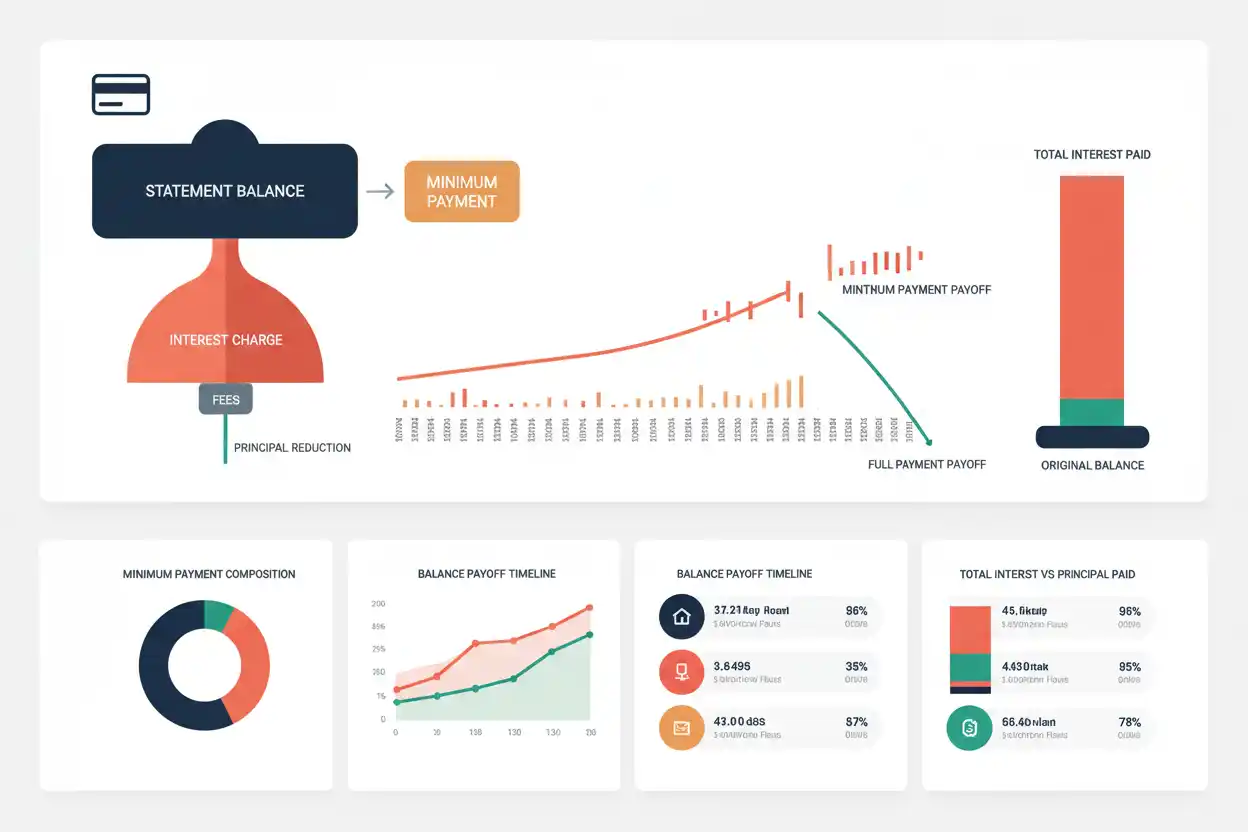
A credit card minimum payment is the smallest amount a cardholder must pay by the statement due date to satisfy the account’s required periodic payment.
It is not a universal percentage, and there is no single minimum-payment formula used by every credit-card issuer.
One issuer might calculate the minimum as a percentage of the statement balance.
Another might use interest plus fees plus a percentage of principal.
A minimum dollar amount can also apply.
For that reason, the card agreement and monthly statement are the authoritative sources for your actual required payment.
Still, understanding the common structures reveals why minimum payments can keep credit-card debt outstanding for years.
What Is a Credit Card Minimum Payment?
The credit card minimum payment is the required payment shown on your statement.
Paying at least that amount by the due date generally satisfies the periodic payment requirement.
However, it does not mean the balance has been paid efficiently.
Suppose:
Statement balance = $5,000
Minimum payment = $150
Paying $150 leaves:
Remaining Balance Before New Interest or Transactions = $5,000 − $150
Remaining Balance = $4,850
Most of the debt remains.
If the account is also charging a high credit card APR, interest can substantially slow the decline.
Common Minimum Payment Formula
A simplified percentage-of-balance structure is:
Minimum Payment = Greater of (Statement Balance × Minimum Percentage) or Minimum Dollar Amount
Suppose:
Balance = $4,000
Percentage = 3%
Minimum dollar amount = $35
Then:
Percentage Minimum = $4,000 × 3%
Percentage Minimum = $120
Because $120 exceeds $35:
Minimum Payment = $120
For a $500 balance:
Percentage Minimum = $500 × 3%
Percentage Minimum = $15
If the issuer’s minimum dollar amount is $35:
Minimum Payment = $35
subject to the issuer’s actual terms and treatment of small balances.
Interest-Plus-Principal Minimum Formula
Another illustrative structure is:
Minimum Payment = Interest + Fees + Percentage of Principal
Suppose:
Balance = $5,000
Monthly interest = $100
Fees = $0
Principal requirement = 1% of balance
Then:
Principal Component = $5,000 × 1%
Principal Component = $50
Minimum payment:
Minimum Payment = $100 + $50
Minimum Payment = $150
Under this simplified example, only $50 reduces principal.
Why Minimum Payments Decline
When a minimum payment is calculated as a percentage of the balance, the required payment can decline as the balance falls.
Suppose the rule is 3%.
At $5,000:
Minimum = $5,000 × 3% = $150
At $4,000:
Minimum = $4,000 × 3% = $120
At $3,000:
Minimum = $3,000 × 3% = $90
This declining-payment structure is one reason minimum-only repayment can take a long time.
As the debt gets smaller, the cardholder also sends less money toward eliminating it.
Minimum Payment Example With Interest
Suppose:
Starting balance = $5,000
APR = 24%
Simplified monthly rate = 2%
Minimum payment = 3% of starting statement balance
Estimated month’s interest:
Interest ≈ $5,000 × 2%
Interest ≈ $100
Minimum payment:
Payment = $5,000 × 3%
Payment = $150
Approximate principal reduction:
Principal Reduction = $150 − $100
Principal Reduction = $50
So even though $150 leaves the cardholder’s bank account, only about $50 reduces principal in this simplified example.
The exact statement calculation can differ because many cards calculate interest daily.
Why Paying Only the Minimum Is Expensive
A high-rate balance creates a simple problem:
interest takes the first substantial portion of the payment.
Suppose a $5,000 balance generates approximately $100 of interest in a month.
If you pay $150:
Approximate Principal Reduction = $50
If you pay $500:
Approximate Principal Reduction = $400
The second payment reduces principal approximately eight times as much in this simplified month.
Lower principal then generates less future interest.
That is why paying more than the minimum can shorten repayment dramatically.
Minimum Payment vs Statement Balance
The statement balance is the total balance captured when the billing period closed.
The minimum payment is only the required payment floor.
Suppose:
Statement balance = $3,500
Minimum payment = $105
Then:
Minimum as % of Statement Balance = $105 ÷ $3,500 × 100
Minimum = 3%
Paying $105 satisfies only the minimum obligation in this example.
Paying $3,500 eliminates the entire statement balance, assuming no other adjustments.
Minimum Payment and Grace Period
A credit card grace period can allow qualifying purchases to avoid interest when its requirements are satisfied.
Paying only the minimum generally does not equal paying the statement balance in full.
Therefore, a cardholder can make the minimum payment on time yet still lose purchase grace-period benefits and incur interest.
This distinction is critical:
On-Time Minimum Payment ≠ Interest-Free Payment
Minimum Payment and Credit Card Payoff
The credit card payoff page focuses on eliminating balances intentionally.
Minimum payments serve a different purpose.
They determine the minimum required account payment, not the optimal amount to become debt-free.
A payoff plan can instead work backward from a desired deadline.
For example:
Balance after applicable interest assumptions = $6,000
Desired payoff period = 12 months
A rough no-interest starting estimate is:
Required Monthly Principal = $6,000 ÷ 12
Required Monthly Principal = $500
Because real interest is also charged, the actual required payment would be higher.
Minimum Payment and Compound Interest
A compound interest loan demonstrates how interest can contribute to future interest.
When a cardholder makes small payments while interest continues accumulating, a larger portion of the balance remains exposed to future finance charges.
The borrower therefore experiences two disadvantages:
principal falls slowly, and the remaining principal continues generating interest.
Minimum Payment and Credit Limit
A credit limit specifies the amount of revolving credit available under the account.
Paying the minimum can free some available credit as the payment is processed.
Suppose:
Credit limit = $10,000
Balance = $8,000
Payment = $240
Ignoring new interest and transactions:
New Balance ≈ $8,000 − $240 = $7,760
Approximate available credit becomes:
Available Credit ≈ $10,000 − $7,760
Available Credit ≈ $2,240
However, paying down a card just to borrow the same amount again prevents meaningful debt reduction.
Minimum Payment and Credit Utilization
The credit utilization ratio compares revolving balances with credit limits.
Suppose:
Balance = $8,000
Limit = $10,000
Utilization = $8,000 ÷ $10,000 × 100
Utilization = 80%
If the balance falls to $7,760:
Utilization = $7,760 ÷ $10,000 × 100
Utilization = 77.6%
Paying only a small minimum reduces utilization slowly when no other activity occurs.
Minimum Payment and APR
The higher the APR, the more of a given payment can be consumed by interest.
Suppose two cards each carry a $5,000 balance.
Card A APR = 12%
Card B APR = 24%
Using simplified monthly approximations:
Card A Monthly Interest ≈ $5,000 × 1% = $50
Card B Monthly Interest ≈ $5,000 × 2% = $100
With the same $150 payment:
Card A may reduce principal by approximately $100.
Card B may reduce principal by only approximately $50.
Thus, payment size and APR interact directly.
Minimum Payment and Cash Advances
A cash advance fee can immediately increase the card balance.
Cash advances can also carry a separate APR.
Those additional costs can increase the amount from which the minimum payment is calculated.
Repeated cash advances while making only minimum payments can therefore make debt reduction especially difficult.
Minimum Payment and Balance Transfers
A balance transfer fee can increase a transferred balance even when the promotional APR is 0%.
Suppose:
Transferred debt = $10,000
Transfer fee = 3%
New Balance = $10,000 + $300
New Balance = $10,300
The minimum payment will then be based on the new card’s terms.
A promotional period should be paired with a payment large enough to eliminate the debt before the promotion expires rather than relying automatically on the minimum.
Minimum Payment and Credit Card APR Changes
If a variable APR increases, interest expense can increase.
That can affect how much of the required payment reduces principal.
For someone already making only minimum payments, a rate increase can extend the repayment period further.
Minimum Payment and Credit Score Factors
The credit score factors framework treats payment history and credit usage as separate considerations.
Making required payments on time matters.
However, maintaining a high revolving balance can also matter through credit utilization and other scoring variables.
Therefore, “I always make the minimum payment” does not describe every aspect of credit management.
Statement Payoff Disclosure
Credit-card statements can include information showing the consequences of minimum-only repayment and an estimated payment that could retire the existing balance in approximately three years under specified assumptions.
This information demonstrates a fundamental mathematical fact:
increasing the payment can dramatically reduce both payoff time and total interest.
The three-year amount is not necessarily the minimum required payment.
It is a repayment illustration.
Common Credit Card Minimum Payment Mistakes
One common mistake is assuming all issuers use the same formula.
Another is believing the minimum payment is a recommended payment.
A third is thinking every dollar of the payment reduces principal.
Interest and fees can consume part of it.
Cardholders also sometimes continue spending while attempting to repay the balance, making the payoff timeline meaningless.
Finally, a falling minimum payment can feel like financial progress even when the debt is simply being repaid more slowly.
Frequently Asked Questions
What is a credit card minimum payment?
It is the smallest payment required by the card issuer for a billing cycle.
How is a minimum payment calculated?
Issuers use different formulas. A common illustrative structure is a percentage of the balance or a minimum dollar amount, while others incorporate interest, fees, and a principal percentage.
Is 3% a standard minimum payment?
No. It is a useful example, not a universal rule.
What happens if I pay only the minimum?
The remaining balance continues into future billing cycles and can continue generating interest.
Does the entire minimum payment reduce principal?
No. Interest and applicable fees can consume part of the payment.
Does paying the minimum avoid interest?
Not generally when you carry a balance. It can satisfy the required payment while interest continues accumulating.
Does paying the minimum preserve the grace period?
Not necessarily. Purchase grace periods often require payment of the applicable statement balance in full.
Why does my minimum payment change?
The balance, interest, fees, transactions, and issuer formula can all affect it.
Can paying more than the minimum save money?
Yes. Faster principal reduction generally reduces future interest and payoff time.
Does paying twice the minimum cut payoff time in half?
Not necessarily. Interest calculations and declining balances make the relationship nonlinear.
Can my minimum payment increase?
Yes. A larger balance, higher interest charges, fees, rate changes, or changes to account terms can increase it.
Where can I find my actual minimum payment?
Your monthly credit-card statement shows the amount required for that billing cycle.
Final Takeaway
A credit card minimum payment is a contractual payment floor, not a debt-elimination strategy.
One common illustrative formula is:
Minimum Payment = Greater of (Balance × Percentage) or Minimum Dollar Amount
But actual issuer formulas vary.
With a $5,000 balance, a 24% APR, and a simplified $150 minimum payment, approximately $100 could represent one month’s interest and only about $50 might reduce principal.
Paying significantly more than the minimum can reverse that relationship by sending more money toward principal, reducing future interest, and shortening the payoff period.
The key distinction is simple:
Minimum required payment and financially efficient payment are not the same thing.