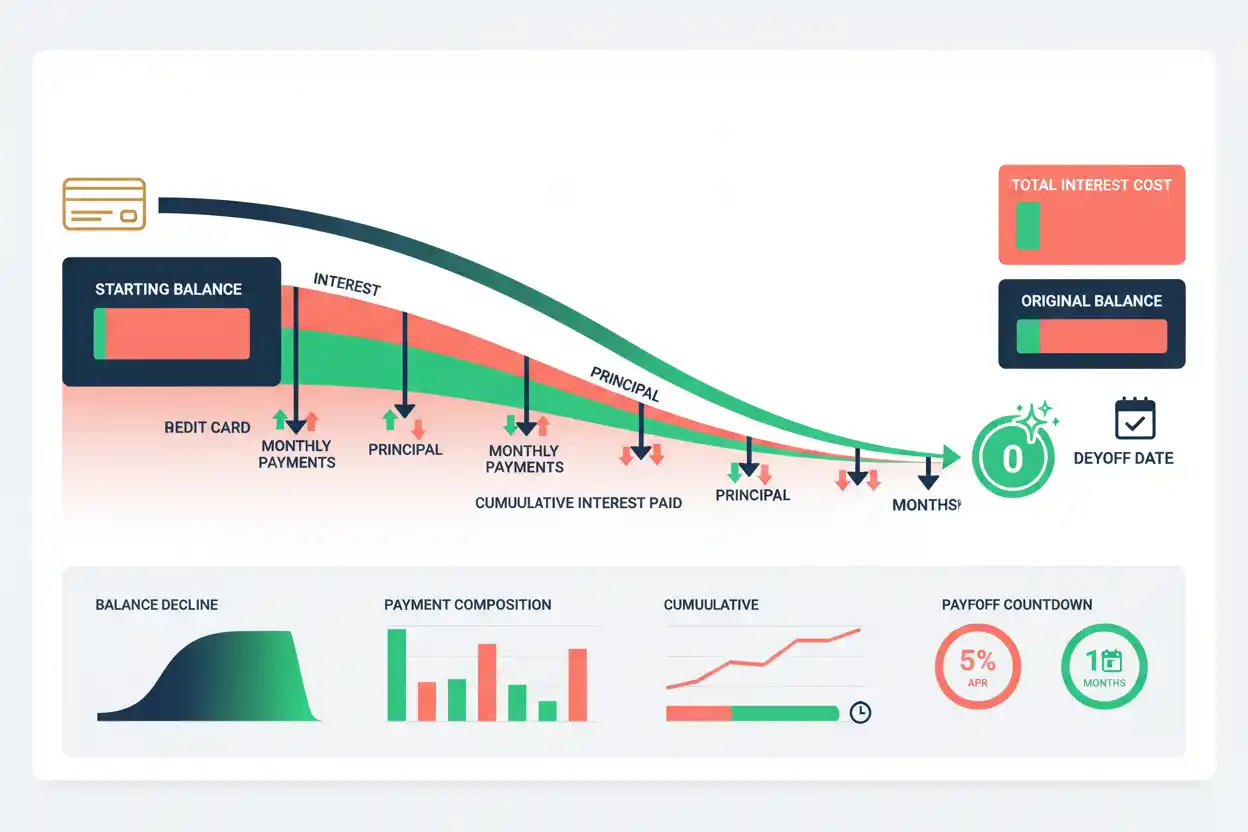

A credit card payoff plan determines how much you need to pay—and for how long—to eliminate a revolving balance while accounting for interest.
The most important inputs are:
current balance, applicable APR, monthly payment, new spending, fees, and desired payoff date.
A credit card payoff is therefore different from simply making the credit card minimum payment.
The minimum tells you what you must pay.
A payoff plan tells you what you need to pay to reach a specific debt-free goal.
Credit Card Payoff Formula
If you want to calculate the fixed monthly payment required to eliminate a balance over a specific number of months, a standard amortization-style formula can provide a useful estimate:
Required Payment = P × [r(1 + r)ⁿ] ÷ [(1 + r)ⁿ − 1]
Where:
P = current balance
r = monthly interest rate
n = desired number of monthly payments
For a simplified monthly-rate calculation:
Monthly Rate = APR ÷ 12
Real credit cards frequently calculate interest daily, so an issuer’s exact results can differ slightly from this planning estimate.
Credit Card Payoff Example
Suppose:
Credit card balance = $8,000
APR = 24%
Desired payoff = 24 months
No new purchases
Approximate monthly rate:
Monthly Rate = 24% ÷ 12
Monthly Rate = 2%
Now calculate the required payment:
Payment = $8,000 × [0.02(1.02)²⁴] ÷ [(1.02)²⁴ − 1]
The estimated payment is:
Monthly Payment ≈ $422.97
Total payments are approximately:
Total Payments = $422.97 × 24
Total Payments ≈ $10,151.28
Estimated total interest is:
Total Interest ≈ $10,151.28 − $8,000
Total Interest ≈ $2,151.28
Paying approximately $423 each month could therefore eliminate the $8,000 balance in roughly two years under the simplified assumptions.
Paying the Same Balance Off in 12 Months
Now keep:
Balance = $8,000
APR = 24%
but shorten the target to 12 months.
Payment = $8,000 × [0.02(1.02)¹²] ÷ [(1.02)¹² − 1]
Estimated monthly payment:
Payment ≈ $756.48
Total payments:
Total Payments ≈ $756.48 × 12
Total Payments ≈ $9,077.76
Approximate interest:
Total Interest ≈ $1,077.76
Comparing the two plans:
| Payoff Target | Approx. Payment | Approx. Total Interest |
|---|---|---|
| 12 months | $756.48 | $1,077.76 |
| 24 months | $422.97 | $2,151.28 |
The 12-month plan requires about $334 more each month but saves more than $1,000 in interest.
Why Larger Payments Save So Much Interest
Interest is generated from the remaining balance.
Reducing principal faster gives future interest less balance to work on.
A simplified sequence is:
Larger Payment → More Principal Repaid → Lower Next Balance → Less Future Interest
This creates a compounding benefit for the borrower even when the debt itself uses daily interest mechanics.
Credit Card Payoff With a Fixed Monthly Payment
If you know how much you can pay rather than how quickly you want to finish, you can estimate the number of payments.
For a fixed-rate mathematical model:
n = −ln(1 − rP ÷ Payment) ÷ ln(1 + r)
Where:
P = balance
r = monthly rate
Payment = fixed monthly payment
Suppose:
Balance = $8,000
APR = 24%
Monthly rate = 2%
Payment = $500
Then:
n = −ln(1 − (0.02 × $8,000 ÷ $500)) ÷ ln(1.02)
n ≈ 19.5 Months
In practice, that means roughly 20 payments, with the final payment adjusted for the remaining balance and actual daily interest.
When the Payment Is Too Small
The monthly payment must exceed the interest generated if the balance is going to decline under a simple fixed-rate model.
Suppose:
Balance = $10,000
Monthly rate = 2%
Monthly interest is approximately:
Interest = $10,000 × 2%
Interest = $200
If the borrower pays only $150 while $200 of interest is being added under the simplified assumption:
Net Balance Increase ≈ $200 − $150
Net Increase ≈ $50
The balance would grow rather than decline.
Actual minimum-payment structures are generally designed differently, but the example illustrates why the relationship between interest and payment matters.
Credit Card Payoff and APR
The credit card APR determines the rate at which financing costs are generated.
At identical balances and payments, a lower APR generally shortens payoff time and reduces total interest.
Suppose two cards each have an $8,000 balance.
Card A APR = 12%
Card B APR = 24%
If both receive the same $500 monthly payment, Card A will generally disappear faster because less of each payment is consumed by interest.
Credit Card Payoff and Grace Period
The credit card grace period is most useful when qualifying purchases are paid in full before interest becomes due.
Once a large revolving balance is being carried, the priority often shifts toward eliminating that debt.
Continuing to add new purchases while following a payoff plan can prevent the balance from reaching zero.
A clean payoff model therefore normally assumes:
New Purchases = $0
unless new spending is explicitly included in the forecast.
Credit Card Payoff and Credit Limit
A credit limit determines how much revolving credit the issuer makes available.
Paying the balance down increases unused credit as payments are processed.
Suppose:
Limit = $10,000
Balance = $8,000
Available credit is approximately:
Available Credit = $10,000 − $8,000
Available Credit = $2,000
If the balance falls to $5,000:
Available Credit ≈ $5,000
However, using the newly available credit again defeats the payoff objective.
Credit Card Payoff and Credit Utilization
The credit utilization ratio declines as revolving balances fall relative to limits.
Suppose:
Balance = $8,000
Limit = $10,000
Utilization = 80%
After reducing the balance to $4,000:
Utilization = 40%
Payoff therefore affects both financing cost and revolving-credit usage.
Those are separate benefits.
Credit Card Payoff and Credit Score Factors
The credit score factors page covers broader scoring considerations.
Reducing revolving balances can affect the amount of available credit being used.
Making payments on time also matters.
However, a payoff strategy should primarily be designed around cash flow and interest savings rather than attempting to manipulate a score from one month to the next.
Fixed Payment vs Minimum Payment
A fixed payoff amount can be much more effective than following a declining minimum payment.
Suppose your minimum begins at $200.
If you continue paying $200 every month even after the required minimum declines, progressively more money can go toward principal.
This is sometimes called maintaining a payment floor.
The critical difference is behavioral:
Minimum-payment strategy allows payments to decline.
Fixed-payment strategy keeps cash directed at the debt.
Debt Avalanche
The debt avalanche prioritizes the highest-interest debt while minimum required payments continue on other debts.
This generally minimizes interest when other assumptions are equal.
Suppose:
Card A = 29% APR
Card B = 22% APR
Card C = 15% APR
The avalanche strategy directs extra cash to Card A first.
After Card A is eliminated, its payment rolls into Card B.
Debt Snowball
The debt snowball prioritizes the smallest balance first rather than the highest rate.
For example:
Card A = $700 balance
Card B = $3,000
Card C = $8,000
Extra money goes to Card A first.
This can create an early psychological win, although it may cost more interest than an avalanche strategy when rates differ substantially.
Debt Payoff Strategy
The broader debt payoff strategy decision depends on more than arithmetic.
A mathematically perfect strategy fails if the borrower cannot maintain it.
A sustainable plan should preserve enough cash for essential expenses and emergencies while consistently reducing debt.
Balance Transfers
A balance transfer fee can be worthwhile when it replaces high-interest debt with a sufficiently long low- or 0%-APR promotional period.
Suppose:
Balance = $8,000
Transfer fee = 3%
Fee = $240
New balance:
Transferred Balance = $8,240
If the promotional rate is 0% for 18 months:
Monthly Payoff Target = $8,240 ÷ 18
Monthly Payoff Target ≈ $457.78
The transfer can reduce interest, but only if the borrower uses the promotional period to reduce principal.
Debt Consolidation
Debt consolidation combines multiple debts into another financing structure.
A debt consolidation loan can convert revolving card balances into a fixed installment payment.
That may simplify repayment and potentially reduce interest.
However, consolidation does not solve overspending by itself.
If the original cards are paid off and then charged again, total debt can increase.
Cash Advances During Payoff
Using a cash advance fee transaction while trying to become debt-free is usually counterproductive because it adds new principal, a transaction charge, and potentially a high APR.
A payoff plan works best when the debt pool is no longer expanding.
Credit Card Compound Interest
The compound interest loan framework explains why lingering debt can become costly.
If interest contributes to subsequent balance calculations, delaying payoff increases the time over which financing costs can accumulate.
That makes early principal reduction especially valuable.
Emergency Fund vs Credit Card Payoff
Sending every available dollar to debt can create another problem if one unexpected expense forces new borrowing immediately afterward.
A borrower may therefore choose to maintain an appropriate cash reserve while paying debt aggressively.
The optimal balance depends on income stability, essential expenses, available liquidity, and borrowing costs.
Common Credit Card Payoff Mistakes
One mistake is creating a payoff plan while continuing to add new spending to the same card.
Another is paying extra on a low-rate balance while ignoring much more expensive debt.
A third is assuming a promotional balance transfer has no cost.
Borrowers also sometimes close every paid-off card immediately without considering how that decision affects available revolving credit and their broader financial needs.
Finally, a payoff calculator is only as reliable as its inputs. Variable rates, new transactions, fees, and irregular payments can change the result.
Frequently Asked Questions
How do I calculate a credit card payoff payment?
For a fixed monthly-rate approximation:
Payment = P × [r(1 + r)ⁿ] ÷ [(1 + r)ⁿ − 1]
How much do I need to pay to eliminate $8,000 in 24 months at 24% APR?
The simplified estimate is approximately $422.97 per month.
How much would I need for 12 months?
Approximately $756.48 per month under the same simplified assumptions.
Does paying more reduce interest?
Yes. Faster principal reduction generally lowers the balance on which future interest is calculated.
Should I pay the minimum?
The minimum satisfies the required payment but can create a very long payoff period. Paying more usually accelerates repayment.
Should I pay the highest APR or smallest balance first?
The debt avalanche prioritizes the highest rate. The debt snowball prioritizes the smallest balance. Each has different mathematical and behavioral advantages.
Is a balance transfer useful for payoff?
It can be when the transfer fee is smaller than the interest avoided and the debt can be eliminated during the favorable-rate period.
Will paying off a credit card improve my credit score?
Paying down revolving balances can affect utilization and other credit factors, but the exact score response depends on the scoring model and credit profile.
Should I close a card after paying it off?
Not automatically. Consider fees, spending behavior, account age, available credit, and your overall financial situation.
Why is my payoff amount different from my statement balance?
Interest, pending transactions, fees, payments, credits, and statement timing can make the current payoff amount differ.
Can I calculate payoff using APR divided by 12?
That provides a useful planning approximation, but actual cards commonly calculate interest using daily balances, so issuer results may differ.
What is the fastest way to pay off credit cards?
Stop adding new debt, make every required payment on time, direct as much sustainable extra cash as possible toward principal, and prioritize debts using a deliberate strategy.
Final Takeaway
A credit card payoff plan converts a revolving balance into a defined repayment target.
For a simplified fixed-rate model:
Required Payment = P × [r(1 + r)ⁿ] ÷ [(1 + r)ⁿ − 1]
An $8,000 balance at 24% APR requires approximately $422.97 per month to disappear in 24 months, compared with approximately $756.48 per month for a 12-month payoff.
The faster plan demands more cash each month but saves more than $1,000 of interest in the example.
The essential principle is straightforward:
The sooner principal falls, the less balance remains available to generate future interest.