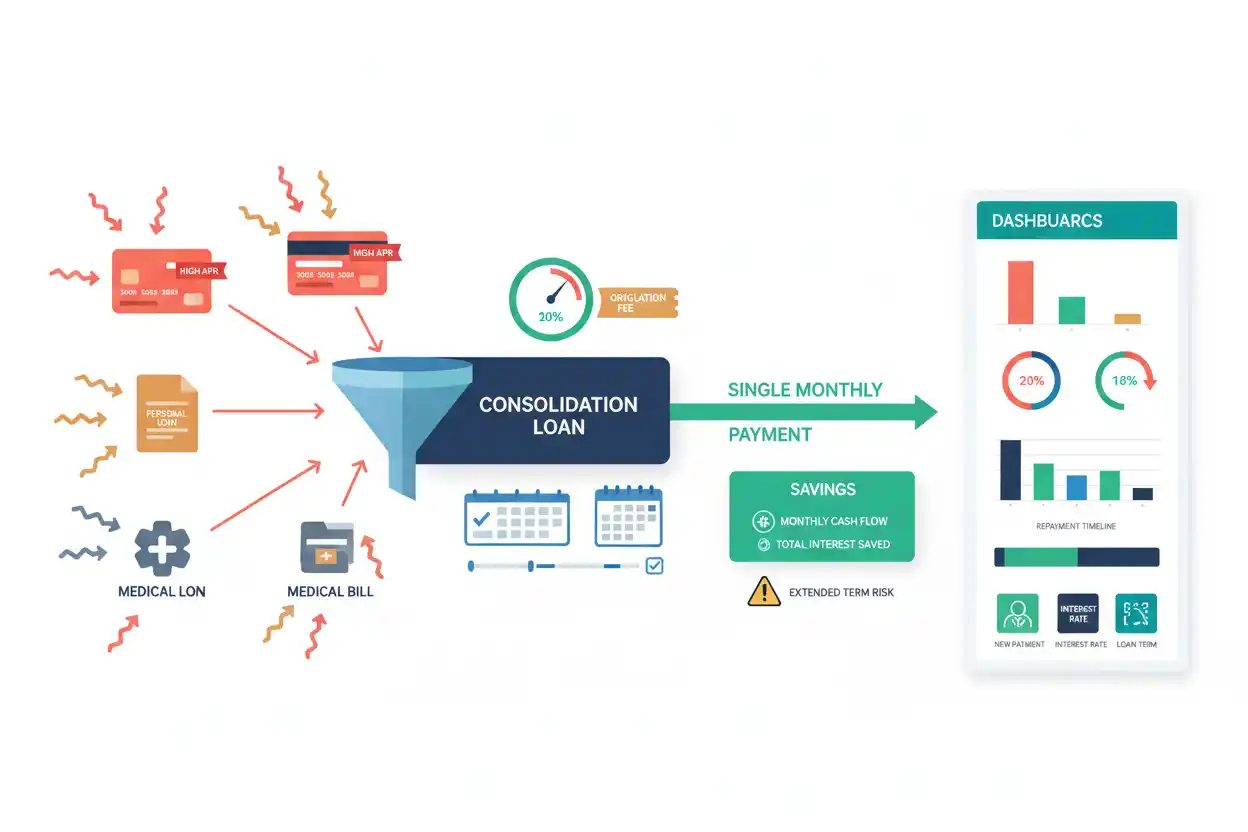

Debt consolidation combines multiple debts into a simpler repayment structure, usually by replacing several balances with one new loan or transferring balances to another credit account.
The objective is often to achieve one or more of the following:
lower interest, fewer monthly payments, a clearer payoff date, or more predictable repayment.
However, consolidation does not erase debt.
The total amount owed remains a financial obligation, and a lower monthly payment can sometimes result from extending repayment for much longer.
That means the key question is not simply:
Can consolidation lower my payment?
It is:
Will consolidation reduce the overall cost and make repayment more sustainable after rates, fees, and term are considered?
What Is Debt Consolidation?
Debt consolidation is the process of combining or replacing several debt obligations with a new financing arrangement.
Common methods include:
- a debt consolidation loan,
- a balance-transfer credit card,
- certain home-secured borrowing,
- other refinancing structures.
The exact risk differs considerably by product.
Replacing unsecured credit-card debt with a loan secured by a home, for example, changes more than the interest rate. It introduces collateral risk.
The broader Loans & Credit framework helps compare these financing structures accurately.
Debt Consolidation Example
Suppose you have three credit cards:
| Debt | Balance | APR |
|---|---|---|
| Card A | $5,000 | 27% |
| Card B | $7,000 | 24% |
| Card C | $8,000 | 21% |
| Total | $20,000 | — |
Assume a lender offers a $20,000 consolidation loan at 13% for 48 months with no fee for this first illustration.
The monthly payment is:
Payment = P × [r(1 + r)ⁿ] ÷ [(1 + r)ⁿ − 1]
Where:
P = $20,000
r = 13% ÷ 12
n = 48
The approximate monthly payment is:
Payment ≈ $536.55
Total payments:
Total Payments ≈ $536.55 × 48
Using full precision:
Total Payments ≈ $25,754
Approximate interest:
Total Interest ≈ $25,754 − $20,000
Total Interest ≈ $5,754
Whether that represents meaningful savings depends on what the existing debts would have cost under the borrower’s actual repayment schedule.
Debt Consolidation Savings Formula
A useful comparison is:
Estimated Consolidation Savings = Cost of Existing Debt Strategy − Cost of Consolidation Strategy
Where total financing cost can include:
interest, origination fees, transfer fees, prepayment costs, and other charges associated with changing the debt.
For example:
Expected remaining interest on existing debts = $9,000
New-loan interest = $5,754
Origination fee = $600
Then:
Consolidation Cost = $5,754 + $600
Consolidation Cost = $6,354
Estimated savings:
Savings = $9,000 − $6,354
Savings = $2,646
The comparison is only valid when both scenarios use realistic payment behavior.
Debt Consolidation Loan
A debt consolidation loan uses a new installment loan to repay multiple existing debts.
Suppose the borrower has five card payments each month.
After consolidation, those balances are paid off and replaced by one fixed loan payment.
This can simplify administration and potentially reduce interest.
However, the new loan can also include:
an origination fee, a longer repayment term, collateral requirements, or a rate that is not sufficiently lower to generate meaningful savings.
The dedicated consolidation-loan page owns that specific calculation and product analysis.
Balance Transfer Consolidation
Another option is transferring several card balances onto a low- or 0%-APR credit card.
Suppose:
Balances transferred = $10,000
Promotional APR = 0% for 18 months
Transfer fee = 3%
The balance transfer fee is:
Fee = $10,000 × 3%
Fee = $300
New balance:
New Balance = $10,000 + $300
New Balance = $10,300
To eliminate the balance during the promotion:
Monthly Payoff Target = $10,300 ÷ 18
Monthly Payoff Target ≈ $572.22
The transfer can save significant interest if the borrower can sustain that payment.
Debt Consolidation vs Debt Avalanche
The debt avalanche leaves the existing debts in place and directs extra money toward the highest-rate balance.
Debt consolidation replaces or restructures the debts.
Consider three cards with high rates.
Avalanche approach:
keep all accounts and attack 28%, then 24%, then 19%.
Consolidation approach:
replace all three with one lower-rate loan.
Which is cheaper depends on:
new rate, fees, repayment term, existing repayment speed, and whether the borrower continues adding balances.
Debt Consolidation vs Debt Snowball
The debt snowball pays the smallest debt first.
Consolidation can eliminate the need to choose among multiple individual balances because they are replaced by one obligation.
However, consolidation may also remove the motivational benefit of seeing individual debts disappear.
Borrowers who rely on small wins for motivation should consider behavioral fit alongside mathematical cost.
Debt Consolidation vs Debt Payoff Strategy
A debt payoff strategy is the broader plan for becoming debt-free.
Consolidation is only a tool within that plan.
A borrower can consolidate and still fail to reduce debt if:
old cards are used again, the new loan term is unnecessarily long, or required payments consume too much cash flow.
The strategy should therefore answer:
what debt is being replaced, how much the new financing costs, when it will be fully repaid, and what prevents new balances from rebuilding.
Potential Advantages of Debt Consolidation
One Payment
Replacing several debts with one obligation can simplify budgeting.
Instead of remembering multiple due dates, the borrower manages one scheduled payment.
Lower Interest Rate
A new loan with a meaningfully lower rate can reduce financing cost.
Suppose $20,000 of revolving debt averages roughly 24%.
Replacing it with a 13% installment loan creates a large rate difference.
The actual savings depend on fees and repayment timing.
Fixed Payoff Date
Credit cards can remain outstanding indefinitely when only minimum payments are made.
A fixed-term consolidation loan provides a scheduled maturity date.
Predictable Payment
A fixed-rate consolidation loan can make monthly cash requirements easier to forecast than several variable-rate revolving accounts.
Potential Disadvantages of Debt Consolidation
Upfront Fees
Origination or transfer charges can offset part of the interest savings.
A lower rate is less valuable when obtaining it requires a large fee.
Longer Repayment Period
A lender can reduce the monthly payment by extending the term.
That can increase total interest even when the rate is lower.
New Debt After Consolidation
This is one of the largest risks.
Suppose consolidation pays three cards to zero.
The borrower now has:
one consolidation loan and three cards with available limits.
If those cards are charged again, the borrower can end up with both the loan and new revolving balances.
Collateral Risk
Some consolidation methods use secured borrowing.
Turning unsecured debt into debt secured by a home or other important asset changes the consequences of default.
Promotional Rate Expiration
A balance transfer can become expensive if the debt remains after the promotional period ends.
Lower Payment Does Not Necessarily Mean Savings
Suppose:
Existing debt payment = $700 per month
New consolidation payment = $450
The $250 monthly reduction appears attractive.
But imagine:
Existing debts could be eliminated in 36 months.
New loan lasts 72 months.
The borrower would make the lower payment twice as long.
You must compare:
Total Repayment = Payment × Number of Payments
rather than assuming the lowest monthly payment is the cheapest option.
Consolidation Term Example
Loan A:
Payment = $650
Term = 36 months
Total Payments = $650 × 36 = $23,400
Loan B:
Payment = $425
Term = 60 months
Total Payments = $425 × 60 = $25,500
Loan B saves $225 per month but costs $2,100 more in total payments.
This simplified example shows why term matters.
Interest Rate vs APR
The new consolidation loan’s headline interest rate can differ from its APR when qualifying financing costs apply.
Suppose:
Interest rate = 12%
APR = 13.2%
The APR signals that additional financing charges raise the annualized borrowing cost.
Compare the complete loan rather than one advertised rate.
Daily Simple Interest Consolidation Loans
A new loan can use daily simple interest.
If so, interest depends on the outstanding principal and number of days between payments.
Paying principal earlier can reduce future interest.
Payment timing therefore remains relevant even after the debts have been consolidated.
Credit Utilization After Consolidation
Paying off revolving credit cards with an installment loan can reduce the credit utilization ratio.
Suppose:
Card limits = $20,000
Card balances = $16,000
Utilization = 80%
After a consolidation loan pays the cards to zero:
Revolving Utilization = $0 ÷ $20,000 = 0%
assuming the limits remain open and reported balances are zero.
But the borrower still owes $16,000 on the consolidation loan.
Utilization falls because the debt has changed form, not because the total obligation disappeared.
Credit Score Factors and Consolidation
The credit score factors page explains that credit scores can react to several changes surrounding consolidation.
Potential changes include:
a new credit inquiry, a newly opened installment account, lower revolving balances, changed utilization, and subsequent payment history.
The net score effect can therefore vary.
A consolidation decision should primarily be based on cost and repayment sustainability rather than trying to predict one short-term score movement.
Closing Cards After Consolidation
Some borrowers immediately close every card that was paid off.
That can reduce available revolving limits and potentially increase future utilization on remaining cards.
On the other hand, keeping cards open can create a temptation to borrow again or can involve annual fees.
There is no universal answer.
Account cost, spending behavior, age, available credit, and financial discipline should all be considered.
Debt Consolidation and Credit Limits
Suppose:
Old card limits = $30,000
Balances before consolidation = $18,000
Utilization = 60%
After consolidation, balances fall to $0.
If all cards remain open:
Utilization = 0%
If most limits are subsequently closed, available revolving capacity falls.
The credit limit and utilization implications should therefore be considered separately from the interest savings.
Debt Consolidation and Minimum Payments
Credit-card minimum payments can decline as balances decline.
A fixed consolidation loan payment generally does not decline in the same way.
That can be useful because it creates a defined repayment schedule.
But it can also create less flexibility during a temporary income disruption.
The borrower should ensure the new required payment is sustainable.
When Debt Consolidation Can Make Sense
Debt consolidation can be attractive when:
the new interest cost is materially lower, fees are reasonable, the term is not unnecessarily extended, the monthly payment fits the budget, and the borrower has stopped creating new debt.
The strongest cases usually combine both:
financial savings and behavioral simplification.
When Debt Consolidation May Not Help
Consolidation may be unattractive when:
the new rate is not materially lower, origination fees are high, repayment is stretched for many extra years, collateral creates unacceptable risk, or the borrower is likely to rebuild balances.
If the underlying problem is that monthly expenses consistently exceed income, replacing one debt with another does not solve the cash-flow deficit.
Debt Consolidation and Credit Counseling
Debt consolidation should not be confused with nonprofit credit counseling or a debt-management plan.
A consolidation loan is new borrowing used to repay old borrowing.
Credit counseling can involve budgeting guidance and structured repayment assistance without necessarily creating a new loan.
Debt settlement is different again and can involve attempts to settle obligations for less than the amount owed, with separate risks and consequences.
These terms should not be used interchangeably.
Common Debt Consolidation Mistakes
One common mistake is choosing the lowest monthly payment without comparing total repayment.
Another is ignoring origination and transfer fees.
Borrowers can also leave paid-off credit cards available and immediately rebuild the balances.
A fourth mistake is replacing unsecured debt with debt secured by an important asset without considering collateral risk.
Finally, consolidation should not be judged only by whether it reduces the number of monthly bills. The new financing must improve the economics or repayment sustainability as well.
Frequently Asked Questions
What is debt consolidation?
Debt consolidation combines or replaces several debts with a simpler repayment structure, commonly one new loan or balance-transfer account.
Does debt consolidation reduce debt?
Not automatically. It restructures the debt. The principal still must be repaid unless another process legally reduces it.
Can debt consolidation lower interest?
Yes, if the new financing rate and fees are materially better than the existing debts.
Does a lower consolidation payment mean I save money?
No. The payment may be lower because the repayment term is longer.
What is a debt consolidation loan?
It is a new installment loan used to repay multiple existing debts.
Is a balance transfer debt consolidation?
It can function as consolidation when several revolving balances are moved to one account.
Does consolidation hurt credit scores?
The effect can vary because new inquiries, new accounts, lower revolving balances, payment history, and utilization can all matter.
Should I close credit cards after consolidating them?
Not automatically. Consider fees, utilization, spending behavior, account history, and your ability to avoid rebuilding debt.
Can I consolidate debt with bad credit?
Products may still exist, but a weaker credit profile can make it harder to qualify for a rate low enough to generate meaningful savings.
Is debt consolidation better than debt avalanche?
It depends on the new financing. Avalanche keeps existing debts and prioritizes high-rate balances, while consolidation replaces or restructures them.
What is the biggest risk of debt consolidation?
One major risk is rebuilding balances after the original debts have been paid off, leaving the borrower with both the new loan and new revolving debt.
How do I know whether consolidation saves money?
Compare the total expected cost of the existing repayment strategy with the total interest and fees of the new consolidation strategy over realistic repayment periods.
Final Takeaway
Debt consolidation can simplify repayment and reduce financing cost, but it does not make debt disappear.
The most useful comparison is:
Estimated Consolidation Savings = Existing Debt Cost − New Consolidation Cost
If existing debts would generate $9,000 of remaining interest while a new loan creates $5,754 of interest plus a $600 fee, estimated savings are:
$9,000 − ($5,754 + $600) = $2,646
That consolidation could be economically attractive under those assumptions.
But a lower monthly payment alone is not proof of savings. The new rate, APR, fees, repayment term, collateral, payment amount, and risk of rebuilding balances must all be considered.
The best consolidation converts expensive or difficult-to-manage debt into a lower-cost, clearly scheduled path to zero rather than simply moving the same financial problem to a new account.