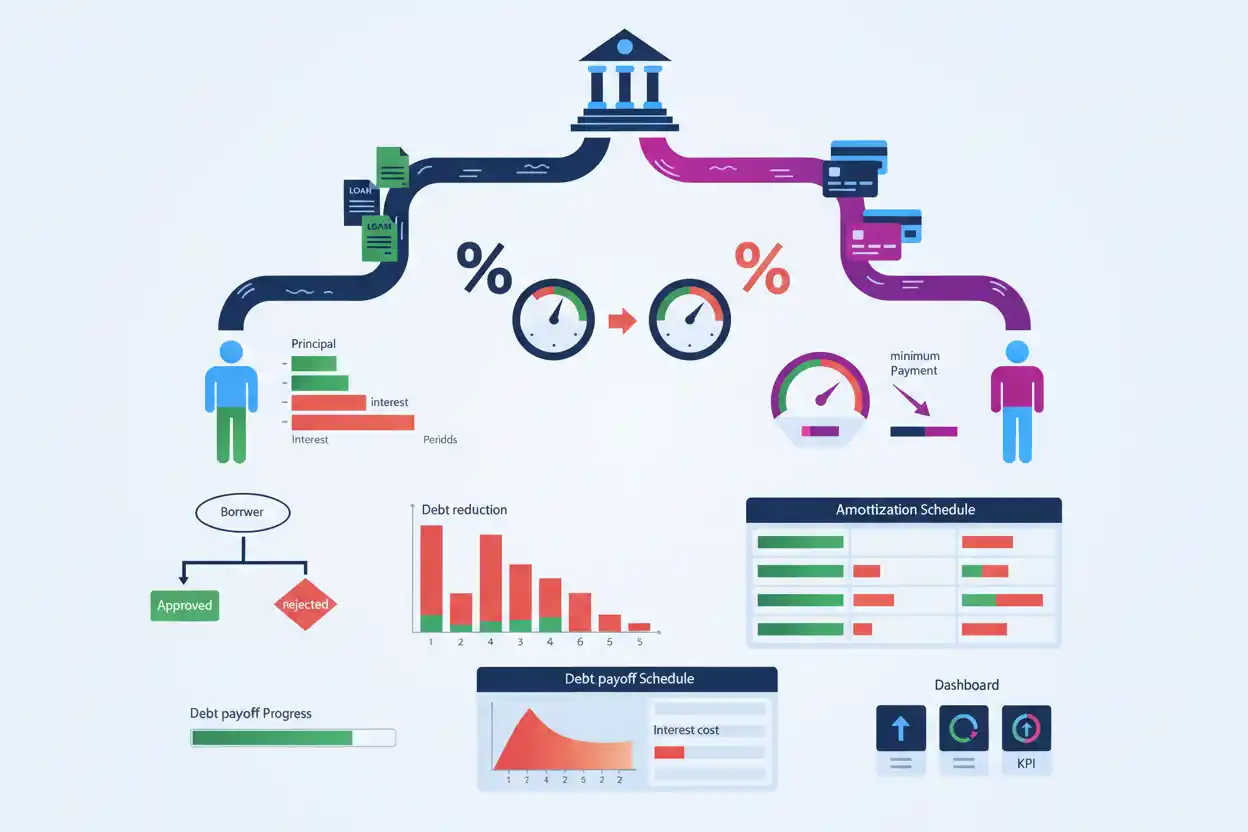

Loans and credit allow a borrower to use money now and repay it later, usually in exchange for interest, fees, or both. The basic idea is simple, but the true cost of borrowing depends on several moving parts: principal, interest rate, APR, payment frequency, loan term, fees, compounding method, repayment structure, and borrower behavior.
This guide provides the framework for understanding those relationships without replacing the specialist calculations that belong to individual pages in The Logic Library’s Loans & Credit cluster.
For example, accrued interest explains how interest builds between dates, while an amortizing loan explains how a fixed payment can gradually reduce a balance. APR focuses on annualized borrowing cost, and APR vs APY separates borrowing-cost disclosure from compound yield.
Together, these concepts provide a more complete way to evaluate credit than looking only at the advertised interest rate.
What Are Loans and Credit?
A loan normally provides a specific amount of money that the borrower agrees to repay according to stated terms.
Credit is broader. It can include installment loans, revolving accounts such as credit cards, lines of credit, secured borrowing, and other arrangements in which a creditor allows payment to occur over time.
The amount originally borrowed is generally called the principal.
Interest is the charge associated with borrowing that principal.
A simple conceptual relationship is:
Total Borrowing Cost = Interest + Applicable Fees and Charges
The amount actually repaid may therefore be considerably higher than the original principal.
For U.S. consumer credit subject to Regulation Z, APR is a standardized measure of the cost of credit expressed as a yearly rate, while the finance charge represents the cost of consumer credit as a dollar amount.
The Main Numbers to Understand Before Borrowing
A loan quotation can contain many figures, but several deserve particular attention.
Principal
Principal is the amount borrowed or the remaining amount of borrowed money on which interest may be calculated.
A separate principal balance analysis becomes particularly useful once repayments have begun.
Interest Rate
The stated interest rate determines how interest is generated under the contract’s calculation method.
However, the interest rate alone does not necessarily capture every financing charge.
APR
APR is designed to express borrowing cost as an annualized rate. Depending on the credit arrangement and applicable rules, certain finance charges can affect the disclosed APR.
That is why a loan carrying an 8% note rate does not necessarily have an 8% APR.
Loan Term
The loan term determines how long repayment is scheduled to continue.
Extending the term often reduces the periodic payment but can increase total interest because the balance remains outstanding longer.
Payment
The payment is the amount due according to the repayment agreement.
The underlying loan payments calculation depends on principal, periodic interest rate, number of payments, and loan structure.
Fees
Origination charges, balance-transfer fees, cash-advance charges, prepayment penalties, and other costs can materially change the economics of borrowing.
For instance, a loan origination fee can reduce the net proceeds received even though the borrower remains obligated for the contractual loan balance.
Simple Interest
A basic simple-interest calculation can be expressed as:
Interest = Principal × Annual Interest Rate × Time
Suppose you borrow $10,000 at 8% simple annual interest for one year.
Interest = $10,000 × 8% × 1
Interest = $800
The calculation becomes more detailed when interest accrues daily, balances decline, or payments occur during the period.
A daily simple interest loan, for example, calculates interest according to the outstanding principal and number of days involved.
Compound Interest on Debt
Compound interest means that interest can become part of the balance on which future interest is calculated when the contract or account structure allows it.
The mathematical future-value relationship is:
Future Balance = Principal × (1 + r)^n
where r is the periodic rate and n is the number of compounding periods.
The dedicated compound interest loan guide examines this structure separately because compounding behavior should not be confused with ordinary amortization.
How Amortizing Loans Work
Many installment loans use amortization.
The borrower makes periodic payments, and each payment is divided between interest and principal.
Early in the repayment schedule, interest can account for a larger portion of the payment because the outstanding balance is higher. As principal falls, the interest component generally declines and more of the payment reduces principal.
For a standard fixed-payment amortizing loan:
Payment = P × [r(1 + r)^n] ÷ [(1 + r)^n − 1]
where:
P = principal
r = periodic interest rate
n = number of payments
The related repayment schedules page shows how those allocations change across the full term.
Example: How Term Changes the Cost of a Loan
Suppose two loans each finance $20,000 at the same interest rate, but one is repaid faster.
The longer loan may produce a lower monthly payment because repayment is spread across more months.
However, that lower payment does not mean the longer loan is cheaper.
A useful comparison is:
Total Payments = Periodic Payment × Number of Payments
Then:
Total Interest = Total Payments − Principal
This is why borrowers should compare total financing cost alongside affordability.
Fixed vs Variable Interest Rates
A fixed-rate loan generally maintains the contractual rate according to its stated terms.
A variable-rate loan can change according to an index, benchmark, or other contractual mechanism.
The detailed fixed vs variable interest rate comparison should be used when deciding how rate changes can affect payments or borrowing risk.
Neither structure is universally better. The appropriate choice depends on term, pricing, rate expectations, risk tolerance, and contractual limits.
Flat Rate vs Reducing Balance Interest
Two loans quoting the same percentage can produce very different costs if the percentage is applied differently.
Under reducing-balance calculations, interest is generally calculated on the outstanding principal.
Under some flat-rate structures, the original principal is used as the interest base even as repayments reduce the amount economically outstanding.
The flat vs reducing balance interest distinction is therefore important when comparing financing quotations.
APR and the True Cost of Borrowing
The advertised rate is not always the most useful comparison number.
APR can incorporate financing costs in a standardized annualized calculation for covered credit. Under Regulation Z, closed-end APR is tied to the amount and timing of value received and payments made, rather than being merely a label attached to the contract rate.
When comparing loans, examine:
the interest rate, APR, finance charge, amount financed, payment, loan term, and total repayment obligation.
For specialized borrowing, dedicated pages such as auto loan APR, business loan APR, and personal loan APR keep those products’ assumptions distinct.
Credit Cards Work Differently From Installment Loans
A credit card is normally revolving credit rather than a fixed installment loan.
Balances can rise with purchases and fall with payments. Interest calculations depend on the account agreement, balance method, transaction type, timing, promotional terms, and applicable APR.
The credit card APR page focuses specifically on these mechanics.
A credit card grace period can also materially affect whether purchase interest is charged when statement balances are paid according to the account’s terms.
Minimum Payments Can Extend Repayment
A low required payment can make a credit-card balance appear manageable while leaving the borrower in debt for a long period.
The credit card minimum payment is therefore not the same as an efficient payoff amount.
When possible, evaluating a complete credit card payoff plan can show how increased payments change both repayment time and total interest.
Credit Utilization
Credit utilization compares revolving balances with available revolving credit limits.
Credit Utilization Ratio = Revolving Balances ÷ Revolving Credit Limits × 100
If total qualifying balances are $3,000 and total limits are $10,000:
Credit Utilization Ratio = $3,000 ÷ $10,000 × 100 = 30%
The dedicated credit utilization ratio page owns that calculation, while credit score factors covers the broader collection of factors associated with credit scoring.
Debt-to-Income Ratio
Lenders may also evaluate debt obligations relative to income.
A common framework is:
DTI = Monthly Debt Payments ÷ Gross Monthly Income × 100
Someone with $1,800 of relevant monthly debt payments and $6,000 of gross monthly income has:
DTI = $1,800 ÷ $6,000 × 100 = 30%
The precise definition and underwriting treatment can vary by product and lender, so the debt-to-income ratio should be evaluated using the applicable lending context.
Secured vs Unsecured Loans
A secured loan is backed by collateral according to the loan agreement.
An unsecured loan does not rely on pledged collateral in the same way.
Collateral can reduce lender risk, but secured borrowing introduces the possibility of losing the pledged asset when contractual obligations are not met.
Pricing should therefore never be the only consideration.
Debt Consolidation
Debt consolidation combines multiple obligations into a different repayment structure.
The goal may be to simplify payments, reduce interest cost, change the repayment period, or obtain more predictable terms.
However, consolidation only improves the economics when the new borrowing structure genuinely produces a better outcome after rates, fees, term changes, and behavior are considered.
The general debt consolidation analysis should therefore be separated from a specific debt consolidation loan calculation.
Debt Avalanche vs Debt Snowball
Two common payoff methods prioritize debts differently.
The debt avalanche generally prioritizes higher-cost debt first.
The debt snowball generally prioritizes smaller balances first.
The broader debt payoff strategy comparison examines the financial and behavioral tradeoffs between those approaches.
Loan Payoff Amounts
The balance displayed on a statement is not always identical to the amount required to extinguish a loan on a specific date.
A loan payoff quote can account for interest accrued through a specified payoff date and other contractual amounts.
This distinction becomes especially important when refinancing, selling collateral, or paying a loan off between ordinary payment dates.
Prepayment Can Change Interest Cost
Paying principal earlier can reduce future interest on many declining-balance loans because subsequent interest is calculated on a smaller outstanding balance.
However, borrowers should inspect contract terms before assuming that every loan can be prepaid without additional cost.
A prepayment penalty may apply to certain loans under specific contractual and legal conditions.
How to Compare Two Loan Offers
Suppose Loan A has:
Principal: $15,000
Interest rate: 8.5%
APR: 9.1%
Term: 36 months
Loan B has:
Principal: $15,000
Interest rate: 8.2%
APR: 9.6%
Term: 36 months
Looking only at the note rate makes Loan B appear cheaper.
However, its higher APR signals that qualifying borrowing costs affect the comparison.
A proper comparison should examine the exact amount financed, payment schedule, finance charges, optional products, fees, prepayment terms, and total cash paid.
Common Loan and Credit Mistakes
One of the most common mistakes is comparing monthly payments instead of total cost. A longer term can lower the payment while substantially increasing interest.
Another is assuming the lowest advertised rate automatically produces the cheapest loan. Fees and calculation methods can change that conclusion.
Borrowers also sometimes treat available credit as affordable spending capacity. A credit limit represents an account limit, not a personal budget.
Finally, borrowing decisions should account for cash-flow resilience. A payment that fits today’s budget may become difficult after a reduction in income or an increase in other essential expenses.
Frequently Asked Questions
What is the difference between a loan and credit?
A loan usually provides a defined principal that is repaid according to specified terms. Credit is broader and includes installment loans, revolving credit cards, lines of credit, and similar arrangements.
What is principal?
Principal is the amount borrowed or the remaining borrowed balance before future interest and other charges.
What is interest?
Interest is the charge for using borrowed money. Its calculation depends on the balance, rate, time, and loan structure.
Is APR the same as the interest rate?
Not necessarily. The interest rate focuses on interest charged under the contract, while APR is an annualized borrowing-cost measure and may reflect additional finance charges under applicable rules.
Does a lower monthly payment mean a cheaper loan?
No. A longer term can reduce the periodic payment while increasing total interest and total repayment.
What is an amortizing loan?
An amortizing loan uses scheduled payments that generally cover interest while reducing principal so the balance reaches the intended endpoint according to the repayment schedule.
Can paying a loan early save interest?
It often can on declining-balance loans, but the actual savings depend on the loan’s calculation method and any contractual prepayment provisions.
What does secured credit mean?
Secured credit uses collateral that supports the lender’s claim under the agreement. Examples may include vehicle or property-backed lending.
What is revolving credit?
Revolving credit allows borrowing, repayment, and additional borrowing up to applicable account limits rather than providing one fixed repayment schedule from the beginning.
Why do loan fees matter?
Fees can increase borrowing cost even when the stated interest rate appears attractive. They can also affect the amount of usable proceeds received.
How should two loans be compared?
Compare APR, interest rate, amount financed, fees, payment, term, total repayment, collateral requirements, variable-rate provisions, and prepayment conditions.
What is the most important loan calculation?
There is no single calculation for every decision. Payment, APR, total interest, payoff amount, and affordability answer different questions and should be used together.
Final Takeaway
Loans and credit should be evaluated as complete cash-flow commitments rather than by one headline rate.
Principal tells you how much is borrowed. Interest determines a major part of borrowing cost. APR helps annualize credit cost. Amortization explains how payments reduce the balance. Fees change the economics, while repayment term determines how long the obligation remains outstanding.
The core principle is straightforward:
A manageable payment is not automatically a low-cost loan.
Understanding the relationship between rate, term, fees, principal, and repayment structure makes it much easier to compare credit accurately and avoid paying more merely because a financing offer looks inexpensive at first glance.